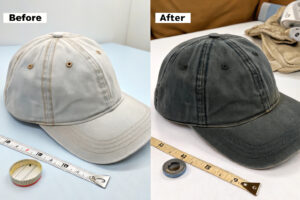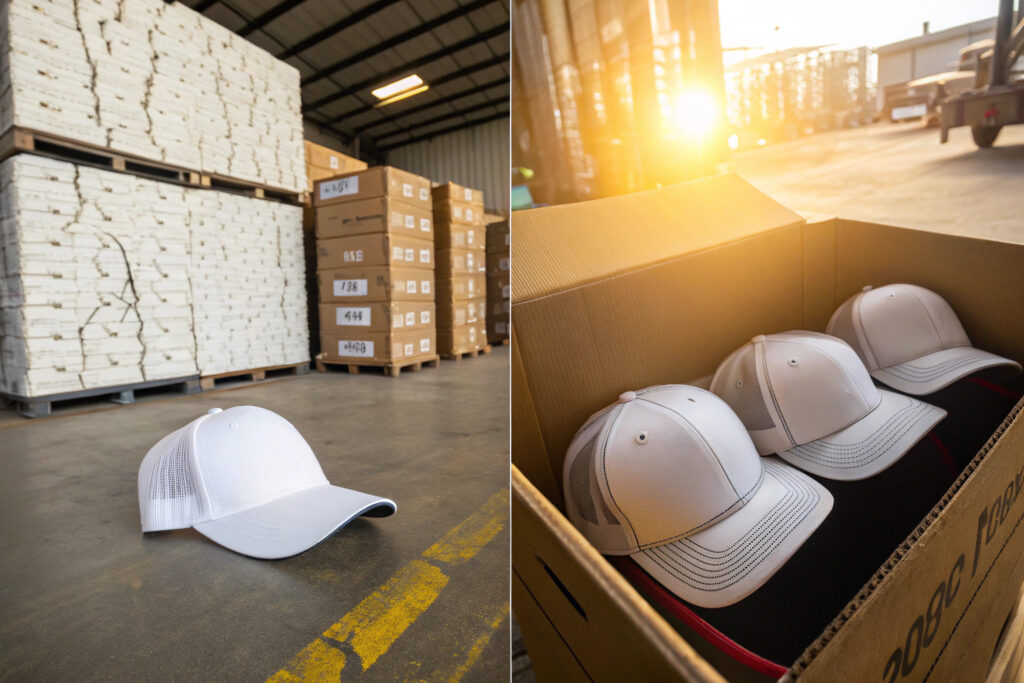
You order 5,000 custom trucker hats for a promotional campaign. The sample was perfect, crisp white foam, bold screen print, sharp mesh back. The bulk shipment arrives. You store the cartons in your warehouse for three months while the campaign materials are finalized. The campaign launches. You open a carton, pull out a hat, and stop. The bright white foam front panel is now a dull, uneven yellow. The foam feels stiff and brittle. When you gently flex it, a small crack appears at the fold. Five thousand hats, five thousand potential brand embarrassments. You call your supplier. They say the hats were perfect when they left the factory. They are probably right. The degradation happened in your warehouse, invisibly, silently, driven by chemistry and environment.
Trucker hat foam degradation and yellowing during warehousing is a known, predictable phenomenon in the headwear industry. It is not a random failure. It is a material science problem with specific causes and, more importantly, specific prevention methods. I run Global-Caps, and I have seen this issue from both the factory and the brand perspective. I have investigated yellowed foam batches, worked with foam suppliers to reformulate materials, and implemented warehousing protocols that stop degradation before it starts. In this article, I will explain exactly why trucker hat foam degrades and yellows, what factors accelerate the process, and how you can specify, store, and inspect your hats to ensure they remain pristine from production to consumer.
What Is the Chemical Composition of Trucker Hat Foam, and Why Does It Yellow?
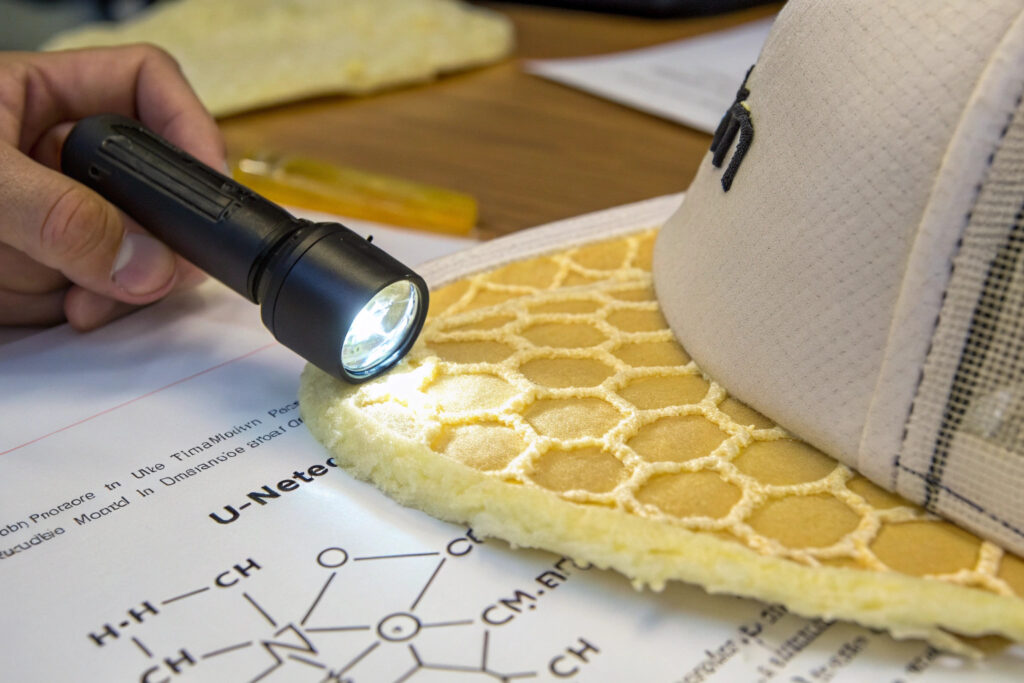
The foam used in the front panel of a trucker hat is typically a flexible polyurethane foam. It is made by reacting a polyol with an isocyanate, creating a polymer network filled with tiny air cells. This foam is lightweight, sewable, and can be laminated with fabric for the cap front. Polyurethane foam, in its pure state, is white or off-white. However, it is chemically unstable in the presence of oxygen, heat, and especially ultraviolet light. This instability is the root cause of yellowing.
Yellowing in polyurethane foam is primarily caused by two chemical processes: oxidation and photo-oxidation. Oxidation is the reaction of the polymer with oxygen in the air. Heat accelerates this reaction. The oxidation process breaks polymer chains and creates chemical groups called chromophores, which absorb blue light and reflect yellow light. This is why the foam yellows. The process is slow at room temperature but accelerates with the elevated temperatures common in non-climate-controlled warehouses. Photo-oxidation is a faster, more aggressive version of the same process driven by ultraviolet light. UV photons have enough energy to directly break chemical bonds in the polyurethane, creating free radicals that react with oxygen. A trucker hat stored near a window or under fluorescent lighting can yellow significantly within weeks.
A secondary cause of yellowing is the migration of chemicals from adjacent materials. The fabric laminated to the foam, the adhesive used in lamination, and even the printing inks on the foam can contain compounds that slowly migrate into the foam and react. This is called contact yellowing. A dark fabric or a certain print ink can cause a localized yellowing pattern on the foam that mirrors the print design. The foam acts like a sponge for migrating chemicals. The yellowing is often not uniform across the foam panel. It is more intense at the edges, at the fold lines where the foam is stressed, and in areas exposed to light or in contact with reactive materials. This non-uniformity is a telltale sign of the specific degradation pathway.
How Does the Type of Polyurethane Affect Yellowing Rate?
Not all polyurethane foams are equal. Polyester-based polyurethanes are more susceptible to hydrolysis, breakdown by moisture, and oxidation than polyether-based polyurethanes. Polyether foams have better resistance to yellowing and degradation. However, they are more expensive. Low-cost trucker hats often use polyester-based foams that degrade faster. This is an invisible cost-saving measure that manifests as yellowing months later.
The foam density also matters. A low-density foam has larger cells and more surface area for oxygen to attack. It degrades faster than a high-density foam with smaller cells. The foam density specification is rarely discussed between buyers and hat suppliers, but it directly affects the hat's long-term stability. I specify polyether-based, medium-density foam for all trucker hats that will be warehoused for extended periods. The material cost is marginally higher, but the warranty cost of yellowed inventory is far greater.
What Role Do Flame Retardants and Additives Play?
Polyurethane foam for textile applications often contains flame retardants to meet flammability standards. Some older flame retardant chemistries, particularly those based on bromine or certain phosphorus compounds, can themselves yellow over time or accelerate the yellowing of the polyurethane. The antioxidants added to the foam to slow oxidation can be consumed over time. Once the antioxidant is depleted, oxidation accelerates. The foam is essentially eating itself from the inside. The yellowing is a visible sign of this ongoing chemical degradation. A foam that has yellowed is also likely to have lost mechanical strength. It will be more brittle and more prone to cracking. Yellowing is not just a color problem. It is a structural warning.
What Environmental Conditions in Warehouses Accelerate Foam Degradation?
The warehouse is not a neutral storage environment. It is a chemical reactor. The three environmental factors that most aggressively accelerate foam degradation are heat, humidity, and light. A standard non-climate-controlled warehouse in a warm climate can become a foam degradation oven. The temperature inside a carton stacked near the roof of a metal warehouse can exceed 50 degrees Celsius in summer. At these temperatures, the oxidation rate of polyurethane roughly doubles for every 10-degree increase. A hat stored for three months at 50 degrees Celsius can age the equivalent of years at room temperature.
Humidity is a separate but related stressor. Polyurethane foam can absorb moisture from humid air. The absorbed water participates in hydrolysis reactions that break the polymer backbone. This is a different chemical pathway than oxidation, but the visible result is the same: yellowing and embrittlement. High humidity also promotes mold and mildew growth on the foam and the fabric, which creates its own set of stains and odors. The combination of high heat and high humidity, which is common in tropical and subtropical warehouses, is the worst-case scenario for foam stability.
Light exposure, particularly exposure to ultraviolet and even strong visible light, drives photo-oxidation. A carton of hats sitting on a top shelf under a skylight, or hats displayed in a retail window, are being actively degraded by light. Fluorescent lighting in warehouses also emits some UV. The exposure may not be direct sunlight, but the cumulative dose over months is significant. The hats at the top of a clear plastic storage bin are more yellowed than the hats at the bottom, shielded from the light. This light exposure gradient is a common observation and a clear diagnostic sign.
How Does Carton Stacking and Ventilation Affect Degradation?
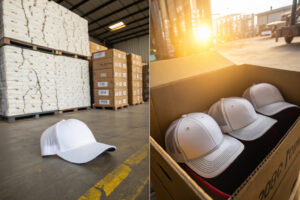
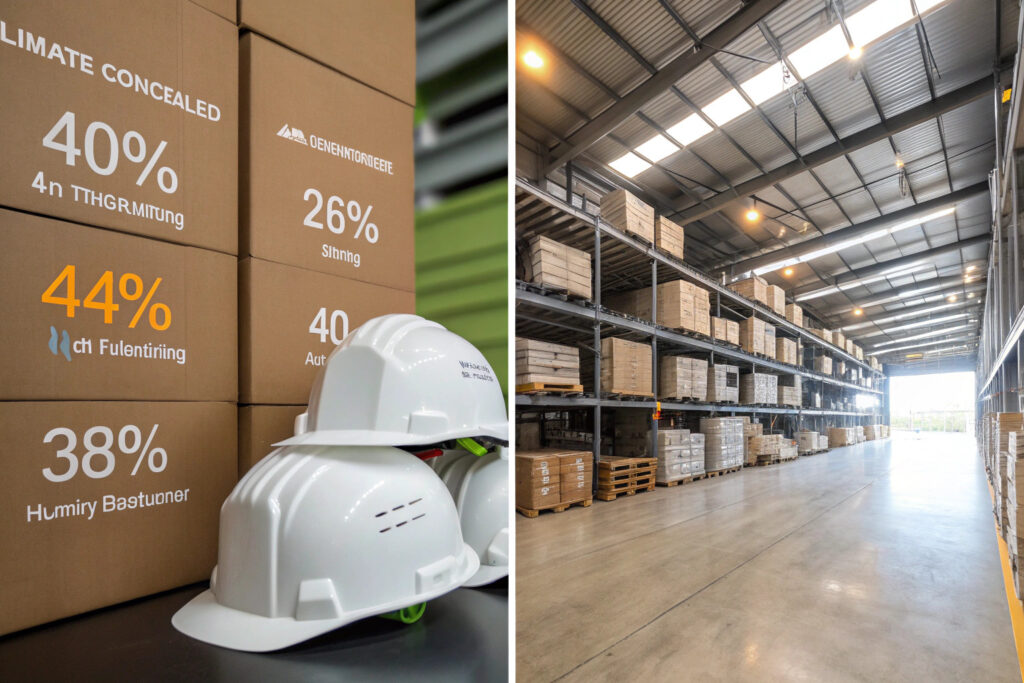
The way cartons are stacked in the warehouse affects the temperature and airflow around the hats. Tightly stacked cartons with no air gap trap heat. The hats in the center of a large pallet of cartons experience higher sustained temperatures than hats in a single, isolated carton. The lack of ventilation also traps any volatile organic compounds outgassing from the foam, fabrics, and printing inks. These trapped VOCs create a concentrated chemical microclimate inside the carton that can accelerate yellowing.
A simple warehousing practice is to leave air gaps between pallets and to ensure some air circulation in the storage area. This dissipates heat and dilutes trapped VOCs. The carton material itself is a factor. A standard corrugated cardboard carton provides some light blocking and thermal insulation. A thin, white carton provides less protection than a thick, dark carton. The carton is the hat's first line of defense against the warehouse environment.
What Is the Ideal Storage Condition Specification for Trucker Hats?
Based on the material science and observed degradation patterns, the ideal storage conditions for trucker hats to prevent foam yellowing are a temperature between 15 and 25 degrees Celsius, a relative humidity between 40% and 60%, and complete darkness. The storage area should be ventilated, and cartons should not be stacked directly against exterior walls that heat up in the sun. These conditions are achievable in a climate-controlled warehouse. They are also achievable in a standard warehouse with some management: storing hats away from the roof, away from windows, and using fans for air circulation. I provide a storage recommendation sheet with every bulk shipment of trucker hats. It is a simple, one-page document that can save thousands of hats from silent degradation.
How Can I Specify and Source Yellowing-Resistant Trucker Hat Foam?
The most effective way to prevent foam yellowing is to never use yellowing-prone foam in the first place. This requires you to specify the foam quality at the sourcing stage, before the first sample is made. You cannot rely on the factory's standard foam. The factory's standard foam is often the cheapest material that meets the basic functional requirements: it is sewable, it holds its shape, it is white on day one. The factory's purchasing department may not prioritize long-term yellowing resistance because they are not the ones holding the warehoused inventory.
You must specify the foam type explicitly in your tech pack and in the purchase contract. The specification should read: "Front panel foam: Polyether-based flexible polyurethane foam, medium density, 80-100 kg/m³, with anti-yellowing additive package and UV stabilizer. Foam shall show no visible yellowing (Delta YI less than 2.0 per ASTM E313) after 48 hours of accelerated UV testing per ASTM G154 Cycle 1." This specification calls out the foam chemistry, the density, the required additives, and a verifiable performance standard with a test method. A factory that can meet this specification is using quality foam. A factory that cannot is using the standard yellowing-prone material.
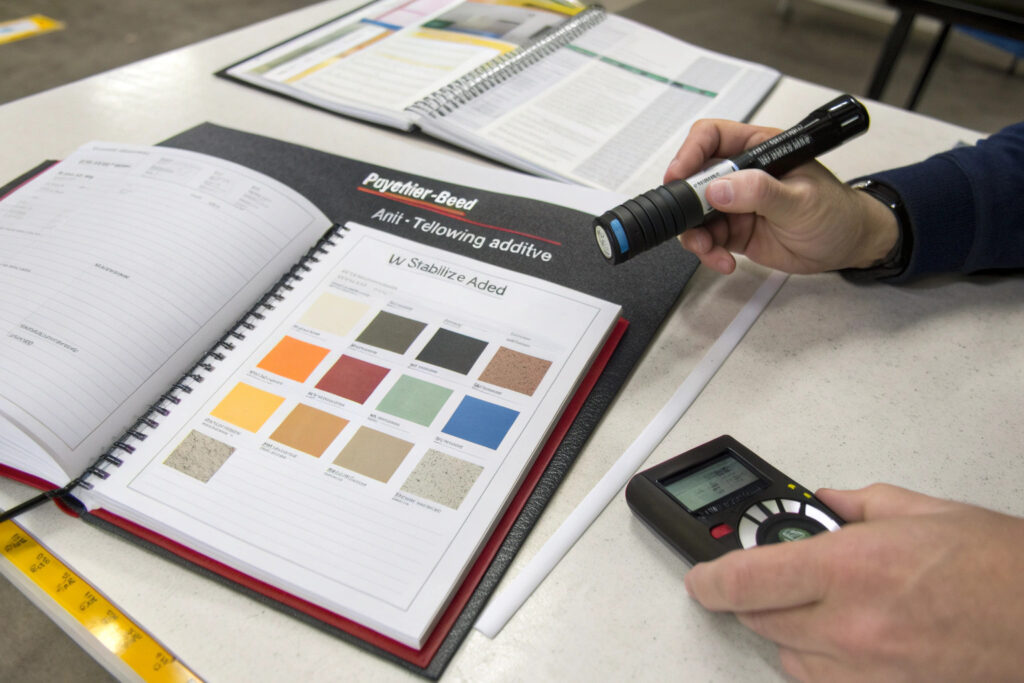
The anti-yellowing additive package is a proprietary blend of antioxidants and UV absorbers that the foam manufacturer incorporates during the foaming process. These additives sacrificially react with oxygen and UV energy, protecting the polyurethane polymer. They are consumed over time, so the protection is finite, but a properly formulated foam will remain white for years under normal storage conditions. The UV stabilizer is specifically designed to absorb UV photons and dissipate the energy as harmless heat. The combination of antioxidants and UV stabilizers provides broad-spectrum protection.
What Accelerated Aging Tests Can Verify Yellowing Resistance?
You cannot wait three years to see if a foam yellows. You need an accelerated test that simulates long-term aging in a short time. The standard test is a QUV accelerated weathering test according to ASTM G154. A foam sample is placed in a QUV chamber, which cycles between UV exposure at elevated temperature and condensation at elevated humidity. A 48-hour QUV cycle can simulate months or years of indoor storage.
The yellowing is measured with a spectrophotometer before and after the test. The metric is the Yellowness Index, per ASTM E313. A Delta YI of less than 2.0 is considered excellent yellowing resistance. A Delta YI of 2.0 to 5.0 is moderate resistance. Above 5.0 is poor resistance. I request QUV test reports from foam suppliers and include the Delta YI specification in our material purchase orders. This test data is objective, defensible, and separates marketing claims from material reality.
Can I Request a Physical Yellowing Demonstration From the Factory?
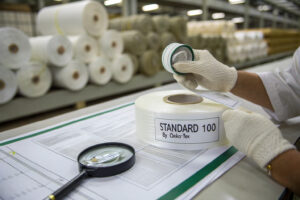
A simple, low-tech demonstration that a factory can perform is a windowsill test. A swatch of the proposed foam is cut in half. One half is stored in a dark drawer. The other half is placed on a sunny windowsill for two weeks. The two halves are then compared. The windowsill sample should show no significant yellowing compared to the dark-stored control. This is not a calibrated laboratory test, but it is a fast, visual, and persuasive demonstration. A factory that is confident in its foam quality will perform this test and send you the photographic result. A factory that hesitates or makes excuses is likely aware that their foam will fail.
What Are the Inspection and Warehouse Management Protocols for Preventing Yellowing?
Preventing yellowing is not just about the initial foam quality. It is about monitoring the foam through the entire supply chain, from receiving inspection through warehousing to final distribution. A batch of hats that was white when it left the factory can yellow in your warehouse if the storage conditions are not managed. You need both an incoming inspection protocol and a storage management system.
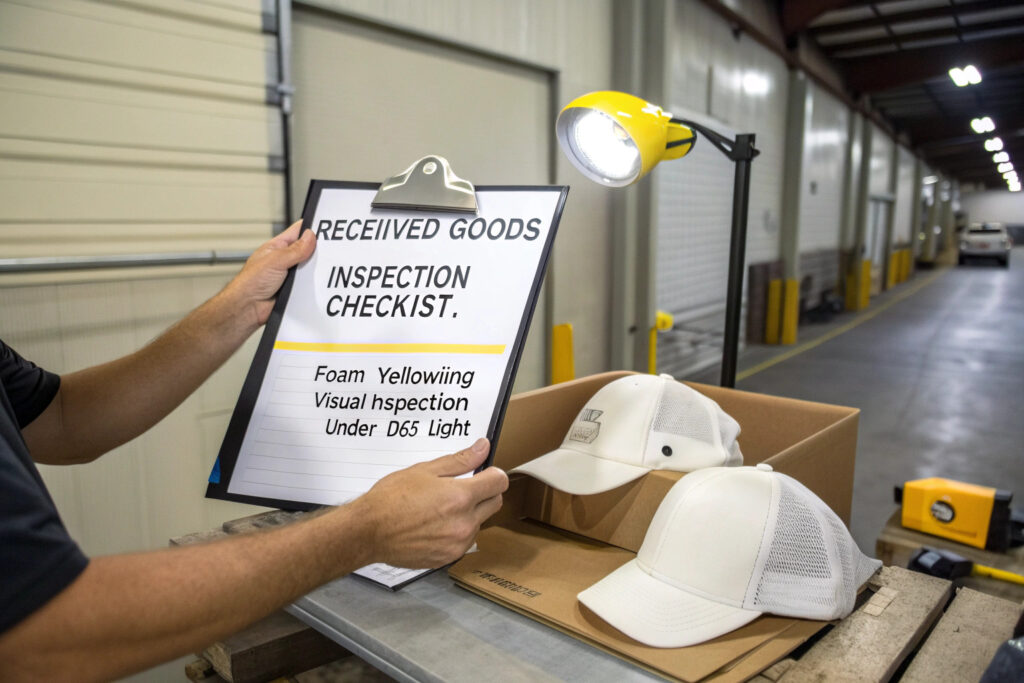
When you receive a shipment of trucker hats, do not just count cartons and check for shipping damage. Open a random sample of cartons from different positions in the shipment, from the center of the pallet, from the bottom, from the top. Pull one hat from each sampled carton. Inspect the foam under a bright, daylight-balanced light source, D65 standard illuminant. Look for any hint of yellowing, especially at the edges of the foam panel and along the fold lines. Compare the foam color to a retained sample from the pre-production approval, or to a fresh piece of white paper as a reference. If any yellowing is present at receiving, document it with photographs, file a claim with the supplier, and quarantine the affected cartons. Do not commingle yellowed inventory with good inventory. The yellowing will only worsen.
The warehouse environment should be monitored. Place a digital thermometer and hygrometer in the storage area and record the daily maximum and minimum readings. If temperatures consistently exceed 30 degrees Celsius, invest in ventilation or climate control. Store trucker hats away from exterior walls, away from the roof, and away from windows. Use blackout curtains or UV-filtering film on any windows in the storage area. Rotate inventory using a first-in, first-out system. Hats that were manufactured six months ago should ship before hats manufactured one month ago. This minimizes the average time any hat spends in storage.
How Should I Inspect Hats for Latent Yellowing Before a Large Distribution?
If you have had hats in storage for more than three months, perform a pre-distribution inspection. Open a larger sample of cartons, focusing on the oldest stock and the stock stored in the least optimal locations, top shelves, near doors. Inspect the foam carefully. If you find any yellowing, do not ship those hats. The yellowing is a visual defect that will be noticed by the customer. It is better to write off a small percentage of inventory than to damage your brand's reputation with a widespread distribution of yellowed hats.
This pre-distribution inspection should also include a flex test. Gently flex the foam panel. It should feel resilient and spring back to its original shape. If it feels stiff, brittle, or develops a crease that does not recover, the foam has structurally degraded. The hat is not fit for distribution, even if the color is still acceptable.
What Information Should I Request From the Supplier About Foam Batch Age?
The foam used in your trucker hats has a manufacturing date. The foam may have been produced months before it was laminated and sewn into hats. The hats may then sit in the factory's warehouse before shipping. The total age of the foam at the time you receive the hats is the sum of these delays. You should request from your supplier the foam batch production date and the date of hat production. This information gives you the true age of the foam and allows you to prioritize older stock for faster distribution. A transparent supplier will provide this batch traceability data. I maintain foam lot traceability for all trucker hat orders, and I provide the foam batch date on the packing list.
Conclusion
Trucker hat foam yellowing during warehousing is a chemical degradation process with well-understood causes and straightforward prevention strategies. The yellowing is the visible symptom of oxidation, photo-oxidation, and hydrolysis reactions occurring within the polyurethane foam. These reactions are accelerated by heat, humidity, and light, the exact conditions often found in non-climate-controlled warehouses. The solution spans the entire product lifecycle: specifying polyether-based foam with anti-yellowing additives and UV stabilizers, verifying yellowing resistance through accelerated QUV testing, inspecting incoming shipments for latent yellowing, and maintaining climate-controlled, dark storage conditions with first-in-first-out inventory rotation.
A yellowed trucker hat is a brand failure that was entirely preventable. It did not need to happen. The material choices, the specification details, and the storage protocols that prevent it are known and available. They require a supplier who understands foam chemistry and a buyer who demands foam quality as a specified, verified parameter, not an assumption.
If you are sourcing trucker hats and want to ensure your foam stays white from production through warehousing and into your customer's hands, I invite you to partner with Global-Caps. We specify polyether-based, UV-stabilized foam as our standard. We provide QUV yellowing resistance test reports and maintain foam batch traceability. We will also provide you with our recommended warehousing guidelines to protect your inventory. Reach out to our Business Director, Elaine, at elaine@fumaoclothing.com with your trucker hat project. Let's build a hat that looks as fresh on the day it is worn as it did on the day it was made, no matter how long it waited in a carton to meet its owner.