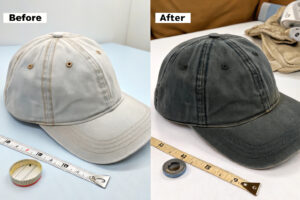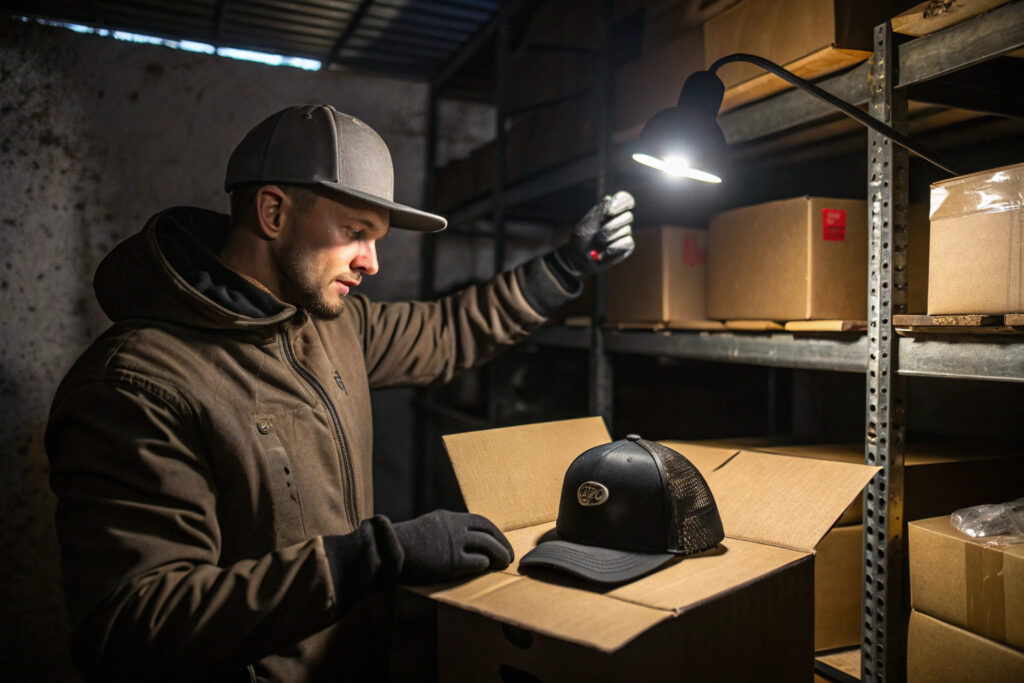
I cracked open a returned carton of premium matte black snapbacks last July. They had been in a distributor's warehouse in humid Singapore for just eight weeks. The caps that left our factory with a beautiful, soft, non-reflective finish now looked patchy and polished. Random sections of the front panels had developed a greasy-looking sheen that caught the light. The distributor had refused the entire 2,000-unit shipment. I pulled one cap out, rubbed the shiny spot, and felt a slightly tacky, smooth surface. My heart sank. I knew immediately what had happened. It was not a sewing defect. It was a chemical reaction that had been slowly cooking inside that hot container for two months.
The shiny patina is caused by the migration and surface re-deposition of the matting agent and plasticizers within the fabric finish or the internal buckram. A matte-finish snapback achieves its non-reflective look through a coating or a fiber treatment containing microscopic particles, typically silica or calcium carbonate, that scatter incoming light. These particles are suspended in a binder resin. When the cap is exposed to sustained heat, high humidity, and prolonged compression during bulk storage, the binder resin softens. The matting particles sink into the softened resin layer, leaving a smooth, particle-free resin surface on top. That smooth surface reflects light specularly, producing the shiny patina you see. The process is called matting agent sink-in. It is accelerated by the plasticizer chemicals that migrate out of the internal buckram layer, through the fabric, and to the surface. The buckram, which gives the front panel its structured shape, is a fabric stiffened with a resin that often contains plasticizers to keep it flexible. Under heat and pressure, these plasticizers volatilize and migrate outward, carrying the binder resin with them. The result is a shiny, sometimes tacky, patch on what was a perfectly matte cap.
I did not replace that Singapore order with the same construction. I fixed the root cause. I want to walk you through the chemistry of the failure, the storage conditions that accelerate it, the materials that resist it, and the packaging protocols that prevent it. This is the hidden material science that determines whether your matte snapback arrives on the retail shelf looking as premium as the day it was packed.
What Is the Chemical Mechanism Behind the Shiny Surface Defect?
The shiny patina is not a surface contaminant that can be wiped off. It is a physical change in the surface topology of the fabric coating. To understand it, you must think of the matte finish as a microscopic mountain range. The matting particles are the peaks. The binder resin is the valley floor. Light hits this rough terrain and scatters in all directions. Your eye perceives this scattered reflection as a soft, non-shiny surface. The shiny patina is what happens when the mountain range collapses into a flat plain. The matting particles sink below the resin surface. The resin forms a smooth, glassy layer on top. Light hits this smooth surface and reflects in a single, coherent beam. Your eye perceives this specular reflection as shine.
The sinking is driven by two forces. The first is thermal softening. The binder resin used in many matte finishes is a thermoplastic polymer. It softens when heated above its glass transition temperature. The inside of a shipping container in summer, or a non-climate-controlled warehouse in a hot climate, can easily reach 50 to 60 degrees Celsius. At these temperatures, the resin softens enough to allow the dense matting particles to sink under gravity. The second force is plasticizer migration. The buckram inside the front panel of a structured snapback contains phthalate or non-phthalate plasticizers. These are small, mobile molecules that keep the stiffening resin flexible. Under heat, they migrate. They travel from the buckram, through the fabric fibers, and into the matte coating on the fabric surface. When they enter the binder resin, they act as an additional plasticizer, further lowering its softening point and accelerating the particle sink-in. The two forces combine. Heat softens the resin. Migrating plasticizers soften it further. The matting particles sink. The surface becomes smooth and shiny. This process is not reversible. You cannot steam, iron, or wash the matte finish back. The physical structure of the surface has permanently changed.
The chemical mechanism is the interaction between the matte coating and the internal components. But the specific component that drives the most aggressive shine development is the one the consumer never sees. The buckram inside the front panel is a chemical reservoir that slowly releases plasticizers into the fabric system throughout the product's entire shelf life.

How Does the Buckram Inside the Front Panel Contribute to the Shine?
The standard buckram used in structured caps is a cotton or polyester fabric impregnated with a resin binder. To make this resin flexible rather than brittle, the buckram manufacturer adds a plasticizer. The most common plasticizers in traditional buckram are phthalate-based, though non-phthalate alternatives are now available. These plasticizers are not chemically bonded to the resin. They are physically mixed in, like water in a sponge. They are designed to remain in the resin, but under heat, they migrate.
When a snapback is pressed flat in a stack of cartons, the buckram is in direct contact with the back of the front panel fabric. The plasticizer migrates from the buckram into the fabric. It then wicks through the fabric to the surface coating. I have tested buckram samples in a heated oven at 60 degrees Celsius. Within 72 hours, measurable plasticizer residue was present on a blotter paper placed against the fabric surface. The plasticizer migration in textiles phenomenon is well-documented in the polymer science literature. The buckram is not inert. It is a slow-release chemical source inside your cap.
Why Does the Shine Often Appear in Random Patches Rather Than Uniformly?
The random patchiness is a signature of the mechanism. If the shine were caused by a uniform coating failure, the entire cap would be uniformly shiny. The patchy pattern is caused by the non-uniform contact between the buckram and the fabric, and the non-uniform distribution of pressure inside the stacked carton.
The buckram is not a solid sheet. It is a fabric that has been coated. The coating is not perfectly uniform. Areas of higher resin concentration on the buckram release more plasticizer. The fabric itself has a weave structure with peaks and valleys. The buckram touches the peaks of the fabric weave more intimately than the valleys. The plasticizer migrates into the peaks first. When the caps are stacked, the front panels are compressed against each other. The pressure is highest at the contact points, which are the high points of the embroidery, the seam intersections, and the areas where the cap is folded. These pressure points experience more intimate buckram-to-fabric contact and more plasticizer migration. The result is a patchy, localized shine pattern that mirrors the internal pressure map of the carton stack. This surface defect analysis pattern is a diagnostic tool. Patchy shine near the embroidery suggests buckram contact at the high points. Shine along the fold lines suggests compression-related migration.
What Storage and Packaging Conditions Accelerate the Patina Formation?
The chemical reaction that causes matte finish shine is always waiting to happen. The storage environment is the trigger that determines whether it happens on your watch or not at all. Three environmental factors form the triangle of risk: heat, humidity, and time. Heat is the primary accelerator. Every 10-degree Celsius increase in temperature roughly doubles the rate of a chemical reaction. A cap stored at 30 degrees Celsius for six months may show no shine. The same cap stored at 50 degrees Celsius for three weeks may show significant shine. Humidity is the secondary accelerator. Water vapor acts as a molecular lubricant, swelling the fabric fibers and the binder resin, creating more space for plasticizer molecules to travel through. Time is the multiplier. A short exposure to high heat may cause reversible softening that reverses when the cap cools. A long exposure causes permanent sink-in of the matting particles.
The most dangerous storage condition is a sealed shipping container in a tropical port during summer. The outside air temperature is 35 degrees Celsius. The sun beats on the metal container roof. The internal air temperature rises to 55 to 60 degrees Celsius. The container is sealed, trapping the heat and the moisture that off-gasses from the cardboard cartons. The caps inside are compressed in stacks. The buckram is pressed against the fabric. The plasticizers are mobile. The matting particles are sinking. Every day the container sits in that port, the shine is developing. A container that is loaded, shipped, and delivered in 21 days may show no shine. A container that sits in a transshipment port for an additional 14 days due to a logistics delay may show extensive shine on arrival. The storage history of the product is as important as the manufacturing quality.
The container environment is the macro-risk. The micro-risk is the environment inside the individual carton. The polybag, the folding method, and the carton stacking pattern create microclimates that can be significantly hotter and more humid than the ambient warehouse air.

How Does Polybag Packaging Trap Heat and Moisture Against the Fabric?
The standard polybag used for cap packaging is a low-density polyethylene bag. It is a vapor barrier. It traps moisture that evaporates from the cap fabric and the cardboard insert. When the carton is heated in a container, the moisture inside the polybag has nowhere to go. The relative humidity inside the bag rises to near 100%. The cap is effectively steaming inside its own packaging.
I changed our polybag specification after the Singapore incident. We now use a polybag with micro-perforations. These are small, laser-drilled holes that allow the bag to breathe. The moisture can escape. The cap stays dry. The micro-perforation does not compromise the bag's function as a dust and dirt barrier. It simply prevents the bag from becoming a miniature steam chamber. The breathable packaging design is a simple, low-cost modification that significantly reduces the microclimate risk inside the carton.
What Is the Safe Temperature and Humidity Range for Long-Term Cap Storage?
Based on the thermal softening point of standard matte finish binder resins and the volatility of common buckram plasticizers, I define a safe long-term storage envelope. The temperature should be maintained between 15 and 30 degrees Celsius. The relative humidity should be maintained between 40% and 60%. The storage area should be shaded from direct sunlight. The cartons should be stored on pallets off the concrete floor. The cartons should not be stacked more than six high to minimize compression pressure on the bottom caps.
I include a storage recommendation sheet in every bulk shipment. It is a one-page document that explains these conditions in simple terms. I know that most distributors and retailers do not have climate-controlled warehouses. But they can choose the coolest, driest corner of their warehouse. They can avoid storing the cartons next to a sun-facing wall or a heating vent. These small choices make a measurable difference. The warehouse storage conditions for textile products are a factor in product quality that is often overlooked in the handoff from factory to distributor.
What Materials and Finishes Resist the Shiny Patina Effect?
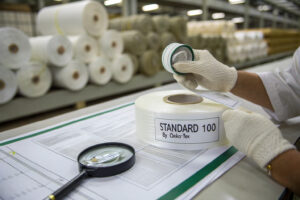
The permanent solution to matte finish shine is not a better storage environment, though that helps. The permanent solution is to use materials that do not contain the chemicals that cause the problem. You replace the thermoplastic matte coating with a thermoset or a mechanical matte finish. You replace the plasticized buckram with a non-migrating stiffener. You remove the plasticizer from the system, and you remove the shine risk at its source.
I have transitioned our premium matte snapbacks to a two-part solution. The first part is the fabric finish. Instead of a coated matte finish, we now use a pigment-dyed, carbon-brushed mechanical finish. The fabric is dyed with a high-crockfastness pigment dye that gives a deep, saturated color. Then the fabric surface is mechanically brushed with a fine carbon-fiber brush that raises a micro-nap on the fiber surface. This micro-nap scatters light exactly like the matting particles in a coating, but it is part of the fiber itself. There is no coating to soften. There are no particles to sink. There is no plasticizer to migrate. The matte appearance is a physical property of the fiber surface. It cannot develop a shine because there is no chemical mechanism to create one. The second part is the buckram. We now use a TPE, thermoplastic elastomer, stiffening sheet instead of a traditional plasticized resin buckram. TPE achieves its flexibility through its block copolymer molecular structure, not through added plasticizers. There are no mobile small molecules to migrate. The TPE sheet is heat-welded to the fabric, creating a mechanical bond rather than a chemical one. This two-part material solution has eliminated the shiny patina defect from our matte snapback production.
The material solution is the engineering fix. But there is also a design-level decision that can bypass the problem entirely for brands that are committed to a matte aesthetic. An unstructured cap eliminates the buckram entirely. No buckram means no plasticizer source. No plasticizer source means the coating, if a coating is used, is not attacked from within.
What Is the Difference Between a Coated Matte Finish and a Mechanical Matte Finish?
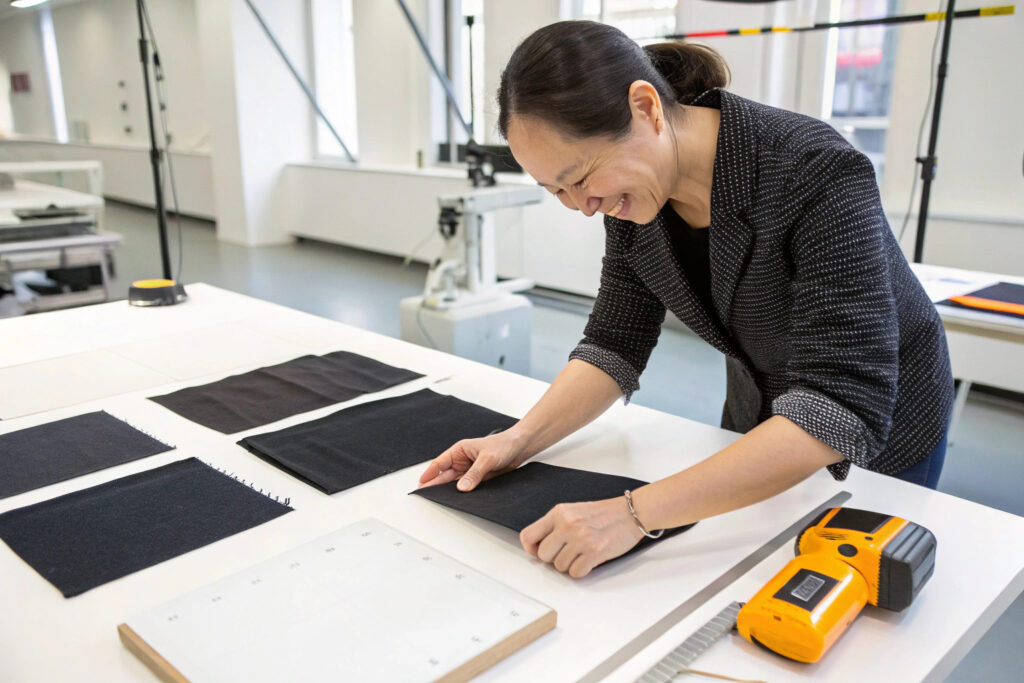
A coated matte finish applies a liquid resin containing matting particles to the fabric surface, then cures it with heat. The matte appearance depends on the particles staying on the surface. A mechanical matte finish alters the fabric surface itself. Brushing, sanding, or enzyme washing creates a micro-roughness on the fiber surface that scatters light.
The mechanical finish is inherently more stable because there is no added coating to fail. The fabric is the finish. The mechanical finish also has a softer, more natural hand feel. The coated finish can feel slightly plastic-like. For a premium matte snapback, the mechanical finish aligns better with the consumer's expectation of a high-quality textile product. The textile finishing techniques reference covers the range of mechanical and chemical finishing options available for woven cotton fabrics.
How Does an Unstructured Cap Design Eliminate the Shine Risk?
An unstructured cap has no buckram. It has no internal stiffening panel in the front crown. The shape is held by the fabric itself, sometimes with a light interfacing, but not a plasticized resin sheet. Without the buckram, there is no internal plasticizer reservoir. The plasticizer migration pathway is completely eliminated. The matte finish on an unstructured cap is subject only to thermal softening, not to the combined assault of heat plus migrating plasticizers. The risk of shiny patina development is dramatically lower.
For brands that want a soft, relaxed silhouette and a matte finish, the unstructured cap is a material-science-friendly design choice. It simplifies the product and eliminates the most aggressive chemical driver of the shine defect. The unstructured cap construction is not just a style preference. It is a chemical stability strategy.
How Can You Test Your Caps for Shine Resistance Before Bulk Production?
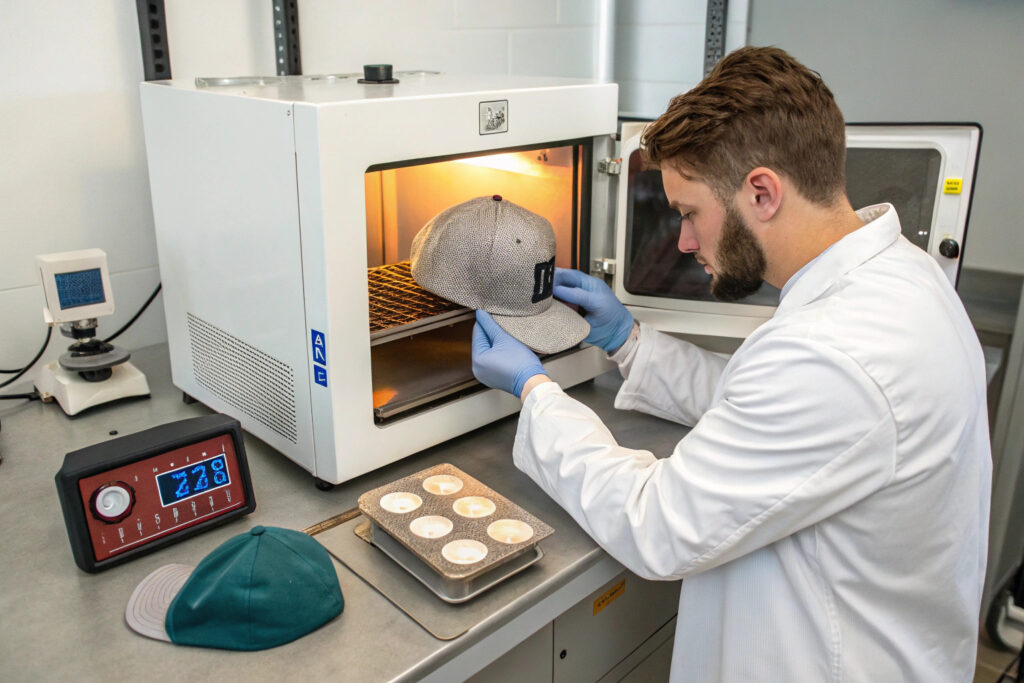
You do not need to wait for a customer complaint to discover that your matte caps develop shine in storage. You can simulate the storage conditions in a laboratory and observe the result in days rather than months. An accelerated aging test is a standard tool in material science. It applies elevated heat and humidity to accelerate the chemical reactions that would occur slowly at room temperature. A properly designed accelerated aging test can predict months of storage behavior in 72 hours.
I have developed an accelerated aging protocol specifically for matte finish snapbacks. The protocol has three test conditions. Condition one is dry heat aging. Place a finished cap, folded as it would be in a polybag, in an oven at 60 degrees Celsius for 72 hours. After the test, remove the cap, let it cool to room temperature, and visually inspect the front panels under a daylight lamp. Compare the cap to an untested control cap from the same batch. Look for any shiny patches, any change in surface gloss, and any change in hand feel. Condition two is humid heat aging. Place a finished cap in a humidity chamber at 50 degrees Celsius and 90% relative humidity for 72 hours. This simulates a tropical container environment. After the test, inspect as above. Condition three is compression aging. Stack five finished caps in their polybags with a 5-kilogram weight on top, and place the stack in the oven at 50 degrees Celsius for 72 hours. This simulates the bottom carton in a pallet stack. After the test, inspect each cap in the stack for shine, with particular attention to the caps at the bottom. If any cap in any of these three tests develops a visible shiny patina, the material combination is not stable for long-term storage. The buckram, the fabric finish, or both must be changed.
The accelerated aging test is a predictive tool. The measurement tool for quantifying the shine is a gloss meter. A visual inspection catches obvious failures. A gloss meter catches subtle changes that the eye might miss but that a retail buyer or a consumer might notice.
How Do You Use a Gloss Meter to Measure Matte Finish Degradation?
A gloss meter projects a beam of light onto the fabric surface at a specific angle and measures the percentage of light that is reflected specularly. For matte finishes, the measurement angle is typically 60 degrees or 85 degrees. A true matte finish should have a gloss reading of less than 5 gloss units at 60 degrees. A semi-matte finish may read 5 to 15 gloss units. A shiny surface reads above 30 gloss units.
I take a baseline gloss measurement on the approved pre-production sample. I record the measurement location, such as the center front panel, 2 centimeters above the brim attachment. I then measure the same location on the caps that have undergone accelerated aging. An increase of more than 5 gloss units from the baseline is a significant degradation. An increase of more than 10 gloss units is a visible shiny patina. The gloss measurement standard provides a quantitative, reproducible method for evaluating surface shine that replaces subjective visual assessment.
What Is a Reasonable Pass or Fail Criterion for the Accelerated Aging Test?
A product that is intended for global distribution, including tropical markets, should pass all three accelerated aging test conditions with a gloss increase of less than 5 units and no visible shiny patches. This is a strict criterion. It may require the use of a mechanical matte finish and a non-plasticized buckram. A product that is intended only for temperate, domestic markets with climate-controlled supply chains may accept a less strict criterion of less than 10 gloss units increase, provided the storage conditions are clearly communicated to the distributor.
I set a pass criterion of less than 5 gloss units increase across all three test conditions for all our matte finish caps. I do not want to have a conversation with a client about why their caps developed shine in a hot warehouse. The internal standard is stricter than what most markets demand, but it eliminates a quality risk that is difficult and expensive to resolve after the product is in the field. The quality testing standards for textile durability should be established before production, not in response to a customer complaint.
Conclusion
The shiny patina on a matte-finish snapback is a material science problem, not a sewing defect. It is caused by the softening of the matte coating binder resin under heat, accelerated by the migration of plasticizer chemicals from the internal buckram. The matting particles sink into the softened resin. The surface becomes smooth and reflective. The damage is permanent. The solution is a combination of material substitution and storage discipline. Replace the coated matte finish with a mechanical matte finish, such as a carbon-brushed surface. Replace the plasticized buckram with a non-migrating TPE stiffener. Store the finished caps in a cool, dry environment, in breathable polybags, away from direct sunlight and heat sources. Test the material combination with an accelerated aging protocol before committing to bulk production.
I learned this lesson through a rejected shipment and a costly air freight replacement. The knowledge that came out of that failure has made every matte cap we have shipped since more stable and more premium. Our clients' matte snapbacks sit on retail shelves in Singapore, in Miami, in Dubai, and they stay matte. That is the engineering result that justifies the material investment.
If you are developing a matte-finish snapback and want to ensure it stays matte through global distribution, let us share our material specifications and our accelerated aging test protocol. Our Business Director, Elaine, can send you a sample of our mechanical matte finish fabric and a TPE buckram swatch, along with the gloss meter readings from our aging tests. Email her at elaine@fumaoclothing.com and ask for the Matte Stability Package. We will help you engineer a cap that looks as good on the retail shelf as it did on the sample table.