You finally found the perfect unstructured dad cap. It has that ideal, relaxed dome shape. It sits low on the head without the stiff, boxy look of a structured cap. You wear it for a week. It gets a little dirty. You wash it carefully in cold water, air dry it flat as the care label says, and come back to find it looking like a deflated balloon. The crown has lost its gentle curve. It has developed random wrinkles. It leans to one side. The front panel has a strange indentation. You try to reshape it with your hands, but the fabric has a memory now, and the memory is ugly.
You are not alone. Unstructured cap crown collapse after washing is one of the most common consumer complaints in headwear, and it is a quality issue that traces directly back to the materials and construction methods used at the factory level. I run Global-Caps, and I have analyzed hundreds of returned caps with this exact problem. An unstructured cap has no buckram stiffener to hold its shape. It relies entirely on the fabric, the interlining, and the sewing construction to maintain its silhouette through wear and washing. When one of these elements fails, the crown collapses. In this article, I will explain the technical reasons this collapse happens, why it happens differently on different caps, and what factory-level controls can prevent it.
What Is the Structural Difference Between a Structured and an Unstructured Cap Crown?
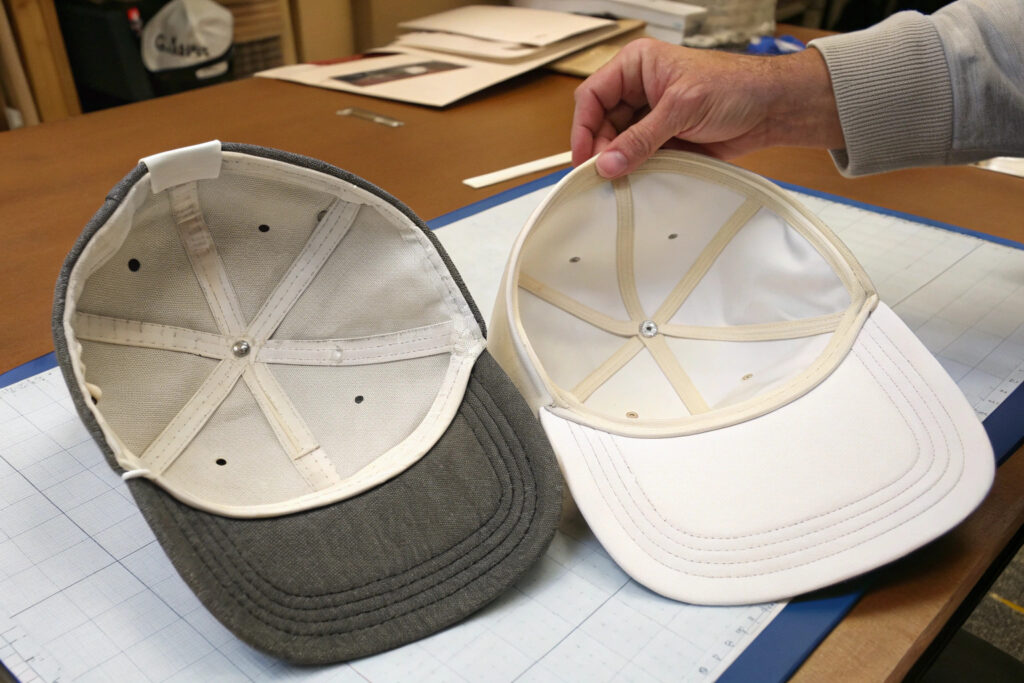
To understand why an unstructured cap collapses, you must first understand what is missing. A structured cap, the classic baseball cap with a high, firm crown, contains a layer of buckram. Buckram is a stiff, thermoplastic material that is fused to the inside of the front two crown panels. It is what gives the cap its rigid, upright shape. You can push down on the crown of a structured cap, and it springs back. The buckram is a permanent skeleton.
An unstructured cap has no buckram. It is designed to be soft, packable, and conforming to the wearer's head. The crown shape is created entirely by the cut of the fabric panels, the seams that join them, and the natural drape of the textile. There is no rigid skeleton. The cap holds its shape through a balance of tensions. The curve of the panel edges, the stiffness of the fabric itself, and any soft interlining or fusible provide subtle support. When you wash the cap, you introduce water, heat, and mechanical agitation. These forces disrupt the balance of tensions. The fabric fibers relax. Any fusible interlining may delaminate or lose its bond. The seams may pucker or twist. The crown shape, which was a delicate equilibrium, is destroyed. The cap collapses because the only things holding it up were temporary.
The different collapse patterns you observe, wrinkling, leaning, flattening, are clues to which specific component failed. A cap that develops random surface wrinkles likely had a fusible interlining that delaminated and is now bunching up independently inside the fabric. A cap that leans to one side likely had the bias stretch of the fabric activated unevenly during washing, causing one panel to shrink more than its neighbor. A cap that flattens into a pancake likely was made from a fabric that had no shape memory at all, such as a loose-weave linen or a very light rayon, and it simply lost all structural integrity when wet. Understanding these failure modes is the first step to demanding a better product from your supplier.
How Does the Absence of Buckram Shift the Structural Load?
In a structured cap, the buckram carries the compressive and bending loads. The fabric is essentially a decorative cover. In an unstructured cap, the fabric and the seams carry all the loads. Every stitch line, every panel join, and the very weave of the fabric are structural elements. The crown shape is an arch. The seams are the ribs of the arch. The fabric is the webbing between the ribs.
When you wash the cap, the water acts as a plasticizer. It temporarily breaks the hydrogen bonds in the cotton fibers or relaxes the polymer chains in polyester. The fabric becomes softer and more pliable. The arch sags under its own minimal weight. If the fabric does not recover its original stiffness upon drying, the sag becomes permanent. This is why the collapse is often not reversible by hand-shaping. The fabric has not just been bent; it has been re-formed in the bent position during the drying process. The shape change is set into the molecular structure of the fibers.
What Role Do the Crown Seams Play in Maintaining Shape?
The seams on an unstructured cap are not just joinery. They are a geometric framework. A classic six-panel unstructured cap has six curved panels that meet at a central top button. The curve of each panel seam is engineered to create a three-dimensional dome. If the seam construction fails, the geometric framework fails.
There are two common seam failures in washed caps. The first is seam slippage. The stitching does not break, but the fabric yarns along the seam line shift, allowing the panels to pull apart slightly. This releases the tension that maintained the dome curve. The cap crown flattens because the panels are no longer pulling against each other in the intended geometry. The second is seam puckering. The sewing thread shrinks at a different rate than the fabric. The thread, often polyester, does not shrink. The cotton fabric does. The thread becomes too short for the seam, and the fabric bunches up along the stitch line like a gathered curtain. This puckering distorts the smooth dome surface and creates an irregular, collapsed appearance. A well-engineered unstructured cap uses a stitch type, thread tension, and seam allowance that accommodate the differential shrinkage between thread and fabric.
How Does the Fabric Choice Determine Wash-Down Crown Stability?
The fabric is the primary structural material in an unstructured cap. The fiber content, the yarn twist, the weave density, and the finishing treatments collectively determine how the cap will behave when wet and dried. Choosing the wrong fabric is the single biggest cause of crown collapse. A fabric that makes a beautiful, soft cap on day one may be a structural disaster on day thirty.
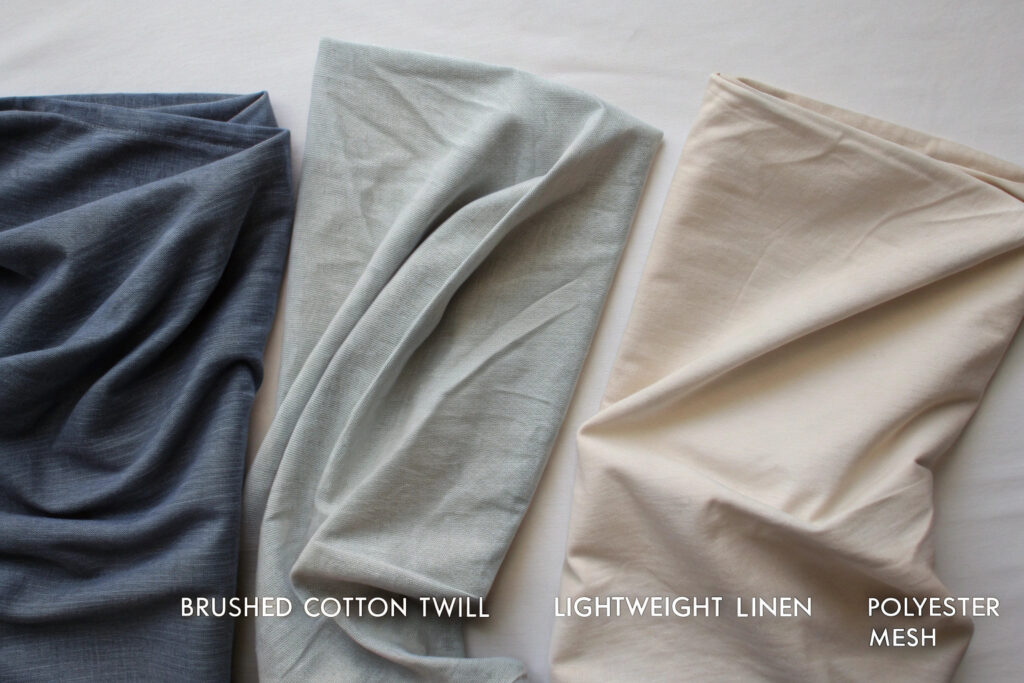
The most reliable fabric for an unstructured cap that must survive washing is a tightly woven, medium-weight brushed cotton twill. The twill weave gives the fabric a natural diagonal structure that resists distortion. The brushing process raises a soft nap on the surface but does not weaken the underlying weave. The medium weight, typically 8 to 10 ounces per square yard, provides enough body to hold a dome shape without buckram. A washed cotton twill cap will shrink slightly and relax, but if the fabric has been properly pre-shrunk at the mill, the shrinkage will be minimal and uniform. The crown will soften and conform to the wearer's head, which is the intended behavior of an unstructured cap. It should not collapse entirely.
The most problematic fabrics are loosely woven linens, lightweight rayon challis, and some novelty knits. Linen has no natural elasticity. Its fibers are stiff when dry but become completely limp when wet. The weave is often open and airy. A linen unstructured cap will collapse into a formless rag after washing, and no amount of ironing will restore the original dome. Rayon, when wet, loses up to 50% of its dry strength. It stretches and sags dramatically. A rayon cap washed in a machine will often come out twisted and permanently elongated. Novelty knits, like a loose jersey, have no structural memory at all. They are designed to drape, not to stand. A knit unstructured cap will follow gravity in whatever position it dries. If dried flat, it becomes flat. If dried crumpled, it stays crumpled.
Blended fabrics can offer a compromise. A cotton-polyester blend, such as 65% polyester and 35% cotton, combines the breathable feel of cotton with the dimensional stability of polyester. The polyester fibers provide a resilient skeleton that helps the fabric spring back to its original shape after washing. The crown collapse on a well-constructed poly-cotton unstructured cap is significantly less than on a 100% cotton cap. However, the hand feel is different. Some brands prefer the authentic, lived-in look of 100% cotton and accept a degree of shape change. The key is that the shape change should be uniform and predictable, not a catastrophic, asymmetrical collapse.
How Does Fabric Pre-Shrinking Affect Post-Wash Shape?
Pre-shrinking is the process of washing and drying the fabric at the mill before it is cut and sewn. This stabilizes the fabric dimensions. If the fabric is not pre-shrunk, the cap panels will shrink for the first time when the consumer washes the finished cap. This first shrinkage is unpredictable. Different panels, cut from different parts of the fabric roll, may shrink at slightly different rates. This differential shrinkage is a major cause of asymmetrical collapse, where one side of the crown pulls inward and the other side does not.
A quality unstructured cap is cut from fabric that has been pre-shrunk to a controlled residual shrinkage rate, typically less than 3% in both warp and weft directions. At Global-Caps, we specify pre-shrunk fabric for all unstructured cap orders. We also conduct a wash test on the finished cap as part of our quality control. We wash a production sample according to the care label instructions, air dry it, and measure the crown height and circumference. If the crown collapses beyond our internal tolerance, we investigate the fabric lot and adjust the construction or the material specification. This is a standard test that any competent headwear factory should perform.
Why Does Fabric Dyeing and Finishing Chemistry Matter?
The chemicals applied to the fabric during dyeing and finishing can influence how the fabric behaves when re-wet. Some softeners and finishing agents are water-soluble. They give the fabric a crisp, full hand feel on the shelf, but they wash out in the first laundry cycle. The cap that felt substantial and structured out of the box now feels thin and limp because the sizing washed away.
This is a common complaint with low-cost caps. The factory uses a heavy starch or a cheap cationic softener to artificially stiffen the fabric and hide its lightweight, low-quality nature. The consumer washes the cap, the sizing dissolves, and the true flimsy character of the fabric is revealed. The crown collapses because it was never structurally sound. It was chemically propped up. A high-quality unstructured cap relies on the intrinsic weight and weave of the fabric, not on temporary finishes. The fabric should feel good, but not artificially stiff, in its raw state. When I source fabric for our unstructured caps, I wash a swatch in hot water before approving the quality. I want to see the fabric as the consumer will see it after the third wash, not as it looks on the roll with a mill finish.
What Construction Techniques Prevent Asymmetrical Crown Collapse?
The collapse of an unstructured cap is not solely a fabric problem. It is equally a construction problem. The way the panels are cut, interfaced, and sewn determines whether the cap distorts symmetrically or asymmetrically. Asymmetrical collapse, where the cap leans, twists, or develops a dent on one side, is often the result of cutting the fabric off-grain or applying the interlining inconsistently.
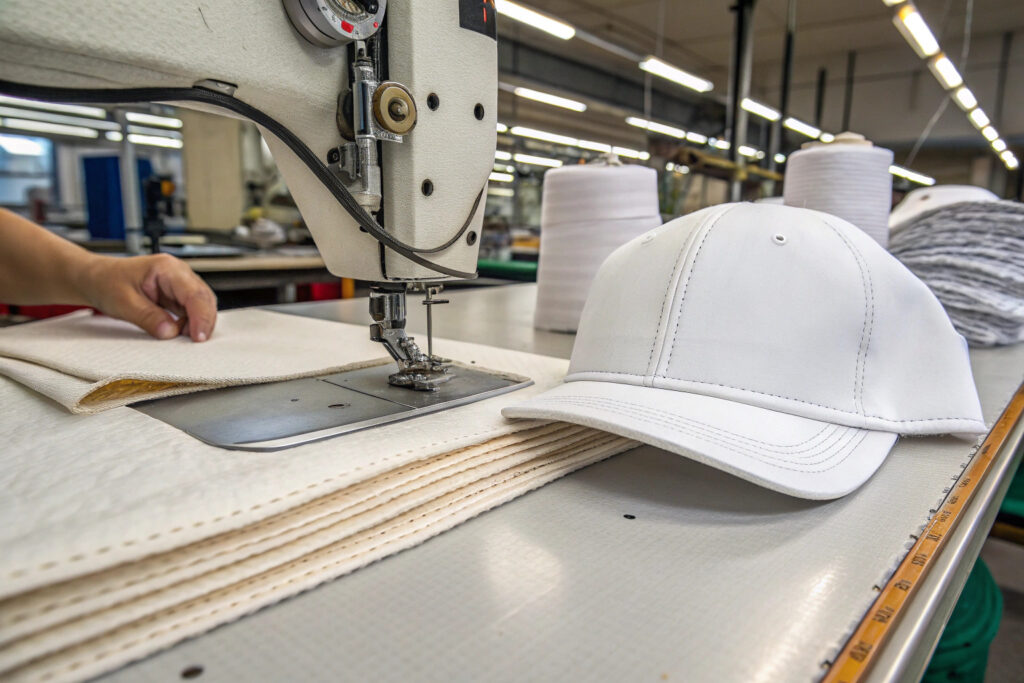
The most critical construction detail is the application of a soft, non-woven fusible interlining to the front two panels only, or to all panels. This interlining is not buckram. It is a thin, flexible, fabric-like material that adds a subtle, uniform stiffness and prevents the fabric from stretching out of shape. It is the hidden skeleton of a quality unstructured cap. If the interlining is not fused correctly, with even heat and pressure, it will partially detach during washing. The detached areas will be soft and stretchy. The still-fused areas will be firmer. This differential stiffness across the cap surface creates unpredictable collapse patterns. A bubbly, wrinkled appearance after washing is almost always failed fusible interlining.
Another construction factor is the seam type used at the crown joins. A flat-felled seam is stronger and more dimensionally stable than a simple overlock seam. A flat-felled seam encloses the raw edge and creates a flat, reinforced rib that helps the crown hold its arch shape. An overlock seam is faster and cheaper, but it creates a bulkier, less stable join that can twist when the fabric shrinks. A quality unstructured cap uses a flat-felled seam or a taped seam for the crown panels.
How Does Panel Cutting Direction Influence Distortion?
Woven fabric has a grain. The warp threads run the length of the fabric roll. The weft threads run across the width. The bias is the diagonal direction. Fabric stretches most on the bias. If the cap panels are cut with their center lines aligned to different grain directions, each panel will stretch and shrink differently when washed. This is a hidden construction flaw that is invisible in a new cap but becomes obvious after washing.
A properly engineered unstructured cap has all crown panels cut on the same grain alignment, typically with the center of each panel aligned to the warp or the weft. This ensures uniform shrinkage and stretch across all panels. The crown shrinks symmetrically, maintaining its overall shape even if it becomes slightly smaller. At our factory, the cutting markers, the large paper patterns laid on the fabric, have grain line arrows on every panel. The cutting room supervisor checks the grain alignment before the fabric is cut. This discipline prevents the leaning, twisted crowns that result from mixed-grain cutting.
What Is the Purpose of a Crown Lining in Unstructured Caps?
Some unstructured caps include a lightweight crown lining, typically a breathable polyester mesh, sewn into the interior of the crown. This lining serves a structural purpose beyond comfort. It acts as an internal sling that supports the fabric crown from the inside. When the outer fabric becomes soft and pliable during washing, the lining, which is dimensionally stable polyester, maintains the dome shape and prevents the outer fabric from collapsing completely.
The lining must be cut and sewn with a slightly smaller circumference than the outer crown. This pre-tensioning ensures the lining pulls inward slightly on the crown seams, creating a gentle, supportive tension. A poorly designed lining that is too large will not support the crown. It will just add bulk. A well-designed lining is an engineering element that significantly improves wash-down performance. I recommend a crown lining for any unstructured cap that uses a lightweight or loosely woven fashion fabric.
How Can You Specify and Test for Wash-Down Crown Stability Before Production?
You do not have to wait for customer returns to discover that your unstructured caps collapse in the wash. You can specify a wash-down stability standard in your purchase contract and require the factory to perform and pass a wash test before production begins. This test is a simple, repeatable procedure that predicts how the cap will behave in the consumer's laundry room.
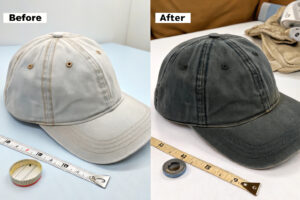
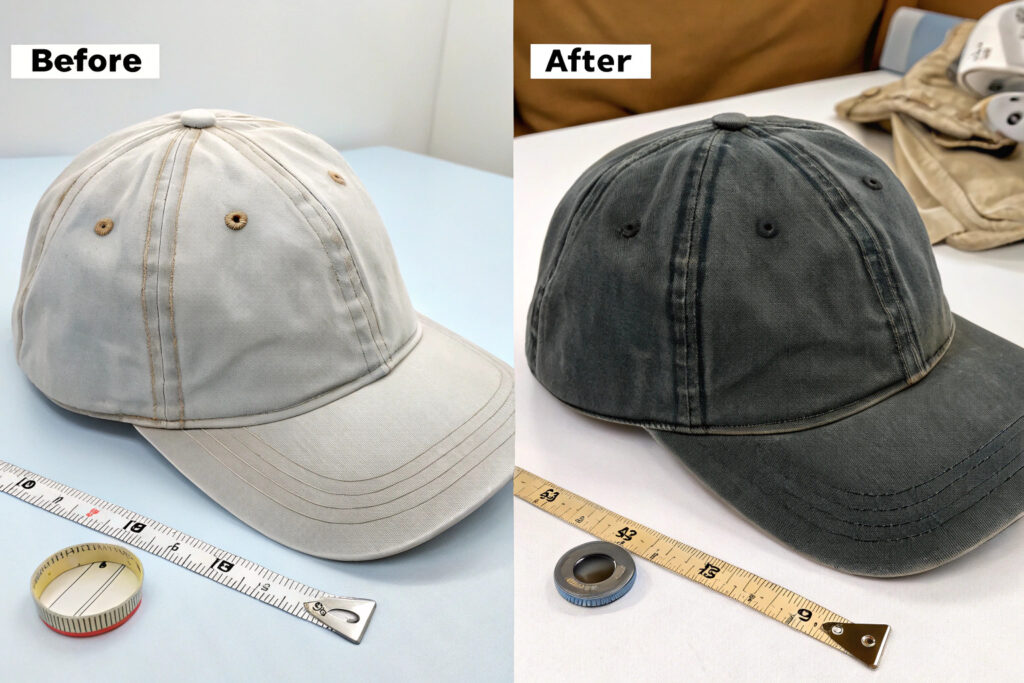
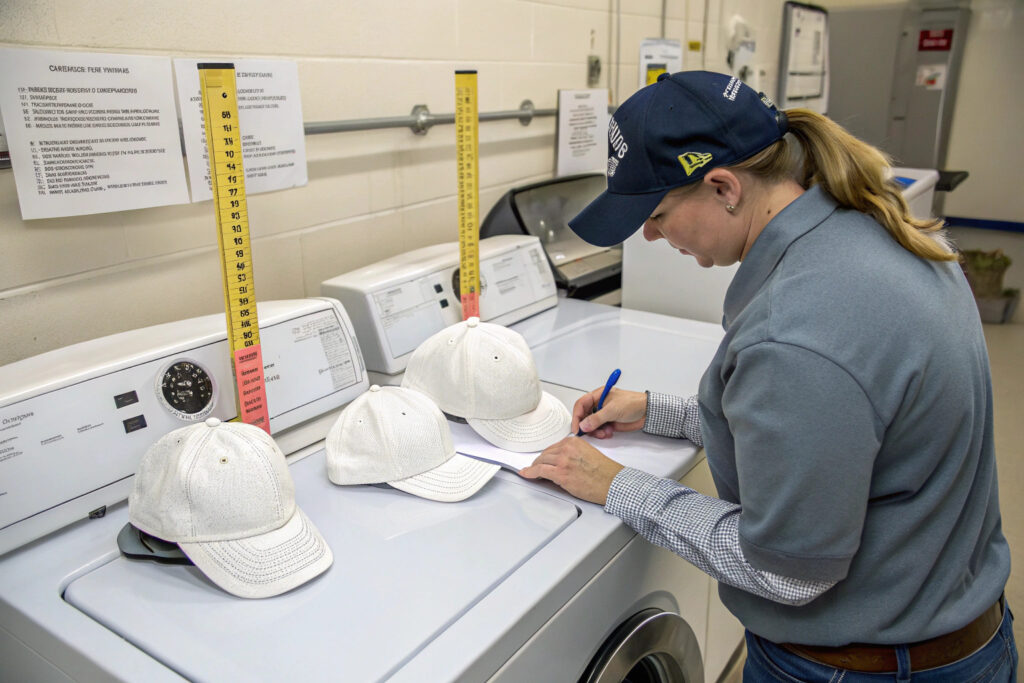
The test protocol I recommend is as follows. Take a pre-production sample or a first-off production sample. Measure the crown height from the bottom of the sweatband to the top of the crown button. Measure the crown circumference at the widest point. Photograph the cap from the front, side, and top under standard lighting. Then, wash the cap according to the care label instructions that will be sewn into the finished product. If the cap is labeled machine wash cold, wash it in a standard front-loading machine on a cold delicate cycle with a mild detergent. Air dry the cap on a flat surface away from direct heat or sunlight. Do not use a cap form or stuff the cap during drying. After it is completely dry, re-measure the crown height and circumference. Re-photograph the cap from the same angles. Compare the before and after measurements and photographs. A well-constructed unstructured cap should not lose more than 5% to 8% of its crown height after the first wash. The shape should be symmetrical and free of random wrinkles, dents, or leans. This is the benchmark I use internally.
This test can be written into the purchase contract as a quality requirement. The specification can read, "Pre-production sample shall be subjected to a wash test per AATCC LP1, machine wash cold, air dry flat. Crown height retention shall be not less than 92% of pre-wash measurement. Crown shape shall be visually symmetrical with no localized collapse, delamination, or seam puckering." AATCC LP1 is a standardized laboratory laundering procedure. Referencing a standard gives the test objectivity and removes ambiguity. The factory cannot argue that your home washing machine was too aggressive if the standard is referenced.
How Can a Factory Demonstrate Its Interlining Fusion Quality?
The adhesion of the fusible interlining is difficult for a buyer to inspect on a finished cap without destroying the cap. You can ask the factory to perform a peel test on a sample panel and provide the result. A peel test involves cutting a strip of the fused fabric and interlining, clamping the layers in a tensile testing machine, and measuring the force required to separate them. A properly fused interlining should require a consistent peel force across the entire panel, with no easy-release zones.
A simpler, qualitative test that the factory can perform and video-record for you is a hand peel test after a mock wash. The factory takes a fused panel, washes it, dries it, and then attempts to peel the interlining away by hand. If the interlining separates easily in some areas and is tight in others, the fusing process is inconsistent. The video of this test is a powerful piece of evidence for a buyer evaluating a new supplier. I have provided this video to clients as part of our unstructured cap qualification process.
What Is a "Wear Trial" and How Can It De-Risk Your Bulk Order?
A wear trial is the ultimate real-world test. Before committing to 50,000 units, produce a small batch of 50 or 100 caps with the exact bulk materials and construction. Give these caps to employees, friends, or a test panel of customers. Ask them to wear the caps normally for two weeks, wash them at least three times, and provide feedback with photos. This trial exposes failure modes that a laboratory wash test might miss, such as how the cap interacts with sweat, hair products, and sun exposure.
The wear trial also gives you marketing insight. You learn how the cap ages aesthetically. Does it develop a desirable, vintage look, or does it just look old and tired? A well-designed unstructured cap should age gracefully, developing a soft, broken-in character that consumers actually prefer. The wear trial validates that the wash-down behavior is commercially acceptable, not just technically acceptable. This step requires time, but it is far cheaper than a recall or a social media backlash over quality.
Conclusion
The collapse of an unstructured cap crown after washing is a physical failure of the cap's structural system. Unlike a structured cap that relies on a rigid buckram skeleton, the unstructured cap depends on a delicate balance of fabric grain, panel geometry, seam construction, and interlining adhesion. When water, heat, and agitation disrupt this balance during washing, the failure mode reveals exactly which component was weak. Random wrinkles point to delaminated interlining. Asymmetrical leaning points to off-grain cutting. Complete flattening points to a fabric with no intrinsic shape memory.
You now have the diagnostic tools to identify these failures and the specification tools to prevent them. The fabric must be pre-shrunk and of sufficient weight, with a tight weave and intrinsic resilience. A soft fusible interlining must be applied with consistent heat and pressure, and its adhesion must be verified. The crown seams must be a stable, flat-felled construction that accommodates differential shrinkage. A crown lining, when used, must be pre-tensioned to support the dome. Most critically, a wash-down stability test must be performed and passed before production, and the standard must be written into the purchase contract.
If you are developing an unstructured cap and you want it to maintain its shape through the rigors of real-world wear and washing, I invite you to partner with Global-Caps. We have engineered our unstructured cap construction over thousands of orders to produce a reliable, predictable wash-down result. We can provide you with our internal wash test reports, interlining peel test videos, and wear trial results on your specific fabric and design. Reach out to our Business Director, Elaine, at elaine@fumaoclothing.com. Send us your design concept, and we will build you an unstructured cap that collapses gracefully, or better yet, does not collapse at all.