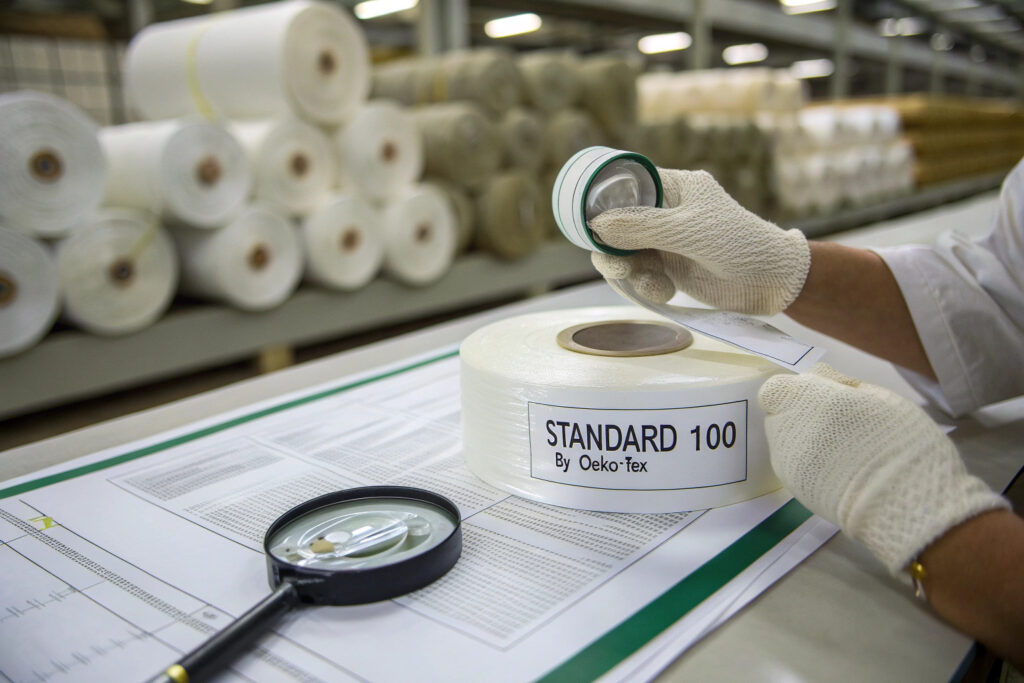
I almost lost a 30,000-unit order for a Scandinavian baby brand three years ago because I underestimated the lead time on certified binding tape. The buyer had specified OEKO-TEX Standard 100 certification for every textile component that touched the skin, including the internal seams of the infant sun hats. I confidently told her we could source the tape in three days and start production immediately. My procurement team called seven local trim suppliers. Five had the tape in stock but no valid certificate. The remaining two had the certificate but only in limited yardage, and the certificate was expiring in four weeks. We scrambled for eleven days, not three, and missed our original shipment window. The buyer was understanding but firm. She said, "Next time, just tell me the truth about the lead time up front."
Your cap factory is asking for an extra week because genuine OEKO-TEX Standard 100 certified binding tape is not a commodity item sitting on every trim supplier's shelf. It is a specialized, documented, and batch-controlled product. The extra week is not a sign of poor planning. It is a sign of an honest factory that refuses to substitute a non-certified tape just to meet an arbitrary deadline. When you see that delay request, the factory is protecting you from a compliance failure that could get your goods rejected at customs or pulled from retail shelves. The question is not "Why are they delaying?" but rather "What exactly takes a week to verify?"
The supply chain for certified trims operates on a different clock than standard commodity trims. A standard cotton binding tape is available in bulk from hundreds of wholesale markets in China with next-day delivery. An OEKO-TEX certified binding tape must come from a mill that has passed an annual audit, submitted every chemical input for testing, and received a valid certificate with a specific license number. When your factory contacts that certified mill, the mill must physically locate the specific dye lot and finishing batch that matches their current certificate. They then issue a transaction certificate that extends the certification coverage to your specific purchase. This paperwork chain cannot be faked and cannot be rushed beyond a certain physical limit.
What Makes OEKO-TEX 100 Binding Tape Different From Standard Cotton Tape?
The visible difference between certified and standard binding tape is often subtle. Both might be white cotton. Both might have the same width and thickness. The difference is not in appearance. It is in chemistry and documentation. Standard cotton binding tape is manufactured for function alone. It binds the raw edge of a seam. The factory that produces it uses whatever sizing agents, optical brighteners, dyes, and finishing softeners are cheapest and most available. Many of these chemicals are perfectly legal for general apparel but restricted under the OEKO-TEX standard, which is far stricter than most government regulations. Formaldehyde-based anti-wrinkle finishes, certain azo dyes that can break down into carcinogenic amines, and heavy metal residues from low-quality dye baths are all prohibited under the certification.
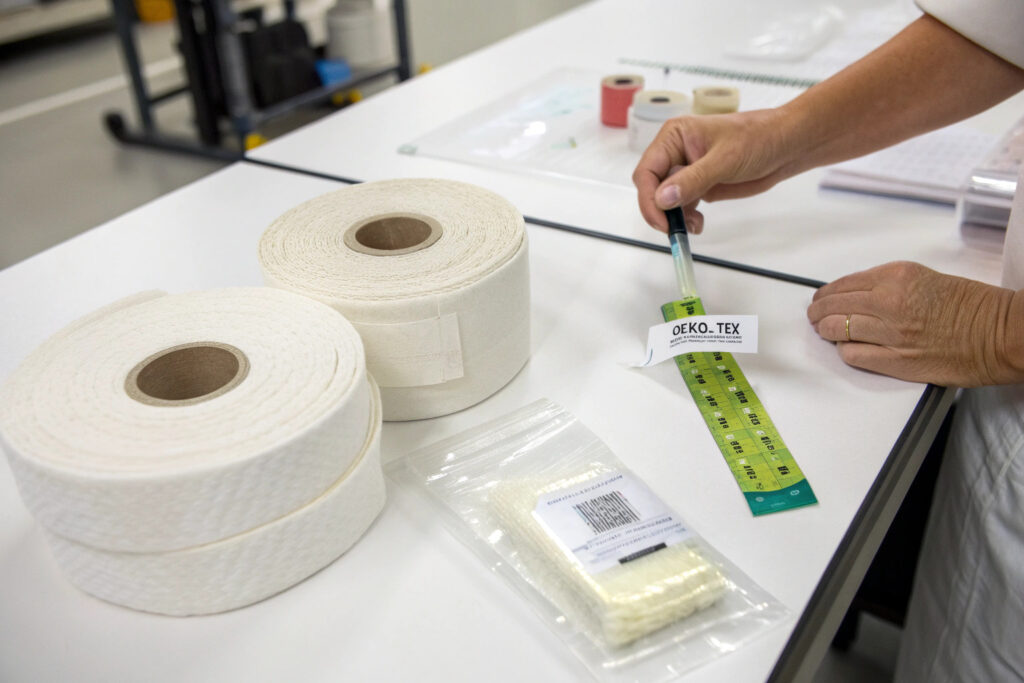
OEKO-TEX Standard 100 certified tape is manufactured in a controlled chemical environment. Every input chemical, the yarn lubricant, the dye, the fixing agent, the softening finish, is evaluated against the OEKO-TEX banned substance list before it enters the factory. The finished tape is then tested by an independent OEKO-TEX accredited laboratory. The lab checks for formaldehyde, heavy metals, pesticides, chlorinated phenols, phthalates, and dozens of other substance classes. The limit values are set based on the product class. A binding tape for a baby hat, product class I, has the strictest limits. A tape for an adult cap, product class II, has slightly more lenient but still rigorous limits. The certificate is issued to the specific manufacturer for a specific product description. It is not a generic "this company makes safe stuff" declaration.
From a manufacturing perspective, certified tape often handles differently on the sewing line. Because it lacks heavy chemical sizing, it is softer and more pliable. It feeds through a folder attachment on a sewing machine more smoothly, reducing skipped stitches. The color consistency from lot to lot is usually tighter because the dyeing process is more controlled. These are side benefits that our production supervisors appreciate, even if the buyer never sees them. The primary value remains the chemical safety guarantee that protects the end consumer and your brand's legal exposure.
How Is OEKO-TEX 100 Certification Testing Different From General Safety Tests?
General safety tests, such as a standard CPSIA total lead test or a REACH restricted substances screen, check for a defined list of specific chemicals. The test lab runs a sample through a machine, compares the results against a regulatory limit, and issues a pass or fail. This is a snapshot. It answers the question: "Does this specific sample contain X chemical above Y concentration?" It does not answer the question: "Was this product manufactured in a clean chemical environment from start to finish?"
OEKO-TEX certification is a systems audit, not just a product test. The certifying body audits the manufacturing facility. They review the chemical inventory. They check that the factory has a documented chemical management system, that they segregate certified and non-certified production lines, and that they maintain traceability from raw material lot to finished product batch. The product testing is then conducted within the context of this audited system. The lab takes samples from the production line, tests them against the full substance list, and verifies that the results fall within the limits for the appropriate product class. The certificate is issued to the factory and the specific product, and it is valid for one year, during which the factory must pass periodic compliance audits to ensure nothing has changed. This is fundamentally different from a one-off lab test. It is a process guarantee. When your cap factory asks for an extra week, they are navigating this audit-backed supply chain, not just waiting for a test result.
Why Do Some Certified Tape Suppliers Have Longer Lead Times Than Others?
The lead time variation among certified tape suppliers comes down to inventory strategy and certificate scope. A large trim supplier with a broad OEKO-TEX certificate covering hundreds of product SKUs is more likely to have your specific tape width, color, and fiber composition in stock at all times. They have certified inventory ready to ship. A smaller mill might have the certification but only produce to order. They do not hold finished goods inventory. When your order comes in, they must schedule a certified production run, dye the tape, finish it, send samples to the lab, and wait for the transaction certificate before they can ship. That process adds one to two weeks.
Another factor is the dye lot certification. If you need a specific color, say a particular shade of navy blue that matches your hat crown, the supplier cannot just pull white tape off the shelf and dye it. The dyeing process itself must be covered by the certification. The dyes used must be on the approved list. The dyed tape must be retested if the color formulation is new or if it has not been certified before. A white or natural unbleached tape is the fastest to source because it requires no dye certification step. A custom-dyed certified tape in a specific pantone color will always take longer. When your factory communicates this delay to you, they are navigating this matrix of inventory availability, dye lot status, and certificate validity.
Can My Factory Use Non-Certified Tape If It Tests Clean in a Lab Report?
This is the most tempting shortcut in the industry, and I have seen multiple importers take it and regret it later. The logic sounds reasonable on the surface. "If I send this non-certified tape to a lab and it passes the same chemical tests, isn't that equivalent to an OEKO-TEX certificate?" The answer, from a retailer compliance and legal standpoint, is no. It is not equivalent. A clean lab report on a single sample proves that the specific piece of tape you sent to the lab did not contain restricted substances above the detection limit on that specific day. It proves nothing about the next batch of tape from the same supplier. It proves nothing about the chemical management system in the supplier's factory. It is a point-in-time check, not a process certification.
Major retailers, particularly in Europe, do not accept a basic lab test as a substitute for the OEKO-TEX certificate. Their compliance manuals explicitly state that textile components must carry the certification if the product makes an OEKO-TEX claim or if it falls under their restricted substance program. If you ship goods with a non-certified tape and your customer's third-party inspector flags it, the inspector will issue a failure regardless of any private lab report you present. The standard is the certification, not a cherry-picked clean test. I had a German department store buyer who explicitly told me, "We don't buy your lab test. We buy the OEKO-TEX certificate because it audits the factory, not just the sample." That perspective is now common across mid-tier and premium retail.
There is also a practical risk. A non-certified tape from a supplier without chemical management discipline might test clean today and dirty tomorrow. The dye house they use might change a chemical input without notifying them. A new batch of yarn might arrive with a different spinning lubricant containing nonylphenol ethoxylates, which are restricted. Without the ongoing audit and batch-level traceability that OEKO-TEX requires, these changes go undetected until a lab finds them in your finished hat. That is a reactive crisis. The extra week your factory is asking for is the time needed to avoid this entire risk category by sourcing from a certified, audited supply chain.
What Is the Difference Between a Transaction Certificate and a Factory Certificate?
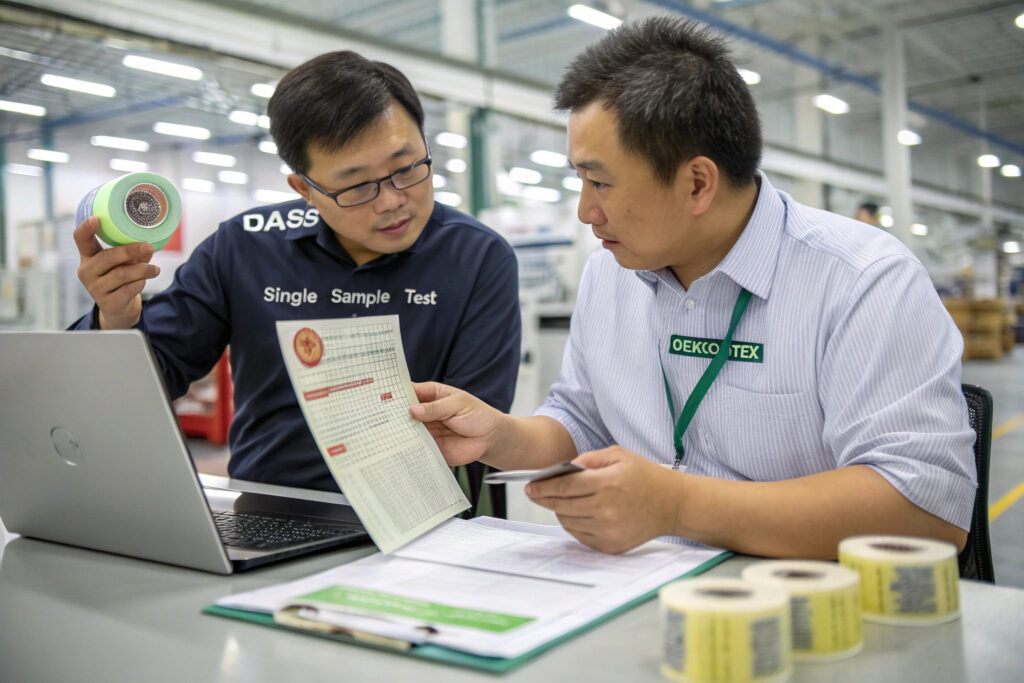
This distinction is critical and often misunderstood. A factory certificate, formally called a conformity certificate, is the base certification issued to the manufacturing facility. It states that this factory, located at this address, has passed the OEKO-TEX audit and is authorized to produce certified products. It lists the product descriptions covered, such as "woven cotton binding tape, white, 10mm to 30mm width." This certificate is valid for one year. Your cap factory will ask the tape supplier for a copy of this certificate as the first step in due diligence.
A transaction certificate is different. It is issued for a specific shipment to a specific buyer. When your cap factory purchases 5,000 meters of certified binding tape, the tape supplier issues a transaction certificate that links that specific lot of tape to the factory's valid conformity certificate. This document travels with the goods and ultimately goes to your brand's compliance file. It proves that the exact tape used in your hats came from a certified source. If your customer asks for evidence, you don't show them your supplier's generic factory certificate. You show them the transaction certificate with your PO number and your hat style reference on it. Getting this transaction certificate issued takes a few days. The certified supplier must verify their stock levels, confirm the lot numbers, and generate the document. This is part of the extra week your factory is accounting for.
Why Won't Retailers Accept a Clean Lab Test Instead of a Certification?
Retailers operate under their own compliance obligations. A buyer at a large chain has a restricted substance list that is contractually binding on their suppliers. That RSL often references OEKO-TEX standard limits. The retailer's internal policy states that suppliers must provide either an OEKO-TEX certificate or test reports from an approved lab conducted at a specified frequency. A one-off test that you commission independently does not meet their frequency or lab qualification requirements. It also does not provide the traceability and factory audit components that their compliance department requires for due diligence.
From the retailer's perspective, a supplier who offers a single test instead of a certification is asking the retailer to accept unknown supply chain risk. The retailer's brand reputation is on the line. If a consumer group or a regulatory agency finds a banned substance in a hat on their shelf, the retailer is held responsible. They cannot defend themselves by saying, "Our supplier showed us one test report from six months ago." They need the systematic assurance that a certification provides. This is why your factory's request for an extra week is actually a protective action for your retail relationship. They are not taking a shortcut that would expose you and your customer to compliance risk.
Where Do Factories Source OEKO-TEX 100 Certified Trims and Notions?
The certified trim supply chain is more concentrated than standard trims. In China, where our factory and most global cap production is based, there are a limited number of trim manufacturers who have invested in the full OEKO-TEX certification. They are typically larger, export-focused companies with dedicated compliance departments. They supply not just the garment industry but also the medical textile, baby product, and home textile sectors. These suppliers charge a premium for their certified products, but they also maintain rigorous inventory and documentation systems that smaller uncertified mills do not.
We source our OEKO-TEX certified binding tape from two primary suppliers, one in Zhejiang Province and one in Jiangsu Province. Both have held their certifications for over a decade. They provide us with a digital portal where we can download their current conformity certificate and request transaction certificates for each order. The process is systematized. We don't have to chase them for paperwork. The lead time for stock colors, white and black, is three to five business days. For custom-dyed colors that need a new dye lot certification, it extends to seven to ten business days. This is the lead time that your cap factory is communicating when they ask for an extra week. They are not delaying production arbitrarily. They are waiting for the certified supplier to complete the documentation and, if necessary, the dye lot testing for a custom color.
Beyond binding tape, the certified trim ecosystem includes woven labels, sewing thread, plastic snap closures, hook and loop fastener tape, zippers, and elastic bands. Any component that touches the skin in a finished hat could require certification, depending on the product class and the customer's compliance manual. A hat for a newborn requires every skin-contact component to be certified. A hat for an adult golfer might only need the sweatband and binding tape certified. Your factory's procurement team must evaluate the certification requirements component by component and build a sourcing timeline accordingly.

How Do I Verify That My Factory's Trim Supplier Has a Valid OEKO-TEX Certificate?
Verification is straightforward but essential. Do not rely on a PDF certificate emailed to you. Certificates can be forged, altered, or expired. The OEKO-TEX association maintains a public online certificate check tool. You enter the certificate number printed on the document, and the system tells you whether it is valid, what company it was issued to, what products it covers, and its expiry date. I use this tool every time we onboard a new certified trim supplier. It takes less than two minutes.
Direct your factory to provide you with the certificate number, not just an image of the certificate. Go to the OEKO-TEX label check website and enter the number. If the certificate is valid, the database will return the company name, address, product description, and validity dates. Compare this information against the supplier your factory is proposing to use. The company name must match. The product description must include the specific trim you are purchasing, such as "woven cotton tape" or "sewing thread." The certificate must be unexpired. If any of these checks fail, your factory needs to find a different supplier. If your factory is reluctant to share the certificate number, that is a red flag. Legitimate certified suppliers are proud of their certification and will freely share the number.
How Does the OEKO-TEX Product Class System Affect Trim Sourcing?
The product class system divides products into four categories based on skin contact intensity. Product class I is for babies and toddlers up to three years old. The chemical limits are the most strict. Product class II is for articles with direct and prolonged skin contact, which includes most adult hats, scarves, and t-shirts. Product class III is for articles with no or minimal skin contact, like jackets and outerwear. Product class IV is for decoration materials like upholstery and table linens.
The binding tape inside a hat crown touches the wearer's forehead and hair. For an adult cap, it falls under product class II. For an infant hat, it is product class I. The certification held by the trim supplier must cover the relevant product class for your application. A supplier certified for product class III cannot legally supply certified trim for a product class II hat. When your factory sources the tape, they must match the supplier's certification scope to your product's intended use and age demographic. This matching process can add time if the initial supplier selected turns out to have the wrong product class coverage and a new one must be found.
How Does an Extra Week of Lead Time Prevent a Larger Supply Chain Delay Later?
I understand the frustration when a factory says they need more time. Your marketing launch date is set. Your retail buyer has a shelf reset scheduled. A one-week delay in the sourcing phase feels like a failure. But in the total timeline of a custom hat program, that one week is a strategic buffer that prevents a cascading chain of much longer delays downstream. The binding tape is one of the first components sewn into the hat during assembly. If it arrives late, the entire production line stalls. If it arrives on time but without proper certification, the finished goods fail inspection after production, which is an exponentially more expensive and time-consuming problem.
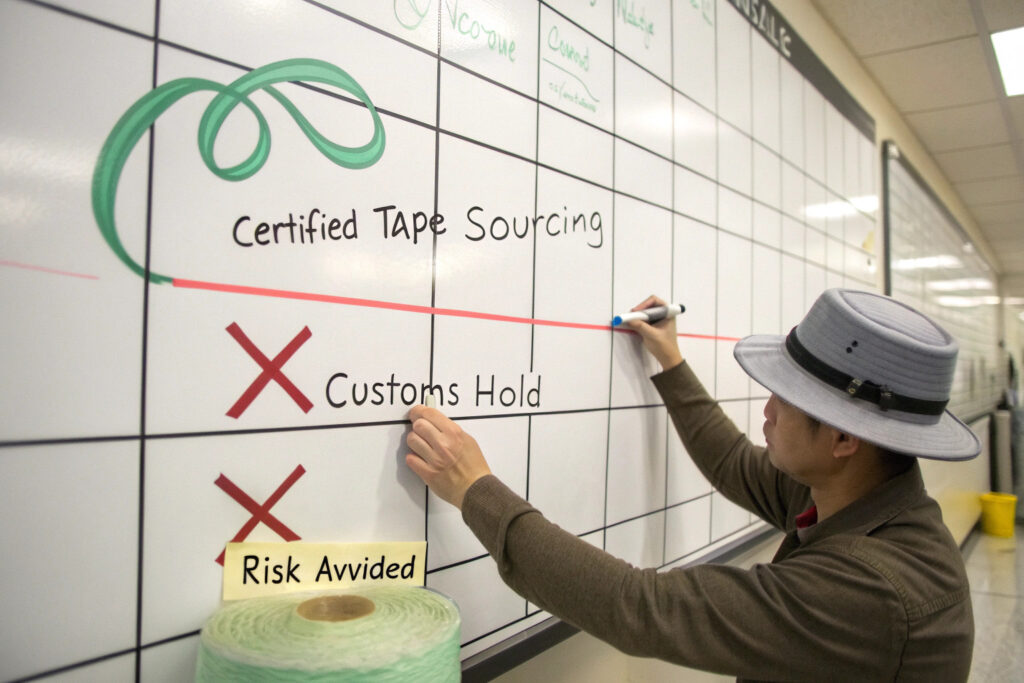
Think of the lead time as a series of gates. Gate one is raw material sourcing. Gate two is production. Gate three is final inspection. Gate four is shipping and customs clearance. A certification failure caught at gate one costs you a week of delay. You adjust the production schedule, inform your customer, and manage expectations. A certification failure caught at gate three costs you three to six weeks of delay. The goods are already made. They must be reworked or scrapped. New certified components must be sourced. The production line must be rescheduled. The shipping window is missed. The retail shelf is empty. The cost multiplies by a factor of ten or more.
That extra week your factory is asking for now is the cost of catching the problem at gate one, when it is still small, manageable, and non-disruptive to the final delivery. It allows the procurement team to verify the certificate, receive the transaction document, and ensure the physical tape matches the paperwork before it feeds into the cutting and sewing lines. It is a deliberate pause that prevents a panic. When a factory pushes back on a tight deadline for certified materials, they are demonstrating experience. They have likely been burned before by rushing a certified trim purchase, and they are protecting you from that same burn.
How Does a Delayed Trim Delivery Cascade Into a Missed Shipping Window?
A cap production line is a sequential assembly system. The fabric is cut first. Then the panels go to embroidery or printing. Then the binding tape is sewn into the seams. Then the sweatband, the closure, and the top button are attached. The binding tape enters the process early, often at the same stage as the crown seam joining. If the tape is not in the component supermarket when the sewing line starts, the entire line must either stop or switch to another order, breaking the schedule.
Rescheduling is not a simple "move it to tomorrow" exercise. A busy factory has a tightly packed production calendar with dozens of customer orders queued. If your order's production slot is missed because the tape was late, your order goes to the back of the queue. The next available slot might be two weeks out. Those two weeks shift the final inspection date, which shifts the container booking date. Ocean vessels sail on fixed schedules. Missing a cutoff by one day can mean waiting another week for the next vessel. A one-week delay in tape sourcing can easily become a four-week delay to the final delivery date at the destination port. The extra week your factory is asking for now is calculated to absorb the certification verification time without pushing your order out of its scheduled production window.
How Does Communicating a Sourcing Delay Early Protect the Buyer-Factory Relationship?
Honest communication about lead times is the bedrock of a strong buyer-factory relationship. When a factory immediately tells you they need an extra week for a certified component, they are treating you as a partner with a shared interest in a successful outcome. They are risking your immediate annoyance to earn your long-term trust. A factory that hides the delay, rushes the order with non-certified material, and hopes you won't notice, is treating you as a one-time transaction.
I have seen relationships end permanently over a concealed substitution. A factory used a standard tape instead of the specified certified tape because the certified version was out of stock. They shipped the goods. The buyer's lab caught the substitution. The entire container was refused. The buyer had to explain the failure to their retail customer, lost the program, and never purchased from that factory again. The cost of that deception was far greater than the cost of a one-week delay communicated honestly in week two of the project.
When your factory asks for the extra week, they are giving you the opportunity to manage your own downstream commitments. You can inform your retail buyer that the production timeline has shifted slightly due to certification verification. You can present this as a quality commitment, not a failure. "Our factory is taking an additional week to ensure all trim components have valid OEKO-TEX certification before production begins." That message reinforces your brand's commitment to safety. It is a much better conversation than explaining why your goods were rejected at the port.
Conclusion
The extra week your cap factory is requesting to source OEKO-TEX Standard 100 certified binding tape is not a delay. It is a quality assurance step that protects your product, your brand, and your retail relationships. Certified tape comes from an audited, chemically controlled supply chain. The factory must verify supplier certificates, secure transaction documents for your specific order, and potentially wait for dye lot testing if a custom color is involved. None of these steps can be safely skipped or compressed.
A standard cotton tape might look the same and might even pass a single lab test, but it lacks the ongoing process certification that major retailers and regulators now demand. Using a non-certified tape to save a week exposes you to inspection failures, container rejections, and costly rework that will consume far more time and money than the original week ever would. The factory that asks for that week is the factory that understands the real cost of compliance shortcuts.
At Global-Caps, we build this certification sourcing time into our project timelines from the start. When a new customer sends us a spec sheet with OEKO-TEX requirements, we immediately audit our trim inventory, check certificate validity dates, and flag any components that need fresh sourcing. We communicate these lead times transparently in our pre-production timeline so there are no surprises later. If a certificate is expiring in three weeks, we order a new certified batch early, not at the last minute. This proactive approach prevents the panic delays and keeps production schedules predictable.
If you are developing a hat program that requires OEKO-TEX certification for any components, or if you are currently frustrated by a supplier's lead time and want a second opinion on whether it is reasonable, our team can help you assess the real timelines and the real risks. Contact our Business Director Elaine. She has managed certified trim sourcing for brands across Europe and North America and can give you a clear, honest assessment of what your specific certification requirements mean for your production schedule. Reach her at elaine@fumaoclothing.com. We will help you build a timeline that works, with no hidden surprises and no compliance shortcuts.