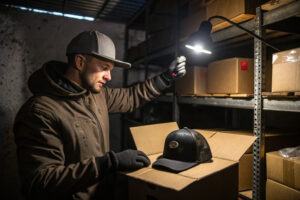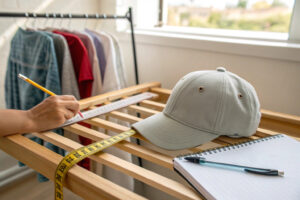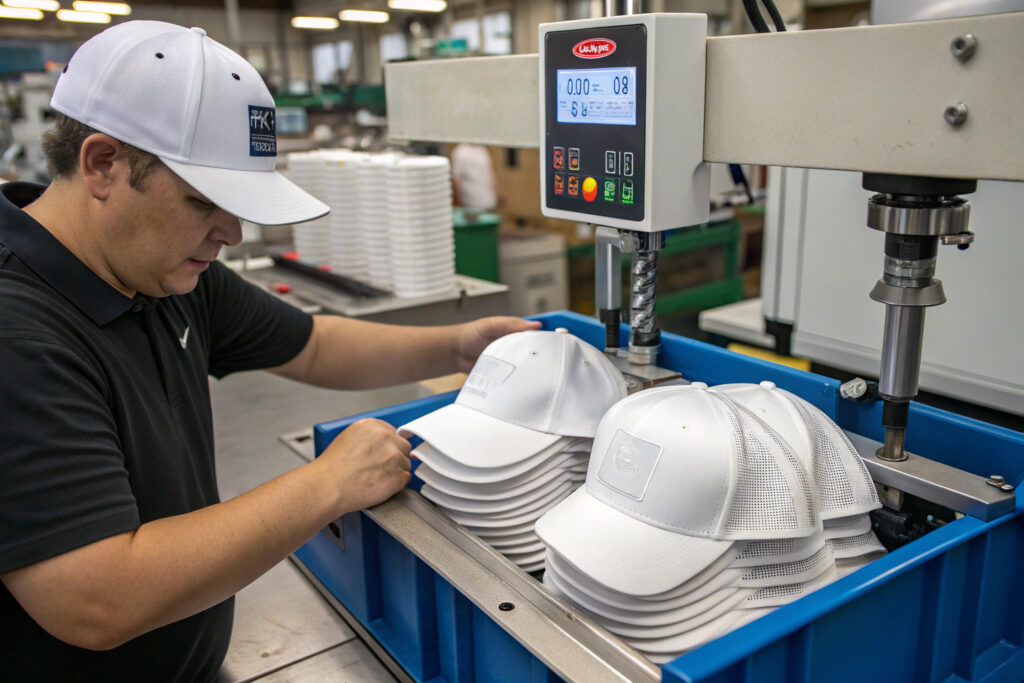
You order 20,000 caps. The pre-production sample arrives. The visor curve is perfect. The left side mirrors the right side. The angle is exactly what you specified. You approve the sample. The bulk shipment arrives. You open carton one. The visor is fine. Carton ten. The visor is flatter. Carton fifty. The visor is more curved. You pull twenty random caps. The visors look like they came from five different factories. The sample was handcrafted by the factory's best technician. The bulk was mass-produced with no process control. The sample was a promise. The bulk was a lottery.
High-volume factories maintain consistent visor shapes across 20,000 pieces by using precision-engineered aluminum molds in hydraulic heat presses with digital temperature and dwell time controls, checking every visor against a master curvature template, and performing in-line quality checks at predetermined intervals. The visor sandwich—face fabric, brim board, and bottom fabric—is die-cut from the same material batch. The brim board is a consistent-density polyethylene or polypropylene sheet that is conditioned in a controlled environment before forming. The operator is not an artisan who shapes each visor by hand. The operator is a machine pilot who loads the sandwich, activates the cycle, and unloads the formed visor. The machine ensures repeatability. The QC system catches drift before it produces 1,000 defective visors.
At Global-Caps, my visor forming station is a digitally controlled press. The mold temperature, the pressure, and the dwell time are locked parameters. The operator cannot alter them. The QC inspector checks the first visor, the middle visor, and the last visor of every batch against the master template. The process is designed for 20,000 identical pieces.
What Machinery Ensures Repeatable Visor Curvature in Mass Production?
You think visor forming is a manual process. A worker bends a plastic sheet over a heated pipe. They hold it until it cools. The shape depends on the worker's eye and the worker's patience. This is how visors were made in 1980. A high-volume factory in 2026 does not do this. If a factory forms visors by hand, the 20,000th visor will look nothing like the first. Human hands drift. Machines repeat.
The machinery that ensures repeatable visor curvature is a hydraulic hot press with a water-cooled aluminum mold set. The upper and lower molds are machined from solid aluminum blocks to the exact curvature radius. The press applies controlled heat, pressure, and time to bond the fabric layers and set the plastic brim board into the permanent curve. The cycle parameters are digitally controlled. The operator cannot change the temperature or dwell time without a supervisor override. The mold is water-cooled after the heat cycle to lock the curve before the visor is removed.
My visor press is a four-station rotary machine. It produces one visor every 15 seconds with identical parameters.
The mold design itself is an engineering discipline. A poorly machined mold produces an asymmetric visor.
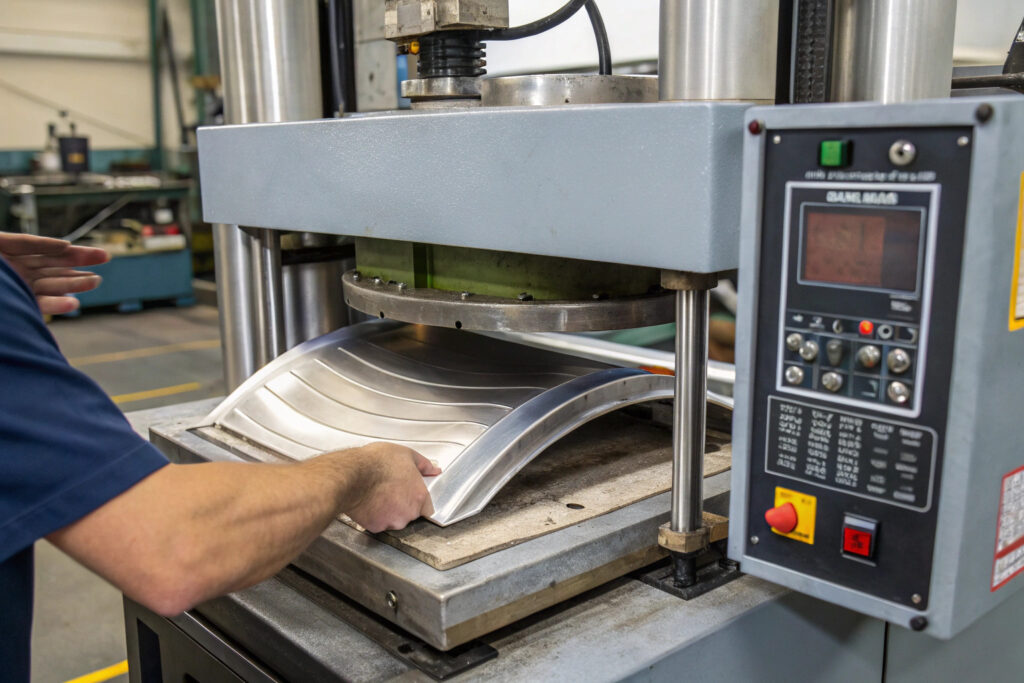
How Does a CNC-Machined Aluminum Mold Guarantee Symmetrical Curvature?
A CNC machining center cuts the aluminum mold cavity with a precision of 0.01 millimeters. The left half and the right half of the cavity are milled from the same digital CAD file. The symmetry is mathematically perfect. A hand-carved mold has slight asymmetries that the human eye cannot detect but that multiply across 20,000 visors.
The aluminum mold is polished to a mirror finish. This prevents the fabric from sticking and ensures even heat distribution. The upper and lower molds align with guide pins that eliminate lateral shifting during the press cycle.
My mold supplier uses 5-axis CNC machining. The mold symmetry is inspected with a coordinate measuring machine before it is put into production.
What Is the Role of Digital Temperature Controllers in Preventing Warping?
The brim board is a thermoplastic sheet. It softens at a specific glass transition temperature. If the temperature is too low, the curve does not set and the visor relaxes back to flat. If the temperature is too high, the plastic degrades and the visor becomes brittle.
A digital temperature controller uses a thermocouple embedded in the mold to maintain the temperature within a tolerance of plus or minus 2 degrees Celsius. The controller adjusts the heating elements in real time. The temperature is logged for every cycle.
My temperature controller is calibrated monthly. The calibration certificate is part of my ISO 9001 quality records.
What Are the Tolerances for Visor Curve Consistency in Bulk Production?
You reject visors because they "look wrong." The factory asks for a specification. You cannot provide a number. You are rejecting based on a feeling. The factory cannot fix a feeling. The specification must be a measurement with a tolerance. A visor curve is not a subjective aesthetic. It is a measurable radius with a defined acceptable range.
The standard tolerance for visor curve consistency in bulk cap production is a deflection measurement of plus or minus 1.5 millimeters from the target. The deflection is measured by placing the visor on a flat surface and measuring the vertical distance from the surface to the center of the visor edge. A typical pre-curved visor has a target deflection of 60 to 70 millimeters. The left side and right side deflection must be symmetrical within 1 millimeter. The curvature radius is checked with a go/no-go checking fixture.
My QC specification states the target deflection and the tolerance. Every inspector uses the same checking fixture.
The checking fixture is the single source of truth for the visor shape.
How Is a Checking Fixture Used to Measure Visor Curvature Objectively?
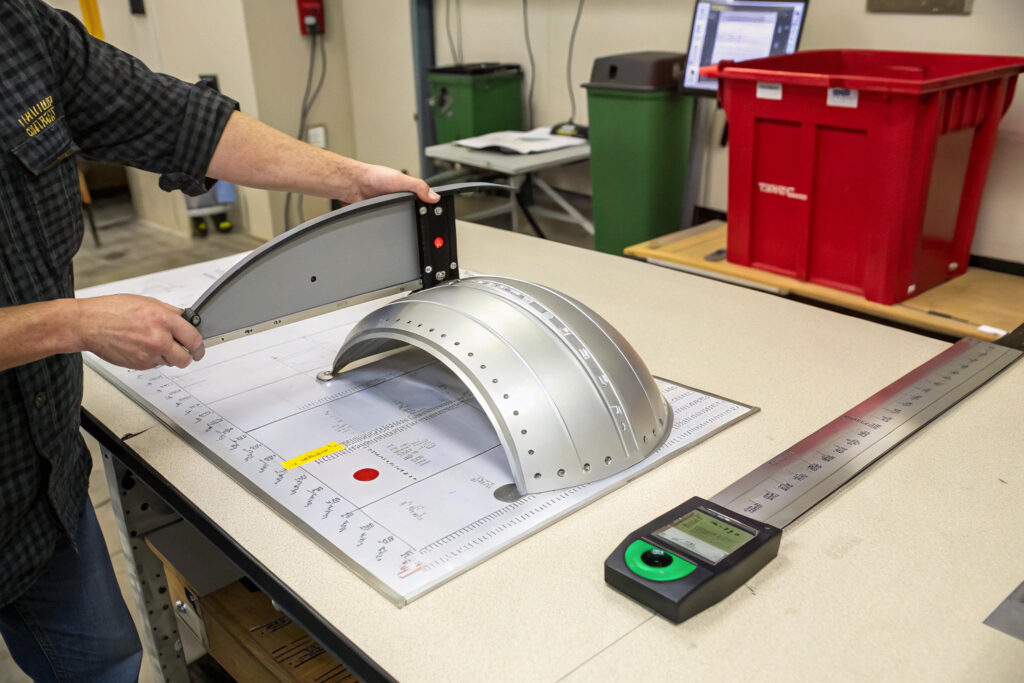
A checking fixture is a rigid template, typically machined from aluminum or cast from resin, that replicates the exact target curvature of the visor. The fixture has a curved channel or a curved surface that the visor must fit into. The inspector places the visor onto the fixture. If the visor matches the fixture curve within the visual gap tolerance, it passes. If there is a visible gap or the visor does not seat properly, it fails.
The fixture eliminates operator subjectivity. The operator is not judging the curve. The operator is checking the fit against a physical standard.
My checking fixtures are stored in a locked cabinet. They are calibrated against the master mold every six months.
What Is the Acceptable Deflection Asymmetry Between Left and Right Visor Sides?
The human eye is highly sensitive to asymmetry. A visor that curves more on the left side than the right side looks crooked when worn. The acceptable asymmetry between the left and right side deflection is 1 millimeter or less.
The inspector measures the deflection at the center point of the left visor edge and the center point of the right visor edge. The difference between the two measurements must not exceed 1 millimeter.
My asymmetry tolerance is checked on the first visor of every batch and every 200th visor thereafter.
How Does Inline QC Catch Visor Defects Before They Multiply?
You inspect the visors after all 20,000 caps are sewn and packed. The inspector finds 300 caps with asymmetric visors. The caps are in sealed cartons. The cartons must be opened. The caps must be found. The visors must be stripped and replaced. The cost is enormous. The shipment is delayed. The problem was not a defect. It was a detection timing failure.
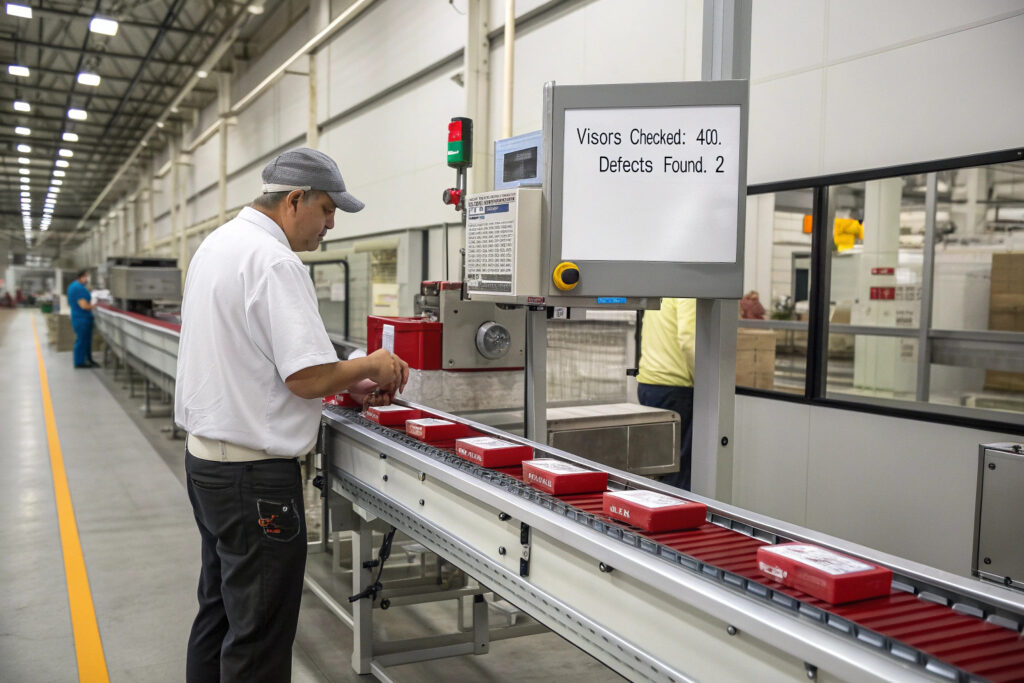
Inline QC catches visor defects before they multiply by placing inspection stations directly on the production line, not at the end of the line. The inspector checks the first visor off the press and then pulls a sample at a defined frequency—typically every 50 to 100 pieces. If a defect is found, the press is stopped. The mold is checked. The temperature is verified. The cause is corrected. The defective visors from the last inspection interval are quarantined and reworked. The remaining 19,700 visors are produced correctly.
My inline QC protocol for visors is a first-off check, a frequency check every 50 pieces, and a last-off check.
The first-off check is the most critical quality gate in the visor production process.
What Is a First-Off Inspection and Why Is It Critical Before a 20,000-Unit Run?
A first-off inspection is a full dimensional and visual check of the very first visor produced at the start of the production run. The inspector checks the curvature against the fixture, the asymmetry between left and right, the fabric adhesion, the stitch line alignment, and the overall appearance.
If the first visor passes, the production run begins. If the first visor fails, the press parameters are adjusted until the first visor passes. The batch of defective first-offs is discarded. No bulk production starts until the first visor is perfect.
My first-off sample is signed by the QC supervisor and hung on the production board as the visual standard for the run.
How Often Should the Visor Curvature Be Measured During a 20,000-Unit Shift?
The curvature should be measured on the first piece, then every 50 to 100 pieces throughout the run, and on the last piece. For a 20,000-unit run, this equates to approximately 200 to 400 curvature checks. The frequency is determined by the production speed and the historical process stability.
If the process is stable and the defect rate is below 0.5 percent, the frequency can be reduced to every 200 pieces. If a defect is found, the frequency is increased to every 25 pieces until the cause is resolved.
My sampling frequency is documented in the production control plan. The inspector logs every measurement.
What Brim Board Materials Maintain Shape After Repeated Washing and Wearing?
You use the cheapest brim board. The visor curves perfectly off the press. The caps ship. The customer wears the cap for a summer. They wash it. The visor goes wavy. The curve relaxes. The customer complains. The brim board was not engineered for durability. It was engineered for a low unit price. The cost of the cheap board is a customer return and a one-star review.
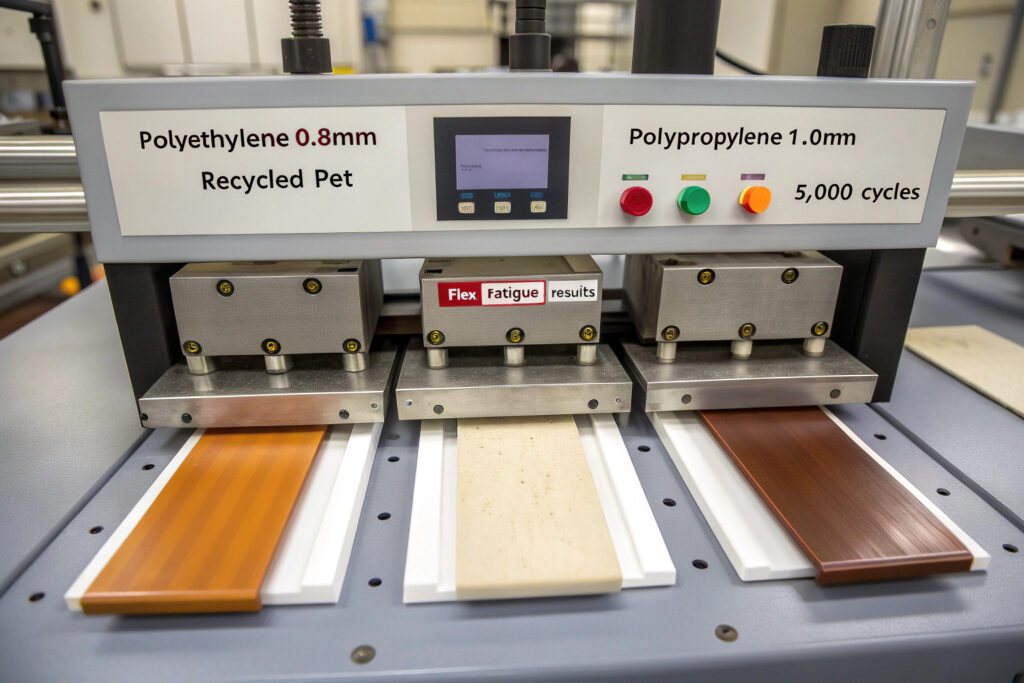
The brim board materials that maintain visor shape after repeated washing and wearing are high-density polyethylene (HDPE) with a thickness of 0.6 to 0.8 millimeters, and polypropylene (PP) with a thickness of 0.8 to 1.0 millimeters. HDPE provides the best balance of flexibility, shape retention, and wash durability. It does not absorb water. It does not crack after repeated flexing. It maintains the thermoformed curve after 25 wash cycles. Polypropylene is slightly stiffer but more prone to stress whitening at the flex points. A recycled PET brim board is available for sustainable product lines but may have slightly lower fatigue resistance.
I use HDPE brim board for my premium caps. The material is tested for flex fatigue and wash durability before it is approved.
The wash durability test simulates the customer's home laundering cycle.
How Does High-Density Polyethylene Compare to Pressed Cardboard for Shape Retention?
Pressed cardboard is a traditional brim board material. It is made of compressed paper fibers with a starch binder. It is cheap and takes a curve well when dry. When wet, the starch dissolves. The cardboard swells. The curve relaxes. The visor becomes wavy. After one wash, the visor is ruined.
High-density polyethylene is a synthetic polymer. It is completely waterproof. It does not absorb water. It does not swell. The thermoformed curve is permanent. The visor maintains its shape through multiple wash cycles.
I eliminated pressed cardboard from my cap production. All my brim boards are HDPE or polypropylene.
Can Recycled PET Brim Boards Match Virgin Plastic in 10,000-Cycle Flex Tests?
Recycled PET brim board is made from post-consumer plastic bottles. The polymer chains are shorter than virgin PET due to the thermal history of the recycling process. This can result in slightly lower flex fatigue resistance.
In a 10,000-cycle flex test, a recycled PET board may show minor surface cracking at 7,000 to 8,000 cycles, while a virgin HDPE board shows no cracking at 10,000 cycles. The difference is small but measurable.
I offer recycled PET brim board as a sustainable option with a disclosed performance trade-off. For premium durability applications, I recommend virgin HDPE.
Conclusion
High-volume factories maintain consistent visor shapes across 20,000 pieces by replacing artisan handwork with precision machinery and statistical process control. The hydraulic hot press with a CNC-machined aluminum mold ensures every visor is formed under identical temperature, pressure, and time parameters. The digital controller maintains the mold temperature within plus or minus 2 degrees Celsius. The checking fixture provides an objective, repeatable curvature measurement with a tolerance of plus or minus 1.5 millimeters deflection.
The inline QC system catches defects before they multiply. The first-off inspection validates the setup before the run begins. The frequency inspection every 50 to 100 pieces monitors the process stability. The last-off inspection confirms the run ended in control. The brim board material—high-density polyethylene or polypropylene—maintains the curve through repeated washing and wearing. Pressed cardboard does not.
Consistency is not an accident. It is the output of a designed process with defined tolerances, calibrated equipment, and disciplined inspection. A factory that cannot describe their visor forming process in this level of detail is a factory that relies on operator skill. Operator skill drifts. A machine process repeats.
At Global-Caps, my visor forming process is fully specified, fully controlled, and fully measured. The mold temperature is locked. The checking fixture is calibrated. The QC data is logged. The result is 20,000 visors that are identical to the approved sample.
If you need 20,000 caps with visors that are consistent from the first piece to the last, contact my Business Director Elaine. She can provide our visor forming process specification and a QC data sheet from a recent bulk run. Email Elaine at elaine@fumaoclothing.com. Let's make visors that match your sample, every single time.