You request a custom sample. The factory quotes $150. You think it's steep. You pay it. The sample arrives. It is perfect. You place the bulk order. Another factory quotes $45 for the same sample. You switch. The $45 sample arrives. The logo is crooked. The fabric is wrong. The sweatband is itchy. You wasted $45 and two weeks. The cheap sample cost you the bulk order.
A realistic custom hat sample fee with DDP delivery to the US or Europe ranges from $80 to $200 for a standard structured cap with embroidery. The fee breaks down into three parts: the physical sample cost, the courier shipping cost, and the digitizing or tooling setup charge. A simple unstructured dad hat with a stock buckle and a flat embroidery logo sits at the lower end. A complex 5-panel cap with a custom metal buckle, 3D puff embroidery, and a special wash sits at the higher end. The sample fee is not a purchase. It is a prototype development service.
At Global-Caps, I do not profit on the sample fee. I charge exactly the cost to make the sample and ship it. The sample is the handshake. It is the moment the client sees if we are the real deal. The fee just covers the work.
What Are the Components of a Sample Fee Beyond Just the Hat Itself?
You see a hat in a bag. You think the price is just the fabric and the stitches. The factory sees a pattern maker who stopped a bulk job to trace your logo. They see an embroiderer who spent an hour threading a machine for a single piece. They see a FedEx bill for a box that weighs half a kilo but is charged at 3 kilos volumetric weight. The hat is the tip of the iceberg.
The components of a sample fee beyond the physical hat are the digitizing or setup charge, the fabric sourcing and cutting time, and the express courier cost. The digitizing charge is the conversion of your logo into a stitch file that the embroidery machine reads. This is a one-time cost, usually between $30 and $60. The cutting table must stop and cut a single piece of fabric. The operator must change the thread color for one hat. These labor minutes are expensive.
I list all these components separately on my sample invoice. I want the buyer to see the work. Transparency turns a fee into an investment.
You need to separate the charges that happen once from the charges that repeat. The one-time engineering costs are the key to understanding why sample one is expensive but sample two is cheap.
What Is a Non-Recurring Engineering Charge for a Custom Visor Mold?
A Non-Recurring Engineering charge is the cost to create the tooling that shapes your custom hat component. For a visor, this is a metal mold. The mold presses the fabric and the plastic brim board together under heat and pressure to create the curved shape.
A standard visor mold is a generic curve that the factory already owns. There is no NRE charge for using the standard mold. A custom visor mold with a unique curve, a wider brim, or an embossed logo requires a new aluminum mold to be machined. The mold making process involves CNC machining a block of aluminum, polishing the surface, and testing the heat distribution. This takes 5 to 7 days and costs between $300 and $500.
I charge the NRE separately because it is a one-time asset. The client owns the mold. I store it in my tooling library for future orders. If the client leaves, I ship the mold to them. The sample fee only includes the mold cost if the sample order is the first use of the mold. For subsequent sample requests with the same mold, the fee drops significantly.
Why Does Embroidery Digitizing Cost More for a Single Sample Than Bulk?
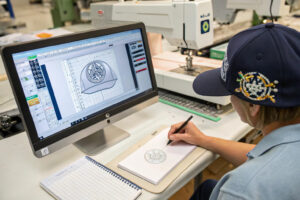
The digitizing technician sits at a computer. They trace your logo with stitch lines. They define the underlay, the pull compensation, and the tie-off points. This takes 30 to 90 minutes. The technician's time is a fixed cost. Whether the final file sews 1 hat or 10,000 hats, the digitizing labor is identical.
On a bulk order of 1,000 hats, a $50 digitizing fee is $0.05 per hat. You don't notice it. On a single sample, that same $50 is 100% of the embroidery cost. The unit economics are brutal for small quantities.
I use a Wilcom digitizing station in-house. The digitizer maps the stitch angles so the logo does not pucker on the curved front panel. This is specialized skill. You are not paying for the digital file. You are paying for the technician's knowledge of hat physics. A flat embroidery file for a jacket will fail on a cap. The cap file must have center-out radial stitching to hold the fabric flat. This is a critical distinction. The sample digitizing fee is insurance against a crooked logo.
How Do DDP Express Costs Inflate the Sample Shipping Line Item?
The factory quotes $30 for shipping. You think "Great, that's reasonable." Then you get the DDP sample quote and the shipping line is $65. You think the factory is gouging you on freight. They are not. DDP express shipping for a single hat is a premium service. The courier is an airplane. The customs broker is a human. The handoff to your door is tracked by GPS. You are not paying for a stamp. You are paying for a hand-delivered prototype with zero hassle.
DDP Express inflates the sample shipping cost because it bundles the air freight, the fuel surcharge, the remote area surcharge, and the destination duties and taxes into one door-to-door price. A single hat in a box is light but bulky. The volumetric weight calculation often doubles the chargeable weight. The courier also charges a flat disbursement fee for advancing the customs duties on your behalf.
I always quote DDP sample shipping transparently. I show the courier breakdown. I want the buyer to know where the money goes.
The physics of a small box and the bureaucracy of customs clearance both add fixed costs. You cannot negotiate these away. You can only understand them.
What Is Volumetric Weight and How Does It Apply to a Single Hat Box?
A single hat weighs 100 grams. The box weighs 200 grams. The total actual weight is 300 grams. But the box is large to protect the hat's shape. It measures 30cm x 30cm x 20cm. The volumetric formula for air express is (Length x Width x Height in cm) / 5000. This equals (30x30x20)/5000 = 3.6 kilograms of volumetric weight.
The courier charges for 3.6 kilograms, not 0.3 kilograms. The price per kilogram to the US is roughly $7 to $10 for DDP express. The shipping cost becomes $25 to $36 just for the air freight, before the fuel surcharge and the duties.
I use a smaller box designed specifically for single-hat samples. It is 25cm x 20cm x 15cm. The volumetric weight drops to (25x20x15)/5000 = 1.5 kilograms. The shipping cost halves. I also use a courier comparison tool to find the most cost-effective DDP route. DHL is fast but expensive for volumetric light packages. FedEx is sometimes cheaper. I check both rates on the day of shipment and pick the best one.
What DDP Customs Charges Apply to a Sample Valued Under $800?
The US de minimis threshold is $800. Shipments with a declared value under $800 enter the US duty-free and tax-free. This is Section 321 entry. For a sample hat valued at $100, there are zero duties and zero taxes. The DDP shipping quote should reflect a zero-duty charge.
The European Union does not have a de minimis threshold for customs duty in the same way. As of July 2021, all commercial goods imported into the EU are subject to VAT, regardless of value. A sample hat valued at €50 will incur import VAT at the destination country's rate, typically 20%. The courier pays this VAT upfront and then charges the shipper.
I handle this differently for US and EU clients. For US samples, the DDP cost is just the freight. For EU samples, I add the estimated VAT to the DDP quote. I also use the courier's DDP service which has a flat disbursement fee of around €15 for advancing the VAT. The total customs charge on a €50 sample is about €10 VAT plus €15 fee, adding €25 to the shipping. The paperwork is the same. The tax is just a market reality.
What Is a Fair Price for a Custom Hat Prototype vs a Stock Sample?
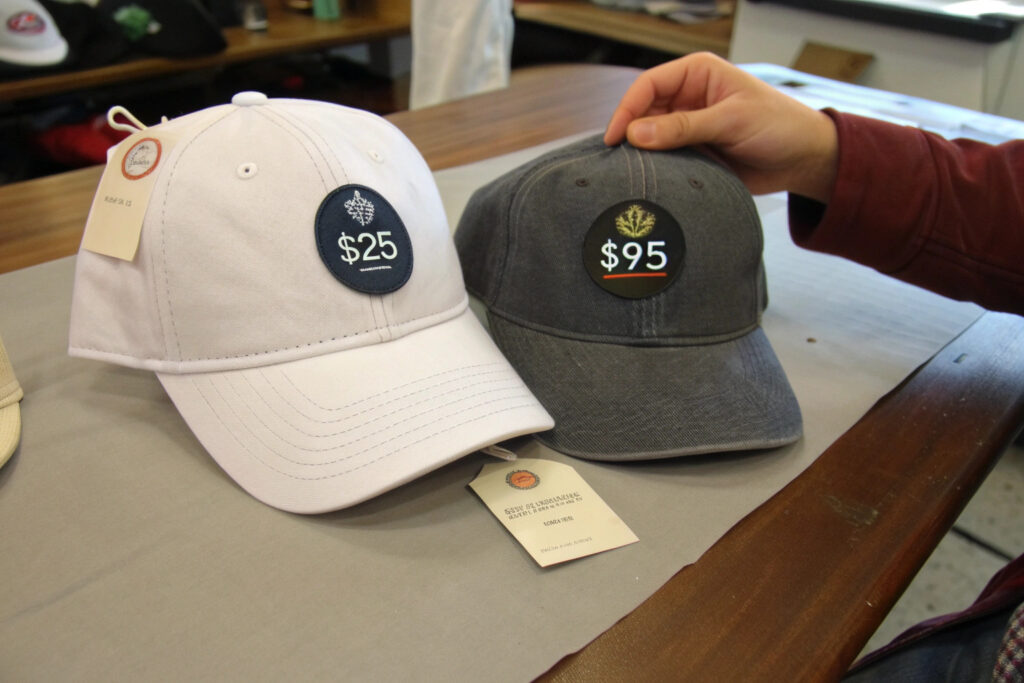
A stock sample is an off-the-shelf cap. It has a generic label. It has no embroidery. The factory pulls it from the shelf and drops it in a box. A custom prototype is a one-off creation. It uses your fabric, your logo, your label, your wash, and your specific structure. Comparing the price of a stock sample to a custom prototype is like comparing a photocopy to an original painting.
A fair price for a stock sample is $15 to $35 shipped via a slow postal service. A fair price for a fully custom hat prototype with DDP express delivery is $80 to $200, depending on the complexity. The stock sample proves the factory's basic quality. The custom prototype proves the factory can execute your exact design.
I send stock samples for free to qualified buyers. I charge for custom prototypes. The stock sample is a brochure. The custom prototype is a commissioned sculpture.
You need to understand the specific labor steps that make a prototype expensive. The cutting table and the sewing line are not set up for one piece.
How Many Labor Hours Does a Single Custom Prototype Require?
A bulk production hat flows through a line. Each operator does one task. They build 500 hats per day. A prototype is built by one master sample maker. They do every task. They cut the fabric by hand. They sew the crown. They attach the visor. They embroider the logo. They finish the sweatband.
A simple 6-panel unstructured cap takes a sample maker about 45 minutes to sew. A complex 5-panel structured cap with a curved visor, a custom strap, and a 3D puff logo takes about 2 hours. The sample maker's hourly rate is higher than a production operator's rate. They are the factory's most skilled sewer.
I schedule my sample maker during the slow afternoon window. The client's prototype does not interrupt bulk production. It fills a gap. This keeps the labor cost at about $25 per hour. The two-hour complex cap has a $50 labor cost built into the sample fee. This is fair. You are hiring a master craftsperson for a custom commission.
Does the Sample Fee Get Deducted From a Future Bulk Order Deposit?
This is the most common question I hear. The answer depends on the factory's policy and the order size. Most factories do not deduct the sample fee from the bulk order deposit. The sample is a separate service. However, many factories will credit the digitizing fee and the tooling fee against the bulk order if the order exceeds a certain volume.
I credit the non-recurring engineering costs—the digitizing fee and any custom mold fee—back to the client if their bulk order exceeds 500 units per style. The physical sample cost and the shipping cost are sunk. I paid the sample maker. I paid DHL. Those costs are not recoverable.
This is an industry-standard practice. You should clarify this before you pay the sample fee. Ask the supplier, "Which components of the sample fee are credited against the bulk order, and what is the minimum order quantity for the credit?" A professional supplier answers clearly. A trader stumbles.
How to Avoid Hidden Fees When Ordering DDP Hat Samples Online?
You find a website. "Custom Hat Samples, $29, Free Shipping Worldwide." You upload your logo. You enter your card details. You click submit. The confirmation email arrives. The total is $87. The $29 was just the base hat. They added a $35 digitizing fee, a $15 "small order surcharge," and an $8 "handling fee." You feel robbed. The fees were hidden in the checkout flow, greyed out in 8-point font.
You avoid hidden fees by requesting a formal Proforma Invoice before paying anything. The invoice must list every single line item: sample hat, digitizing, special material surcharge, courier cost, and any remote area delivery fee. You also ask for a screenshot of the courier booking showing the tracking number and the declared value. You never accept a verbal quote. You demand a written, itemized invoice.
I send a detailed Proforma Invoice for every sample order. It has five or six line items. Nothing is hidden. The client knows exactly what they are paying for.
You need to watch for specific surcharges that only appear at the last step. The courier's "remote area" database is the biggest trap. A factory in a major city might not know your address is classified as remote.

What Is a Remote Area Surcharge and How Can It Surprise You?
Courier companies divide the world into urban, suburban, and remote locations. A remote area is a delivery address far from the courier's main depot. Delivering to a remote area requires a special vehicle dispatch. The courier charges a Remote Area Surcharge, typically $25 to $40, for every package delivered to these zones.
The factory books the shipment. The courier system accepts the address without complaint. Then, the day after the package leaves, the courier sends an invoice adjustment. The remote area surcharge is added. The factory has two choices: absorb the cost or email you for more money.
I check the remote area list for every new client address before quoting the DDP price. I enter the postal code into the DHL online tool. If the address is remote, I inform the client and add the surcharge to the Proforma Invoice upfront. No surprises. You should ask your supplier, "Did you check if my address has a remote area surcharge?" If they look confused, they haven't. The surprise is coming.
Why Should You Request a Proforma Invoice Before Paying a Sample Fee?
A Proforma Invoice is a draft invoice. It is not a payment demand. It is a price confirmation. It lists all the costs, the delivery terms, the payment method, and the estimated ship date. It is the contract before the contract.
Requesting a Proforma Invoice forces the supplier to calculate the actual costs. It prevents them from pulling a number out of the air and adding more later. The PI also protects you in case of a dispute. If the supplier demands more money after you paid, you have the PI as evidence of the agreed price.
I issue a Proforma Invoice within 2 hours of a sample request. It states the sample fee, the DDP shipping cost, the digitizing fee, and the payment details. I also include a note: "This invoice covers all costs to deliver the sample to the specified address. No additional charges will be requested." That sentence is my word. It is the buyer's peace of mind. You should not pay a sample fee without a sentence like that.
Conclusion
A custom hat sample fee with DDP delivery is a bundle of engineering, craftsmanship, and logistics. A realistic budget is $80 to $200. The price is driven by the digitizing fee, the sample maker's labor, the volumetric weight of the box, and the destination country's tax rules. A stock sample is cheaper. A custom prototype is an investment.
You navigate this by understanding the components. A Non-Recurring Engineering charge for a custom mold is a one-time asset you own. The digitizing fee is a skilled technician's time. The DDP shipping cost is inflated by volumetric weight and remote area surcharges. The customs charges depend on whether your country has a de minimis threshold.
You avoid hidden fees by demanding a written Proforma Invoice. Check the line items. Ask about the remote area surcharge. Confirm which fees are credited against a future bulk order. A transparent supplier lists everything. A trader hides it.
At Global-Caps, we treat the sample process as the foundation of a long-term partnership. We do not profit on samples. We charge exactly what it costs us to make your vision real and put it in your hands. The sample is your test drive of our factory. If the sample is perfect, the bulk order will be perfect.
If you want a custom hat sample delivered to your door with zero hidden costs and zero surprise invoices, let's talk. Contact our Business Director Elaine. She will send you a detailed Proforma Invoice within hours and walk you through every line item. Email Elaine at elaine@fumaoclothing.com. Let's build your prototype.