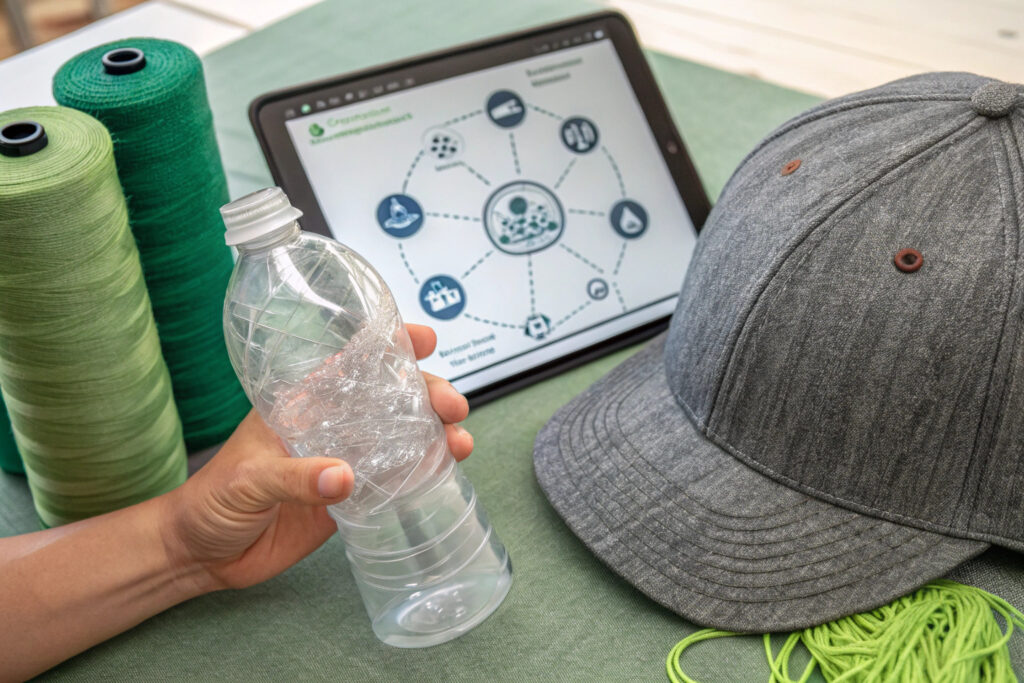
You order "recycled polyester" trucker hats. The sales rep sends a photo of a green leaf logo. The hat arrives. It looks great. But a customer asks, "Is it made from ocean plastic or just factory waste?" You don't know. You ask the supplier. They go silent. Your eco-claim is suddenly a liability. I have watched fashion brands get publicly shamed for this exact gap. The term "recycled" without traceability is just a marketing word.
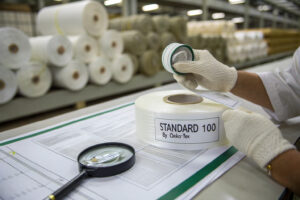
You trace the origin of recycled polyester in your custom trucker hats by demanding a third-party transaction certificate that follows the mass balance from the bottle collection point to the yarn spinning mill. You need the GRS (Global Recycled Standard) certificate. This document proves the input material is genuine post-consumer waste. You also look for a physical tracer technology. Some mills embed a microscopic fingerprint into the fiber. At Global-Caps, I require my yarn suppliers to provide a certified batch number linked to a specific recycling facility.
Greenwashing is easy. True traceability is hard work. I want to equip you with the bullshit detector. This guide will walk you through the certificates, the physical tests, and the digital tools that separate a real recycled trucker hat from a pretender.
What Does a GRS Certification Prove About My Trucker Hat Mesh?
You see "GRS" on a quote. You think it covers the whole hat. You relax. But the certification only covers the mesh back. The foam front, the plastic snap, the sweatband are all virgin materials. You advertise "100% recycled hat." Your claim is false. This mislabeling exposes you to consumer fraud lawsuits.
A Global Recycled Standard certificate proves the recycled input material in a specific component has been audited by an independent body. It verifies the chain of custody. It does not prove the whole hat is recycled unless every component is listed on the scope certificate. The standard also covers social and environmental processing requirements. This means the recycling factory cannot use toxic solvents and must treat workers fairly.
You must read the specific product scope on the certificate. If it says "100% recycled polyester knit mesh," then only the mesh is certified. That is enough for an honest "Recycled Mesh Back" claim. It is not enough for a "Recycled Trucker Hat" claim.
The certificate has two distinct parts that serve different functions in your legal defense. You need to understand both to avoid the trap of partial certification.
How Does the GRS Scope Certificate Differ From the Transaction Certificate?
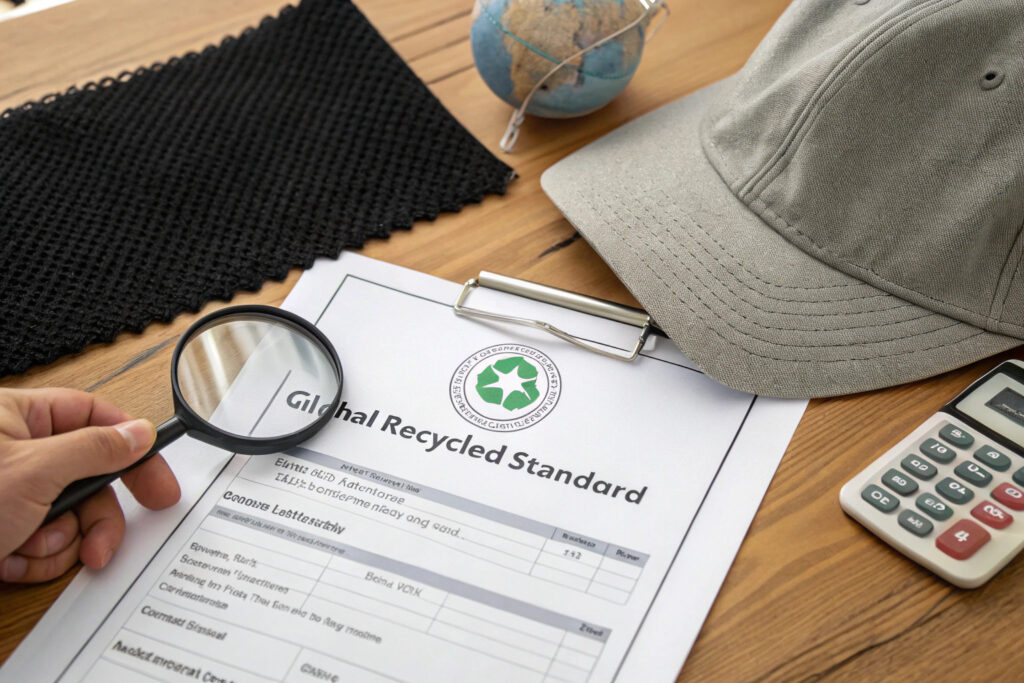
A Scope Certificate is a license to handle recycled goods. A Transaction Certificate is the receipt for your specific batch. Factories often flash the Scope Certificate and hope you stop asking questions. That is a mistake.
The Scope Certificate lists the company address and the certified activities. It will say something like "Lamination of foam backed mesh using recycled fibers." It is valid for one year. You check it to confirm the factory is legally allowed to sell you recycled material. But it does not link to your specific 1,000 trucker hats.
The Transaction Certificate is the specific proof. It contains your invoice number. It states the exact weight of recycled polyester yarn used. It traces the flow from the recycler to the weaver to the hat factory. The mass balance must add up. If a factory buys 500 kilograms of certified recycled chips, they can only sell you roughly 480 kilograms of mesh. Material is lost in the spinning and weaving process. If they sell you 2,000 kilograms of mesh but only bought 500 kilograms of input, the certificate is fraudulent.
You should also check the certification body. Look for Control Union or SGS. These are reputable auditors. Ask for the PDF of the TC. Look at the "Input Material" section. It should say "Post-Consumer PET Bottles" or "Pre-Consumer Industrial Waste." Post-consumer means actual bottles from the street. Pre-consumer means factory scrap. Both are valid, but post-consumer is a better story for your brand marketing.
Can the GRS Label Be Applied to the Entire Trucker Hat or Just Components?
The GRS logo usage is strict. You cannot slap a GRS logo on the whole hat if only the mesh is recycled. That is logo misuse. Textile Exchange audits brands for this.
If you want to market the product as "GRS Certified," the entire product must contain at least 50% recycled content. The label must specify the percentage: "This hat contains 65% recycled polyester." This is the product claim standard. If only the mesh back is recycled, you label the component. You can say "Mesh: 100% recycled polyester." You cannot put the full logo on the inside seam label.
I advise my clients to use a component-specific labeling strategy. It is honest. It protects you. We print a small insert card. It says "The mesh back on this hat was made from approximately 3 recycled plastic bottles." This is specific. It is traceable. It sells the story without a legal risk. The GRS also has a logo use guide. The logo must always reference the certifying body license number. You submit your labels to your certifier for pre-approval. Don't print 10,000 labels without approval. One wrong logo and you face a recall order.
How Do You Ensure the Plastic Buckram Is Ethically Sourced?
Everyone asks about the mesh. Nobody asks about the buckram. The buckram is the hidden skeleton inside the front panel. It gives the trucker hat that tall, flat structure. But that stiff plastic backing is often virgin petroleum. It comes from a factory with zero environmental records. You ignore it. You lose the moral right to call your supply chain green.
Ensuring the plastic buckram is ethically sourced means treating it like the polyester mesh. You ask for the resin source. You look for recycled PET buckram or bio-based alternatives. You audit the chemical binders used to stiffen the sheet. Many cheap buckram factories use phenol-based glue. That is a respiratory hazard for the sewing machine operator. At our factory, we switched to a GRS-certified recycled buckram. It costs 12% more, but the front panel is now fully circular.
You cannot claim an ethical trucker hat if the hidden plastic skeleton is dirty. The front panel is the brand's forehead. Keep it clean.
The buckram sits between the face fabric and the inside lining. The worker breathes near it. The customer's forehead sweats against it. The chemical load matters.
What Chemicals Are Used in Traditional Buckram Production and Why Avoid Them?
Traditional buckram is a cotton or polyester fabric soaked in a resin bath. The resin gives it the snap and stiffness. The cheapest resin is urea-formaldehyde. It off-gasses formaldehyde gas. It smells like a chemistry lab. It is a known human carcinogen.
You do not want this inside a hat that touches skin. The OEKO-TEX standard tests for formaldehyde. A clean buckram will have a pass certificate for Annex 6 for baby articles, which is the strictest. I demand our buckram supplier uses a water-based acrylic stiffener. It is formaldehyde-free. It does not become sticky in high humidity.
Another issue is the plasticizer in PVC buckram. Phthalates are banned in Europe and California under Prop 65. If your trucker hat has a PVC buckram, you need a phthalate test from a CPSC-accepted lab. The test scans for DEHP and DBP. I avoid PVC entirely. Our buckram is 100% PET with an acrylic binder. It is chemically inert. When you audit the buckram factory, ask for the SDS (Safety Data Sheet) of the resin. If the supplier cannot provide it, the chemistry is likely dirty. Reject it.
How Does Recycled PET Buckram Compare to Virgin Plastic in Stiffness?
Recycled PET buckram feels slightly different. It has a "memory." It wants to return to being a bottle. Virgin polyester buckram is rigid and dead flat. Recycled PET has a micro-springiness. You have to adjust the lamination heat.
In my experience, recycled PET fibers are shorter. The staple length is less uniform because the grinding process varies. This means the buckram sheet needs a thicker application of binder to reach the same Gurley stiffness value. We test the stiffness using a Gurley Stiffness Tester to ensure the peak holds its shape. We found that a 20% thicker recycled PET sheet matches the stiffness of a virgin sheet.
The benefit is the weight. Recycled buckram is often slightly lighter. For a fashion trucker hat, that's a comfort upgrade. The cost difference is shrinking. More brands are demanding recycled buckram. The mills are scaling up. I tell my clients the environmental cost of virgin plastic is too high. The slight adjustment in stiffness is a feature, not a bug. It gives the hat a softer, more natural curve on the front panel edge. It does not look like a plastic shield. It looks like fabric.
Why Is Blockchain Tracing Important for Recycled Hat Components?
A paper certificate can be faked. A PDF can be edited. I have seen transaction certificates with manipulated dates and quantities. The buyer never checks with the original certifier. They trust the paper. Trust is not traceability. Blockchain is a shared record that no single factory can alter.
Blockchain tracing locks the data at each stage. The recycling collection center enters the batch weight. The flake maker enters the processing date. The yarn spinner enters the lot number. The weaving mill enters the roll number. Each step is a block. The data is immutable. This creates a "digital twin" of the physical mesh in your trucker hat. The consumer can scan a QR code and see this history in plain language.
This is not a gimmick. It is a shield against fake recycled claims. When I source recycled mesh, I prefer suppliers connected to a blockchain fiber tracing platform.
You need to look at the specific platforms that connect the physical fiber to the digital record. This is not cryptocurrency hype. This is supply chain forensic accounting.
What Is a Digital Twin in Polyester Yarn Supply Chains?
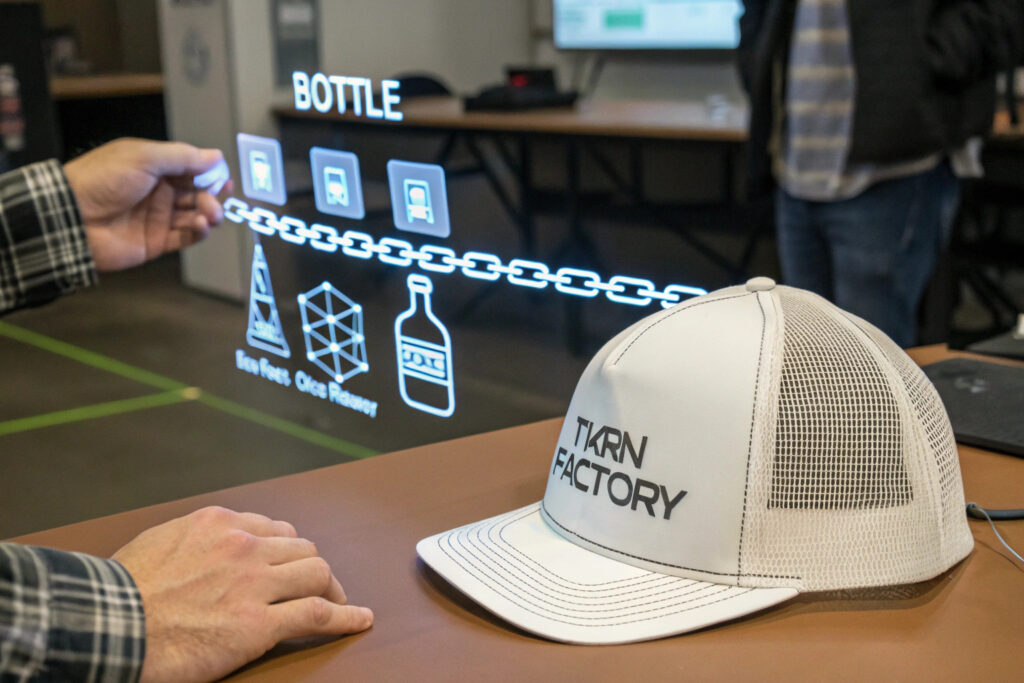
A digital twin is a virtual copy of a physical yarn lot. The yarn exists on a pallet. The digital twin lives in the cloud. They are linked by a unique identifier. It could be a QR code on the pallet or a tracer inside the fiber itself.
The digital twin starts at the bottle recycling plant. The plant weighs the bales of clear PET bottles. They enter the weight, the time, and the GPS location into the blockchain platform. When the bottles are chopped into flakes, the twin updates. When the flakes melt and extrude into filament, the twin updates. By the time I receive the yarn cone, I scan the QR label. I see the entire history.
I can also transfer the twin to you, the brand owner. The final scan at the sewing line links the twin to your specific purchase order. The consumer sees the hat came from bottles collected in Osaka, flaked in Taiwan, spun in Vietnam, and sewn in our factory. This is the physical-to-digital link. This transparency commands a higher retail price. Customers pay for proof. They do not pay for unsubstantiated words.
How Do DNA Tracers and Fluorescent Markers Verify the Bottle Origin?
Sometimes a digital tag is not enough. The fiber itself can be tagged. A company mixes a non-toxic fluorescent marker into the plastic flake. The marker has a unique optical signature. It is like a genetic code for the plastic.
At the spinning mill, they have a handheld scanner. They point it at the yarn. It reads the marker. It confirms the yarn came from the certified bag of flakes. This forensic tagging cannot be washed out. It survives the dyeing and finishing process. It even survives if the hat is washed 50 times.
I have a supply chain partner that uses this DNA technology. The marker is called SigNature T. It is safe for skin contact. It provides an absolute physical link. This technology is critical for avoiding the substitution fraud that plagues the recycled textile industry. A truck of recycled flakes can be swapped for a truck of virgin flakes at the gate if nobody is watching. With the marker, the scanner sees the virgin plastic is fake. It stops the production line. For high-value collaborations where brand integrity is paramount, I recommend a dual system. Use blockchain for the document trail. Use DNA markers for the physical material. This is the gold standard of traceability.
How Can You Audit a Factory's Renewable Energy Use in Hat Production?
The fabric is recycled. The buckram is water-based. The hat ships in a recycled paper box. But the factory burned coal to sew it. The electricity mix kills your carbon footprint calculation. A truly sustainable trucker hat needs clean energy input. This is where greenwashing hides in the electricity bill.
Auditing a factory's renewable energy use requires access to the utility bills or a Renewable Energy Certificate. You look at the kilowatt-hours consumed per hat. You match that to the solar on the roof or the wind contract. At Global-Caps, we installed a solar array on our factory roof. It covers 40 percent of our cutting and sewing load. The balance comes from grid power. We buy Green-e certified RECs to offset the remaining 60 percent.
You have a right to ask for these numbers. A factory that claims "green" but has no energy data is simply not green. Energy is the biggest hidden impact.
There are specific measurement tools and contract types for renewable energy. You do not just look at the solar panels. You look at the paperwork that tracks the electrons.

What Is a Renewable Energy Certificate and How Does It Offset Hat Making?
Electricity is a shared pool. Once solar power hits the grid, it mixes with coal power. You cannot track a specific electron. A Renewable Energy Certificate is the legal right to claim that green electricity. It is a tradable certificate. One REC equals one megawatt-hour of renewable electricity.
For a hat factory, purchasing RECs is a valid way to neutralize the carbon footprint of the sewing line. The standard for auditing is the GHG Protocol Scope 2 guidance. I request my REC provider to retire the certificates in our name. This means they are deleted from the market. Nobody else can claim them. We do this for our sustainable product line.
To audit this, you ask for the REC retirement statement. It lists the project, the vintage, and the volume. It must match the annual production volume. If we produce 100,000 hats and each hat consumes 0.5 kWh, we need to retire 50 MWh of RECs. I show this statement to my buyers. It proves the factory energy claim is not hot air.
How Does Solar-Powered Sewing Impact the Carbon Footprint of Trucker Hats?
The sewing machine is a small electric motor. But a factory floor has 200 of them, plus compressors, lights, and steam irons. The load adds up. Solar panels on the roof directly reduce the grid demand during peak sun hours.
We installed a 100 kW system. It covers the morning shift completely on a sunny day. The digital inverter tracks the daily solar yield. I can look at the app and say, "Yesterday we sewed 500 trucker hats on pure sunlight." This on-site generation is more credible than buying RECs from a wind farm 1,000 miles away. It is additive.
The carbon footprint calculation uses the emission factor of the local grid. In our province, the grid factor is about 0.7 kg CO2 per kWh. By using on-site solar, the emission factor for those hours drops to near zero. We calculate the Product Carbon Footprint per trucker hat. A standard mesh-back trucker hat has a baseline footprint of about 2.5 kg CO2. With recycled mesh and solar sewing, we drop that below 1.5 kg.
I send an annual energy report to my long-term partners. It shows the solar fraction. It shows the grid mix. You want to work with a factory that treats energy like a raw material. It can be sourced clean or dirty. You choose clean.
Conclusion
Tracing the origin of recycled polyester in your trucker hats is a multi-layered investigation. You start with the paper. You must demand the GRS Transaction Certificate that links your invoice to the specific batch of recycled mesh. You must read the scope to see if the certificate covers just the component or the whole hat. You then look at the hidden structure. The buckram inside the front panel must also be recycled or chemically safe. Avoid formaldehyde resins. Push for recycled PET buckram with the same stiffness.
Then you bring in the digital tools. Blockchain platforms and DNA tracers turn the supply chain into an open book. A QR code on the hangtag can link the hat to the bottle collection center. A fluorescent marker in the yarn proves the fiber is not virgin plastic. Finally, you look at the factory's energy. Audit the renewable energy certificates or the solar inverter data. A clean hat sewn with coal power is a half-truth.
This deep traceability is the future of headwear. It is not a burden. It is a competitive advantage. At Global-Caps, we have built these traceability pipelines for brands that refuse to greenwash. We connect the bottle, the yarn, the energy, and the sewing into one verified story.
If you want custom trucker hats where the recycled claim is backed by science and audits, let's connect. Contact our Business Director Elaine. She can show you our GRS certificates, our solar energy dashboard, and a sample of the blockchain traceability tag. Email Elaine at elaine@fumaoclothing.com. Let's make a hat that proves its story.