You email your factory contact. No reply. You send a follow-up. No reply. You call. The phone rings. Voicemail. You send a WhatsApp message. One grey tick. Three days pass. You start imagining disasters. The factory went bankrupt. They lost your order. They are avoiding you because they made a mistake. Your anxiety spirals. You are a small brand. You have one order. You feel invisible. The silence is deafening.
Your Chinese hat factory is suddenly unresponsive during peak production season because their project managers are overwhelmed with urgent production issues from multiple clients, all of whom have deadlines compressed into the same July-to-October window. The factory is not ignoring you specifically. They are triaging. They respond to the client whose container is loading today, whose fabric arrived damaged, whose embroidery machine broke down. Your email about a lab dip status or a sample revision falls into the "important but not yet screaming" category. The silence is not a relationship failure. It is a capacity failure. The factory's communication bandwidth, like their production capacity, is oversubscribed.
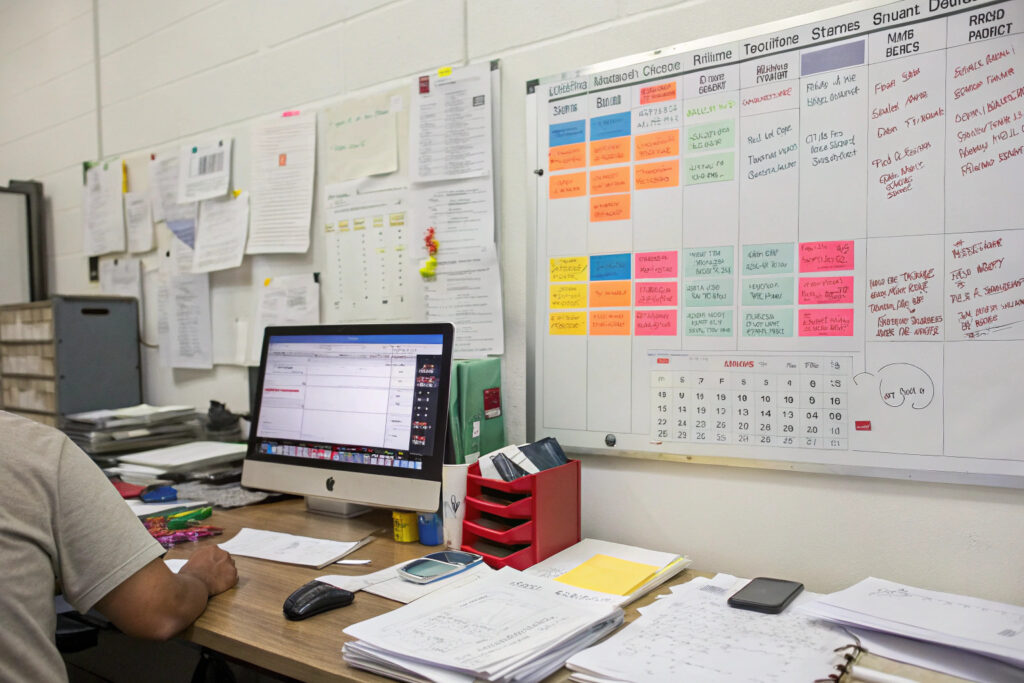
At Global-Caps, I staff my project management team with a ratio of one project manager to every eight active clients during peak season. I add temporary client liaison staff in July. I have a protocol for communication blackouts. I know the problem exists. I built systems to prevent it.
What Is Peak Production Season in the Chinese Headwear Industry?
You send your order in September. You think the factory is working at normal speed. You are wrong. The factory is working at 150 percent capacity. Every brand in the Northern Hemisphere placed their winter beanie orders in August. The back-to-school caps shipped in July. The holiday promotional hats are being cut in September. The factory floor is running 16-hour shifts. The project managers are sleeping five hours a night. Your order is in a queue behind a thousand other orders.
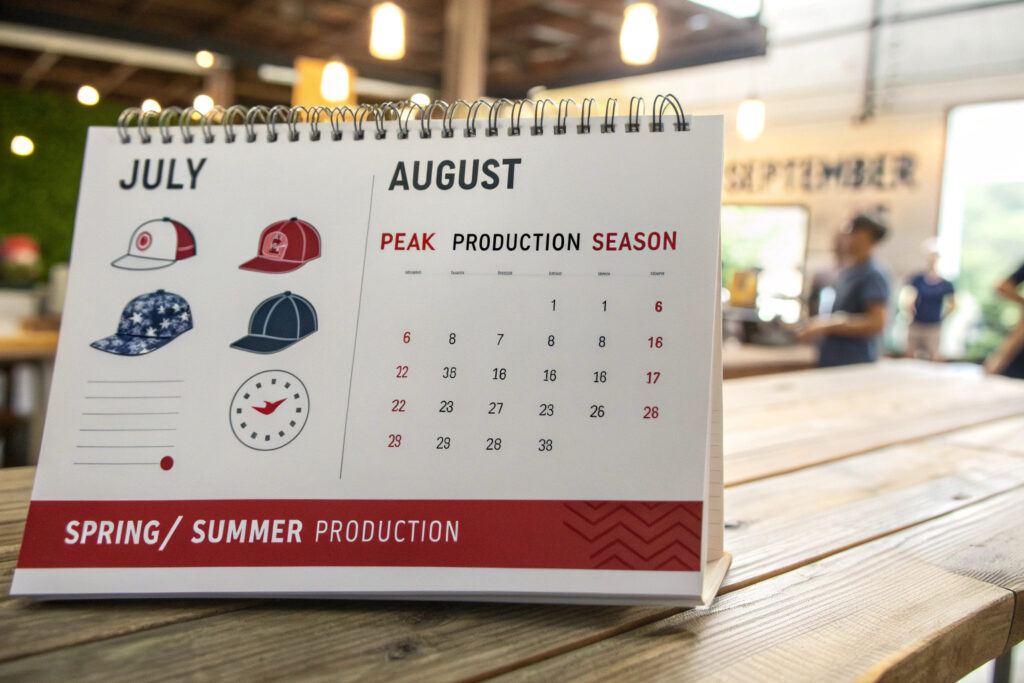
Peak production season in the Chinese headwear industry runs from July through October. This is when factories produce the bulk of their annual volume. The winter hat season begins cutting in July. The holiday promotional season runs through September and October. The back-to-school season ships in July and August. The Chinese National Day holiday in the first week of October creates an additional deadline crunch. The months of November through February are lower volume, followed by the Chinese New Year closure. The summer production peak for spring delivery runs from January through March.
I publish my production calendar to clients at the start of each year. The peak months are clearly marked. I advise clients to book capacity in April for July production.
The Chinese New Year closure is a separate, predictable communication blackout that is often confused with peak season unresponsiveness.
How Does the Chinese New Year Holiday Create a Secondary Communication Blackout?
Chinese New Year occurs in late January or February. The official holiday is one week. The practical factory closure is two to four weeks. Workers travel to their hometowns. Many do not return. The factory reopens with a reduced workforce.
During the closure, emails go unanswered. Projects stall. The factory reopens to a mountain of backlogged requests. The communication blackout extends for another week as the team digs out. The recovery period can last until mid-March.
I send a holiday notice to all clients in early January with the exact closure dates and the name of the emergency contact person who remains on duty.
Why Do European Back-to-School Orders Overlap With US Holiday Orders?
European back-to-school retail is July through September. US holiday promotional product delivery is October through November. The production windows for these two massive order categories overlap in July, August, and September. The same factory floor is producing caps for French schoolchildren and beanies for American corporate holiday gifts simultaneously.
The overlap creates a double peak. The factory's cutting tables, embroidery machines, and sewing lines are booked solid. The project management team is handling twice the normal communication volume.
I segregate my production lines by order category during peak season. The back-to-school line runs separately from the holiday line.
What Happens Inside the Factory When Communication Goes Silent?
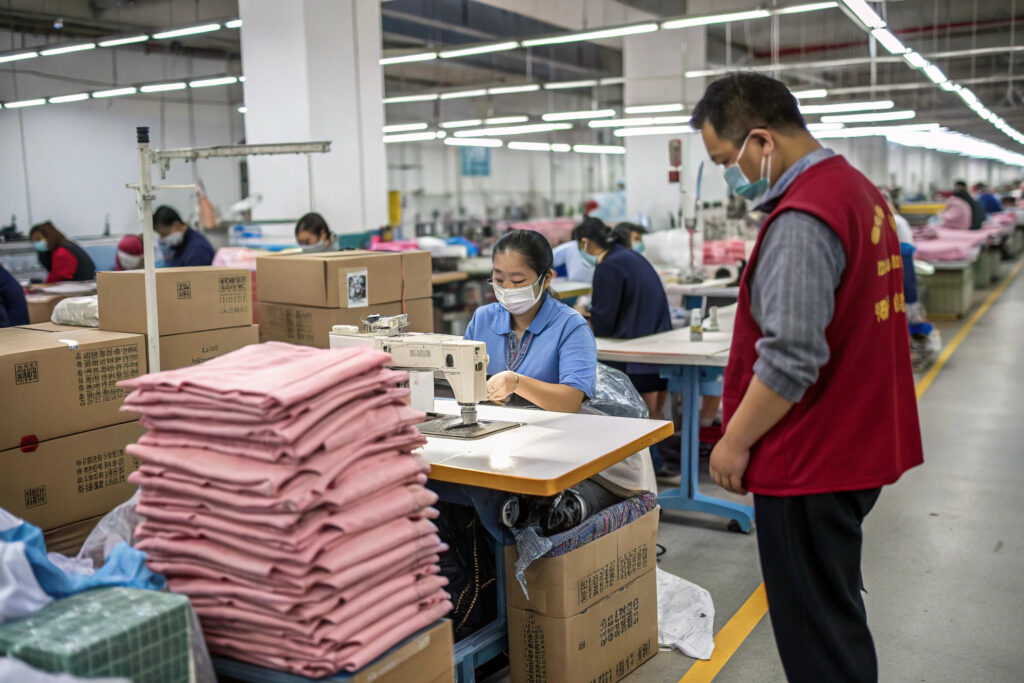
You imagine the factory is ignoring your email while drinking tea. The reality is that your project manager just discovered that the dye house delivered the wrong shade of burgundy for a 20,000-unit order that ships on Friday. She is on the phone with the dye house demanding an emergency re-dye. She is at the cutting table checking if any other fabric can substitute. She is not reading your email about the hangtag font size.
The internal factory reality during a communication blackout is that the project management team is fighting fires on the production floor. A machine breakdown, a fabric defect, a missing shipment of buckram, a customs hold on imported yarn—each crisis demands immediate, on-the-ground attention. The project manager is not at their desk. They are on the factory floor, physically solving problems. Email response time drops from hours to days because the project manager's hands are on fabric, not on a keyboard.
My crisis protocol requires the project manager to notify the client of any delay within 24 hours, even if the message is just "We have a production issue. I will update you in 48 hours."
The production floor crisis is a physical event. The project manager is a firefighter, not an email responder.
How Do Machine Breakdowns and Material Defects Disrupt the Communication Chain?
A multi-head embroidery machine breaks down. Twelve heads stop. The machine technician is called. The diagnosis takes an hour. The repair takes four hours. The production schedule for 500 caps is delayed by a day. The project manager is at the machine, coordinating the technician, calculating the schedule impact, and deciding whether to shift the order to another machine.
Your email about the packaging insert card arrives during this crisis. The project manager sees the notification. They cannot respond. They are holding a broken needle bar. The email waits. The crisis is resolved. Fifty other emails have accumulated.
My machine maintenance log is reviewed weekly during peak season to predict failures before they happen.
Why Does the Shipping Clerk's Deadline Override the Project Manager's Emails?
The shipping clerk has a container closing at 4:00 PM. The container must be loaded by 3:30 PM. The documentation must be submitted to the freight forwarder by 2:00 PM. If the container misses the cutoff, the vessel sails without it. The shipment is delayed by a week. The demurrage charge is $500.
The project manager abandons all emails to help the shipping clerk finalize the documentation, check the carton counts, and verify the shipping marks. The container deadline is an immovable object. Your email about the next season's sample can wait until the container door is sealed.
I schedule shipping cutoffs with a 24-hour internal buffer. The project manager is not firefighting the container loading.
What Pre-Season Planning Prevents Peak Period Communication Failures?
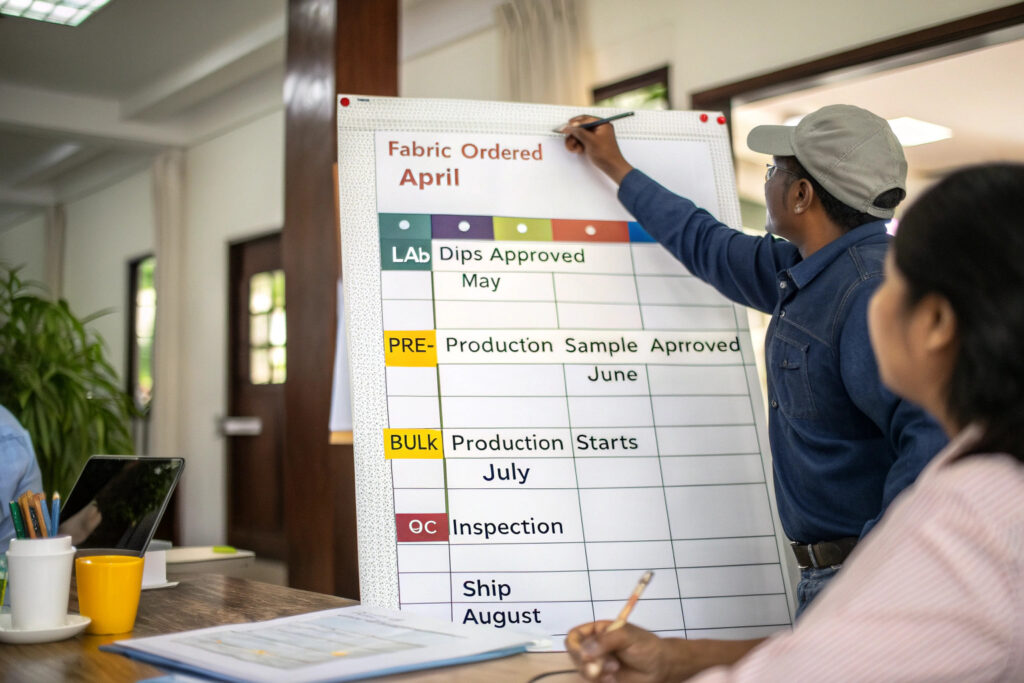
You place your order in July for October delivery. You think you planned ahead. You are three months late. The factory that plans your production in April has your fabric in stock by May. Your lab dips are approved by June. Your bulk production starts in July before the peak season crush hits. The factory that receives your order in July is scrambling to fit you into an already overloaded schedule. The silence you experience in September is the consequence of a planning failure in April.
Pre-season planning prevents peak period communication failures by booking production capacity 90 to 120 days before the delivery date, approving all materials and samples before the peak season starts, and establishing a communication schedule with the factory that defines response time expectations for routine and urgent queries. The factory's peak season project management bandwidth is reserved for production execution, not design development. If your design is still being developed in August, you are competing for bandwidth with every other brand.
I require pre-production approval by June 30th for all fall and winter orders. Orders with approved samples by that date get priority scheduling.
A single point of contact with escalation protocols is the most effective communication structure.
A shared sales representative handles dozens of clients across multiple product categories. They are a generalist. They take orders. They forward requests. They have limited authority to solve production problems. When the factory floor is in crisis, the sales rep is waiting for answers from the production manager, who is also their information bottleneck.
A dedicated project manager is assigned to a limited portfolio of clients. They are embedded in the production team. They attend the daily production meeting. They know the status of every order on the floor. They have the authority to make scheduling decisions. When a client emails, the project manager already knows the answer.
My project management team is structured with dedicated managers, not shared sales reps. Each manager owns the client relationship from sample to shipment.
What Information Should You Provide to Minimize Back-and-Forth During Crunch Time?
Every email you send that requires a response consumes the project manager's time. Every incomplete specification generates a clarifying question. Every vague instruction generates a revision cycle. The way to minimize back-and-forth is to provide complete, unambiguous information in a single communication.
Provide the purchase order number in the email subject line. Attach the approved spec sheet. Reference the approved lab dip number. Provide the exact Pantone code, not a verbal color description. Provide the logo in vector format. Specify the packaging requirements in a bulleted list. Anticipate the questions the factory will ask and answer them in the first message.
My client communication guide includes a pre-written email template for common requests.
What Alternative Communication Channels Work Best During Factory Crunch Time?
You send five emails. No response. You are frustrated. You are communicating through the channel you prefer. You are not communicating through the channel the factory prefers. In China, WeChat is the primary business communication tool, not email. The factory project manager checks WeChat messages instantly. They check email twice a day. Your email is in a queue. A WeChat voice message would have been answered in five minutes.
The best alternative communication channels during factory crunch time are WeChat for instant messages and voice calls, WhatsApp for international clients who do not have WeChat, and a scheduled video call for complex issues that require screen sharing or physical sample review. A quick voice message in the factory's preferred language, even if translated by an app, often gets a faster response than a formal email in English.
My team uses WeChat for daily client communication. Email is used for formal approvals and document transfers.
WeChat voice messages are the preferred medium for quick updates during a busy production day.

Why Are WeChat Voice Messages More Effective Than Emails During Production?
A voice message can be recorded while the project manager is walking between the cutting table and the sewing line. It takes 15 seconds to record. It requires no typing. The recipient can listen while doing another task. The tone of voice conveys urgency and emotion that text cannot.
An email requires the project manager to sit at a desk, open the email client, read the message, type a response, and hit send. During a production floor crisis, the desk is a distant location. The voice message is immediate.
My communication protocol encourages voice messages for status updates and quick questions. Email is for formal approvals.
Can a Scheduled Bi-Weekly Video Call Prevent the "Black Hole" Feeling?
Yes. A recurring 15-minute video call on Monday and Thursday provides a predictable communication rhythm. The client knows that even if daily emails go unanswered, the video call will happen. The project manager prepares a brief status update. The client asks accumulated questions. The call provides reassurance and maintains the relationship.
The black hole feeling comes from unanswered messages and uncertainty. A scheduled call replaces the uncertainty with a calendar event.
I offer bi-weekly video calls to all clients during peak season. The call is short. The agenda is structured.
Conclusion
Your Chinese hat factory goes silent during peak production season because the project management team is overwhelmed by simultaneous production crises, shipping deadlines, and client demands compressed into a four-month window from July through October. The silence is not personal. It is not a sign of factory failure. It is a sign that the factory's communication capacity, like its production capacity, is oversubscribed.
You can prevent the silence by planning your order 90 to 120 days in advance, approving all materials and samples before peak season begins, and establishing a dedicated project manager as your single point of contact. You can mitigate the silence by using WeChat voice messages instead of email, scheduling bi-weekly video calls for predictable updates, and providing complete, unambiguous information in every communication.
At Global-Caps, I understand the peak season communication challenge because I live it every year. My project managers are dedicated, not shared. My pre-production deadlines are enforced. My communication channels include WeChat, WhatsApp, and scheduled video calls. I do not promise instant email responses during peak season. I promise scheduled, reliable communication that keeps you informed even when the factory floor is on fire.
If your current factory has gone silent and you need a supplier who communicates predictably even during peak season, contact my Business Director Elaine. She can provide our peak season production calendar, assign you a dedicated project manager, and schedule your first bi-weekly video call. Email Elaine at elaine@fumaoclothing.com. Let's break the silence together.