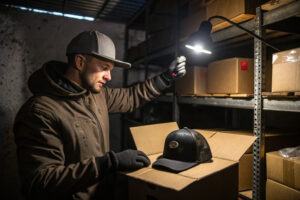
You finally unbox the custom bucket hats for your new summer collection. The fabric feels great. The color is perfect. But then you hold one up, and your heart sinks. The brim doesn't sit flat. It pulls to one side. The stitching line wanders just slightly off the edge. You flip through the whole box, and maybe a handful are like that. Now you are not just holding a hat. You are holding a problem. A delay in your launch. A tough conversation with your own customer. It's frustrating because you did everything right. You paid for a premium sample. You approved it. So why did this happen in bulk production?
A crooked brim on a custom bucket hat almost always comes down to a few very specific production control failures. It is rarely a mystery to someone who has spent years on the factory floor like I have. The root cause is usually found in how the fabric layers are cut, how they are fed into the sewing machine, or how the final pressing is done. A shift in the fabric's grain, a blunt cutting blade, or an operator rushing through the stitch without proper guides can all twist that brim out of shape. It is not always a sign of a bad factory, but it is a clear sign of a factory that skipped some critical checkpoints in the sewing line.
I know how much this small detail matters. My name is not important, but I run Global-Caps, and we have been making headwear for brands in Europe and America for many years. A crooked brim might seem like a tiny flaw, but it changes the whole silhouette of the hat. It makes the product look cheap. Over the years, I have personally walked our production floor thousands of times to figure out exactly how to stop this issue before a single hat gets packed into a shipping carton. In this article, I will explain the real reasons this happens, the steps we take to control it, and what you should ask your own supplier to guarantee flat, perfect brims every time.
What Causes Bucket Hat Brims to Stitch Crooked?
When a buyer sees a wavy or crooked brim, their first thought is usually that the sewing machine operator made a mistake. That can be true, but more often, the problem starts long before the needle hits the fabric. The real trouble begins at the cutting table. If the fabric panels for the brim are not cut perfectly on the true bias or grain, the brim will have a memory of that distortion. Once you sew that slightly off-grain piece, it fights to twist back to its natural shape. Combine that with a sewing operator who is forced to stretch the fabric just to make it fit the curve, and you end up with a brim that looks permanently bent.
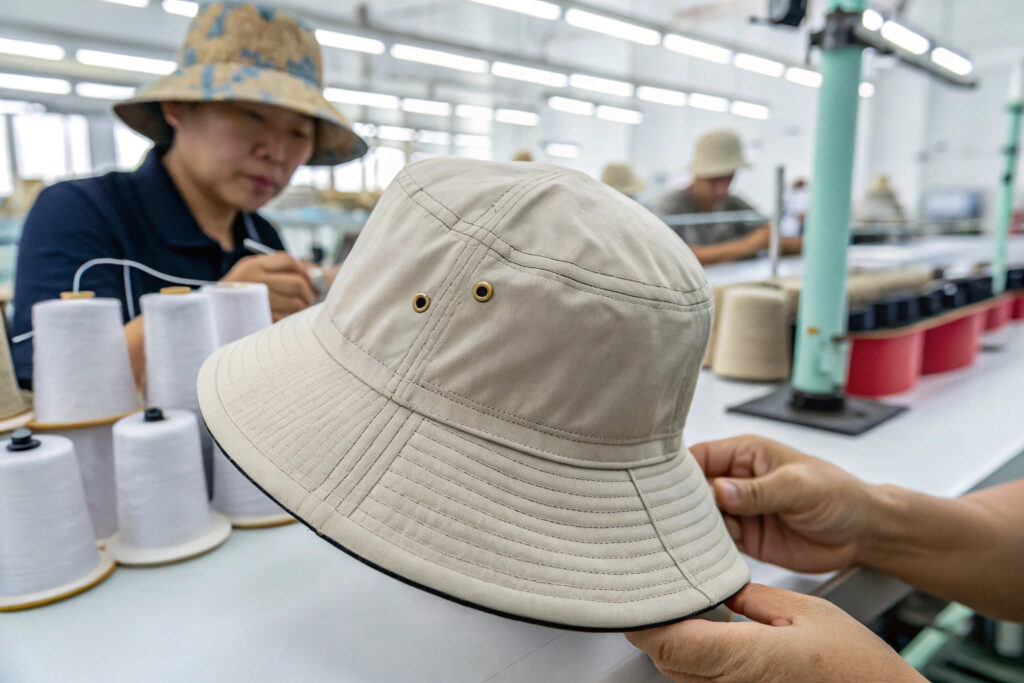
The most critical moment is not the sewing. It is the marriage between the top panel and the brim panel. These two pieces have different circumferences. A bucket hat brim curves up, so the outer edge of the brim is longer than the inner edge where it attaches to the crown. If the cutting was imprecise, the operator has to ease in too much extra fabric, creating puckers, or stretch the crown too much, creating tension that pulls the brim crooked. This is a geometry problem disguised as a sewing problem. If the fabric is a heavy canvas or a thick bonded fleece, the issue is magnified. The multiple layers can slip under the presser foot of a standard industrial machine if the operator does not use a walking foot attachment. This slippage means the top layer of the brim feeds through the machine at a slightly different speed than the bottom layer, causing a permanent twist by the time the final topstitch is locked in.
Why Does Fabric Cutting Distort the Brim Shape?
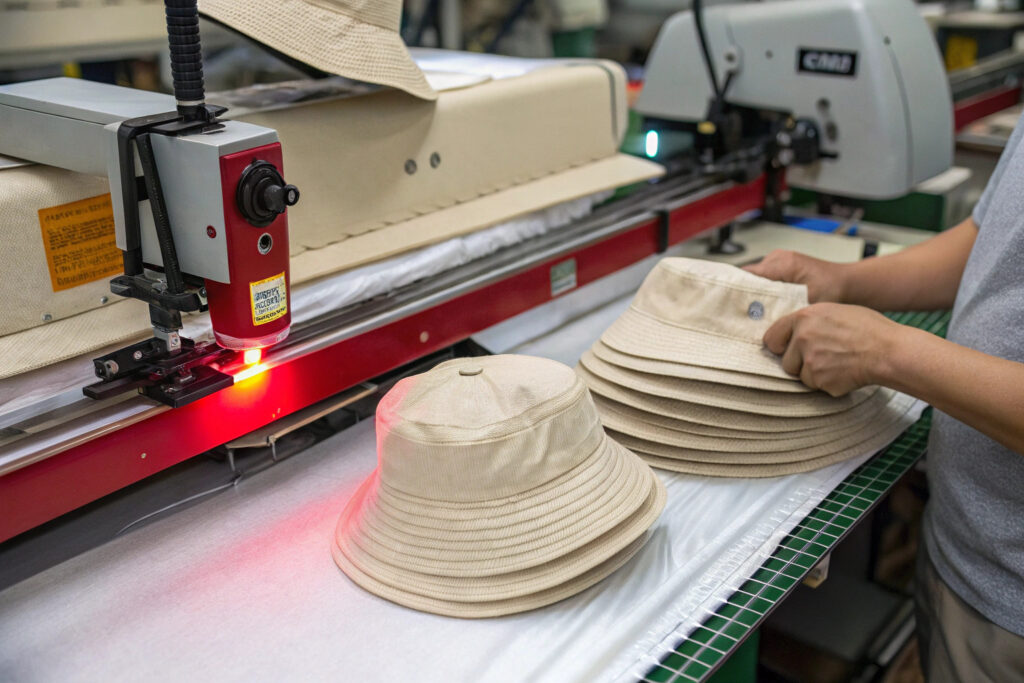
The first knife cut on a stack of fabric determines the fate of the brim. We use automated laser cutting machines and precise hydraulic presses with sharp dies. A dull blade on a traditional band saw will drag the top layer of fabric while pushing the bottom layer. This creates panels where the top piece is microscopically smaller than the bottom piece. When the sewer picks up these mismatched layers and sews them together, the edges will never line up perfectly. The brim has a built-in imbalance. For structured bucket hats using a bonded inner lining like interfacing, this distortion becomes permanent once the heat press fuses the materials together. The brim might look flat on the table, but internal stress is trapped inside. After a few days in a hot shipping container, that stress releases and the brim twists. I have seen entire shipments develop a memory curl simply because the fabric was stretched during spreading and cutting.
The solution is not just a sharp blade. It is controlling the tension of the fabric while it is being spread on the cutting table. Natural fibers like cotton canvas or linen need to be relaxed, never stretched. We let the fabric rest for 24 hours in the cutting room so it can shrink to its natural state. This is a step that many rushed factories skip. They take the fabric directly from a compressed roll, spread it tight as a drum, cut it, and then watch it shrink back later, pulling the brim seams with it.
How Does Stitching Speed Cause a Crooked Brim?
Even with a perfectly cut panel, a sewer set at the wrong speed can ruin the brim. Operating an industrial machine at high RPMs generates heat on the needle. On a synthetic fabric like polyester or nylon often used in waterproof bucket hats, this heat can slightly melt or glaze the fabric edge as the needle penetrates. This creates a stiff, shiny track on one side of the stitch line that does not give or flex naturally. The brim loses its fluid drape and starts to hold a rigid, bent angle. More commonly, high speed forces the operator to manhandle the material just to keep it aligned with the edge guide. Instead of the machine feeding the fabric smoothly, the operator pushes and pulls the brim through the curve. On a bucket hat with a 360-degree brim, you are sewing an infinite circle. Any inconsistent pushing on one side will create a visible wave.
At Global-Caps, we have standard operating procedures for our sewing line. For brim topstitching, we use a specific machine setting with a compound feed mechanism, often called a triple feed or needle feed machine. The presser foot, the needle, and the lower feed dogs all move the fabric layers together in sync. This prevents the top layer from advancing ahead of the bottom layer. We also use a folder attachment, which is a metal guide that folds the edge of the brim fabric over perfectly as it enters the needle, eliminating the chance of the operator veering off the edge. If the guide is set correctly and the operator simply focuses on keeping the fabric edge flush against the guide, the brim will exit the machine dead straight.
How Does Quality Control Detect Crooked Brims Before Shipment?
Finding a crooked brim is easy when you look at a single hat. The challenge is catching it when you are looking at 5,000 hats, packed tight in poly bags, waiting to be loaded into a container. An experienced QC team does not just look at the finished hat. They test the process that makes the hat. A crooked brim is often a symptom of a drifting machine or an exhausted operator, and a good inline quality system catches the drift in real-time, not just at the final audit. We do not wait until the hats are packed to discover a problem. Our QC process stops the machine to fix the root cause, not just to fix the hat.
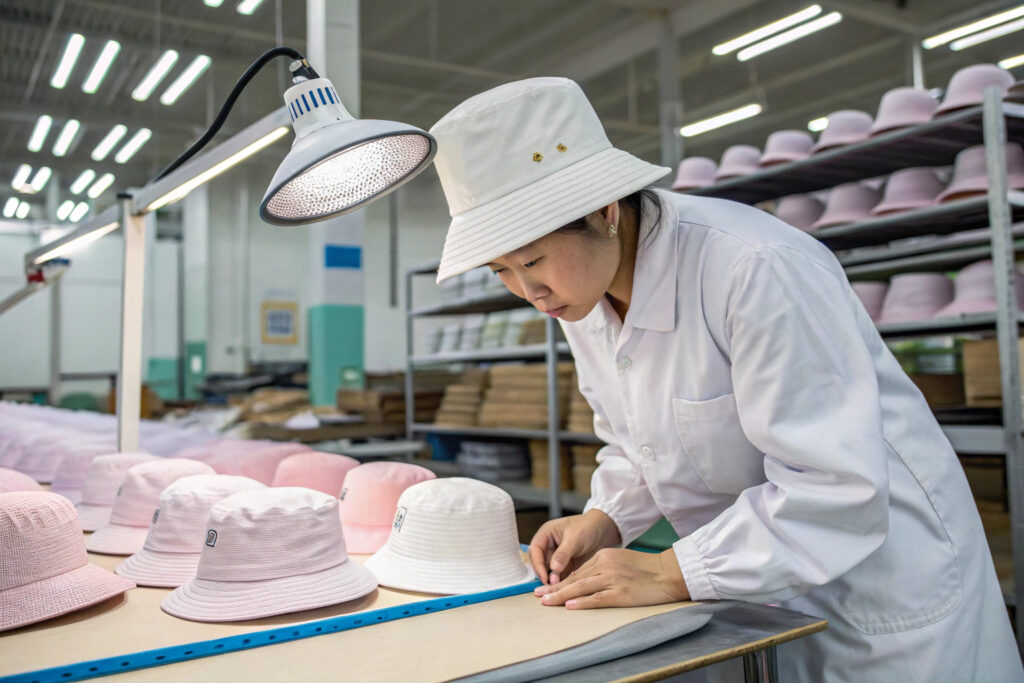
For a bulk order, we perform what we call a "table flat test." The inspector takes a random sample of hats from the middle of a production run, not just the beginning and end when operators are most careful. They place the hat crown down on a calibrated flat granite table. The brim should fall naturally into a perfect circle. If the brim is crooked, it will not sit flat. One side will lift or pucker. This is more reliable than just eye-balling a hat on a mannequin head. A crooked brim can hide when stretched over a form, but it cannot hide on a flat surface. We also measure the depth of the brim at four cardinal points—front, back, left, right—using a rigid ruler. If the variation exceeds our internal AQL (Acceptable Quality Limit), the entire production lot is put on hold for rework or rejection.
How Do You Inspect a Bucket Hat Brim Symmetry Professionally?
When I train a new QC inspector, I teach them a three-step symmetry check. Step one is the fold test. You fold the hat exactly in half, crown seam to crown seam, and then check if the front brim and back brim edges align. If the brim is crooked, the edges will show a scissored misalignment, like two crescent moons overlapping badly. Step two is the stitching alignment test. You run a fingertip along the brim edge stitching. It should maintain a consistent distance from the raw edge, typically 6 to 7 millimeters for a classic bucket hat. If the needle has walked inwards or outwards, it means the guide on the machine shifted and the brim's structure is weakened, allowing it to warp. Step three is the drape test. You hold the hat by the tip of the crown and let it hang freely. Spin it. A symmetric brim will drape evenly like a bell. A crooked brim will skew to one side, looking like an ellipse.
These three checks take about fifteen seconds per hat for a trained professional. During a final inspection using the AQL 2.5 standard, we check hundreds of hats this way. It is standard practice in top-tier factories, but you would be surprised how many suppliers just check the color and the label and shake the hat a bit. If your supplier cannot show you a video of these specific tests being performed on your actual order before payment, you are taking a risk on the brim geometry.
Can Finished Bucket Hats Be Fixed After a Crooked Stitch Occurs?
This is a question I get often from buyers hoping to salvage an off-spec shipment. The hard answer is that it depends on the fabric. For a 100% cotton hat, we can sometimes re-block the brim using steam and a custom metal mold in our pressing department. The steam relaxes the cotton fibers and the mold reshapes them. Once cooled, the brim can hold a new, correct shape. This is a rework process, not a quick fix. Each hat has to be placed on the mold by hand and then run through a hat press, adding labor cost. For a synthetic hat made of polyester or nylon, heat re-blocking is extremely dangerous. Synthetic fibers are thermoplastic. If you apply too much heat, you melt the material or give it a shiny, crushed look that ruins the hand-feel. You also cannot fix a crooked brim if the root cause is a badly cut panel. If the fabric piece itself is cut off-grain, no amount of pressing will permanently correct it. It will just slowly twist back after a few days. In those cases, the brim panels have to be ripped out and the hat re-sewn, which is often more expensive than making a new hat. This is why we focus so heavily on cutting precision; rework is the enemy of profit and on-time delivery.
How Do You Source Custom Bucket Hats With Perfect Brims From China?
Sourcing a perfect bucket hat is not just about finding a low price. It is about finding a manufacturing partner who respects the physics of fabric. Many buyers send an inquiry asking for the "best price for 100% cotton bucket hat." They send a picture from Pinterest and expect a duplicate. But a picture does not tell a factory the brim width, the stitch type, or the seam allowance. A factory guessing at these details will often produce a generic hat with a generic brim, and those often run crooked because the pattern hasn't been engineered for that specific fabric weight.
My advice to brands who want perfect brims is to shift the conversation from price to process early on. Ask about the cutting room. Is the fabric relaxed before cutting? Do they use a die press or a laser cutter? Ask about the sewing floor. Do they use folder attachments for the brim? Do they run a walking foot or compound feed machine? A legitimate factory will happily boast about these technical capabilities because they represent investment. A low-tier trading company will not understand why you are asking these questions and will just repeat "high quality" over and over without showing you the hardware. When we talk to a new client like Ron, an experienced American buyer, we discuss packing lists and shipping schedules, but first we discuss our stitching standards because Ron, like me, knows that the brim is the face of the bucket hat.

What Questions Should You Ask a Potential Hat Manufacturer?
You should treat your first conversation with a potential supplier as a technical audit. Start by asking for a copy of their measurement tolerance sheet. A professional factory has documented tolerances. For a bucket hat brim, a standard tolerance is +/- 2 millimeters in width variance around the circumference. If they cannot tell you this number, they are likely not measuring it. Ask specifically about their cutting method. "Do you use a CNC laser cutter for synthetic fabrics to seal the edge and prevent fraying and distortion?" A laser cutter melts the edge of polyester just slightly, which locks the yarns in place. This single technology step removes the possibility of the edge stretching out crooked during sewing. Ask about their pressing procedure. "Do you have a final shaping press for bucket hats?" Some factories sew the hat and immediately fold it into a poly bag. When the customer opens the package, the brim holds the crimp and bias from the folding process. A proper factory presses the finished hat on a heated crown and brim block to set its final memory before packaging. These questions signal that you are a serious buyer, and they immediately filter out suppliers who cut corners.
Why Choose a Hat Factory With an In-House Design Team?
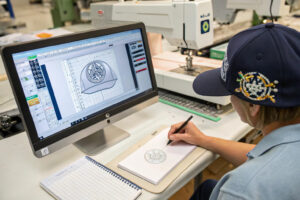
A factory that just copies will always struggle with brim distortion because copying does not account for material stretch. An in-house design team understands pattern making. They know that a brim designed for a stiff canvas needs a slightly different curve than a brim designed for a soft, drapey Tencel. When my design team receives a buyer's tech pack, they digitize the pattern and grade it. They add specific notches on the brim curve that must match the notches on the crown. These notches act as a physical map for the sewer. If the notches line up, the brim cannot be crooked. It forces a true fit.
Our design team also tests the construction technique. For a bucket hat with a downward-sloping, sun-protection brim, we might add a single invisible row of stay-stitching on the inner curve of the brim before it is attached. This stay-stitch stabilizes the bias cut and prevents it from stretching out while being handled by the operator. These are not expensive steps. They just require knowledge. A factory without an internal design and development capability often misses these details because they are just pulling a stock pattern off a shelf, a pattern that might have been made for a different fabric weight entirely. When you choose a factory like Global-Caps, you are essentially paying for the accumulated knowledge of hundreds of previous bucket hat orders, which is the best insurance against a shipment of crooked brims arriving at your warehouse.
How Does International Logistics Affect Bucket Hat Brim Shape?
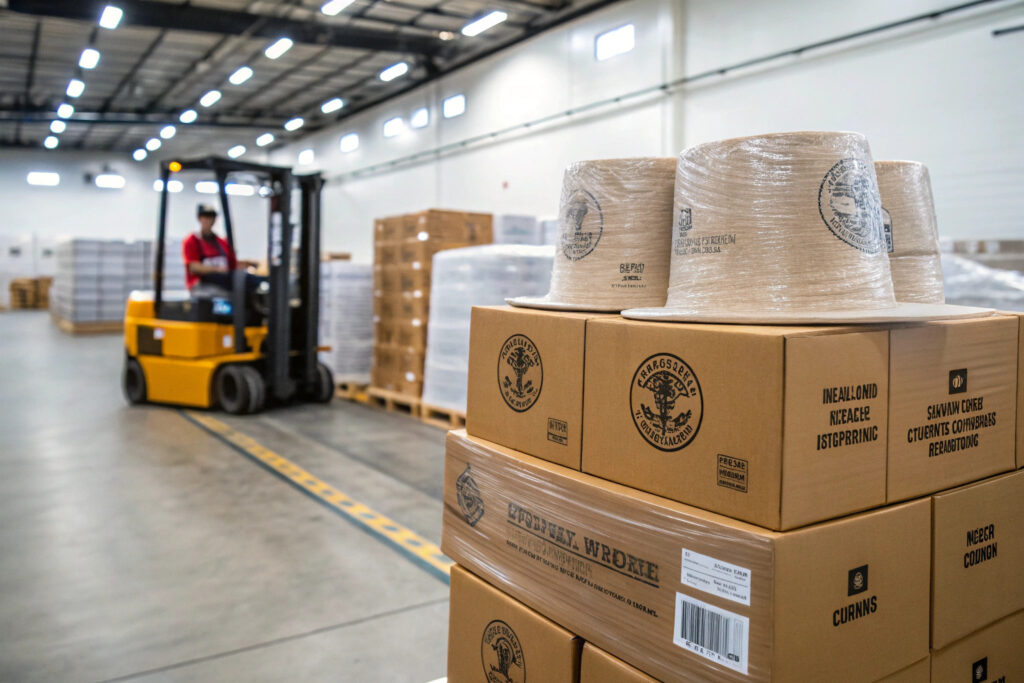
You might have approved a perfect sample. Your QC agency might have given a green light at the factory. Then the hats sail across the ocean, you open the container, and the brims are crooked. What happened? The culprit is often compression and humidity inside the shipping container. A bucket hat brim, especially if it is made of a natural fiber or a delicate straw material, is a structural form. It can be crushed into a different shape if packed too tightly and exposed to a hot, sweaty environment for three weeks at sea. The container acts like a pressure cooker. Temperatures inside a container sitting on a deck can spike, softening the interfacing and allowing the weight of hats stacked on top to press the brims of hats at the bottom into a permanent warp.
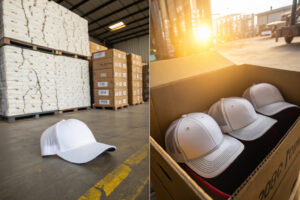
I have learned over the years that export-ready packaging is not just about saving space. It is about protecting the silhouette. For bucket hats, we never fold the brim in half. Some factories do this to squeeze more hats into a smaller carton, distorting the brim's memory. We use an internal paper or inflatable plastic hat filler to support the crown and keep the brim floating in the box. For higher-end straw bucket hats, we actually ship them in individual boxes, like a Panama hat, because straw has zero recovery; once crushed, it is dead. We also monitor the moisture content of the carton environment. If the hats are packed in a high-humidity factory in South China during the rainy season, we add silica gel packs. This prevents the moisture from relaxing the fabric fibers and causing the hats to slump.
What Packaging Solutions Prevent Crooked Brims?
The worst thing you can do to a structured bucket hat during shipping is to over-pack the carton. When the carton bulges, it means the lids are pressing down hard on the product inside. We calculate carton dimensions based on the exact height of the finished hat after pressing. The carton must be tall enough so the brim of the bottom hat never carries the weight of the hats above it. We use horizontal dividers, like cardboard trays, every two layers of hats. This distributes the weight to the carton walls, not the hats' brims.
For clients shipping individual units directly to Amazon FBA centers, we use a rigid box mailer. The hat is placed in a flat, wide box with the brim supported by a cardboard shape-retention insert. This insert is a simple die-cut card that fits inside the hat's brim, maintaining its circular diameter. If a customer squashes the mailer during transit, the insert absorbs the pressure, not the brim stitching. I tell my clients that spending an extra 5 cents on a cardboard brim insert can save them thousands of dollars in returns due to "item arrived deformed" complaints. When you calculate your landing cost, never shave costs off the structural packaging. A perfectly made hat that arrives crooked is worth less than a flawed hat that never should have been made.
How to Avoid Tariff Costs Impacting Hat Quality Decisions?
This is a sensitive topic for buyers importing from China to the US right now. When tariffs increase, the total landed cost rises. Many buyers react by pushing the factory to cut the FOB price. The factory, to survive, might look for shortcuts. They might reduce the weight of the interfacing, or they might stop using the slow but precise sawing process and switch to a faster, rougher cut. The first thing to degrade in these cost-cutting scenarios is often the brim structure. A lighter interfacing is harder to control under the presser foot, leading to more crooked stitches.
At Global-Caps, we operate from our own self-contained production lines in Zhejiang. We are not affected by some of the same tariff pressures hitting other regions because we have long-term, stable contracts with our material suppliers and we focus on efficiency, not corner-cutting. My advice to buyers is to accept that the factory's ex-works price is only one part of the puzzle. If you force a price cut that is lower than the cost of production, you are literally buying a worse brim. There is a threshold where a bucket hat cannot be made correctly for a certain price if it is going to have a stable, straight brim and meet US safety standards for lead and phthalates. Work with your factory to find savings in logistics efficiency, such as optimizing carton cube to get more units per container, rather than asking them to cheapen the sewing process. A crooked brim creates a much higher cost later: the cost of your brand's reputation.
Conclusion
A crooked brim on a bucket hat is rarely an accident. It is a signal. It tells you whether a factory relies on precise, repeatable systems or on the luck of a steady-handed operator. As I have walked you through the process, the journey of a straight brim begins with the fabric grain and how it rests on the cutting table. It continues through the feed dogs of a correctly set sewing machine using a folder guide, and it is protected by a QC team that measures brim depth at four points on a flat granite table, not just by looking at a mannequin. Finally, it survives the ocean journey because of thoughtful structural packaging that respects the hat's shape. Missing any one of these steps can twist that brim, but getting them all right guarantees a crisp, professional silhouette every time.
When a hat arrives with a crooked brim, the true cost is not the pennies lost on the rejected piece. The real cost is the conversation you now have to have with your retail buyer, the shelf space you lose, and the trust that evaporates. You cannot afford to be that supplier. And you shouldn't have to be.
If you are sourcing bucket hats and you are tired of explaining to your team why the brims look "a bit off," I invite you to reach out to us at Global-Caps. We do not claim to be magicians, but we have spent years refining the machinery, the patterns, and the checkpoints that eliminate this specific problem. Let's discuss your next collection. You can contact our Business Director, Elaine, directly at elaine@fumaoclothing.com to start a conversation about your technical requirements. Whether it is a classic heavy canvas bucket or a packable nylon travel hat, we will make sure your brims land in the US exactly how they left our factory floor in Zhejiang: dead flat and perfectly round.