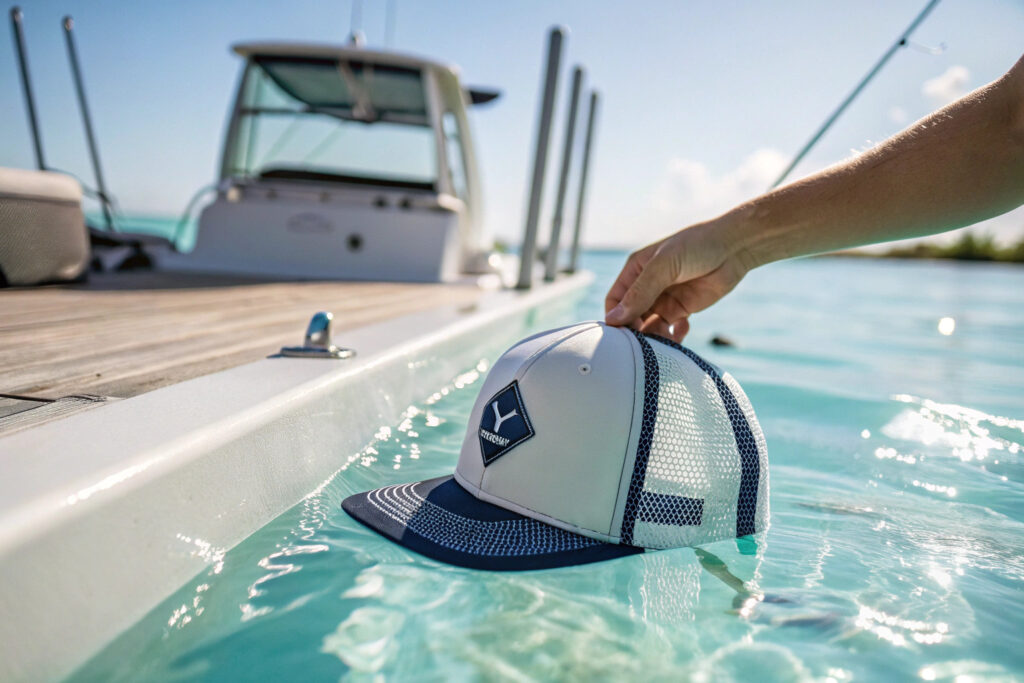
About two years ago, I received an urgent call from a buyer representing a chain of coastal marine supply stores in Florida. He was furious. His previous supplier had sent him a container of "marine-grade" golf hats that sank like stones the moment a gust of wind blew them off a boat deck. The foam-filled brim absorbed water through the stitch holes, and the heavy cotton twill crown acted like a sponge. His customers were losing thirty-dollar hats in the Intracoastal Waterway every weekend. His store managers demanded a refund. He needed a hat that floated, and he needed it fast. I told him the problem wasn't just the foam, it was the entire material philosophy behind the hat. That conversation led us to develop one of our most successful niche product lines.
To source lightweight mesh-back golf hats that genuinely float for marine retail, you need a factory that understands the buoyancy equation from the ground up. A floating hat is not a standard golf hat with a piece of foam shoved into the brim. It is a fully engineered water-safety accessory. The entire hat, the crown fabric, the sweatband, the back mesh, the thread, and the closure, must collectively possess a density lower than water. At Global-Caps, we calculate the specific gravity of every component before assembly. We test prototypes in a water tank in our QC lab, not just a bucket, but a tank that simulates saltwater buoyancy. If a hat sinks, we reverse-engineer the bill of materials until it floats reliably.
The market for these hats is growing fast. Boat dealerships, fishing tackle shops, paddleboard rental companies, and high-end coastal resorts all want branded headwear that survives a dip in the ocean. A lost hat is a lost branding opportunity. A floating hat gets retrieved, worn again, and seen by more potential customers. The performance requirement also gives you a strong retail pricing advantage. You can command a premium because the hat solves a concrete, frustrating problem for boaters and anglers.
What Materials Make a Mesh-Back Golf Hat Naturally Buoyant in Saltwater?
The material selection for a floating hat is completely counterintuitive to traditional hat makers. Most factories start with cotton because it is cheap and familiar. Cotton sinks. It absorbs water, becomes heavy, and pulls the entire hat under. The foundation of a buoyant hat is hydrophobia. Every material must repel water rather than absorb it. We use 100% polyester for the crown and visor shell. Polyester is naturally hydrophobic. It absorbs less than 0.4% of its weight in water, compared to cotton which can absorb up to 25 times its weight. This is a fundamental physical difference, not a marginal improvement.
The mesh back panels are critical. We use an open-hole polyester honeycomb mesh. The holes are not just for ventilation, they trap air bubbles when the hat enters the water. Those trapped air pockets add significant buoyancy in the first crucial seconds. The mesh itself must be a monofilament polyester yarn that does not wick water along the fiber surface. The sweatband cannot be cotton. We use a thin polyester microfiber sweatband with a ventilated foam core. The foam is a closed-cell type, meaning the individual foam bubbles are sealed from each other. Even if the outer fabric gets wet, the foam cells remain filled with air, providing continuous buoyancy. The brim insert is the most important piece. We exclusively use closed-cell EVA, ethylene-vinyl acetate, foam with a density rating of around 0.15 to 0.30 grams per cubic centimeter. Water density is 1.0 g/cm³. An EVA foam with 0.25 density will float with tremendous upward force, easily supporting the weight of the entire hat plus a metal logo badge if needed.
How Does Closed-Cell Foam Technology Keep Golf Hats Afloat?
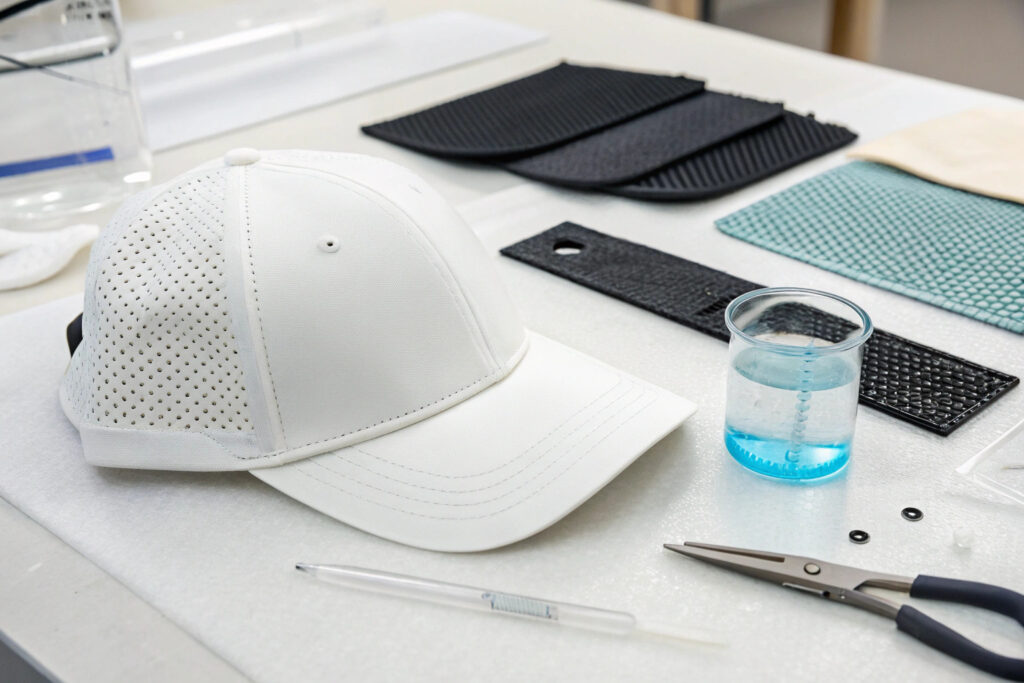
Closed-cell foam is the engine of the floating hat. To understand it, think of a kitchen sponge versus a pool noodle. A sponge is open-cell. It has interconnected air passages. Squeeze it underwater, and the air escapes, replaced by water. The sponge sinks. A pool noodle is closed-cell. Each air bubble is a sealed, independent sphere. You cannot squeeze the air out. The foam remains buoyant even under pressure or when punctured. That is the exact technology we need in a hat brim insert.
We use an EVA closed-cell foam sheet that we die-cut into the exact shape of the golf hat visor. EVA is flexible, lightweight, and has excellent memory. It bends when you pack the hat into a gear bag, but it springs back to its original curved shape. When the hat hits the water, the EVA insert acts as a buoyancy platform across the entire brim area. Unlike a solid plastic insert, EVA foam is stitchable. We sew right through it without creating leak paths that would fill with water. The closed-cell structure ensures that even if a fishhook or a boat cleat punctures the fabric shell, the individual foam cells remain intact and air-filled. One puncture does not cascade into a total buoyancy failure. For our marine retail clients, we also offer a double-layer EVA insert. Two thin sheets laminated together provide redundancy. If one layer compresses or gets cut, the second layer maintains the float. This is the kind of detail you won't find in a generic promotional hat catalog.
Why Is Polyester Mesh Superior to Cotton Mesh for Marine Hat Applications?
Polyester mesh is not just a better option. It is the only viable option for a hat intended to get wet regularly. Cotton mesh, even if treated with a water-repellent spray, will eventually absorb moisture. The spray wears off after a few washes or exposure to salt and sun. Once the cotton fibers absorb saltwater, they hold onto the salt crystals. The salt attracts more moisture from the air, keeping the mesh perpetually damp. This leads to mildew growth and a sour smell that no amount of washing removes completely.
Polyester mesh has a slick, non-porous fiber surface at the microscopic level. Water beads up and rolls off. It does not penetrate the fiber structure. In saltwater environments, this is crucial. Polyester does not degrade from salt exposure. It resists UV radiation far better than cotton, which weakens and turns yellow under constant sun. The open-hole mesh structure we use creates a breathable fabric that also acts as a buoyancy aid when it traps air. Cotton mesh, even in an open-hole weave, collapses when wet. The yarns swell and close the ventilation gaps. The hat becomes a soggy bag on your head. A polyester mesh back hat retains its shape and its cooling airflow even after repeated dunkings. For a customer standing on a boat deck in 95-degree heat, that airflow is a comfort feature. For you as the brand, the durability and shape retention mean fewer returns and higher customer satisfaction.
Which Certifications Should I Require for Marine-Grade Floating Headwear?
When you sell products into the marine retail channel, you are entering a regulatory environment that is stricter than standard apparel. Marine stores and boat dealerships are hyper-aware of product liability. A hat that is marketed as "floating" must actually float. If a customer loses a hat, and the hat was advertised as buoyant, you could face a chargeback or, worse, a safety claim if someone argues they went into dangerous waters trying to retrieve a sinking hat that they believed would float. Certifications are your legal shield and your marketing sword.
The first certification I recommend is a documented buoyancy test report from a recognized third-party laboratory like SGS, Intertek, or Bureau Veritas. This test places the hat in a controlled water tank and measures whether it floats for a specified duration. Our internal standard is that a floating hat must remain on the surface for at least 24 continuous hours without any part of the crown dipping below the waterline. We also require saltwater testing, not just freshwater. Saltwater is denser and provides slightly more buoyancy, but it also degrades materials differently. You need a test that replicates actual ocean conditions.
For the European and North American markets, you need chemical safety certifications. The foam insert, the polyester fabric, and the sweatband adhesive must all comply with REACH regulations in the EU and CPSIA in the United States. These regulations restrict harmful substances like phthalates, lead, and certain flame retardants. A hat that sits on sweaty skin for hours is a high-contact product. The testing is not optional if you sell to major retailers. We also strongly recommend a UPF rating certification for marine hats. A UPF 50+ rating proves the fabric blocks at least 98% of UV radiation. Boaters and anglers spend long hours under direct sun. A UPF-certified floating hat becomes a sun-safety device, which significantly increases its perceived value and retail price point.
How Do I Verify That a Hat Factory's Buoyancy Testing Is Legitimate?
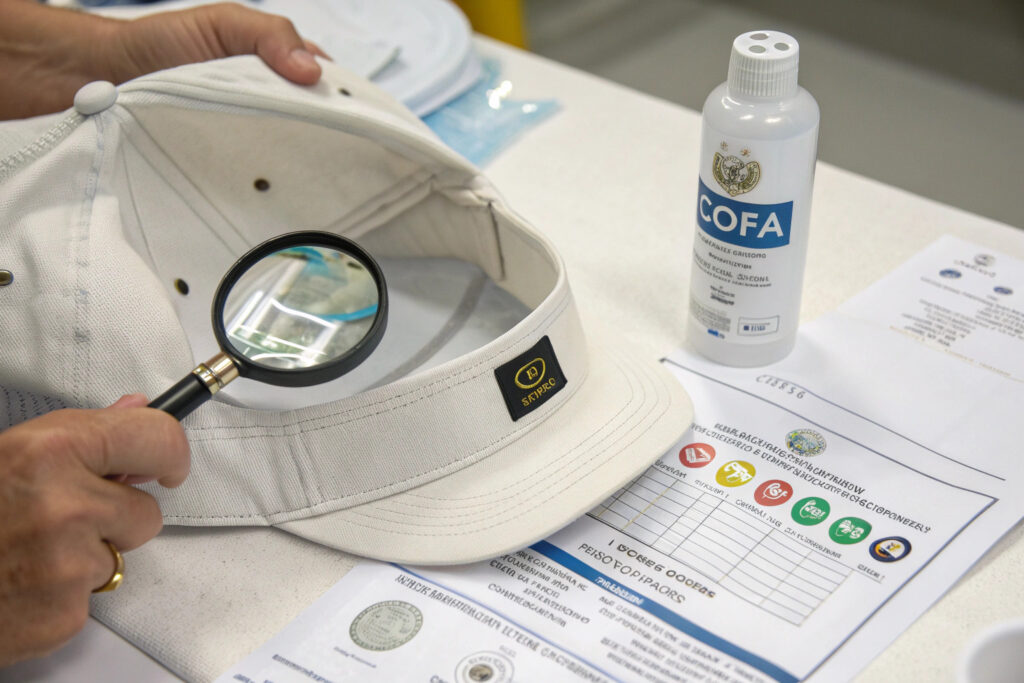
I will be direct. Some factories will send you a video of a hat floating in a kid's inflatable pool and call it a test report. That is not legitimate testing. A legitimate buoyancy test follows a protocol. The test begins with the hat being weighed dry on a calibrated scale. Then the hat is submerged completely and allowed to saturate before being released to float. The test measures the time to surface recovery, the freeboard height, which is the distance the brim sits above the waterline, and the duration of floatation. A certified lab like SGS produces a report with a unique traceable number you can verify on their website.
In our factory, we conduct an in-house pre-test using a method adapted from the ASTM F2129 buoyancy test standard. We use a clear acrylic water column with depth markings. A technician places the hat in the column and records video evidence with a timecode overlay. We then share that raw video and our internal data sheet with the buyer before sending samples to the external lab. This transparency builds trust. If a factory refuses to show you their internal test methodology or cannot name the lab they use for certification, walk away. A genuine marine-grade hat factory treats buoyancy as a measurable engineering property, not a marketing claim. Ask for the test report number. Call the lab. If the report is real, the lab will confirm it.
Why Is a UPF 50+ Rating Critical for Golf Hats Sold in Coastal Resort Shops?
Coastal resort shops are not selling to casual park walkers. They are selling to people who will be on a boat deck, a beach, or a golf course for six to eight hours with zero shade. The sun reflects off the water, doubling the UV exposure. A standard cotton hat provides maybe UPF 15 when dry, and far less when wet. A wet cotton hat stretched over a head lets significant UV radiation pass directly through the weave. That is a sunburn waiting to happen on a customer's scalp, an area notoriously hard to apply sunscreen to.
A UPF 50+ rated polyester hat blocks ultraviolet radiation mechanically through a dense weave and chemically through UV-inhibiting additives in the yarn. The rating stays effective even when the hat is soaking wet, a critical advantage for a floating hat that is, by definition, going to get wet regularly. For the resort shop, this certification allows them to merchandise the hat as a health and wellness product. They can place it next to reef-safe sunscreen and polarized sunglasses. The UPF certification also reduces the shop's liability. They are selling a product that demonstrably protects their customer from a known carcinogen. The price resistance drops significantly when the product moves from a fashion accessory to a functional piece of protective equipment. We have seen our resort clients successfully retail floating UPF 50+ hats at $45 to $60, compared to $25 for a standard unbranded golf hat.
How Do Snapback Closures Perform in Saltwater Versus Traditional Fitted Designs?
The closure system is the Achilles' heel of most hats marketed for water use. A traditional fitted hat has no closure, which sounds ideal. But fitted hats require exact sizing, which creates inventory and SKU complexity for retail. A customer who normally wears a medium might need a large when the hat is worn wet over damp hair. Fitted hats also lack adjustability if the hat stretches from water exposure. The adjustable closure is the practical choice for marine retail, but only if the correct hardware is selected from the start.
We supply almost exclusively plastic snapback closures for our marine-grade hats. A snapback made from high-density polyethylene or polypropylene is completely impervious to saltwater corrosion. It will not rust, pit, or seize up. A metal buckle, even a zinc alloy or brass buckle marketed as "marine grade," will eventually show salt bloom and green oxidation. Brass corrodes in a saline environment. Stainless steel performs better, but it adds weight to the back of the hat, which works against buoyancy. A plastic snapback weighs almost nothing, contributes zero metal ions to the water, and allows the wearer to adjust the fit with one hand, even with wet, slippery fingers.
The secondary benefit is comfort. A plastic snapback sits flat against the back of the head. There is no metal digging into the skull when the wearer leans back in a deck chair or lies on a boat cushion. The plastic posts are injection-molded to be snag-free, so they will not catch on fishing line or loose hair. For brands concerned about the "cheap" perception of plastic, we offer a matte-textured finish on the snapback that mimics a technical outdoor aesthetic. Combined with a subtle laser-etched logo, a plastic snapback looks high-end and rugged, not like a giveaway toy.
Why Do Metal Buckles Corrode and Fail in Marine Hat Applications?
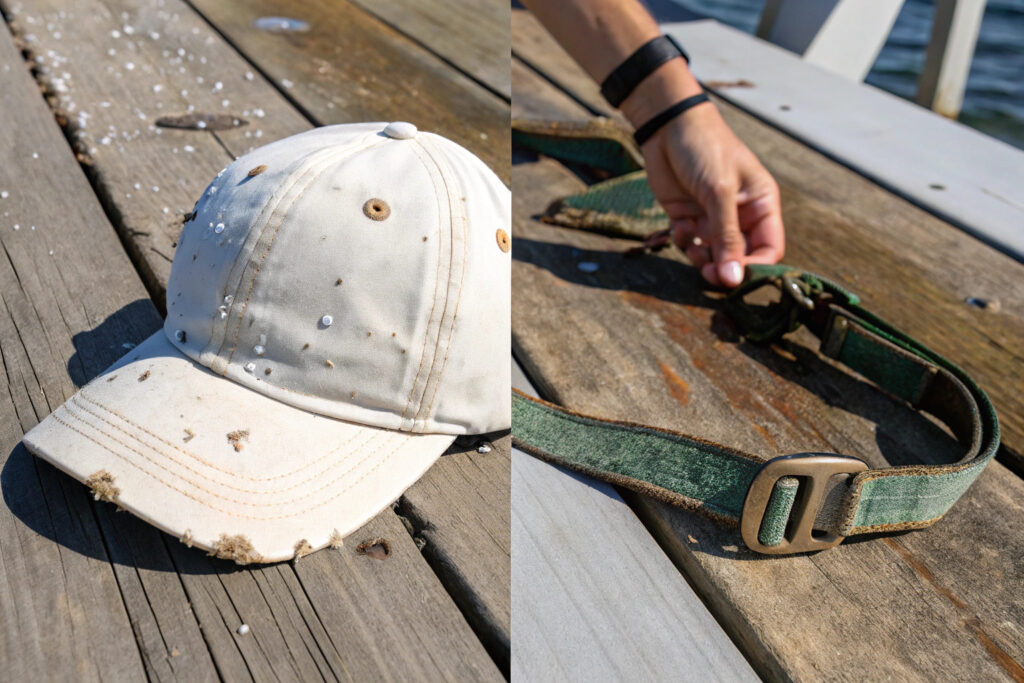
The corrosion process is galvanic and relentless. Saltwater is an electrolyte, meaning it conducts electricity. When a metal buckle sits in a damp saltwater environment, it becomes a tiny battery. Different metals within the alloy, or between the buckle and the grommet it attaches to, create a current. This current strips ions from the metal surface, forming that familiar white or green crust. This is not just cosmetic surface damage. The corrosion physically weakens the metal structure. A buckle post can snap clean off under the tension of a snug fit.
Even plated metals fail quickly. A nickel-plated steel buckle looks shiny when new. But the plating has microscopic pores. Saltwater penetrates those pores and attacks the steel core underneath. The steel swells as it rusts, cracking the plating off in flakes. Within a month of regular marine use, the buckle looks terrible and leaves rust stains on the hat fabric. The corrosion resistance of plastic is essentially infinite in this context. Polypropylene does not react with salt. It does not degrade from UV exposure if UV-stabilized additives are included in the plastic formula. For a product that will live in a wet boat locker or a beach bag, metal hardware is a liability that generates customer complaints and warranty claims. The decision is simple. If the hat is for marine retail, specify a plastic snapback and do not let any supplier talk you into a metal alternative for aesthetics.
How Does a Floating Closure Tab Help Retrieve a Hat That Goes Overboard?
A floating closure tab is a small, brightly colored piece of closed-cell foam or lightweight cork integrated into the back of the snapback strap. Its purpose is visual and physical. When the hat lands on the water, the brim keeps it afloat. But from the deck of a moving boat, a dark navy or black hat can be nearly impossible to spot against the water surface, especially in choppy conditions. A high-visibility orange or neon yellow floating tab provides an instant visual marker that catches the eye.
The tab also serves as a grab point. A standard hat in the water is a flat disc with nothing to hook. A person leans over the gunwale with a boat hook or a net, and the hat slips away with each wave. The floating closure tab creates a loop or a protruding element that can be snagged. We manufacture these tabs from the same closed-cell EVA foam used in the brim, often in a bright contrasting color. They are die-cut in a teardrop or triangular shape and sewn directly into the snapback assembly. The tab is buoyant material that adds zero metal and zero weight penalty. It transforms the hat from a passive floating object into an actively retrievable one. For a fishing charter company that loses hats overboard multiple times a day in a season, that retrieval feature directly saves money and keeps their branded hats visible on the water, not littering the seafloor.
What Customization Options Work Best for UV-Stable Marine Hat Branding?
Branding a marine hat is not the same as branding a streetwear cap. The decoration must survive intense UV exposure, repeated saltwater immersion, and physical abrasion against boat surfaces and fishing gear. I have seen beautiful screen-printed logos peel off in sheets after one summer season. The salt crystallizes under the ink edge and lifts it like a hydraulic jack. The sun fades certain colors to white. A black logo turns into a ghostly grey smudge, and the brand disappears. The customization must be selected for chemical and UV resilience first, and visual impact second.
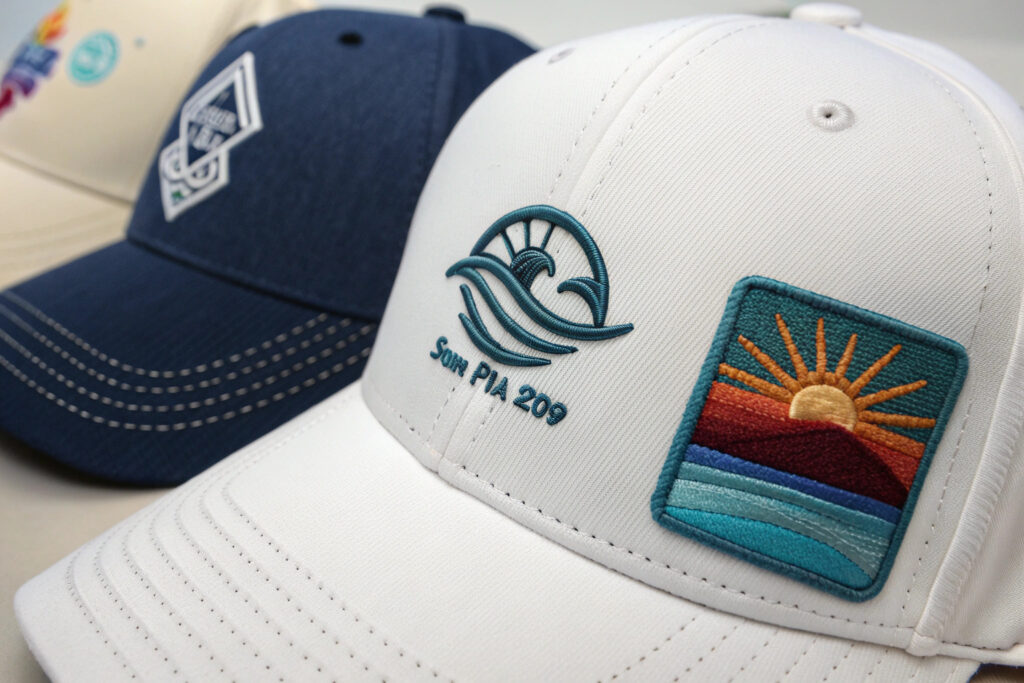
Embroidery remains the most durable option for marine hat branding. A polyester thread embroidered directly into the polyester crown fabric creates a permanent mechanical bond. There is no adhesive to break down, no ink to oxidize. The thread itself is UV-stabilized. We use a high-tenacity polyester embroidery thread with a proprietary UV inhibitor package. It resists fading for years of direct sun exposure. The stitch density must be carefully controlled. Too loose, and the threads snag on fishhooks. Too tight, and the needle perforations weaken the hat fabric and create leak points. We run the embroidery at a specific tension that creates a slightly raised, dimensional logo without tearing the base material.
For brands that want a patch aesthetic, silicone patches are an excellent choice. Silicone is naturally UV-stable and hydrophobic. It does not absorb water, it does not fade in a predictable way, and it can be molded into intricate 3D shapes. We bond silicone patches to the hat crown using a high-frequency welding process, not glue. This creates a molecular bond between the silicone and the polyester fabric that saltwater cannot penetrate. The result is a flexible, rubbery logo that looks premium and survives machine washing and saltwater soaking without any edge lifting.
Why Does High-Tenacity Polyester Thread Outperform Cotton Thread for Marine Embroidery?
Cotton thread rots in a marine environment. It is an organic cellulose fiber that absorbs saltwater and becomes a food source for mold and bacteria. Within weeks, the cotton thread weakens. The embroidery loses its structural integrity and starts to fuzz and break. A customer runs a finger over the logo, and the thread disintegrates into lint. The hat looks old and cheap.
High-tenacity polyester thread is a completely synthetic polymer. It has a breaking strength significantly higher than cotton of the same thickness. It stretches slightly under load and recovers, so when the hat fabric stretches on the head, the embroidery stretches with it and does not snap. It is also colorfast to an extreme degree. We have tested our black polyester embroidery thread in a QUV accelerated weathering chamber for 500 hours. The color change was less than one delta E value, invisible to the naked human eye. Cotton thread in the same test faded to a brownish grey in less than 100 hours. If your brand logo relies on specific Pantone colors, and I know most do, polyester thread is the only way to ensure that logo looks the same on the hat in October as it did when it left our factory in March.
How Does a Silicone Patch Compare to Direct Embroidery for Saltwater Longevity?
Silicone patches and embroidery are both excellent, but they offer different advantages. Embroidery is the most integrated option. It becomes part of the hat fabric. It cannot delaminate because there is no laminate. Silicone patches offer a different aesthetic, a raised, rubbery, modern look that many outdoor and fishing brands prefer. The key to silicone longevity is the attachment method. A poorly adhered patch will separate from the hat crown when saltwater creeps under the edge and expands as it dries.
Our welding process eliminates the glue layer entirely. The silicone patch and the polyester fabric are fused using radio frequency energy that melts a thin layer of the silicone into the fibers of the crown. The bond is hermetic, meaning nothing can get between the patch and the hat. Silicone itself is inert. It does not react with salt, it does not oxidize, and it can be cleaned with a simple wipe. Colors are molded into the silicone, so they cannot scratch off. For a marine retail brand, a molded silicone patch with a raised logo and a subtle texture feels like a piece of nautical equipment. It communicates durability and water-readiness at the point of sale, an immediate visual differentiator from the cotton logo hat sitting next to it on the shelf.
Conclusion
Sourcing a floating mesh-back golf hat for marine retail is a specialized mission. It is not about finding a cheap cap and waterproofing it with a spray. It is about starting from a floating-first material philosophy. Polyester fabric, closed-cell EVA foam brim inserts, hydrophobic mesh, plastic snapback closures, and UV-stable branding methods all work together as a system. When engineered correctly, the hat floats reliably for hours, resists salt corrosion, protects against the sun, and lasts for seasons of hard use on the water.
The demand from marine retailers is real and growing. Boaters, anglers, and resort guests want performance headwear that solves a genuine problem. They want to retrieve their hat when it blows off, not watch it sink. They want a closure that works with wet hands and does not rust. They want a logo that still looks sharp after a summer of salt spray. These are not unreasonable requests. They are the baseline expectations of a customer paying a premium price for a specialized product.
If your brand is ready to launch a floating hat program for the marine channel, we have the materials, the testing protocols, and the production experience to bring your design to the water. At Global-Caps, we keep closed-cell EVA foam and high-tenacity polyester thread in stock as standard components, not special-order oddities. We test flotation in-house so you don't have to discover failures through customer complaints. For a detailed consultation on your marine hat project and to receive a buoyancy-tested sample against your design brief, contact our Business Director Elaine. She can walk you through material options, certification timelines, and customization techniques specific to saltwater performance. Reach her at elaine@fumaoclothing.com.