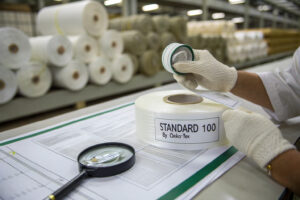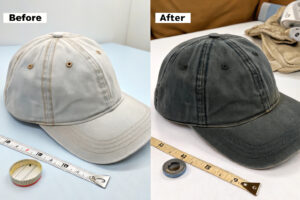
Your marketing team has a brilliant concept. A summer promotional event on a boardwalk, in a park, at a music festival. The giveaway item is a custom-branded visor. It must be light, cool, and perfectly aligned with your company's new sustainability pledge. You cannot hand out petroleum-based plastic visors that will sit in a landfill for 500 years. The entire item, the brim, the sweatband, the strap, the packaging, must be biodegradable or compostable. You begin searching online. You find a few companies offering "eco visors." The product photos look suspiciously like standard polyester visors with a green leaf added to the website banner. You request material specifications, and the suppliers go silent or send vague marketing language. You realize you are navigating a category where the word "biodegradable" is often more of a branding exercise than a material fact.
Sourcing genuinely biodegradable visors is a specialized challenge that sits at the intersection of material science, product engineering, and supply chain transparency. I run Global-Caps, and I have developed biodegradable headwear solutions for brands that needed verified, certifiable sustainability claims, not just green packaging. In this article, I will guide you through the material options that actually biodegrade, the certification standards that separate fact from greenwashing, the supply chain sources for these materials, and the manufacturing partners who can turn them into a visor that performs at a summer event and then returns to the earth.
What Materials Can a Visor Be Made From That Are Actually Biodegradable?
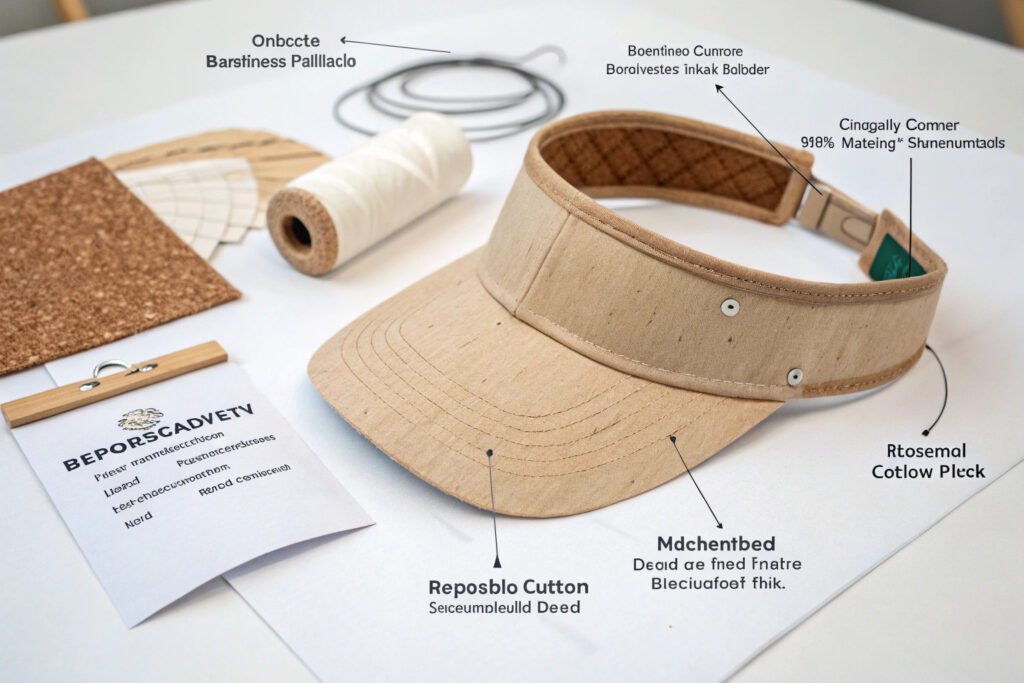
A truly biodegradable visor is not made from a single material. It is a composite product, and every component must be biodegradable for the claim to be honest. A visor with a biodegradable brim but a polyester sweatband is not a biodegradable visor. It is a mixed-waste product that cannot be composted or biodegraded without disassembly. The consumer cannot separate the components, so the entire product ends up in the landfill. The sourcing challenge is to find biodegradable alternatives for each component: the brim substrate, the crown fabric, the sweatband, the closure strap, the sewing thread, the label, and the packaging.
The brim is the most structurally demanding component. It must be stiff enough to hold its curve, resilient enough to survive being bent and packed, and yet biodegradable. The best biodegradable brim substrate I have worked with is a compressed bamboo fiber board. Bamboo is technically a grass, not a wood, and it is one of the fastest-renewing resources on the planet. The fibers are processed into a non-woven board material that can be die-cut into visor brim shapes. It has a natural stiffness similar to traditional visor board but will biodegrade in industrial composting conditions. An alternative is a bioplastic sheet made from polylactic acid, which is derived from fermented corn starch or sugarcane. PLA can be thermoformed into a brim shape and has good stiffness. However, PLA biodegradation requires specific industrial composting conditions, high temperature and humidity, and will not break down in a home compost pile or in the ocean. The claim must be specific: "industrially compostable," not generically "biodegradable." I prefer bamboo board for its simpler, more robust biodegradation pathway.
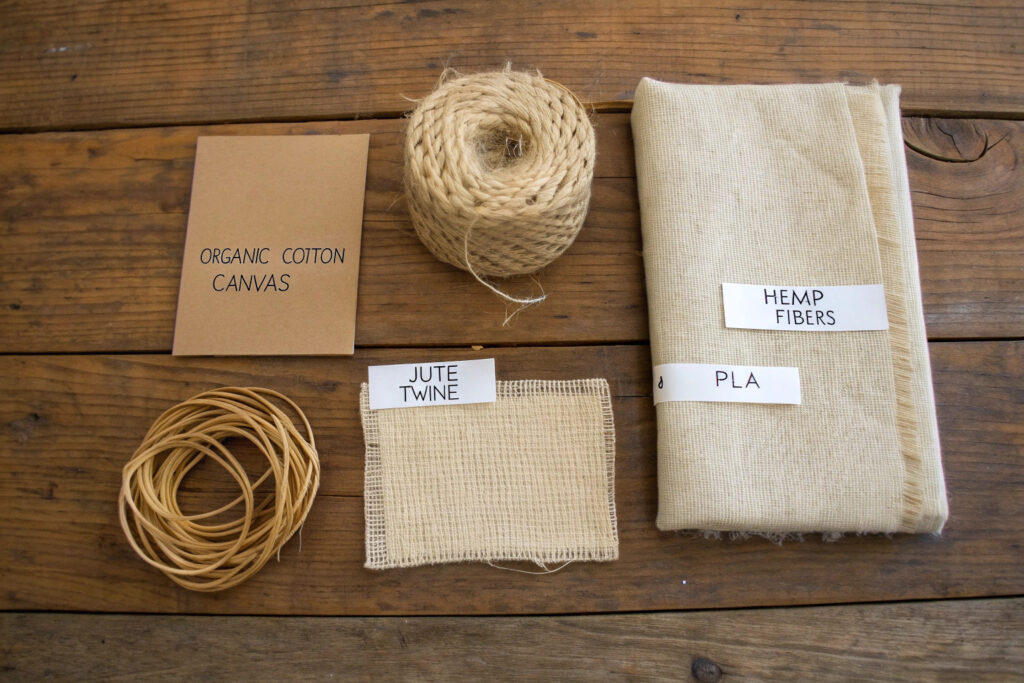
The crown fabric, sweatband, and strap can be made from certified organic cotton canvas, hemp, or a hemp-organic cotton blend. These natural fibers are inherently biodegradable. The sewing thread must also be natural. Standard polyester thread is plastic and will not biodegrade. The thread will remain as a ghost skeleton long after the cotton fabric has decomposed. The solution is a cotton sewing thread with a biodegradable coating, or a PLA thread if the industrial composting pathway is acceptable. The labels and hangtags must be printed on uncoated, FSC-certified paper with soy-based inks, attached with cotton string. The packaging must be plastic-free, using glassine paper bags or FSC-certified kraft boxes with cellulose windows. The entire product system must be engineered for end-of-life.
How Does Bamboo Fiber Compare to Traditional Plastic Visor Board?
Traditional visor board is a petroleum-based material, typically a polyethylene or polypropylene sheet laminated with a non-woven fabric. It is inexpensive, waterproof, and durable for decades. It is also a permanent plastic pollutant. A visor made with this board will outlive the wearer, the brand, and possibly the landfill it ends up in.
Bamboo fiber board has a different performance profile that must be understood for a successful product. It is naturally breathable, which is a comfort advantage in a summer visor. It is slightly less rigid than plastic board, which produces a softer, more organic brim curve. This can be aesthetically desirable for a natural, eco-conscious product. It is more susceptible to moisture absorption. If the visor is soaked in water repeatedly, the bamboo board can swell and lose some stiffness. This is generally acceptable for a promotional item intended for occasional summer use, but it must be communicated clearly to the customer. The board can be sealed with a natural, biodegradable wax coating to improve water resistance without compromising the end-of-life biodegradability. The cost of bamboo board is higher than plastic board, typically two to three times, but for a premium eco-conscious promotional product, the cost is often within budget and is offset by the marketing value of the authentic sustainability story.
What Is the Role of PLA Threads and Bioplastic Components?
PLA is a versatile bioplastic for components that require specific performance characteristics. PLA sewing thread has the strength and sewability of polyester thread but will hydrolyze and biodegrade in an industrial composting environment. PLA can also be injection-molded to create size adjusters, buckles, or cord locks if the visor design includes an adjustable strap. Conventional visors use acetal or nylon for these hardware components, which are durable plastics but not biodegradable. PLA hardware provides the same functionality with a compostable end-of-life option.
The limitation of PLA is its thermal sensitivity. It begins to soften at around 60 degrees Celsius. A PLA visor left on the dashboard of a car on a hot summer day could deform. This is an important use-case consideration for a promotional product that may be distributed and used in high-heat environments. I advise clients using PLA components to include a care instruction on the packaging: "Store away from direct high heat. Compostable at end of life." Transparency about the material's behavior builds trust and prevents customer disappointment. The alternative to PLA for hardware is simply eliminating plastic hardware entirely. A visor can be designed with a fixed circumference, using a fabric strap and a natural cord tie, or a button-and-elastic loop closure made from organic cotton elastic woven with natural rubber threads. This design-for-disassembly approach simplifies the material palette and makes the biodegradability claim robust.
What Certifications Verify That a Visor Is Genuinely Biodegradable?
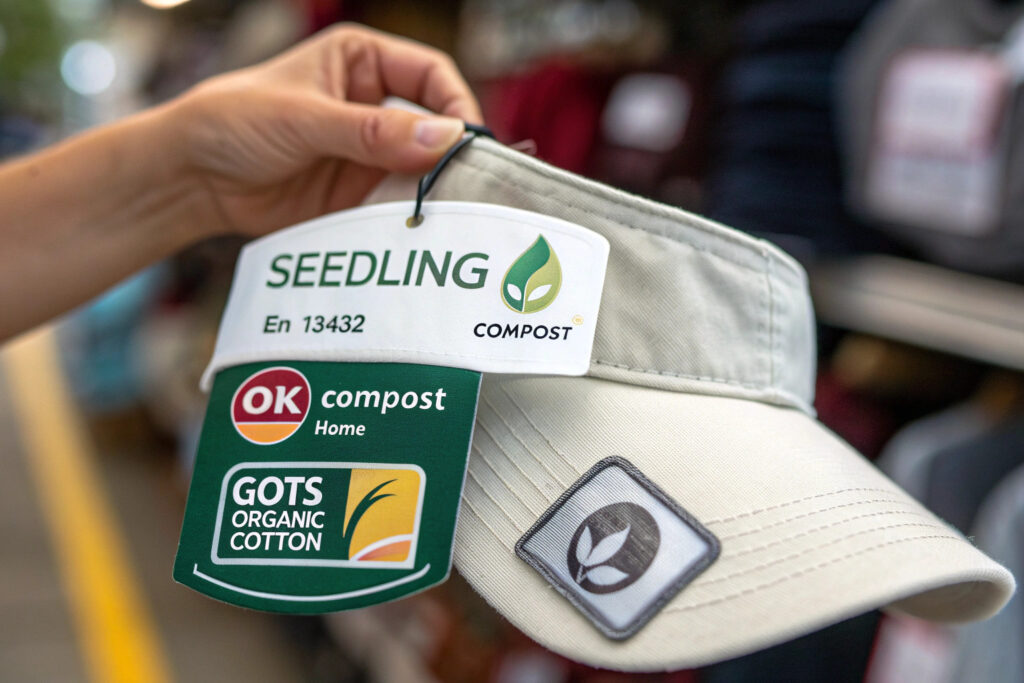
The word "biodegradable" on a product label is unregulated in many jurisdictions and is frequently used without substantiation. A claim that a visor is biodegradable must be supported by a recognized third-party certification that specifies the conditions and timeline of biodegradation. Without this certification, the claim is marketing opinion, not environmental fact. The two most relevant certifications for a biodegradable visor are the EN 13432 standard for industrial compostability and the OK Compost HOME standard for home compostability.
EN 13432 requires that the product disintegrates within 12 weeks and biodegrades by at least 90% within 180 days under industrial composting conditions, which include controlled temperature, humidity, and microbial activity. The certification is issued by bodies such as TUV Austria and DIN CERTCO. Products that pass earn the Seedling logo. OK Compost HOME has stricter requirements. The product must biodegrade at ambient temperatures in a home compost pile within 12 months. This is a higher bar and is more meaningful for a consumer product that may end up in a backyard bin. If the visor is certified to OK Compost HOME, the consumer can literally bury it in their garden at the end of its life. This is a powerful marketing story. At Global-Caps, when we develop a fully compostable product, we target the OK Compost HOME certification because it is the most credible and consumer-relevant standard.
Beyond compostability, the natural fiber components should have their own certifications. The organic cotton should be certified to GOTS. The bamboo board should come from an FSC-certified source, ensuring the bamboo was responsibly harvested. The inks and dyes should be certified to OEKO-TEX Eco Passport or meet GOTS chemical requirements. These certifications build a complete, auditable sustainability package. A buyer evaluating a biodegradable visor supplier should request copies of the actual certificates, not just logos on a product photo, and should verify the certificate numbers on the issuing body's public database. A legitimate eco-supplier will provide this documentation proactively.
What Is the Difference Between "Biodegradable" and "Compostable" in a Product Claim?
This distinction is critical and often misunderstood. "Biodegradable" means that the material will eventually be broken down by microorganisms into water, carbon dioxide, and biomass. It does not specify a timeline, an environment, or the absence of toxic residues. A plastic visor might be technically biodegradable over 10,000 years. The claim is true but meaningless. "Compostable" means the material will biodegrade within a specified timeframe, typically six months to a year, under specific composting conditions, and will leave no toxic residues. It is a defined, measurable claim.
For a promotional visor that will be handed to consumers, "compostable" is the correct claim if the product is certified. If the product is only industrially compostable, the claim should be "industrially compostable," and the consumer should be informed that the visor should be disposed of in a municipal composting facility where available, not in home compost or regular trash. Vague "biodegradable" claims are a red flag for greenwashing. I train my sales team to use precise language with clients. We do not sell "eco visors." We sell visors that are "certified to OK Compost HOME for home composting" or "made with GOTS-certified organic cotton and FSC-certified bamboo." The specificity is the proof.
How Can I Verify a Supplier's Compostability Certificate?
The verification process is straightforward. Request the certificate document from the supplier. The document will have a certificate number, the name of the certification body, such as TUV Austria, DIN CERTCO, or the Biodegradable Products Institute in North America, and the scope of certification, which should specifically list the visor product or its component materials. Visit the certification body's website and use their certificate validation tool. Enter the certificate number. Confirm that the certificate is valid, that the certified entity matches the supplier's legal name, and that the scope covers visors or headwear.
If the supplier cannot provide a valid certificate number that you can independently verify, do not place an order. The risk of receiving a conventional plastic visor with a green label is too high. I have built our biodegradable product line on transparent, verifiable certifications. I provide clients with a compliance pack that includes copies of all relevant certificates and direct links to the verification databases. This documentation is their defense against greenwashing accusations and their marketing team's source material for legitimate sustainability storytelling.
What Design Considerations Maximize the Biodegradability of a Visor?
The biodegradability of a visor is not just a material choice. It is a design philosophy. A visor can be made from biodegradable materials but still be designed in a way that prevents biodegradation. For example, a bamboo brim board fused with a non-biodegradable adhesive to a polyester lining is a composite that will not compost cleanly. The design must follow principles of material purity and disassembly. Every component should be either naturally biodegradable or industrially compostable, and components with different degradation pathways should be easily separable or, ideally, designed to degrade together.
The best design strategy is monomaterial thinking. Use the same fiber family for all textile components. If the crown is organic cotton, the sweatband should be organic cotton, the strap should be organic cotton, and the thread should be cotton. This creates a product where every textile element degrades at the same rate and in the same conditions. The brim board, even if it is a different material like bamboo, is easily separable or will degrade alongside the cotton in a composting environment. Avoid blended materials. A cotton-polyester blend crown defeats the purpose. The polyester fraction will remain as microplastic particles in the compost. Pure, single-fiber construction is the gold standard for end-of-life.
The closure system is a common design pitfall. A traditional plastic snap or Velcro closure introduces a non-biodegradable element that is difficult for the consumer to remove. Design the visor with a fixed, sized circumference, like a fitted cap, or with a natural adjustment system. A fabric strap that ties in a bow at the back, a cotton drawstring with a wooden bead cord lock, or an elastic loop made from natural rubber and organic cotton are all biodegradable solutions. The design should be elegant in its simplicity. The absence of plastic hardware is not a limitation; it is a design feature that communicates the product's eco-consciousness more effectively than any logo.
How Does Dyeing and Printing Chemistry Affect Biodegradability?
The dyes and inks used on the visor must be compatible with the composting environment. Some synthetic dyes contain heavy metals or persistent organic pollutants that will contaminate the compost. The dye chemistry must be certified as safe for the intended end-of-life pathway. GOTS-approved dyes, low-impact fiber-reactive dyes, and natural dyes derived from plants or minerals are appropriate choices.
Screen-printing inks for branding must be PVC-free and phthalate-free. Water-based inks that cure without toxic solvents are the standard. Soy-based or algae-based inks are emerging alternatives with excellent sustainability profiles. The ink chemistry certification should be part of the supplier's compliance pack. At our factory, we use GOTS-approved dyes and water-based printing inks for all biodegradable products. We maintain a positive list of approved chemicals that have been vetted for compost compatibility. This chemical discipline is invisible to the consumer but essential to the integrity of the product.
What Is the Shelf Life of a Biodegradable Visor, and How Should It Be Communicated?
A legitimate concern for a promotional product is its shelf life before distribution. A visor designed to biodegrade should not begin degrading on the shelf in a warehouse. The biodegradation process requires specific conditions, moisture, warmth, and microbial activity. A biodegradable visor stored in a dry, cool warehouse in its packaging will remain stable for years. The shelf life is not a practical limitation.
However, the consumer communication must be clear. The packaging should include a statement such as, "This visor is designed for a useful life of one summer season. When you are ready to retire it, please compost at home or in an industrial composting facility. Do not discard in the regular trash." This statement sets the expectation that the product is not immortal. It has a life cycle. This is a feature of the product, not a defect. The brand that communicates this honestly and poetically builds a deep connection with the eco-conscious consumer. I help my clients craft this end-of-life messaging for their packaging and marketing materials.
How Do I Identify and Vet a Factory That Can Actually Produce Biodegradable Visors?
Finding a factory that markets "eco visors" is easy. Finding a factory that can actually produce a fully certified, biodegradable visor with auditable material traceability is a different challenge. The factory must have experience with natural fiber construction, access to certified biodegradable material supply chains, a production environment that prevents cross-contamination with conventional synthetic materials, and a quality control system that verifies the biodegradability of the finished product.
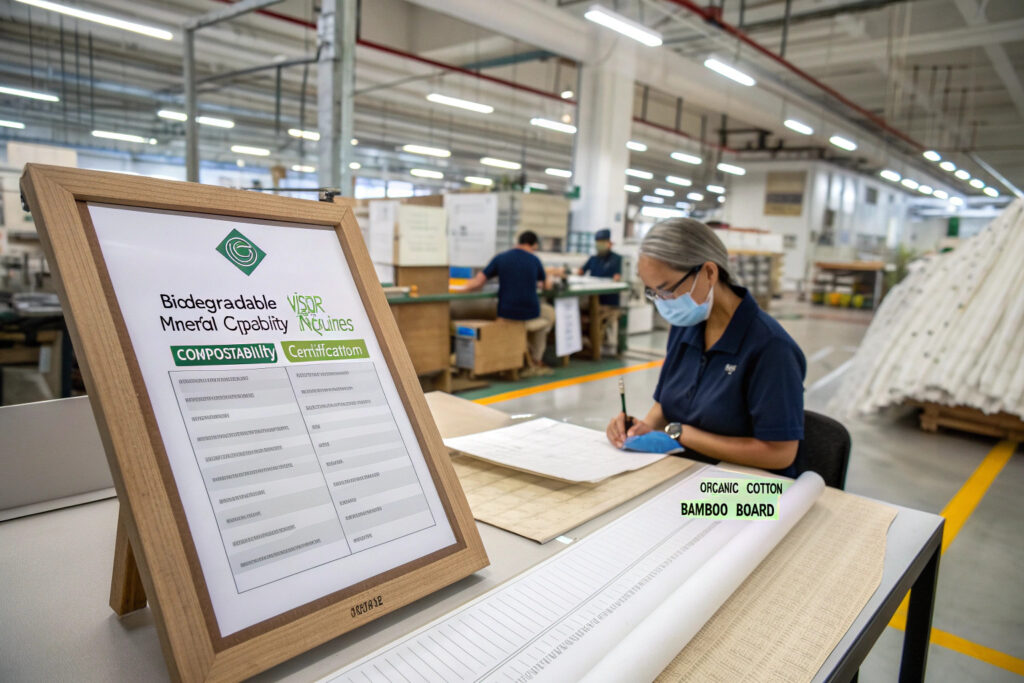
The vetting process begins with a material capability inquiry. Ask the factory to list every component of their biodegradable visor, with the material specification and the compostability certification for each component. A legitimate factory will provide a component-level bill of materials with certifications. A pretender will provide a single, vague "eco-friendly visor" description. Next, request a virtual tour focused on material storage. Ask the guide to show you the organic cotton fabric inventory and the bamboo board inventory. Ask to see the cutting area. A factory that genuinely produces biodegradable products will have dedicated, segregated material storage and cutting areas to prevent mixing with conventional synthetic materials. If you see polyester thread cones or plastic brim board in the same production area, the risk of cross-contamination is high. The factory's commitment to segregation is a visible indicator of their seriousness.
Finally, request a pre-production sample and commission independent compostability testing. Send the sample to a certified composting laboratory and request a disintegration test according to ISO 20200 or a similar standard. This is an expense, but it is the definitive verification. A factory that is confident in its product will welcome independent testing. A factory that resists or makes excuses is likely aware that their product will not pass. At Global-Caps, we have had our biodegradable visor tested by an external lab, and we provide the test report to clients as part of our qualification package.
How Can I Verify That the Factory's Supply Chain Is Truly Biodegradable?
The factory's own claims are only as good as their upstream suppliers. Request the transaction certificates or purchase records for the biodegradable materials. The bamboo board should come from an FSC-certified mill. The organic cotton fabric should come from a GOTS-certified weaver. The PLA thread should come with a compostability certificate from the polymer manufacturer. The factory should be able to trace each biodegradable component back to a certified source.
I maintain a supply chain map for our biodegradable product line. The map shows each material, its supplier, its certification body, and its certificate number. I provide this map to clients. It is a living document that is updated as suppliers are re-audited. This level of transparency is the standard for a legitimate eco-supply chain. A factory that cannot or will not share its supply chain map is either sourcing from uncertified, unverified suppliers or is simply assembling conventional materials with a green marketing story.
What Questions Expose a Factory's Real Eco-Capability?
Ask these specific, direct questions during the vetting process. "What is the biodegradation standard and certification your visor meets?" A correct answer is "OK Compost HOME certified by TUV Austria, certificate number X." Any answer that does not include a standard number and a certifier name is insufficient. "What is the sewing thread made from?" A correct answer is "100% GOTS-certified organic cotton with a biodegradable coating" or "PLA certified to EN 13432." If the answer is "polyester core-spun thread," the visor is not fully biodegradable, regardless of the brim material.
Ask, "Can you provide a video of your material storage area showing the segregation of natural and synthetic materials?" A factory that can do this has the physical infrastructure for eco-production. Ask, "What is your procedure for cleaning the cutting tables between synthetic and natural fiber runs?" A factory that has a documented clean-down procedure understands cross-contamination risk. A factory that seems confused by the question does not have the procedure. These questions separate the genuinely capable eco-manufacturers from the greenwashers. They are the questions I would want a buyer to ask me, because I have good answers for every one.
Conclusion
Sourcing biodegradable visors for an eco-conscious summer promotional event is a journey into the specifics of material science, certification standards, and supply chain integrity. The product you seek is not a conventional visor with a green sticker. It is a carefully engineered system where every component, the brim board, the fabric, the thread, the ink, the label, the packaging, is designed to return safely to the earth after its useful life. Bamboo fiber board, organic cotton, hemp, PLA bioplastic, and natural sewing threads are the materials that make this possible. OK Compost HOME certification, GOTS, and FSC are the standards that verify the claim.
Your promotional event is an opportunity to demonstrate your brand's values through a physical product that consumers can touch, wear, and ultimately compost. A genuine biodegradable visor is a conversation starter, a tangible embodiment of your sustainability commitment. A fake one is a reputation risk that can explode into a greenwashing scandal. The difference is in the documentation, the certification, and the supplier's transparency.
If you are ready to source biodegradable visors that are certified, tested, and manufactured with full supply chain traceability, I invite you to partner with Global-Caps. We have developed a fully compostable visor platform that can be customized with your brand's colors, logo, and packaging. We provide a complete compliance documentation package, including OK Compost certification, GOTS certificates, and a supply chain map. Reach out to our Business Director, Elaine, at elaine@fumaoclothing.com with your event details and branding requirements. Let's create a visor that shades your customers from the summer sun and then, when its work is done, returns quietly to the soil, leaving no trace but a memory of your brand's integrity.