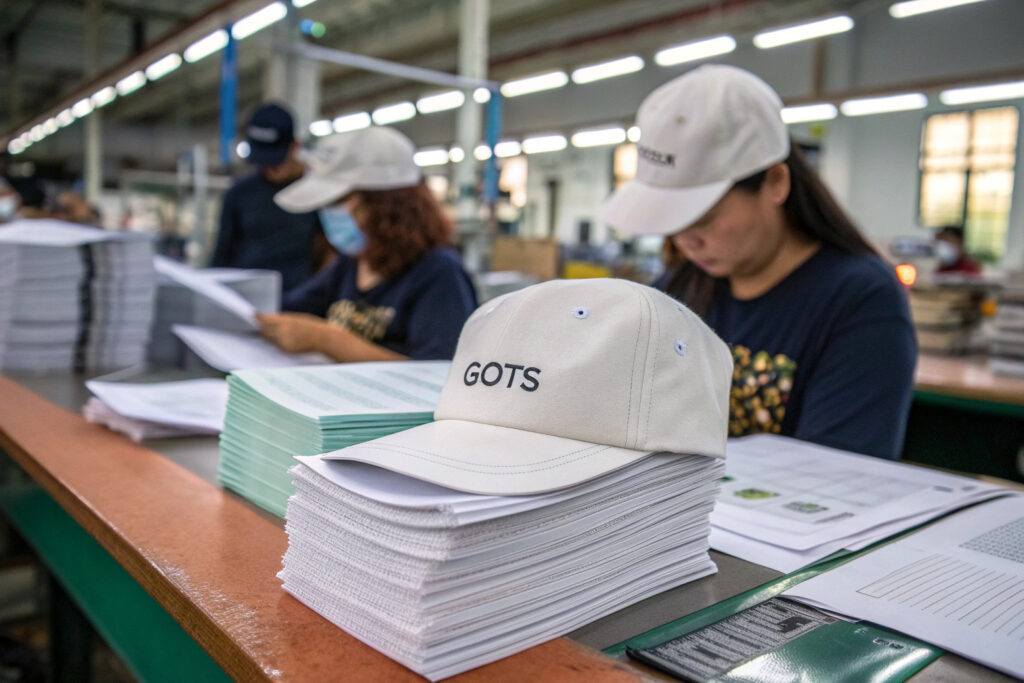
You launch a cap collection. You label it "Eco-Friendly." You write "Made with Sustainable Materials" on the hangtag. A consumer emails you. "What materials? Where from? Prove it." You email the factory. The factory sends a one-line email: "We use eco-friendly materials." That is not proof. That is a word. The consumer posts your response on social media. "This brand cannot prove their eco claims. Greenwashing." Your launch is now a PR crisis. The word "eco-friendly" without documentary evidence is a liability.
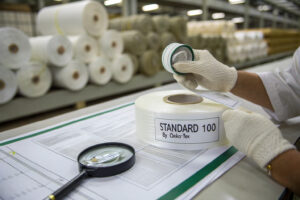
The supply chain documents that prove your custom caps are truly eco-friendly are third-party certifications and transaction records that trace the material from its certified origin to the finished product. For organic cotton caps, you need the GOTS scope certificate and the transaction certificates tracing the cotton from the farm to the gin to the spinner to the knitter to the cap factory. For recycled polyester caps, you need the GRS scope certificate and the transaction certificates tracing the recycled content from the bottle collection point to the flake producer to the yarn spinner to the cap factory. For chemical safety, you need the OEKO-TEX Standard 100 certificate with the appendix listing every component. For carbon footprint claims, you need a third-party life cycle assessment or a carbon neutrality certification from an accredited body. The eco-friendly claim is not a single document. It is a chain of documents.
At Global-Caps, I provide my clients with a complete eco-compliance pack for every order. The pack includes the GOTS or GRS scope certificate, the full chain of transaction certificates, the OEKO-TEX certificate with the appendix, and the carbon footprint audit report. The documents are verified by third-party certification bodies. The claims are backed by evidence.
What Is the Difference Between a GOTS Scope Certificate and a Transaction Certificate?
You ask the factory for the GOTS certificate. They send the scope certificate. It lists the factory name and the certified product categories. You think this proves your caps are organic. You are wrong. The scope certificate proves the factory is licensed to handle organic cotton. It does not prove that your specific caps were made from organic cotton. The scope certificate is a driver's license. The transaction certificate is the receipt for the specific fuel purchased. You need the receipt.
A GOTS scope certificate is the license issued by the certification body to a specific facility. It states the facility is approved to process certified organic textiles. It lists the processing stages covered—spinning, knitting, dyeing, sewing—and the product categories. It is valid for one year after a successful audit. A GOTS transaction certificate is the batch-specific document issued for each sale of certified organic material. It traces the material from the seller to the buyer. It states the quantity, the fiber composition, the organic content percentage, and the TC number of the previous input material. A chain of TCs traces the organic cotton from the farm to the finished cap.
My GOTS documentation pack for each order includes the scope certificate and the complete chain of transaction certificates.
The transaction certificate chain is the forensic audit trail. Each TC references the previous TC in the chain.
How Many Transaction Certificates Should Trace a Cap From Farm to Finished Product?
A typical organic cotton cap supply chain requires five to seven transaction certificates. The farm sells the seed cotton to the gin. TC 1 is issued. The gin sells the cotton lint to the spinner. TC 2 is issued. The spinner sells the yarn to the knitter or weaver. TC 3 is issued. The knitter or weaver sells the fabric to the dye house. TC 4 is issued. The dye house sells the finished fabric to the cap factory. TC 5 is issued. The cap factory sells the finished caps to the brand. TC 6 is issued.
Each TC references the previous TC number. The chain is unbroken. The final TC for the finished caps contains the full traceability back to the farm. A missing TC breaks the chain. The organic claim cannot be verified beyond the break.
My TC chain documentation is complete for every order. The TC numbers are sequential and verifiable with the certification body.
Can a Factory's Scope Certificate Be Valid While Their TC Chain Is Broken?
Yes. A factory can hold a valid, current scope certificate and still have a broken TC chain for a specific order. The scope certificate is a standing license. The TC chain is the per-order documentation. If the factory bought organic cotton fabric but lost the transaction certificate from the fabric supplier, they cannot issue a valid TC for the finished caps. The caps cannot be labeled GOTS certified, even though the factory is GOTS certified.
The scope certificate must be valid. The TC chain must be complete. Both conditions must be met for the product to carry the GOTS label.
My pre-production compliance check verifies that the TC chain is complete before the GOTS labels are sewn into the caps.
What Does a GRS Certificate Prove About Recycled Polyester Caps?
You order caps made from "recycled polyester." The factory sends a certificate that says "GRS Certified." The certificate lists the factory name. You accept it. You label the caps "100% Recycled Polyester." A consumer asks: "How much recycled content? 100% or 50%? Where did the bottles come from?" You cannot answer. The GRS certificate you received was the scope certificate. It did not state the recycled content percentage for your specific caps. The percentage could be anywhere from 50 to 100 percent. The claim "100% Recycled" is unverified. The GRS scope certificate proves the factory handles recycled materials. The GRS transaction certificate proves the percentage.
A GRS certificate proves the recycled content percentage and the chain of custody for recycled polyester caps. The scope certificate states the factory is GRS certified. The transaction certificate states the exact percentage of recycled content in the specific batch—typically 50 percent minimum for the GRS label, with the exact percentage stated. The TC chain traces the recycled polyester from the waste source to the finished cap. A valid GRS label on a product must state the recycled content percentage. The certificate supports that stated percentage.
My GRS documentation for each order includes the scope certificate and the TC showing the recycled content percentage for that specific batch.
The recycled content percentage on the GRS label must match the percentage on the transaction certificate exactly.

What Is the Minimum Recycled Content Percentage for the GRS Label?
The GRS standard requires a minimum of 50 percent recycled content for a product to carry the GRS label. The label must state the exact percentage. A product with 60 percent recycled polyester and 40 percent virgin polyester is labeled "This product contains 60% recycled polyester - GRS Certified." A product with 100 percent recycled polyester is labeled "100% recycled polyester."
A product with less than 50 percent recycled content cannot carry the GRS label. It may qualify for the RCS label, which has a 5 percent minimum but does not include social or chemical criteria.
My GRS-labeled caps contain 100 percent GRS-certified recycled polyester. The label states the exact percentage.
How Does the GRS Chemical Management Requirement Support Eco-Friendly Claims?
The GRS standard includes mandatory chemical management requirements for all processing stages. The certified facility must have a chemical management system that restricts hazardous substances. The chemicals used in the recycling process, the spinning, and the dyeing must meet the GRS limits, which are aligned with the ZDHC Manufacturing Restricted Substances List.
A GRS-certified recycled polyester cap is not just recycled. It is also chemically safer. The GRS chemical management requirement adds a layer of credibility beyond the recycled content claim alone.
My GRS chemical compliance is verified during the annual audit. The chemical inventory and the wastewater test reports are reviewed by the certification body.
What Role Does a Carbon Footprint Audit Play in Verifying Eco-Friendly Caps?
You claim your caps are "low carbon." A regulator asks for the carbon footprint calculation. You do not have one. The claim was an estimate. A guess. A marketing phrase. The regulator issues a fine for unsubstantiated environmental claims under the EU Green Claims Directive. The claim without a calculation is a liability. The carbon footprint audit is the calculation.
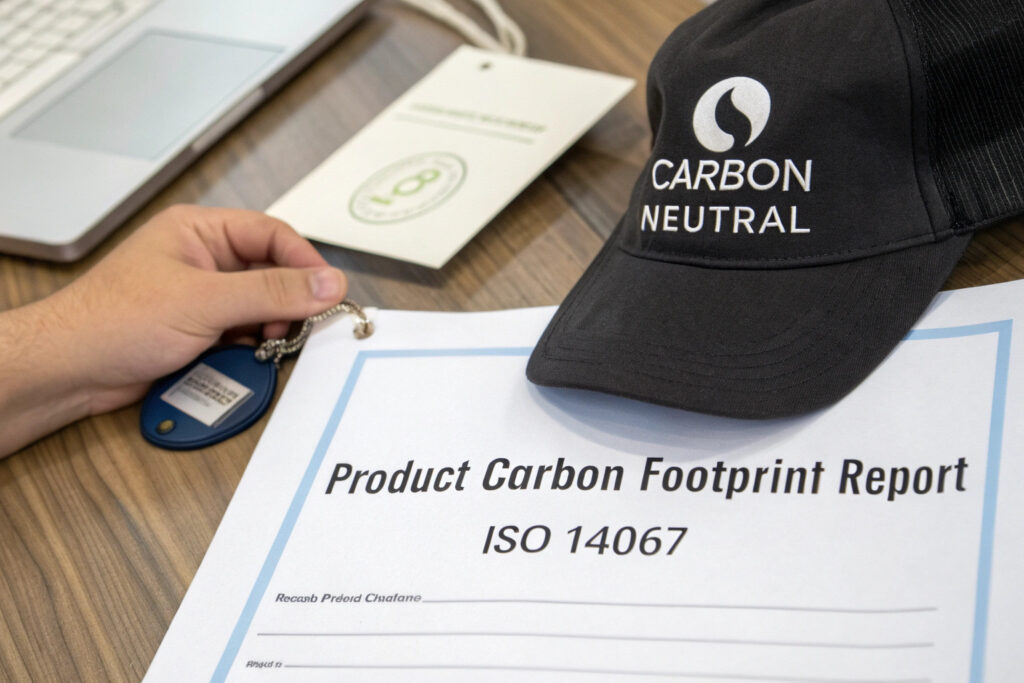
A carbon footprint audit verifies eco-friendly cap claims by quantifying the greenhouse gas emissions associated with the product's lifecycle. The audit follows the ISO 14067 standard for product carbon footprint. It calculates the emissions from raw material extraction, manufacturing, transportation, use, and end-of-life. The result is a carbon footprint per cap, typically expressed in kilograms of CO2 equivalent. A third-party verification of the calculation adds credibility. A carbon offset certificate from a verified offset program can support a "carbon neutral" claim.
My carbon footprint audit is conducted annually by an independent auditor. The audit report is shared with clients.
A carbon offset certificate must be linked to a verified offset project with a unique serial number.
What Is the Difference Between a Carbon Footprint Audit and a Carbon Offset Certificate?
A carbon footprint audit measures the emissions produced. It is the calculation of the problem. A carbon offset certificate represents the purchase of carbon credits that reduce or remove an equivalent amount of emissions elsewhere. It is the financial instrument that addresses the problem.
A cap with a carbon footprint of 2.3 kg CO2 can be marketed as "Carbon Footprint: 2.3 kg CO2 per cap." The audit provides the number. If the brand also purchases 2.3 kg of verified carbon offsets per cap, the cap can be marketed as "Carbon Neutral." The offset certificate proves the purchase. Both documents are needed for a carbon neutral claim.
My carbon offset certificates are purchased from Gold Standard or Verra verified projects. The certificates are retired in the client's name.
How Does the Higg Index or Other LCA Tools Support Sustainability Claims?
The Higg Index is a suite of tools developed by the Sustainable Apparel Coalition for measuring the environmental and social performance of apparel and footwear products. The Higg Product Module provides a life cycle assessment score for the product across multiple environmental impact categories, including carbon footprint, water use, and eutrophication.
A completed Higg Index assessment, verified by a SAC-approved verifier, provides a standardized, comparable sustainability score. The score can be used to support eco-friendly marketing claims and to benchmark products against industry averages.
My Higg Index data is collected at the factory level and shared with clients for their product-level assessments.
You write "Eco-Friendly" on your hangtag. You think the word is a marketing benefit. Under the EU Green Claims Directive, a vague, unsubstantiated environmental claim is a regulatory violation. The word "eco-friendly" without specific, verifiable evidence is greenwashing. The word that you thought was marketing is a legal risk.
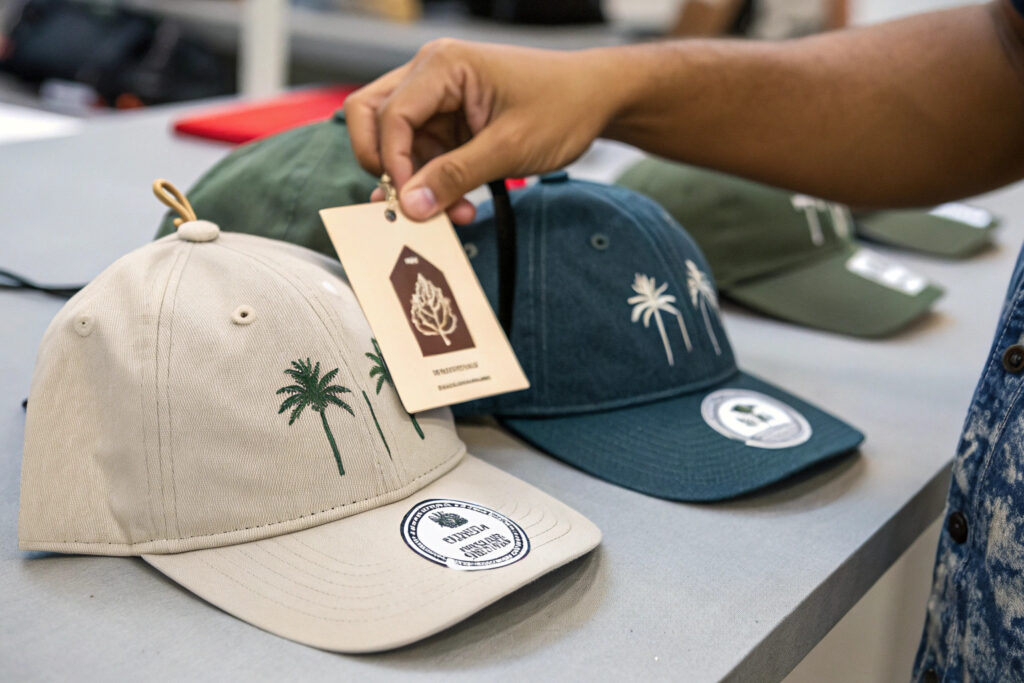
Eco-claims on hangtags should be specific, substantiated, and component-level. Replace "Eco-Friendly Cap" with "Front Crown: 100% GOTS-Certified Organic Cotton. Mesh Back: 100% GRS-Certified Recycled Polyester (65% Recycled Content)." Replace "Chemical-Free" with "OEKO-TEX Standard 100 Certified - Tested for Harmful Substances." Include the certification body name, the certificate number, and a QR code linking to the verification page. The claim must be clear about which part of the product it applies to. A cap with an organic cotton front and a conventional polyester back must not claim the whole cap is organic.
My hangtag compliance review ensures every eco-claim on the hangtag is backed by a specific certification document with a verifiable certificate number.
The QR code link to the live certification record is the most powerful tool for substantiating an eco-claim.
What Is the FTC Green Guides Rule for "Organic" vs "Made With Organic" Labels?
The FTC Green Guides require that an "Organic" claim on a textile product means the product is made entirely of certified organic fiber, excluding minor trims and embellishments. A "Made With Organic" claim requires that at least 70 percent of the fiber content is certified organic. The specific percentage must be stated.
A cap with a 100 percent organic cotton crown and a conventional polyester mesh back cannot be labeled "Organic Cap." It can be labeled "Crown: 100% Organic Cotton." The claim must be component-specific. The FTC can pursue enforcement action for deceptive organic claims.
My labeling guidance to clients ensures the organic claim matches the GOTS transaction certificate percentage and is applied to the correct component.
How Does a QR Code Linking to the Live Certificate Protect the Claim?
A QR code on the hangtag that links to the live certification record on the certification body's database transforms the hangtag from a static claim into a verifiable fact. The consumer scans the code. The live certificate appears, showing the certificate holder, the product scope, and the validity dates. The consumer verifies the claim independently.
The QR code protects the brand from accusations of greenwashing. The consumer does not need to trust the brand's printed statement. The consumer can check the certification body's own database. The claim is verified by an independent authority, not just stated by the brand.
My QR code hangtag system links directly to the GOTS, GRS, and OEKO-TEX certificates. The consumer sees the live certificates, not a marketing page.
Conclusion
The supply chain documents that prove custom caps are truly eco-friendly are the third-party certifications and transaction records that trace the material from origin to finished product. For organic cotton, the GOTS scope certificate plus the unbroken chain of transaction certificates from farm to factory. For recycled polyester, the GRS scope certificate plus the transaction certificates showing the exact recycled content percentage. For chemical safety, the OEKO-TEX Standard 100 certificate with the full component appendix. For carbon claims, a carbon footprint audit following ISO 14067 and verified carbon offset certificates.
The eco-friendly claim is a legal statement, not a marketing slogan. Under the FTC Green Guides and the EU Green Claims Directive, vague claims like "eco-friendly" and "sustainable" without specific substantiation are regulatory violations. The hangtag must state the specific certification, the specific percentage, and the specific component. A QR code linking to the live certification record provides independent verification.
At Global-Caps, I provide the complete eco-compliance pack with every order. The GOTS and GRS certificates are verified. The transaction certificates trace the batch. The OEKO-TEX appendix lists every component. The carbon footprint is audited. The hangtag language is reviewed for regulatory compliance. The eco-claims are backed by evidence, not adjectives.
If you need custom caps with verifiable eco-credentials, contact my Business Director Elaine. She can provide a sample eco-compliance pack, walk you through the transaction certificate chain, and help you draft compliant hangtag language. Email Elaine at elaine@fumaoclothing.com. Let's make your eco-claims provable, not just printable.