You design a beautiful children's sun hat. The fabric is soft. The brim is wide. The colors are playful. You order 2,000 units. They arrive. You ship them to a major US retailer. The retailer's compliance team requests the CPSIA Children's Product Certificate. You ask the factory. The factory sends a generic lab report for adult hats. The retailer rejects the shipment. You cannot sell the hats. The sun hats are not legally children's products. They are just hats with a cartoon print. The law sees a difference.
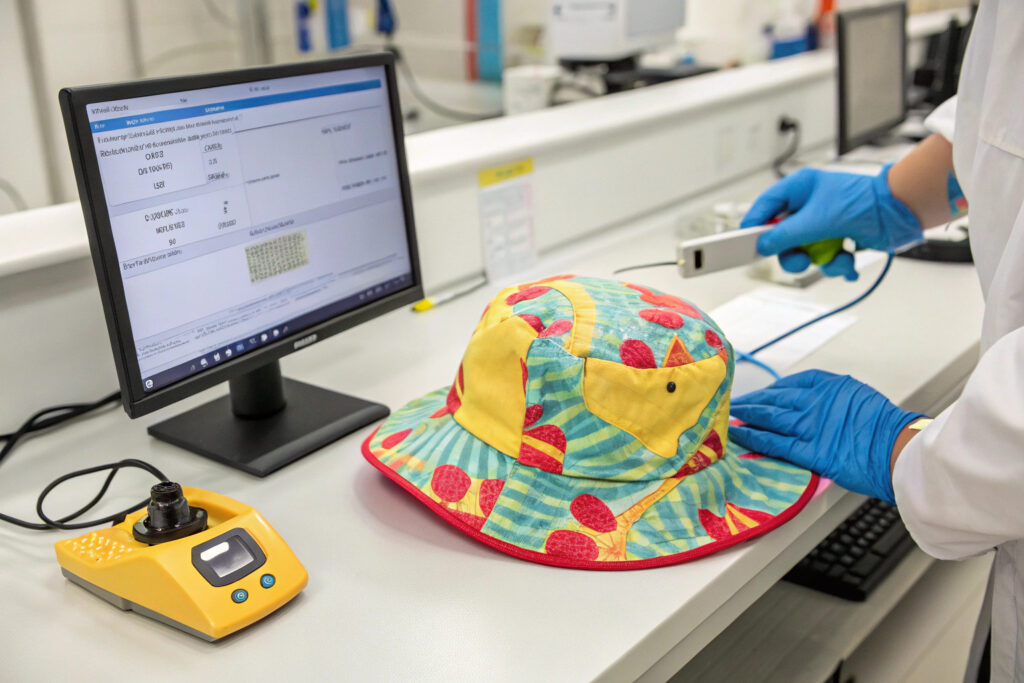
A CPSIA certificate for children's sun hats requires passing specific safety tests mandated by the Consumer Product Safety Improvement Act. The tests include total lead content in surface coatings and substrates, phthalate content in plasticized components, and physical and mechanical safety tests including small parts, sharp points, sharp edges, and drawstring or chin cord requirements. The testing must be performed by a CPSC-accepted third-party laboratory. The certificate must list each applicable safety rule, the test results, the production date, and the batch identification. A generic fabric test is not sufficient. The sun hat is a children's product, and the law treats it as such.
At Global-Caps, I produce children's sun hats for brands that sell to Target, Walmart, and independent boutiques. The testing protocol is non-negotiable. The certificate is included in the shipment.
What Lead Content Limits Apply to Children's Sun Hat Fabrics and Trims?
You buy fabric from a mill. The mill says it is "safe." You make hats. The print on the fabric is a bright yellow sun. The yellow pigment is lead chromate. The lead content is 200 parts per million. The legal limit for surface coatings is 90 parts per million. The hats are illegal. The mill's verbal assurance is not a test report. The pigment is the danger. The test is the proof.
The CPSIA lead content limits for children's sun hats are 90 parts per million in surface coatings, including printed designs, screen prints, and painted trims, and 100 parts per million in accessible substrate materials, including the fabric, the sweatband, the brim board, and the sewing thread. These limits apply to every component of the hat that a child can touch or mouth. The testing must be performed on the finished product, not on the raw materials alone.
I test the surface coating and the substrate separately. The lab report lists the lead result for each tested component.
The distinction between surface coating and substrate is legally critical.
Why Are Surface Coatings Tested to a Stricter 90 ppm Lead Limit?
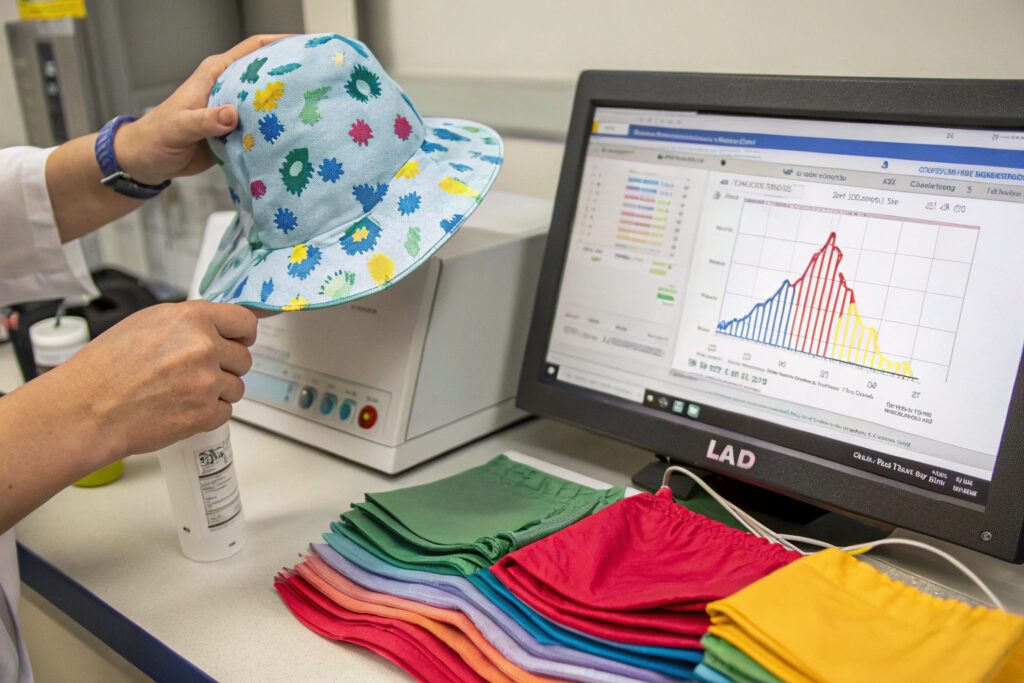
Surface coatings are the paints, inks, and screen prints applied to the surface of the fabric or trim. Children mouth these surfaces directly. The lead in a surface coating is more bioavailable than lead embedded in a plastic substrate. The risk of ingestion is higher. The legal limit is therefore stricter at 90 parts per million.
The 90 ppm limit was established by the CPSIA in 2008 and lowered from the previous 600 ppm limit. It applies to all children's products.
I send every printed fabric for surface coating lead testing. The print is tested separately from the base fabric.
How Does the 100 ppm Substrate Limit Apply to Sweatbands and Stitching?
The substrate limit of 100 parts per million applies to the base materials of the hat. The sweatband fabric, the polyester stitching thread, the plastic brim insert, and the elastic chin cord are all substrates. Each must be tested or covered by a component part certificate from the supplier.
A cotton sweatband with a polyester elastic content must have both the cotton and the elastic tested. The stitching thread on the brim must not contain lead above 100 ppm.
I maintain a component testing library for my standard materials.
How Are Phthalates Regulated in Plastic Chin Cords and Toggles?
You add a chin cord with a plastic toggle. The toggle is small. It is a minor accessory. You assume it is exempt from testing. It is not exempt. The plastic in the toggle contains DEHP phthalate at 8 percent. The legal limit is 0.1 percent. The toggle makes the entire hat illegal. The minor accessory is a major violation.
Phthalates are regulated in plastic chin cords and toggles under CPSIA Section 108. The restriction applies to children's toys and child care articles, which includes children's sun hats. The limit is 0.1 percent by weight for each of the eight restricted phthalates: DEHP, DBP, BBP, DINP, DIDP, DNOP, DIBP, and DPENP. The test must be performed on each plasticized component. Any plastic component that is accessible to the child must comply.
I use phthalate-free plastic components sourced from suppliers who provide batch-specific test reports.
The chin cord itself, if made of elastic or synthetic fiber, must also be tested.
What Are the Eight Restricted Phthalates Under CPSIA Section 108?
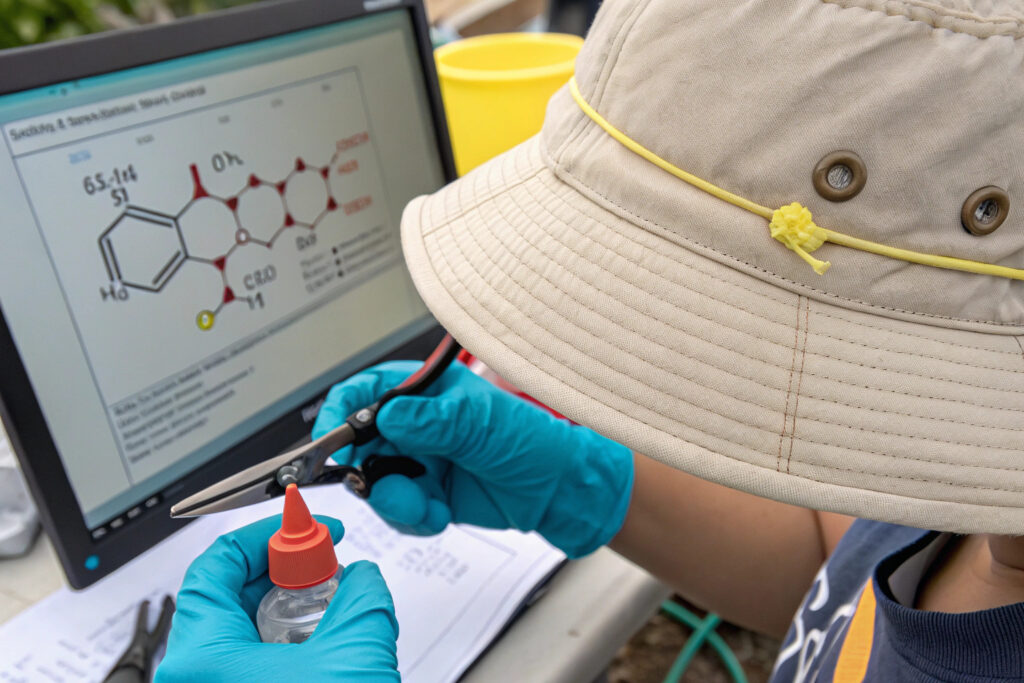
The eight restricted phthalates are DEHP (diethylhexyl phthalate), DBP (dibutyl phthalate), BBP (benzyl butyl phthalate), DINP (diisononyl phthalate), DIDP (diisodecyl phthalate), DNOP (di-n-octyl phthalate), DIBP (diisobutyl phthalate), and DPENP (di-n-pentyl phthalate). The first three are permanently banned in concentrations above 0.1 percent. The remaining five are interim banned in concentrations above 0.1 percent in children's toys and child care articles.
The test report must list each phthalate individually with a pass or fail result.
My lab reports name all eight phthalates. The result column reads "Not Detected" or "< 0.1%."
Does the Spring-Loaded Cord Lock Require a Separate Mechanical Test?
Yes. The spring-loaded cord lock is a mechanical component. It contains a small metal spring and a plastic housing. The phthalate test covers the plastic housing. A separate small parts test covers the entire cord lock assembly. If the cord lock detaches from the cord, it must not fit entirely within the small parts cylinder. If it does, it is a choking hazard.
The cord lock must also not have sharp points or sharp edges.
I test the cord lock for phthalates and for small parts in the same test batch.
What Physical and Mechanical Safety Tests Are Required for Sun Hats?
You think chemical tests are enough. The hat passes lead and phthalates. You ship it. A child wears it. The decorative button on the brim falls off. The child puts it in their mouth. It fits entirely in the small parts cylinder. The child chokes. Your hat is a hazard. The chemical tests were passed. The physical tests were never performed. Safety is chemical and physical.
The physical and mechanical safety tests required for children's sun hats include the small parts test under 16 CFR Part 1501, the sharp points test under 16 CFR Part 1500.48, the sharp edges test under 16 CFR Part 1500.49, and the drawstring or chin cord requirements under ASTM F1816. The hat must not have any component that detaches with less than 15 pounds of force and fits inside the small parts cylinder. It must not have any accessible sharp point or sharp edge. The chin cord must not form a loop that poses a strangulation hazard and must have a breakaway feature.
My physical testing protocol is performed on the finished hat.
The use and abuse testing simulates the rough handling a child applies to a hat.
How Does the Small Parts Test Apply to Decorative Buttons and Toggles?
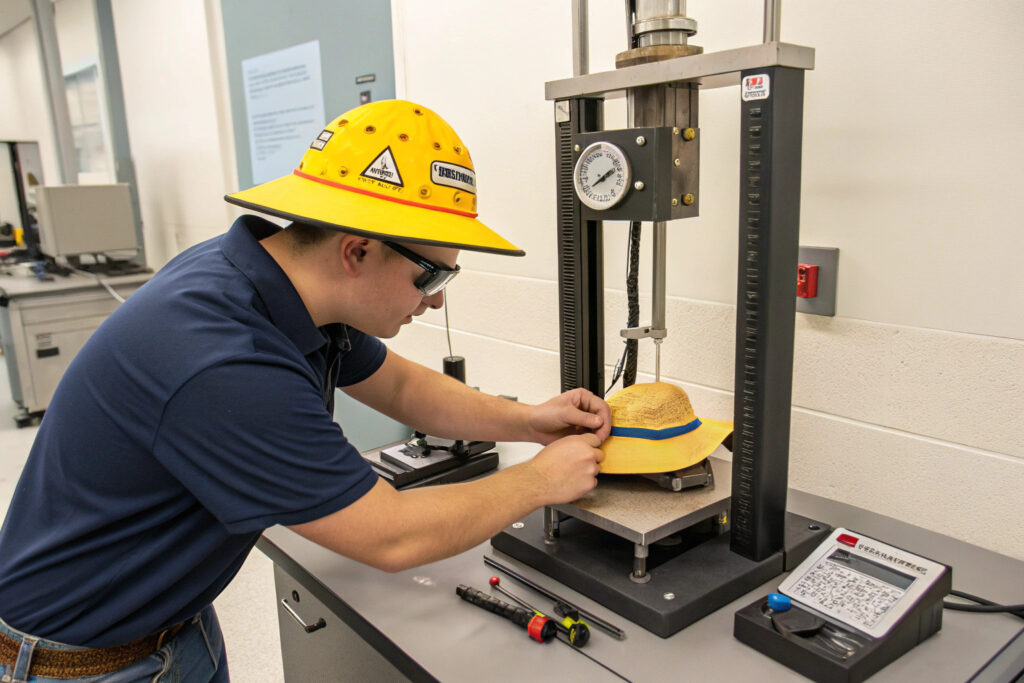
The small parts test uses a cylinder with a diameter of 31.7 millimeters and a depth ranging from 25.4 to 57.1 millimeters. Any component that detaches from the hat during use and abuse testing and fits entirely within this cylinder without compression is a small part and a choking hazard.
A decorative button on the brim, a toggle on the chin cord, or a sewn-on appliqué must not detach under 15 pounds of pull force. If it detaches, it must not fit in the cylinder.
I reinforce all decorative attachments with lock stitches and backing fabric.
Why Must Chin Straps Pass the ASTM F1816 Drawstring Safety Standard?
ASTM F1816 is the standard safety specification for drawstrings on children's upper outerwear. A chin strap on a sun hat is functionally a drawstring. It passes around the neck area. If the strap forms a loop and catches on playground equipment, it poses a strangulation hazard.
The standard requires that the chin strap must break away at a force between 5 and 15 pounds. The breakaway mechanism must be designed so that the strap separates cleanly without leaving a strangulation loop.
I use ASTM F1816 compliant breakaway clasps on all children's sun hats.
How Do You Maintain an Ongoing CPSIA Testing Program for Bulk Orders?
You test one hat. You get a certificate. You think you are done. You order the same hat for three years. You use the same certificate. A retailer audits you. The certificate is expired. The test was for a different production lot. The fabric supplier changed their dye house. The new dye uses a different chemical. Your certificate is invalid. Testing is not a one-time event. It is an ongoing program.
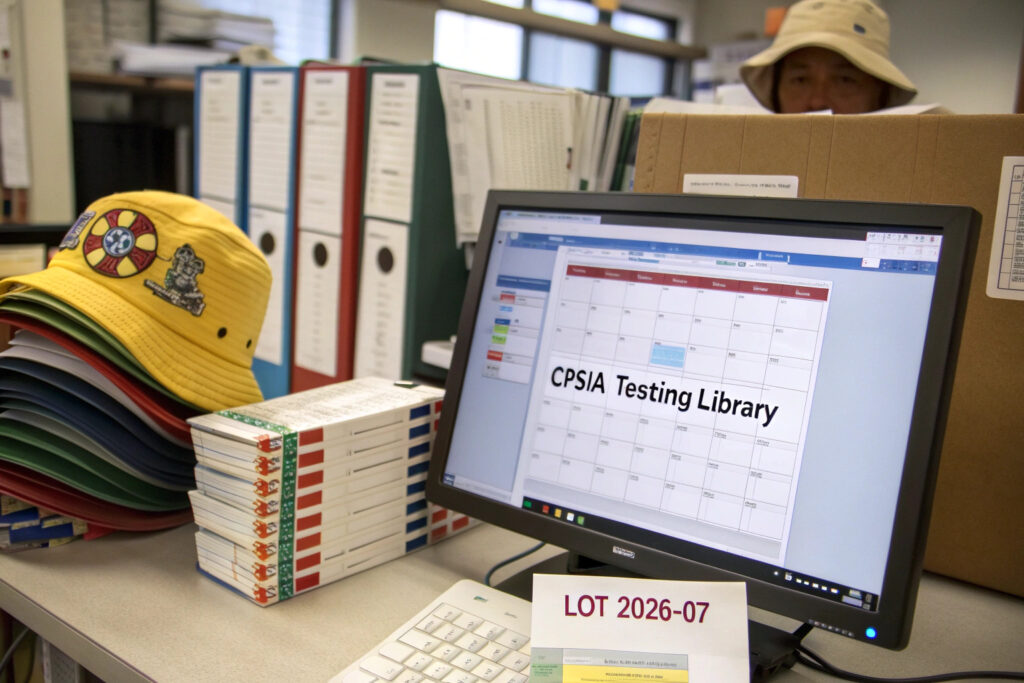
You maintain an ongoing CPSIA testing program by implementing a periodic testing schedule, a material change policy, and a production lot tracking system. Periodic testing requires re-testing at least annually for lead and phthalates. A material change policy requires immediate re-testing whenever the fabric, dye, plastic component, or any other input material changes. A production lot tracking system links each production batch to specific test reports, enabling traceability from the retail shelf back to the lab certificate.
I run a periodic testing program with quarterly intervals for high-volume children's products.
A material change is the most common reason a valid certificate becomes invalid.
What Constitutes a "Material Change" That Triggers Re-Testing?
A material change is any change in the product design, the raw material source, the dye or chemical formulation, the component supplier, or the manufacturing process that could affect the product's compliance with the safety rules. Changing the fabric mill is a material change. Changing the dye house is a material change. Adding a new decorative print is a material change.
The responsible party must re-test the affected components after any material change. The certificate must be updated.
I log every material change in my compliance system. The testing is triggered automatically.
How Often Should You Conduct Periodic Testing for Lead and Phthalates?
The CPSIA requires periodic testing at a minimum frequency of once per year for children's products. However, the responsible party must determine the appropriate frequency based on the risk of material changes and the production volume. High-volume products with complex supply chains may require quarterly testing.
For my children's sun hat program, I conduct periodic testing every six months or every 10,000 units, whichever comes first.
Conclusion
A CPSIA certificate for children's sun hats requires comprehensive safety testing. The lead content must be below 90 parts per million in surface coatings and below 100 parts per million in substrates. The eight restricted phthalates must each be below 0.1 percent in plasticized components. The physical and mechanical tests must demonstrate no small parts, no sharp points, no sharp edges, and compliance with the drawstring safety standard for chin straps. The testing must be performed by a CPSC-accepted third-party laboratory. The certificate must list each applicable rule, the test results, and the batch identification.
An ongoing testing program is required. Periodic testing must be repeated at least annually. Any material change triggers immediate re-testing. A production lot tracking system links each hat to its test reports. The certificate is a living document, not a one-time paper.
At Global-Caps, I treat children's sun hat safety as the foundation of the product. The testing is rigorous. The documentation is complete. The certificate travels with the shipment. Your brand is protected. The children are protected.
If you need CPSIA-compliant children's sun hats from a factory that has the testing infrastructure and the compliance discipline, contact my Business Director Elaine. She can provide our most recent CPSIA test reports and a sample Children's Product Certificate for your review. Email Elaine at elaine@fumaoclothing.com. Let's make sun hats that are safe from the inside out.