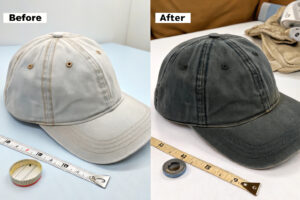
You wash your favorite 100% cotton cap for the third time. You pull it from the washing machine, shape it gently with your hands, and let it air dry. The next morning, it does not fit. The crown feels tighter. The brim has a slight wave that was not there before. The front seam has a subtle but permanent pucker. You compare it to another cap, a cotton-polyester blend, that you have washed a dozen times. That cap fits exactly the same as the day you bought it. It looks sharper. The seams are flat. The brim curve is consistent. The difference is not the brand, not the price, not the color. The difference is the fiber content, and what that fiber content does when it meets water, heat, and mechanical stress.
Dimensional stability is the ability of a fabric to retain its original size and shape through wear, washing, and environmental exposure. In headwear, dimensional stability is everything. A cap that shrinks, puckers, or warps is no longer the product the customer purchased. I run Global-Caps, and I have cut and sewn millions of caps in both pure cotton and cotton-poly blends. I have watched how each behaves on the production floor, in the wash test, and in the real world. In this article, I will explain the material science behind why a cotton-poly blend cap consistently outperforms a pure cotton cap in dimensional stability, and how you can use this knowledge to specify a cap that holds its shape for the life of the product.
What Is the Fundamental Difference Between Cotton and Polyester Fibers Under Stress?
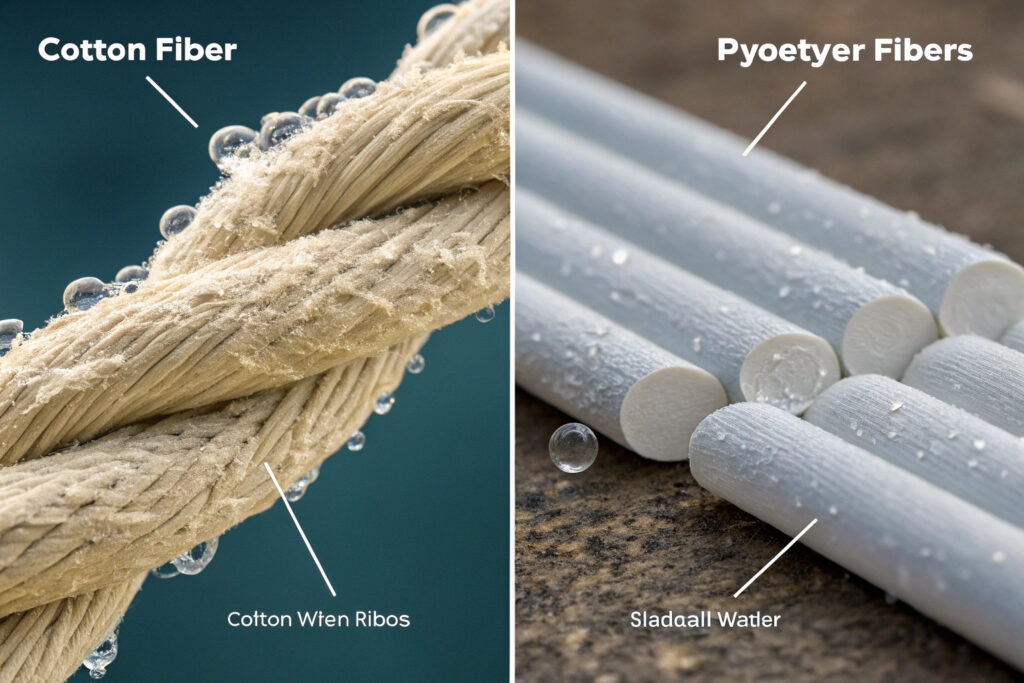
Cotton and polyester are fundamentally different materials at the molecular level, and this difference determines everything about how they behave in a cap. Cotton is a natural cellulose fiber. It is hydrophilic, meaning it loves water. The cellulose molecule has abundant hydroxyl groups that form hydrogen bonds with water molecules. When cotton gets wet, water penetrates the amorphous regions of the fiber, acting as a plasticizer. The hydrogen bonds between cellulose chains break. The fiber swells in diameter. The yarns in the fabric swell, pushing against each other. The fabric relaxes and expands. When the cotton dries, new hydrogen bonds form, but they form in the fabric's relaxed, swollen state. The fabric has effectively set a new, smaller dimension. This is shrinkage.
Polyester is a synthetic polymer, typically polyethylene terephthalate. It is hydrophobic. It does not absorb water. The polymer chains are arranged in a semi-crystalline structure that is thermally set during the fiber spinning and drawing process. When polyester gets wet, nothing happens at the molecular level. The water sits on the surface of the fiber or is wicked between fibers, but it does not penetrate the polymer. There is no swelling, no hydrogen bond disruption, no relaxation. When the polyester dries, it returns to its original, heat-set dimensions. This is why polyester does not shrink. In a cotton-poly blend, the polyester fibers act as a stable internal skeleton. The cotton fibers may try to shrink and swell, but they are mechanically restrained by the polyester fibers that are not changing dimension. The blend fabric shrinks less because the polyester locks the structure in place.
This fundamental difference also explains why pure cotton caps wrinkle and pucker more. Cotton fibers are naturally irregular. They have a twisted, ribbon-like morphology. When a cotton fabric is deformed, folded, or compressed, the fibers slide past each other and settle into new positions. The hydrogen bonds reform in the new, wrinkled configuration. The wrinkle is locked in. Polyester fibers are smooth, straight, and resilient. They have a high elastic modulus. When you bend a polyester fiber, it springs back to its original shape. In a blend, the polyester fibers act like tiny springs distributed throughout the fabric. They resist permanent deformation and help the fabric bounce back from folding and compression.
How Does the Hydrophilic vs. Hydrophobic Nature Affect Seam Stability?
Seam puckering is a specific dimensional stability failure that is common in pure cotton caps. The sewing thread, typically a polyester core-spun thread for strength, does not shrink. The cotton fabric panels do shrink. The thread, being relatively inelastic compared to the shrunken cotton, becomes too long for the seam length. The excess thread has nowhere to go, so it forces the fabric to gather and pucker along the stitch line.
In a cotton-poly blend, the fabric shrinkage is dramatically reduced. The differential shrinkage between the sewing thread and the fabric is minimal. The seam remains flat and smooth after washing. This is particularly important for the crown seams of a cap, which are the most visible structural element. A puckered crown seam on a pure cotton cap makes the entire cap look old and worn. A flat crown seam on a blend cap maintains a crisp, new appearance.
What Is the Role of Heat-Setting in Polyester Dimensional Stability?
Polyester's dimensional stability is not an accident of chemistry. It is engineered through a manufacturing process called heat-setting. During the finishing of polyester fabric, the fabric is heated to a specific temperature, typically between 180 and 200 degrees Celsius, while being held at the desired dimensions. This temperature is above the glass transition temperature of the polyester polymer. The polymer chains in the amorphous regions become mobile. They relax into a low-energy configuration that matches the set dimensions. When the fabric is cooled, this configuration is locked into the polymer structure. The fabric will now return to these heat-set dimensions after any subsequent deformation, as long as the temperature does not exceed the heat-setting temperature.
Washing and drying temperatures are far below the polyester heat-setting temperature. A home washing machine operates at 30 to 60 degrees Celsius. A home dryer might reach 70 degrees Celsius. These temperatures have no effect on the polyester's heat-set memory. The fibers remain dimensionally stable. Pure cotton has no equivalent heat-set memory. The cotton fiber's dimensions are determined by the most recent wet-dry cycle. Every wash is a new dimensional lottery.
How Does the Blend Ratio Affect the Degree of Dimensional Stability?
The blend ratio is the single most important specification you will make for a dimensionally stable cap. It is not a binary choice between cotton and polyester. It is a continuum, and each ratio offers a different balance of stability, hand feel, breathability, and cost. Understanding this continuum allows you to target the exact performance profile your brand needs.
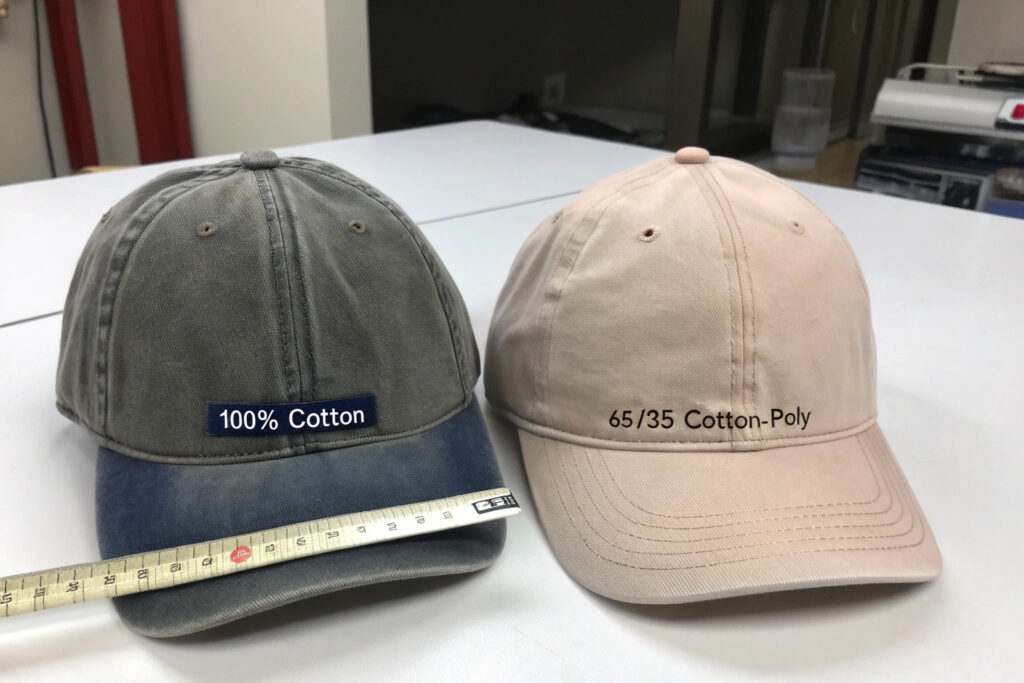
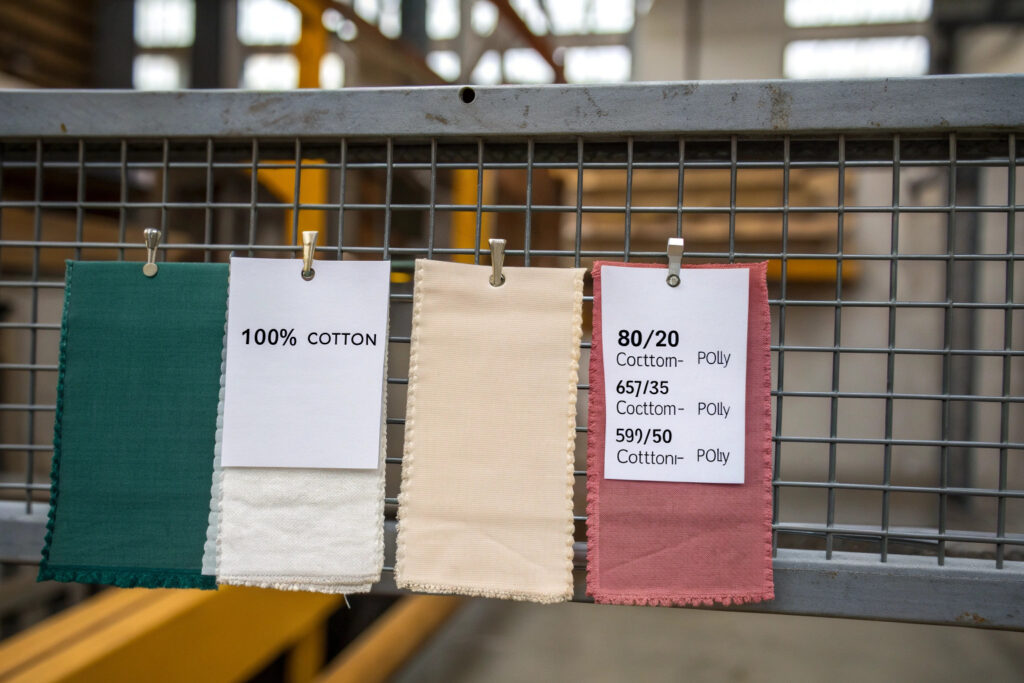
A 100% cotton cap sits at one extreme. It offers the softest, most natural hand feel, excellent breathability, and a classic, lived-in aesthetic that many consumers love. Its dimensional stability is the lowest. Expect 5% to 8% shrinkage in crown circumference after repeated washing. Expect seam puckering. Expect brim warping in unstructured styles. This is the authentic cotton experience, but it comes with the quality perception risk of a cap that does not look new for long.
Moving to an 80% cotton, 20% polyester blend introduces a small amount of polyester for stability without significantly changing the hand feel. The cap still feels like cotton. The shrinkage drops to around 3% to 5%. The improvement is noticeable but not dramatic. This blend is often used for fashion caps where the cotton look and feel are paramount, but a minimum level of stability is required.
The 65% cotton, 35% polyester blend is a sweet spot for many headwear applications. The polyester content is high enough to provide meaningful dimensional stability. Shrinkage is typically under 2%. Seam puckering is minimal. The cap retains its shape through multiple washes. The hand feel is still predominantly cotton-like, though slightly smoother and cooler to the touch. This is the blend I recommend most often for brands that want a natural-fiber aesthetic with reliable performance.
The 50% cotton, 50% polyester blend shifts the balance further toward performance. Shrinkage is negligible, under 1%. The cap is highly resistant to wrinkles, puckering, and shape loss. The hand feel is noticeably more synthetic, with a slicker surface and a lighter weight. This blend is ideal for athletic caps, performance caps, and caps that will be subjected to hard use and frequent washing.
A 100% polyester cap sits at the other extreme. Zero shrinkage. Maximum dimensional stability. The hand feel is entirely synthetic. It lacks the warmth and breathability of cotton. For fashion applications, it can feel cheap. For athletic applications, it is the standard. The choice of blend ratio is a strategic brand decision. It communicates what your brand values: natural authenticity or technical performance.
What Is the Minimum Polyester Content for a Meaningful Stability Improvement?
Based on our internal wash testing data, a polyester content of at least 25% is required to see a meaningful, consumer-noticeable improvement in dimensional stability. Below 25%, the polyester fibers are too dispersed to form a continuous, load-bearing network within the fabric. The cotton fibers dominate the behavior, and the shrinkage remains close to pure cotton.
At 25% to 30% polyester, a percolation threshold is reached. Enough polyester fibers are present and interconnected that they begin to mechanically restrain the cotton fibers. The shrinkage curve drops significantly. This is why you rarely see commercial cap fabrics with a 90/10 or 85/15 blend. Those ratios capture the cost of the polyester without delivering the performance benefit. If you are going to add polyester for stability, add enough to matter.
How Does the Blend Affect Dyeing and Color Consistency?
Dimensional stability is not the only factor affected by the blend. Color consistency is also impacted. Cotton and polyester dye differently. Cotton is dyed with reactive or direct dyes. Polyester is dyed with disperse dyes. In a blend, two separate dyeing processes are required, or the polyester is left undyed and the cotton is dyed, creating a heathered appearance. This cross-dyeing can produce beautiful, complex color effects, but it requires precise process control.
If the dyeing is inconsistent, the cotton and polyester components can show different color shades, creating a frosty or two-tone appearance. This is less of a concern for solid, dark colors and more of a concern for bright, saturated fashion colors. A cap that is dimensionally stable but has a visually inconsistent color is still a quality failure. When specifying a blend, you must also specify the color standard, typically a Pantone code, and require a lab-dip approval on the actual blend fabric, not on a substitute.
What Specific Cap Components Benefit Most From Blend Stability?
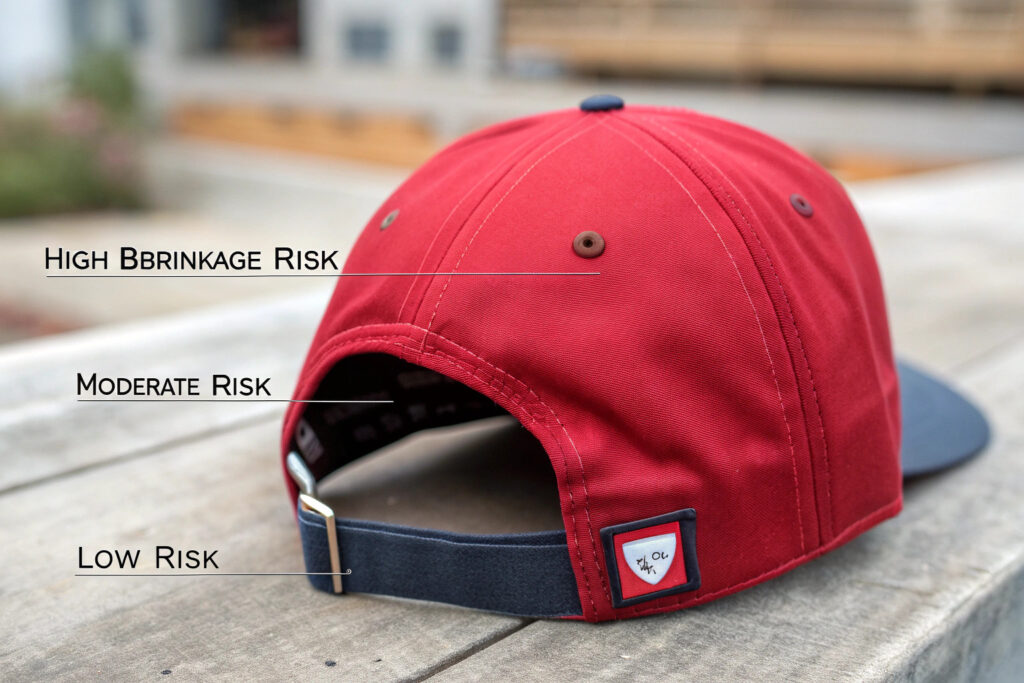
The dimensional stability of a cap is not uniform. Different components experience different stress, moisture, and heat conditions. A savvy specification targets the most vulnerable components with the most stable materials. You do not necessarily need a 50/50 blend throughout the entire cap. You can engineer a hybrid cap that puts stability where it is needed most and maintains a cotton hand feel where stability is less critical.
The front crown panels are the most visible and most structurally demanding component. They hold the embroidery or print. They are the focal point of the cap's appearance. If the front panels shrink or pucker, the defect is immediately visible. The front panels also experience the highest tension, as they are stretched over the buckram in a structured cap or shaped by the head in an unstructured cap. A cotton-poly blend for the front panels, with a polyester content of at least 35%, provides the stability needed to keep the embroidery flat and the seams smooth. The side and back panels can be a higher cotton content, even 100% cotton, to provide breathability and a soft hand feel, as their dimensional changes are less visually critical.
The sweatband is a component that is saturated with sweat, skin oils, and hair products. It undergoes extreme moisture cycling, wet from perspiration, dry from air exposure. A pure cotton sweatband will shrink, stiffen, and stain. A polyester or poly-rich blend sweatband will remain dimensionally stable, wick moisture, and resist staining. I almost always recommend a poly-rich or 100% polyester sweatband, even on a predominantly cotton cap. The sweatband is a functional component hidden from view, and performance should take priority over aesthetics.
How Does the Brim Benefit From Polyester Stability?
The brim of an unstructured cap is particularly vulnerable to dimensional instability. It has no buckram stiffener. It relies on the fabric itself, any soft interlining, and the brim stitching to maintain its curve. A 100% cotton unstructured brim will warp, wave, and lose its curve with washing as the cotton shrinks and relaxes unevenly.
A cotton-poly blend brim, with at least 35% polyester, maintains its curve and flatness through washing. The polyester fibers provide a resilient memory that the cotton alone lacks. For structured caps with a plastic brim insert, the fabric cover on the brim also benefits from blend stability. A pure cotton brim cover can shrink more than the plastic insert, causing the fabric to pull tight and the brim to curl. A blend cover shrinks minimally and stays smoothly bonded to the insert. This is a subtle detail that separates a premium cap from a budget cap.
Why Is the Closure Strap Another Stability Critical Point?
The closure strap, whether it is a fabric strap with a snap, a Velcro closure, or a buckle, is subjected to repeated tension and adjustment. A pure cotton strap will stretch permanently with use and will shrink when washed. The result is a strap that is either too loose from stretching or too tight from shrinkage. The fit of the cap becomes inconsistent.
A cotton-poly blend strap, or a 100% polyester strap, maintains its length and elasticity through repeated tension and washing cycles. The snap or closure hardware stays in the correct position. The consumer experiences a consistent fit every time they wear the cap. The closure is a high-touch, high-function component. Dimensional stability here directly affects the consumer's daily satisfaction.
How Can I Test and Specify Dimensional Stability for a Cotton-Poly Cap?
Specifying a cotton-poly blend is the first step. Verifying that the specified blend delivers the expected dimensional stability is the second step. You cannot rely on the fabric mill's data sheet alone. You must test the finished cap, made from the actual bulk fabric, under conditions that simulate consumer use. The test protocol should be written into the purchase contract so that dimensional stability is a measurable, enforceable quality parameter.
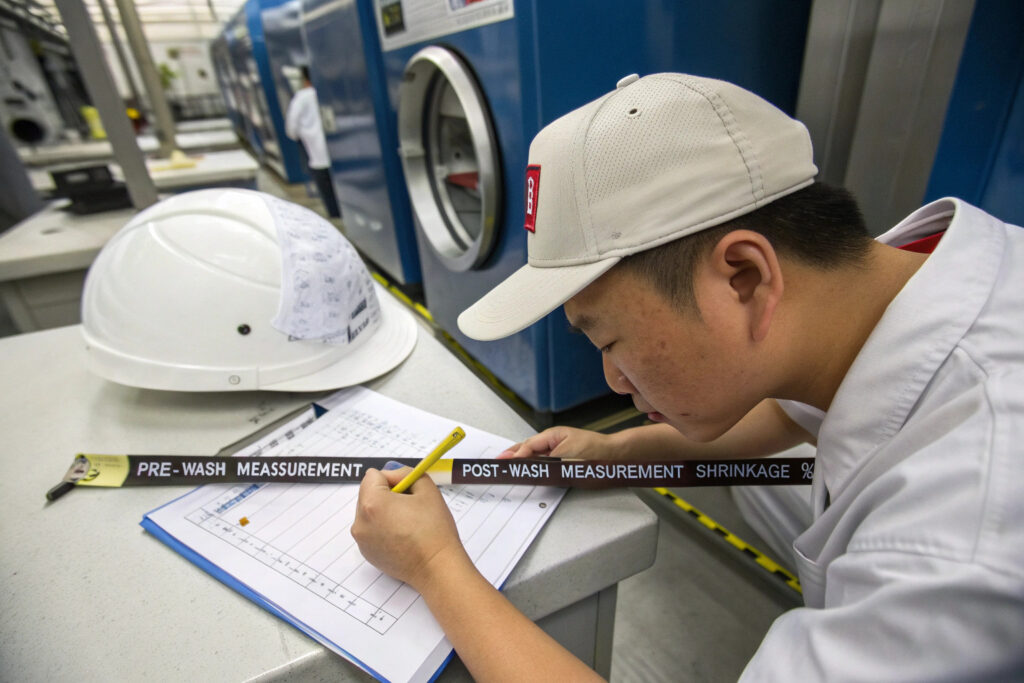
The standard test method is the AATCC LP1 home laundering procedure, adapted for headwear. A pre-production sample is measured. Crown circumference, crown height, brim width, and brim curve radius are recorded. The cap is washed in a standardized washing machine at a specified temperature, typically 30 degrees Celsius for a delicate cycle or 40 degrees Celsius for a normal cycle, with a standard detergent. The cap is air-dried on a flat surface. After drying, the same measurements are taken. The percentage change is calculated. A stable cap should show less than 3% change in crown circumference and less than 5% change in crown height. These tolerances should be written into the contract. If the sample exceeds these tolerances, the fabric or the construction must be adjusted before bulk production begins.
The test should be repeated for three to five wash cycles to assess cumulative shrinkage. A cap that passes one wash cycle but progressively shrinks over five cycles is still a stability failure. The multiple-cycle test reveals the long-term behavior. I also recommend a heat exposure test. Place the cap in a dryer on a low or medium setting for 30 minutes. Some consumers will machine dry, despite the care label instructions. The cap should survive this abuse without catastrophic shrinkage. A polyester component provides a safety margin against dryer heat that pure cotton does not have.
What Should a Fabric Specification for Dimensional Stability Include?
The fabric specification in your tech pack should include the blend ratio, such as "65% Cotton, 35% Polyester," the fabric weight in GSM, the weave type, and the dimensional stability requirement. The dimensional stability requirement should read, "Finished fabric and finished cap shall not exceed 3% shrinkage in warp or weft direction after 3 home launderings per AATCC LP1, wash at 40 degrees Celsius, tumble dry low."
The specification should also address the fabric's pre-shrinking status. "Fabric must be pre-shrunk at the mill to a residual shrinkage of less than 2%." This ensures that the bulk of the shrinkage has already occurred before the panels are cut. A pre-shrunk cotton-poly blend will have minimal additional shrinkage in the finished cap. The combination of polyester content and pre-shrinking is a powerful one-two punch against dimensional instability.
How Can I Verify the Blend Ratio of a Bulk Fabric?
Suppliers sometimes substitute a lower polyester content than specified to reduce cost. A fabric sold as 65/35 might actually be 80/20 or even 90/10. The difference in hand feel can be subtle, but the dimensional stability will be compromised. You can verify the blend ratio with a simple burn test on a fabric swatch. Cotton burns with a steady flame, smells like burning paper, and leaves a fine, grey ash. Polyester melts, shrinks from the flame, smells like burning plastic, and leaves a hard, black bead.
A more precise verification is a chemical dissolution test. The fabric swatch is weighed, then soaked in a solvent that dissolves one fiber type but not the other. For a cotton-poly blend, sulfuric acid or a specific polyester solvent can be used. The remaining fibers are dried and weighed. The weight difference gives the exact blend ratio. This test can be performed by a textile testing laboratory. I recommend it for initial bulk fabric qualification, especially if the supplier is new. The burn test is a quick field check. The dissolution test is the definitive evidence. Both are worth the effort when the dimensional stability of your entire order hangs on the blend ratio being correct.
Conclusion
A cotton-poly blend cap is more dimensionally stable than a pure cotton cap because polyester fibers are hydrophobic, heat-set, and resilient, while cotton fibers are hydrophilic, amorphous, and deformable. When cotton gets wet, it swells, the hydrogen bonds that hold its shape break, and the fabric relaxes into a new, smaller dimension. The polyester fibers in a blend do not participate in this molecular dance. They remain rigid, stable, and anchored in their heat-set configuration. They form an internal skeleton that mechanically restrains the cotton fibers, limiting shrinkage, preventing seam puckering, and resisting the wrinkles and warps that plague pure cotton caps.
The degree of stability is a function of the blend ratio. A minimum of 25% to 30% polyester is required for a meaningful, consumer-noticeable improvement. The sweet spot for most fashion and lifestyle caps is a 65/35 cotton-poly blend, which balances the natural hand feel of cotton with the dimensional reliability of polyester. The benefits are most critical in the front crown panels, the sweatband, the brim, and the closure strap. A smart specification targets stability where it matters most. The specification must be verified by standardized wash testing and, if necessary, by laboratory blend ratio analysis. A "cotton-poly blend" label is a promise. The test data is the proof.
If you are developing a cap line and want to engineer dimensional stability into the product from the fiber level up, I invite you to contact Global-Caps. We have decades of experience with cotton, polyester, and every blend ratio in between. We can provide you with wash test data on different blend options, fabric swatch cards, and a technical recommendation tailored to your brand's performance requirements and aesthetic goals. Reach out to our Business Director, Elaine, at elaine@fumaoclothing.com with your cap concept. Let's build a cap that fits perfectly on day one and continues to fit perfectly for the life of the product, because the fiber blend was chosen with science, not guesswork.