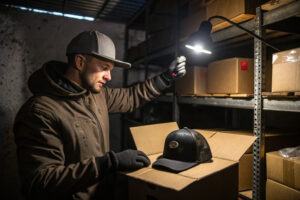
You place the order. The sales rep says "Four weeks." You plan the marketing launch. The influencers are booked. Six weeks later, the beanies are still in production. The launch is dead. Your seasonal revenue window is closed. I have seen this movie play out too many times in the custom headwear business. The promise of a fast lead time means nothing if the factory does not control the knitting, dyeing, and embroidery under one roof.
The standard lead time for custom embroidered beanies in 2026 is 20 to 35 days for a bulk order of 1,000 to 5,000 pieces, assuming the yarn is in stock and the embroidery digitizing is approved. If the yarn requires custom dyeing or if the order falls during the peak season from July to October, the lead time stretches to 40 to 50 days. A small rush order of 200 pieces with a stock yarn color can ship in as fast as 15 days. At Global-Caps, we run our own knitting machines and embroidery floor. This co-location cuts the transit time between subcontractors to zero.
You cannot gamble on a supplier who outsources the knitting. The yarn mill has its own backlog. The embroiderer has its own queue. You are stuck in the middle. I want you to understand the real schedule behind a custom beanie so you can plan your inventory like a professional.
Why Does Yarn Sourcing Delay Custom Beanie Production?
You have a perfect design. The spec sheet is signed. The factory says "We start Monday." Thursday comes and they email you. "The yarn is out of stock. We need to change the color." The Pantone you picked is suddenly unavailable. The factory chose the cheapest supplier and that supplier ran out. You are not a priority. You are a victim of poor inventory management.
Yarn sourcing delays beanie production because standard acrylic and wool blend yarns are often held in limited stock at the factory or the local market. Specialty yarns like merino wool, cashmere blends, or recycled polyester yarns require a mill order. The mill takes 2 to 3 weeks to spin and deliver the cones. If the factory does not maintain a safety stock of base yarns, your order waits for the spinning machine. You must confirm the yarn availability in writing before you pay the deposit.
The yarn is the heartbeat of the beanie. No yarn, no hat. I keep a 30-day buffer of my top 20 selling yarn colors. This is not cheap, but it makes the schedule reliable.
You need to dig deeper into the different fiber types. A generic answer like "acrylic yarn" covers a huge range of quality and availability. The spinning timeline changes completely based on the fiber content.
What Is the Spinning Lead Time for Acrylic vs Wool Blend Yarns?
Acrylic yarn is synthetic. The fiber comes from a petrochemical plant. The spinning mill can run it continuously. Wool is natural. It depends on the shearing season. Alpaca yarn depends on the herd. These biological timelines rule your beanie schedule.
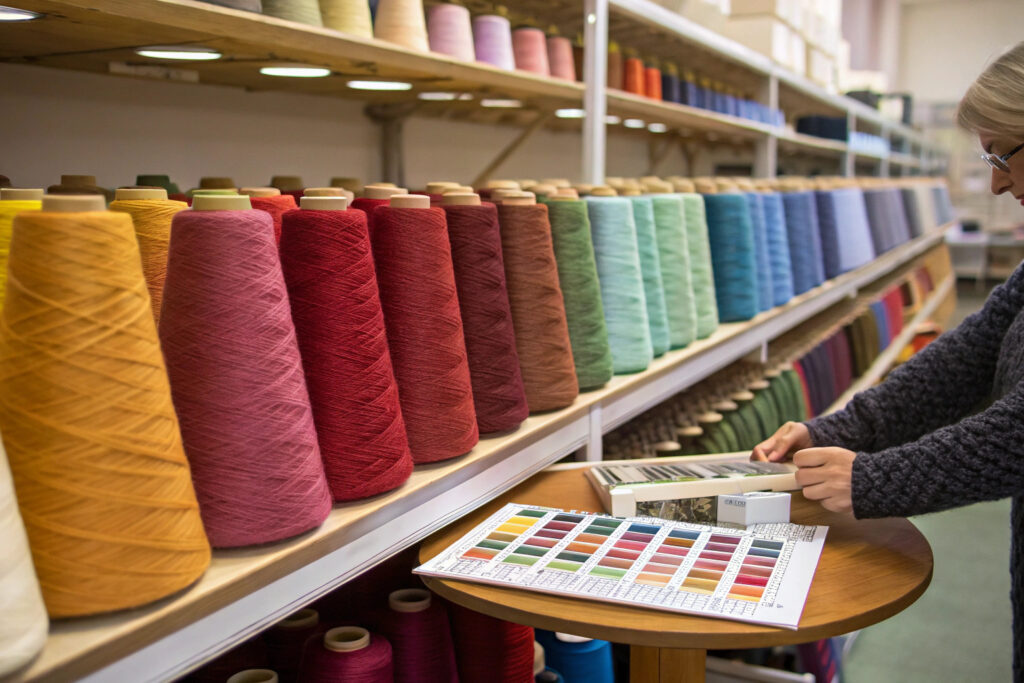
Standard acrylic yarn is typically in stock. If a factory runs out, the domestic spinning mill can usually restock within 5 to 7 days. Acrylic is fast fashion's best friend. A basic wool blend, like a 50% wool and 50% acrylic mix, takes longer. The mill might not run a blend batch every day. They wait until they have enough orders. This can add 7 to 10 days. 100% merino wool is a special order for most beanie factories. The yarn is often imported from Australia or South Africa. The lead time for the yarn alone is 3 to 4 weeks.
I always ask my yarn supplier for their "stock service" list. These are the colors and counts they keep on the shelf. If a client wants a sustainable beanie, I push them towards recycled acrylic or GRS-certified polyester. Recycled yarns are a niche. The batch sizes are smaller. The color matching is trickier. I tell my project managers to add a mandatory 10-day buffer to the schedule for any recycled yarn order. The spinning lead time is the invisible predecessor task. You cannot knit the beanie until the yarn is on the cone.
How Do Seasonal Yarn Shortages Affect January vs August Orders?
Seasonality is a monster in the beanie business. You design in January for the next winter. You need samples fast. But the mills in China are shut down for the Lunar New Year. The whole country stops for two weeks. August is the pre-winter bulk run. Every buyer in the world wants yarn in August.
A January order for samples often hits the Chinese New Year wall. If your deposit clears on January 10th and the factory does not have the yarn in stock, the mill might not ship until February 15th. That is a 35-day gap for a simple sample. I warn my European and American buyers about this. We front-load our yarn purchases in December. We buy extra cones of our popular heathered greys and navy blues to survive the holiday shutdown.
An August order faces a different battle. The mills are overloaded. The lead time for dyed-to-order yarns blows out from 2 weeks to 4 weeks. The price of acrylic staple fiber also peaks. I tell my buyers to lock in their bulk orders by July 1st. This way, we reserve the yarn capacity. A forward contract with the spinner is a smart move. If you wait until August 15th, you are at the back of the line. Your beanie might not ship until October. You miss the retail shelf set. You end up clearing stock at a discount. The calendar wins. You lose.
How Long Does Embroidery Digitizing Take for Custom Beanie Designs?
You send the logo. The factory says "3 days for a sew-out." A week passes. The sew-out photo arrives. It looks terrible. The lettering is squashed. The stitches are loose on the knit fabric. The factory digitized it on a flat surface, not a curved beanie crown. You paid a cheap digitizing fee. Now you pay with time.
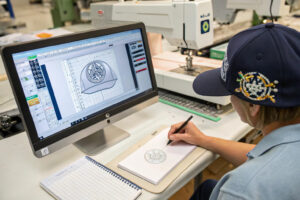
Embroidery digitizing for a custom beanie takes 24 to 72 hours for a standard logo, assuming the digitizer understands knit fabric compensation. The beanie surface is stretchy and unstable. The digitizer must map the stitch sequence to pull outward from the center to avoid the "sink" effect where the stitches disappear into the fabric. If the logo requires 3D puff or a complex gradient, the digitizing can take an extra 24 hours.
Digitizing is not a commodity. It is a craft. A bad file costs days. A good file costs hours. I keep my digitizer on the factory floor. He talks to the machine operators daily.
You should know the specific technical steps that take time. The digital file is not just a vector conversion. It is a mechanical program for a needle to hit a moving stretchy target.
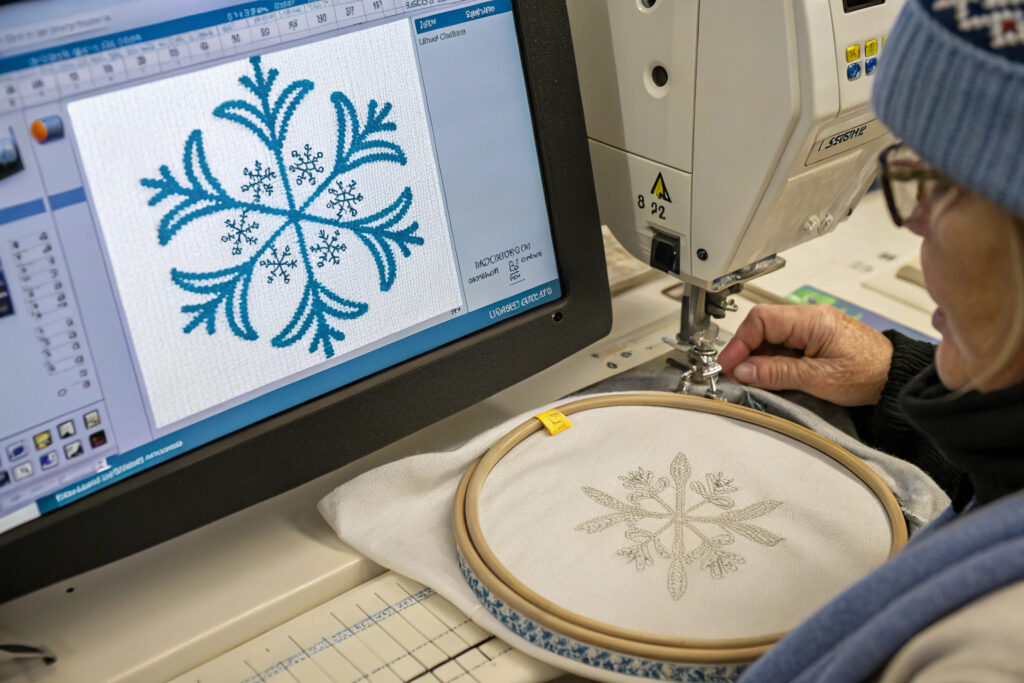
What Is the Difference Between Standard and Complex Puff Digitizing Timelines?
Standard flat embroidery on a beanie is a 2D operation. The digitizer traces the logo and assigns stitch types. 3D puff embroidery uses a foam layer. The needle cuts the foam. The digitizer must program a knife-edge border.
A simple left-chest text logo takes a digitizer about 30 minutes to map. The sew-out test takes 15 minutes on the machine. You can have a photo within 4 hours if the digitizer is in-house. A complex puff design requires a density test. The foam thickness must match the yarn bulk. If the beanie is a chunky cable knit, the foam might float above the valleys in the knit. The digitizer must adjust the underlay stitches to pull the foam down. This test-and-adjust cycle takes a full day.
I send my clients a digitizing checklist. They mark the minimum letter size and the desired height of the puff. We use a specific high-density foam that cuts clean on wool blends. The timeline stretches if the client wants a sew-out on three different beanie colors. Each color might have a different yarn tension. The digitizer adjusts the pull compensation for each. Do not plan your launch assuming the first sew-out will be perfect. Plan for one revision. A 48-hour digitizing timeline saves you a week of shipping wrong samples back and forth.
How Can Pre-Approved Logo Templates Speed Up Bulk Production?
If you order a variety of beanie styles but use the same brand logo, you do not need to digitize from scratch for each style. A pre-approved template is a locked stitch file. You transfer it to the different hoop frames.
We create a master digitized file for the brand logo. We test it on a flat stitch-down beanie, a ribbed cuff beanie, and a cable knit beanie. Once the client approves the logo on all three substrates, we lock the file. This becomes a "known good" file. For any future re-order, we skip the digitizing stage entirely. The lead time drops by 3 days.
I tell my recurring clients to standardize their logo placement. "Always left side, 1.5 inches from the fold." This standardization lets us pre-hoop the beanies. We load the template, hit start, and run. The time saved is not just the digitizing. It is the mental overhead of re-approving a sew-out. We also archive the thread tension settings for each yarn color. Black acrylic yarn might need a different top tension than cream wool. We save these parameters in the job file. A repeat order of 2,000 beanies with an approved template ships in 14 days instead of 21. That is a 33% time saving.
What Are the Cutting and Sewing Steps for Ribbed Knit Beanies?
You think a beanie is just a tube with a string on top. Easy. But the cutting and linking process has multiple hidden steps. The factory cuts corners to save time. They overheat the cutting blade. They miss a linking stitch. The beanie unravels in the customer's hand. The time saved in production becomes time lost in returns.
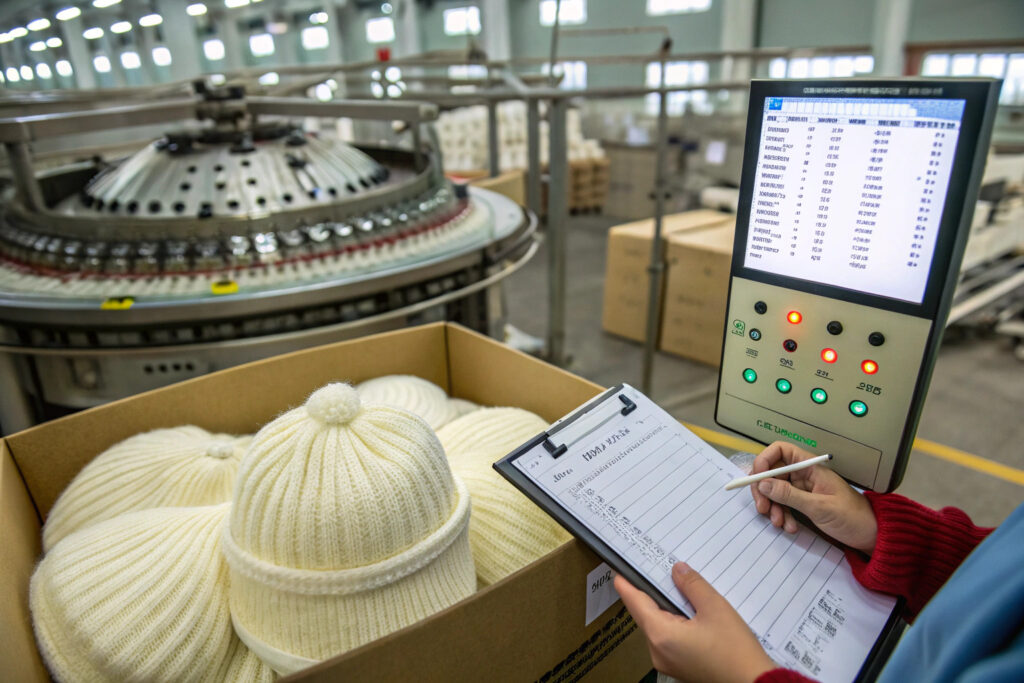
The cutting and sewing steps for ribbed knit beanies are circular knitting, steaming, panel cutting, seam closing, and top linking. The circular knitting machine produces a continuous tube of ribbed fabric. This tube is steamed to relax the yarn memory. Then it is laid flat and cut into individual beanie panels with a bandsaw or a hot wire cutter. The crown seam is closed with an overlock stitch. The top opening is gathered and closed with a linking machine that replicates the knit structure. A cuff is folded and tacked down.
Each step has a specific cycle time. I know the exact minute a beanie leaves the knitting machine and hits the finishing table. This visibility lets me promise a date and keep it.
The two most time-sensitive operations are the cutting method and the top closure. A mistake here costs hours of rework. The fabric is delicate. The knife must be sharp.
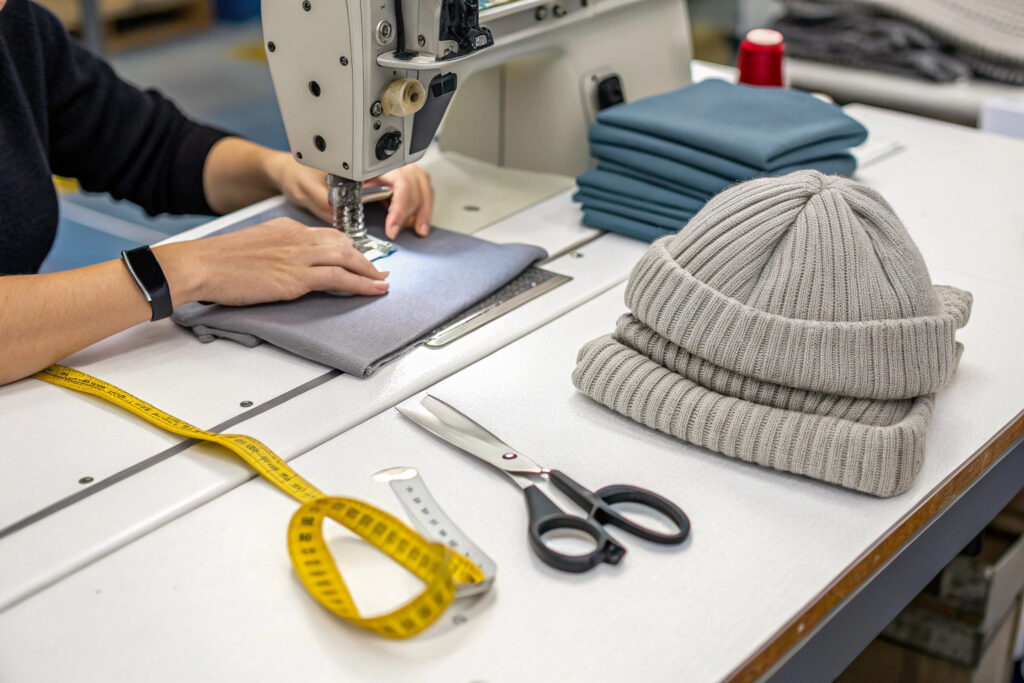
How Does Laser Cutting Compare to Traditional Bandsaw Cutting for Beanies?
A bandsaw is a mechanical blade. It cuts through layers of knit fabric. The heat from friction can melt the acrylic fibers at the edge. The edge hardens. It pricks the wearer's forehead. Laser cutting uses a beam of light. It seals the edge instantly. It is faster and cleaner.
Traditional bandsaw cutting stacks the fabric tube. We can cut 20 panels at once. The blade moves fast. The cycle time per beanie is about 5 seconds. Laser cutting is even faster. The automated laser head follows the digital pattern. It cuts one panel at high speed with no physical contact. The edge is sealed, which stops the knit from laddering.
The real time saver is the setup. A bandsaw needs a physical metal template for each size. Changing sizes takes 15 minutes. A laser cutter is digital. I change the size on the touch screen in seconds. For an order with mixed adult and child sizes, laser cutting cuts the lead time by half a day. The laser cutting machine also scores the fold line for the cuff. The operator just folds on the line. No measurement required. This improves sewing consistency. The investment in laser cutting is not just about speed. It is about removing the hand-trimming step. The beanie comes off the laser finished. It goes straight to the seamstress.
What Is the Top Linking Process and Why Does It Create a Bottleneck?
The top of a beanie is not just sewn shut. If you just overlock the top, it looks like a cheap sock. A proper beanie uses a linking machine. This machine copies the knit stitch at the seam. The seam is flat and invisible from the outside.
Linking is a manual operation. The operator takes the open end of the beanie and feeds it point by point onto the linking machine's dial. It takes about 60 to 90 seconds per beanie. This is slow. A sewing factory can churn out hundreds of bodies per hour but only link 50 per hour per operator. The linking station is the classic production bottleneck.
I solve this by cross-training my sewing staff. During peak beanie season, we double the linking stations. We pull operators from the baseball cap lines. We use an automated linking machine for basic rib structures. It can link 120 beanies per hour. For delicate yarns, hand linking is still better. The seam is softer. If your order has a pom-pom attachment, the linking step is even more complex. The pom-pom is sewn on during the linking process. This adds 30 seconds per hat. I always ask the client if the pom-pom is essential. A folded top without a pom-pom cuts the linking bottleneck by half.
How Do Quality Checks Extend or Shorten the Final Ship Date?
The beanies are boxed. The truck is waiting. The quality manager finds loose embroidery on 10 pieces. You have a choice. Ship them and hope the customer doesn't notice. Or hold the shipment, unbox the carton, and fix the issue. The factory that ships bad goods hits the date but kills the relationship. The factory that holds the shipment keeps the brand but misses the vessel.
Quality checks extend the ship date when failures are found. They shorten the ship date when the process is preventive. An inline QC system catches loose threads at the linking machine, not at the final audit table. This stops bad beanies from reaching the packing station. If you only inspect at the end, you build 1,000 beanies, find 50 bad ones, and then have to rework them. The rework time is unplanned. It pushes the booking.
My QC team does not just inspect. They prevent. A prevention mindset keeps the vessel booking secure.
There are two main inspection philosophies for beanies. The method you choose determines whether the quality step is a speed bump or a brick wall.
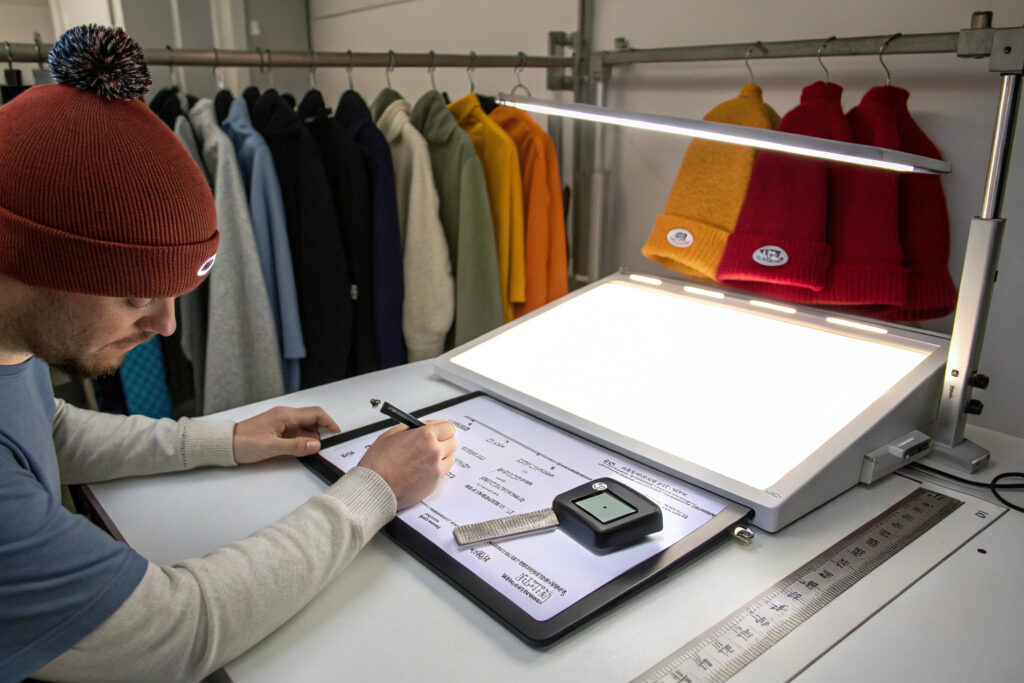
What Is an Inline Inspection vs a Final Audit for Knit Headwear?
Final audit is a rearview mirror. The order is complete. The inspector pulls a random sample from the finished cartons. Inline inspection is a speedometer. The inspector stands on the production floor and checks the beanies as they flow out of the linking machine.
Inline inspection saves the ship date. If the linking operator's tension is wrong, the inline inspector catches it on beanie number 10. The operator adjusts the dial. Beanies 11 to 1,000 are perfect. With final audit, you catch the mistake on beanie 1,000. You rework 990 beanies. The rework takes 2 days. The ship misses the cut-off.
I schedule our inline inspection at three gates. Gate 1 is the knitting machine. We check the yarn tension and fabric weight. Gate 2 is the embroidery station. We check the logo registration. Gate 3 is the linking and finishing table. We measure the cuff fold and clip the loose threads. The final audit is a safety net. It is an AQL 2.5 pull from the packed cartons. But at that point, it should find zero surprises. The goal is to make the final audit boring. Boring audits mean fast releases. Fast releases mean the truck makes the port.
How Does a Pilling Resistance Test Affect the Approval Timeline?
Pilling is the enemy of a soft beanie. Tiny fuzz balls form on the surface after a few wears. The hat looks old. The customer returns it. You need to test the yarn's pilling resistance before you cut the fabric.
A pilling test takes time. The standard method is the Martindale test. A swatch of the knitted beanie fabric is rubbed against a standard abrasive for 2,000 cycles. The lab then rates the surface against a visual scale. Grade 5 is no pilling. Grade 3 is moderate pilling. This test takes 8 hours to run, plus lab transit time.
We conduct a Martindale pilling test on every new yarn lot. If the yarn fails, we reject the lot. We find a new yarn. This adds 2 to 3 days to the pre-production stage. It is a good delay. It saves you from shipping 5,000 beanies that pill on the first wear. I always advise clients to pre-test the yarn during the sampling stage. Don't wait for the bulk order. A 3-day pilling test in January saves a 30-day return cycle in November. Factor this quality gate into your critical path schedule.
Conclusion
The standard lead time for custom embroidered beanies in 2026 is a puzzle with many pieces. You start with the yarn. Acrylic is fast. Wool is slow. Seasonal bottlenecks like Chinese New Year and August bulk windows add weeks to the yarn shelf. You then digitize the logo. A flat design takes a day. A complex puff design takes longer. Pre-approved templates save you three days on repeat orders.
Then you cut and sew. Laser cutting speeds up the fabric prep. The linking machine is the bottleneck. A skilled hand linker can only do 50 hats an hour. Inline quality inspections at the knitting, embroidery, and linking gates prevent rework delays. A final pilling test adds time upfront but prevents returns later.
A reliable supplier owns the yarn inventory, the knitting floor, the embroidery station, and the linking tables. Any break in this chain adds a week. At Global-Caps, we have knitted these steps together into one seamless flow. We track the yarn cone from the shelf to the ship.
If you need custom embroidered beanies delivered on a schedule you can set your watch by, let's talk. Contact our Business Director Elaine. She can give you a real-time production calendar for your order and show you the exact gate dates. Email Elaine at elaine@fumaoclothing.com. Let's knit your vision into a beanie that arrives right on time.