You get a quote for 5,000 snapbacks. The unit price looks beautiful. You sign the contract. Then the forwarder sends you the final bill. The ocean freight is four times higher than you budgeted. Your profit is gone. I have held hands with too many buyers during these freight crisis moments. The price of moving a box changes faster than the weather. You look like a hero to your boss when you budget correctly. You look careless when you get surprised.
For a 40-foot high cube container leaving Shanghai or Ningbo for Los Angeles or New York in the current market, you should budget a sea freight cost between $2,800 and $4,500 for the base ocean rate. A typical bulk order of custom snapbacks uses a 20-foot container if the order is around 50,000 units. That base rate currently sits around $1,600 to $2,600. You have to add fuel surcharges, peak season fees, and documentation charges. You must look at the actual spot rates on the day you book. The contract rate is a promise, but the spot rate is the reality.
I hate seeing brands get nickel-and-dimed by hidden logistics fees. A factory that offers you a cheap EXW price and then abandons you at the port gate is not a partner. They are just a vendor. I want you to understand the whole flow of the ocean. From the truck in Zhejiang to the warehouse in Chicago. This guide breaks down the real numbers and the real timing.
What Determines the Price of LCL vs FCL Shipments for Caps?
The toughest decision for a growing hat brand is choosing between a shared container and a private one. You might be scared of paying for empty space in a full container. So you go with a shared load. But the math sometimes makes that a bad deal. Fear of waste pushes you into a cost trap.
The price of LCL (Less than Container Load) is driven by the volume in cubic meters (CBM). You pay a higher base rate per unit of space, but you don't pay for air. FCL (Full Container Load) is a flat fee for the entire steel box. If you have enough goods to cross the CBM threshold, FCL usually wins. That threshold for caps is around 12 to 15 cubic meters. A snapback cap in a polybag weighs about 90 grams. Its boxed volume is roughly 0.0009 CBM. The math changes with the headliner stuffing or if you use individual boxes.
Let's really dig into the mechanics of these two modes. I want you to see the invisible costs that sit inside each method. It is not just the ocean rate. It is the touchpoints at the port.
How Do You Calculate Volume for a Mixed PO of Trucker and Snapback Hats?
A snapback hat packs differently than a high-crown trucker hat. Trucker hats have a structured foam front. You cannot flatten them easily. They eat up space fast. I see buyers cry when their "cheap" trucker hat order costs $1,200 in freight for 200 cartons because the volume was so high.
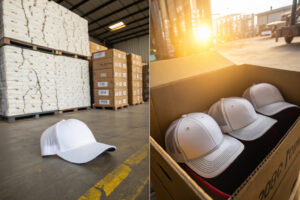
We need to use the standard freight density formula. Weight matters. But volume is the ruler for light cargo like caps. You take the length times width times height of the export carton in meters. Our standard snapback carton holds 72 units. The size is 0.6m x 0.4m x 0.4m. That is 0.096 CBM per carton. For a trucker hat, because of the foam, the carton might hold only 36 units for the same size box. That instantly doubles your freight cost per hat.
The freight cost per piece drops with vacuum packing or by nesting the caps. I always ask my packers to nest the front crown of the snapback into the back opening of the next cap. This "spooning" method saves about 15 percent of volume. For big mixed orders, I use a volume calculator to estimate the load before we quote the sale. You should ask for the CBM estimate on the proforma invoice. A good supplier lists the carton count and the carton size exactly. If they don't, they might be hiding a freight loss behind the unit price. You want a partner who lists the gross weight and the volumetric weight on the packing list. This stops disputes at the co-loader's warehouse.
What Hidden Charges Appear on a House Bill of Lading?
The freight quote says $1,900. The final bill hits your card for $3,400. Why? The "destination charges" or "local charges" on the House Bill of Lading are the shark in the water. These fees are separate from the ocean freight price.
You need to ask for the 'all-in' rate. Common hidden fees include the CFS (Container Freight Station) charge for LCL and the origin receiving charge. For FCL, watch out for the chassis rental fee and the port congestion surcharge. These fees are legal. But some unscrupulous forwarders jack them up after the boat leaves. You are a hostage. Your goods are on the water.
You have to insist on a detailed fee breakdown before shipping. The fees to look at are: Documentation Fee, Customs Clearance Fee, ISF Filing Fee, and Bill of Lading Release Fee. The B/L Release fee is a trick. Sometimes they ask for a "Telex Release" fee of $50, but it's just an email. They also add an "AMS" (Automated Manifest System) fee. That is legit for the US, a fixed cost of about $30 to $45. Ask if the quote includes the destination terminal handling charge. This is the handshake fee for the longshoremen union. In LA, this can be heavy. I always ask my forwarder to prepay the freight to the door if possible. If you allow the freight to be "collect," you have zero control over the destination ripoff fees. Prepaid gives you the chance to negotiate the total lump sum before it ships.
How Long Does Sea Freight Take from Ningbo to Los Angeles?
You planned a launch event. The DJ is booked. The email blast is scheduled. But the hats are on a boat creeping across the ocean. The silence from the tracking page is deafening. Missed retail windows bleed money. The anxiety of "where is my cargo" drains your energy.
The sailing time from Ningbo to the Los Angeles port is roughly 12 to 15 days on the direct ocean leg. You must add 3 to 5 days for terminal operations. This includes unloading, chassis availability, and customs clearance. So a realistic "dock to door" in California is 20 to 25 days. Congestion at the LA/LB port complex used to be horrific. It has eased, but labor slowdowns or peak season surcharges can still kill a weekend unloading slot.
Time is inventory. You must plan a buffer. I don't let my project managers promise an exact delivery date for ocean freight. We promise a sail date. We control the sailing date. We don't control the Pacific Ocean.
Let's break the timeline down to the granular level. If you check your tracking, you see a few scary statuses. We need to demystify what actually happens when the boat hits the pier.
What Steps Occur During US Customs Clearance for Headwear?
Customs clearance is the black hole. Your tracking just says "Customs Hold." You picture a guy in a uniform ripping open your boxes. The reality is usually boring data processing. But small mistakes cause costly holds.
First, you need an ISF (Importer Security Filing) 10+2 filed 24 hours before the boat loads in China. I file this with my broker. If we miss this, the fine is $5,000. For the clearance itself, the hat must have the correct HTS code. That's the 6505.00 we discussed earlier. The customs officer looks at the manifest and the commercial invoice. They check for anti-dumping or countervailing duties. Right now, there are no ADD/CVD orders on baseball caps from China. That is good.
The process can trigger an FDA hold if you have any antimicrobial finishes or medical claims on the cap. Avoid marketing your sweatband as "medical grade" unless you have the 510k. It will get seized. For a normal cotton snapback, it goes through ACE (Automated Commercial Environment). If the data matches and no flags pop up, it clears in hours. If the data is wrong or the manifest says "100% cotton" but the tag says "polyester," you get a document review. That takes a week. Consistent data entry is the safety key.
How to Avoid Demurrage and Detention Fees at the Port?
These fees turn a $200 delivery into a $2,000 nightmare. Demurrage is the rent you pay on the container when it sits at the terminal too long. Detention is the fee you pay the steamship line for keeping their container outside the port too long. Both burn cash daily.
The standard "free time" at the port for a 40-foot container is about 4 working days. After that, the meter runs. I have seen fees of $150 per day for demurrage and $175 per day for detention. You bleed out fast. The worst is when Customs puts a "hold" on day 2. By the time the hold lifts on day 5, you owe a full day of rent. You must track the "Last Free Day" obsessively.
I ask my drayage trucker to pre-clear the customs entry. We file the entry two days before the boat docks. This is called "pre-clearance." It means the Customs hold is usually released before the vessel arrives. When the container hits the ground, it's already free. I also recommend booking appointments immediately. The LA/LB ports require a trucker appointment. If you wait until the container is available, the slots are gone for two days. Those two days eat your free time. You need a trucker who watches the vessel schedule and grabs the appointment slot the moment the container is discharged. The difference between an active and a passive logistics partner is $600 in saved fees.
What Are the Best Materials for Wholesale Snapback Hats?
Fabric tells the truth. A cheap wool blend feels like cardboard. A heavy mesh traps heat. I see new brands pick materials based on a blurry photo. They get a sample that looks good but feels awful. The end consumer touches the hat. They feel the itch. They smell the synthetic dye. They don't buy again. A snapback is a billboard for your brand. If the material is bad, the brand looks cheap.
The best materials for wholesale snapbacks depend on the use case. For a premium streetwear line, a heavy structured wool blend with a high-profile crown creates the iconic flat-bill look. For a summer sports event, a cotton twill front with a polyester mesh back is unbeatable. Polyester foam laminate gives the perfect "trucker" snapback structure. The key is the weight. I use 280gsm to 350gsm wool for a stiff crown. I use 200gsm cotton twill for a softer, dad-hat style snapback.
Materials drive cost more than labor. A small upgrade in the sweatband material from standard cotton to a wicking poly-spandex band changes the retail perception from "gas station" to "athletic brand."
Let's break down the specific material categories. I want to help you avoid the situation where you order "wool" but receive a flimsy acrylic mix that pills after a week.
What Is the Difference Between Structured and Unstructured Snapback Crowns?
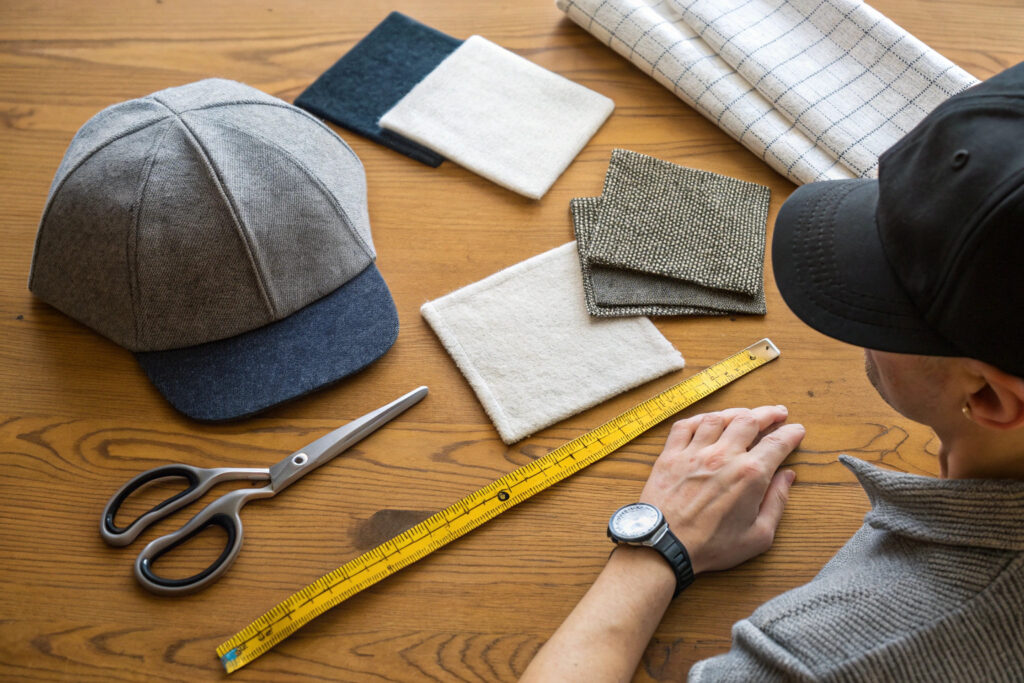
The crown is the face of the hat. It defines the silhouette. Structured caps have a stiff inner layer. Unstructured caps drape and flop. The choice is not just style. It's about your brand identity and embroidery ease.
A structured crown uses a buckram backing. Buckram is a stiff cotton or polyester mesh fused with glue. It makes the front panels stand up straight even when the hat is not on a head. This is the classic New Era fitted or snapback look. You embroider on a flat, stable surface. The stitch density is perfect. For an unstructured crown, there is no backing. The fabric folds. Your logo might warp if the thread tension is too high. We often use a soft canvas or heavy interlining to give a slight shape to an unstructured cap without making it a stiff box.
The customer's hair touches the buckram. If we use cheap glue, the customer gets hot and itchy. I use a breathable perforated buckram for our premium structured snapbacks. It holds the front profile up but lets air flow through the needle holes. You should ask if the buckram is washable. Cheaper buckram dissolves in the rain. Your cap collapses. A good polyester-based buckram survives the washing machine. It keeps its shape for the life of the hat. We cut our buckram with a laser to avoid sharp edges that poke through the cotton front panel. You cannot see this in a photo. You must feel it.
How to Choose Mesh Backing for Breathability in Summer Snapbacks?
Plastic mesh, polyester mesh, or cotton mesh? The wrong mesh fades red in the sun and leaves a pattern on your forehead. The right mesh makes a cap wearable in 95-degree heat.
Trucker snapbacks famously use plastic mesh. That's the classic wide-hole grid. It is durable. It is loud. The color is limited because it's usually made of polyethylene. Polyester mesh is a softer hand. It's a fabric with tiny holes. It's used for athletic performance caps. It wicks moisture. It doesn't crunch when you adjust the snap.
The key spec is the air permeability. If you are doing a corporate fun run in Texas, you need a mesh with high CFM (cubic feet per minute) airflow. I recommend a honeycomb polyester athletic mesh. It has a smooth face. You can print on it. Cotton mesh is rare because it absorbs sweat and sags. It loses its shape after two washes.
For the snapback closure, the mesh attaches to the plastic snap. This is a stress point. A cheap mesh unravels at the seam because the plastic snap backing is too stiff. We always reinforce the back seam with nylon binding tape. Also, check the UV resistance of the mesh. Polyethylene degrades in the sun. For outdoor summer camps, the UV-stabilized mesh lasts one season longer. The difference is 50 cents in material cost but a $5 value in brand perception. I usually send a mesh card to new clients. It's a ring with 15 different mesh swatches. You can hold it up to the light. You pick the one that looks best with your logo. Don't guess the mesh from a photo.
Why Do Custom Embroidery Digitizing Fees Vary So Much?
You send your logo. The factory quotes a $50 digitizing fee. Another quotes $150. You think the first factory is giving you a deal. You are actually paying for the mistake twice. A bad digitizing file is a tattoo gun in the hands of a blind robot. It shreds the fabric and spits broken thread. The hat looks like a failed science project. You pay for the sample anyway. Then you pay again to fix it.
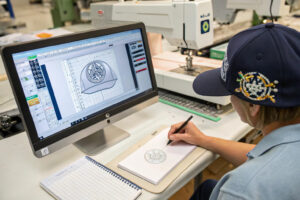
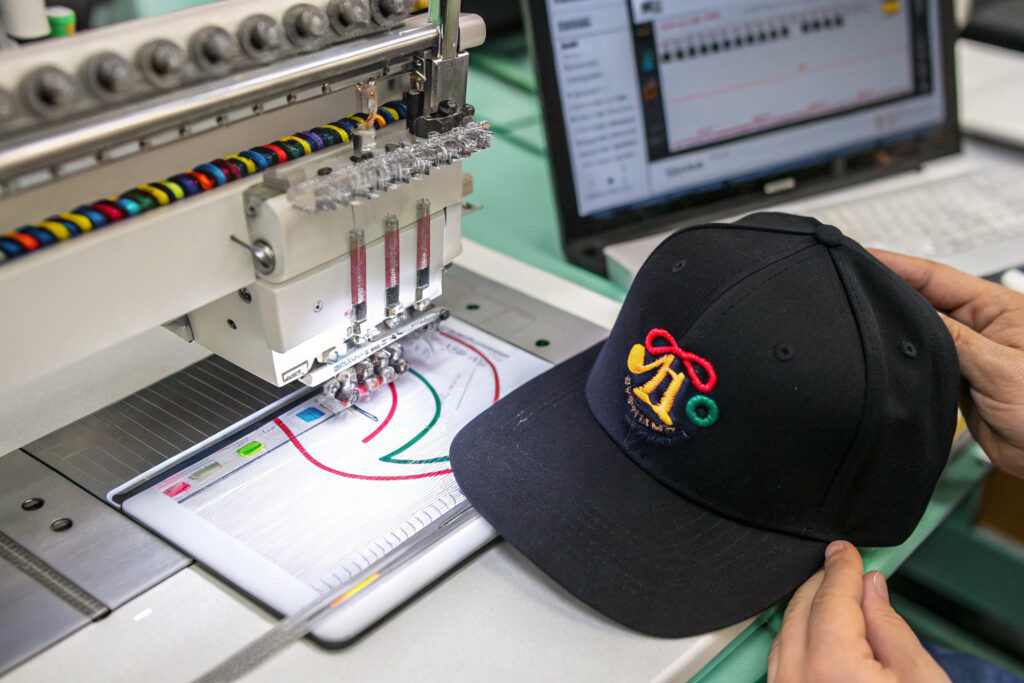
The digitizing fee varies based on the stitch count, complexity, and the skill of the digitizer. A simple left-chest text logo is about 2,500 stitches. That is a quick map. A complex 3D puff logo covering the entire front panel is 12,000 stitches or more. A human digitizer who understands cap physics charges more. They know the stitch must pull outward from the center to avoid puckering. The machine file is not just a picture. It is a sequence of mechanical instructions for needle penetration.
I keep our digitizing in-house. It saves the back-and-forth translation errors. You should never accept the first sew-out without seeing it on the actual cap fabric.
We need to talk about the details of thread and technique. The cost is in the adjustments. A cheap digitizer uses auto-trace software. An expensive one uses a brain and two decades of hat machine experience.
What Is the Difference Between 3D Puff and Flat Embroidery on Caps?
This is the most visible design choice on a snapback. Flat embroidery sits on the fabric. 3D puff rises off the crown. It feels thick. It is a statement. The failure rate for puff is higher. That's why it costs more.
Flat embroidery uses standard underlay stitches. The thread lies flat. This works for logos with sharp detail and small text. The machine tension is easy to manage. Puff uses a foam layer sewn onto the cap. The needle cuts the foam and traps it under the top thread. The foam raises the logo. The height can be 2mm or 5mm. If the digitizing angle is wrong, the needle slices the foam at the edge. It leaves jagged chunks.
We use a specific high-density foam that is 3mm thick for caps. It cuts clean. The file requires a "knife edge" stitch. This is a sharp angle where the needle moves sideways to slice the foam perfectly. If the file just goes around the foam, the foam stays attached. You get a fuzzy mess. The digitizer must place the tie-in and tie-off stitches under the foam edge so they are hidden. On a curved cap peak, the foam wants to shift. We use a sticky backing sheet. I ask the production line to slow the machine RPM by 15 percent for puff runs. This keeps the registration tight.
Why Does Stitch Count Impact the Final Price of a Custom Hat?
Stitch count is the meter of embroidery cost. You buy thread, time, and machine life. A logo with 8,000 stitches consumes more thread and takes longer than a logo with 4,000 stitches. It is that simple. But the cost is not just the extra thread. It is the risk.
High stitch counts on caps are dangerous. The fabric is on a curved frame. If you pack 15,000 stitches into a 3-inch patch, the needle punctures the same hole twice. It cuts the fabric. We call it a "bullet hole." The cap is scrap. You need high thread density for solid fills. We use a technique called "satin stitch railing" to reduce the internal density without sacrificing the visual fill.
Labor cost is the other factor. If the thread changes color, the machine stops. A human clips the thread and changes the cone. A 6-color design takes 3 times longer to run than a 1-color design. The machine time is billed per 1,000 stitches. A domestic US decorator might charge $1.50 per 1000 stitches. In our factory, it's much lower. But the complexity premium remains. I always ask the digitizer for a "trim" optimization. Minimize the jumps between letters. A 2mm jump doesn't need a trim. A 10mm jump needs a manual trim. Less trimming reduces the run time and lowers your FOB cost. You pay for the digitizing once. You pay for the trim time on every single hat. Do the math.
Conclusion
Shipping custom snapbacks in bulk is a physics and paperwork puzzle. You must solve the sea freight cost first. It shifts between $1,600 and $4,500 depending on spot rates and container size. Don't let LCL fees fool you if your volume is high. Check the volumetric weight and ask for the 'all-in' destination charge list on the House Bill of Lading.
You must also respect the clock. Transit from Ningbo to LA is fast, but port dwell time can cripple your launch. Pre-clear the ISF and Customs entry. Grab the trucker appointment early to avoid demurrage ruin. Then you need to pick the physical form of the cap. Choose between structured wool and breathable polyester mesh. Don't use cheap buckram that dissolves. Don't use mesh that fades in the sun. Finally, nail the logo. Custom embroidery digitizing is not a place to save a quick buck. A skilled 3D puff file pays for itself in zero-defect products. The stitch count directly drives your unit price and scrap rate.
This is the whole picture. A factory that handles the freight, the customs, the material sourcing, and the digitizing under one roof is rare. Global-Caps is that factory. We don't push you to the open market to find your own freight forwarder and your own digitizer and then just sit and wait for the boxes to arrive. We take the full weight of the project.
If you need to get a bulk shipment of custom snapbacks from China to the States without the headache of chasing five different vendors, let's talk. We can walk through your design and your delivery timeline. Reach out to our Business Director Elaine for a realistic shipping quote and a digitizing estimate that matches your logo. Email elaine@fumaoclothing.com right now. Let's build a hat that looks sharp and arrives on time.