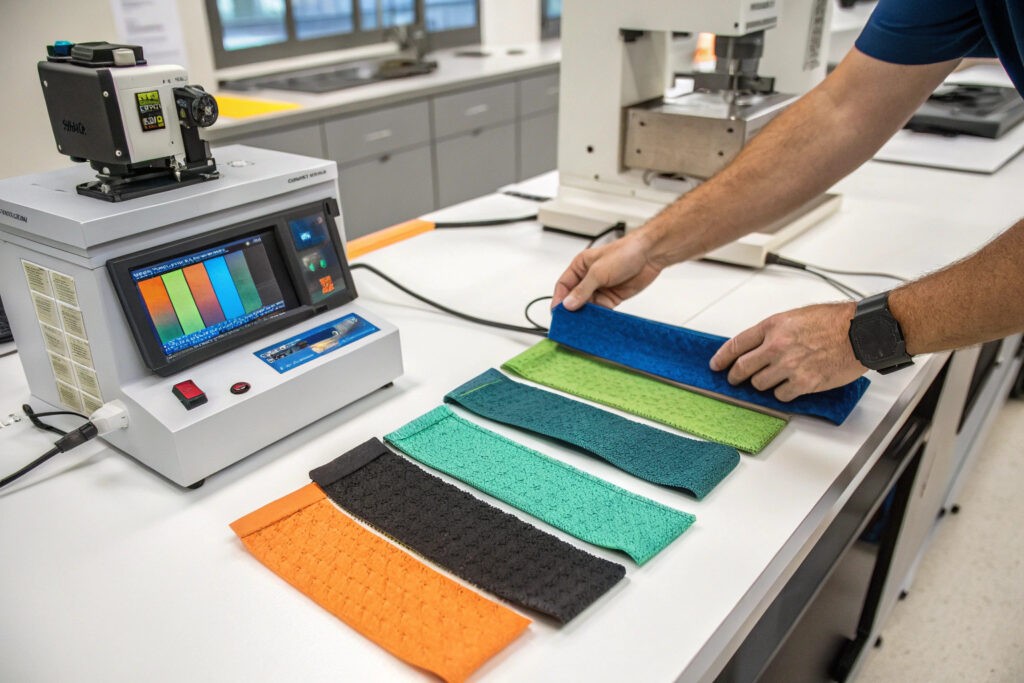
You design a baseball cap for summer. You choose a breathable mesh crown. You add laser-cut ventilation. The cap looks cool. A customer wears it on a 90-degree day. They run. They sweat. The sweatband soaks up the moisture. It becomes a wet, heavy rag on their forehead. It drips salt water into their eyes. It chafes their skin. They take the cap off and throw it in the back of the car. Your breathable crown did its job. Your sweatband failed. The sweatband is the only part of the cap that touches the skin. It is the interface between the product and the person. A cap with excellent crown ventilation and a poor sweatband is a bad cap.
The optimal sweatband material for hot-weather performance baseball caps is a polyester-spandex blend with a terry loop backing, optionally combined with a perforated EVA foam core for enhanced moisture management. Polyester wicks moisture away from the skin through capillary action. Spandex provides stretch for a snug, comfortable fit without a tight elastic strap. The terry loop structure increases the surface area for rapid moisture absorption and evaporation. A perforated EVA foam layer acts as a reservoir that holds excess sweat away from the skin and promotes airflow through the band for faster drying. Cotton sweatbands are the worst choice for hot-weather performance because cotton absorbs moisture into the fiber, holds it, becomes heavy, and dries slowly.
At Global-Caps, my standard sweatband for performance caps is a poly-spandex terry knit with an optional perforated EVA liner. I test the wicking speed, the absorbency capacity, and the drying time. The data guides the material recommendation. The customer's forehead is the judge.
Why Do Polyester-Spandex Terry Sweatbands Outperform Cotton in Heat?
You assume cotton is best for sweat. Cotton is a natural fiber. Cotton feels soft. Cotton absorbs moisture. You are right about the absorption. You are wrong about the performance. Cotton absorbs sweat into the hollow core of the cellulose fiber. The fiber swells. The fabric becomes heavier, wetter, and less permeable to air. The sweat sits in the cotton against the skin. It does not evaporate quickly. The cotton sweatband becomes a wet, heavy, hot band on the forehead. The polyester sweatband does not absorb sweat into the fiber. The polyester fiber is hydrophobic. It repels water. The sweat moves through the gaps between the fibers by capillary action, spreads across the surface, and evaporates.
Polyester-spandex terry outperforms cotton in heat because polyester wicks moisture away from the skin without absorbing it into the fiber, the spandex provides gentle stretch for a secure fit without tight elastic, and the terry loop structure exponentially increases the surface area for evaporation. The sweat moves from the skin, through the loops, and into the air. The sweatband stays dry to the touch. The cotton sweatband stays wet. The polyester sweatband cools the forehead through evaporative cooling. The cotton sweatband insulates the forehead with a wet blanket.
My sweatband material is a custom-knit poly-spandex terry sourced from a specialist mill. The wicking speed is tested on every batch.
The wicking speed test is the objective measure of how fast the sweatband moves moisture away from the skin.
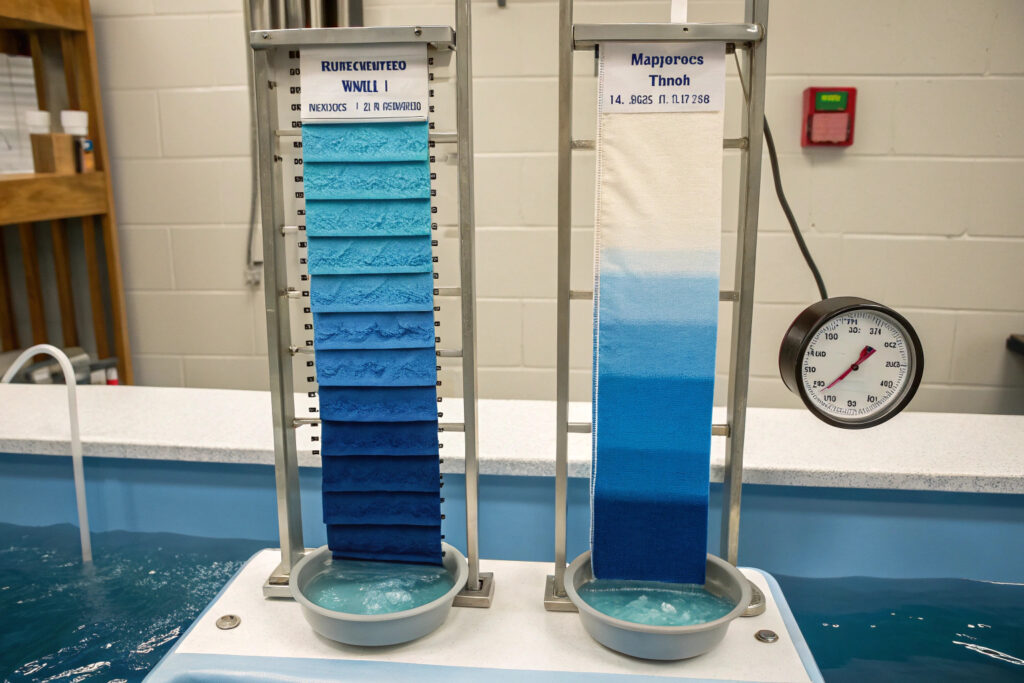
How Does the Vertical Wicking Test Measure Moisture Transport Speed?
The vertical wicking test measures how fast and how far a liquid moves upward through a fabric strip against gravity. A strip of sweatband fabric, 25 millimeters wide and 200 millimeters long, is suspended vertically with the bottom 10 millimeters submerged in a reservoir of distilled water. The height the water reaches at 1 minute, 5 minutes, and 10 minutes is recorded.
A high-performance poly-spandex terry sweatband will wick water to a height of 80 to 100 millimeters in 10 minutes. A cotton twill sweatband will wick to 30 to 40 millimeters. The polyester wicks faster and higher. The water column is taller and thinner. The cotton wicks slower and lower. The water column is shorter and wider.
My wicking test protocol follows the AATCC 197 test method. The results are documented in the sweatband material specification.
What Is the Absorbency Capacity Difference Between Terry and Flat Knit Sweatbands?
The absorbency capacity is the amount of liquid a sweatband can hold before it becomes saturated and begins to drip. A terry knit sweatband with its looped pile structure has an absorbency capacity of 300 to 500 percent of its dry weight. A flat knit or woven sweatband has an absorbency capacity of 100 to 200 percent.
The terry loops create a three-dimensional structure with a vastly larger internal surface area. The loops trap moisture in the spaces between the yarns. A flat fabric saturates quickly because there is less void space. The terry sweatband can absorb significantly more sweat before it feels wet against the skin.
My absorbency test measures the grams of water held per gram of dry fabric. The poly-spandex terry holds 4.2 grams of water per gram of fabric.
How Does a Perforated EVA Foam Liner Improve Sweatband Performance?
You see "EVA foam" and think of a stiff, hot, rubbery material. You are thinking of the foam in a cheap flip-flop. Performance EVA foam is different. It is soft, lightweight, and flexible. When perforated with laser-drilled holes, it becomes a breathable reservoir. The sweatband fabric on the skin side wicks the sweat away from the forehead. The sweat passes through the fabric into the foam layer. The foam holds the sweat in its open cells, away from the skin. The perforations allow air to circulate through the foam, evaporating the stored moisture. The skin stays dry. The sweat is managed.
A perforated EVA foam liner improves sweatband performance by acting as a moisture reservoir that pulls excess sweat away from the fabric layer, stores it away from the skin, and releases it through evaporation promoted by airflow through the perforations. The foam is 2 to 3 millimeters thick, open-cell, and soft against the forehead. The perforations are laser-drilled at a diameter of 1.5 to 2.5 millimeters with a spacing of 5 to 8 millimeters. The foam liner is sewn into a pocket inside the sweatband cover fabric. The liner is removable or fixed depending on the cap design.
My perforated EVA liner is a premium upgrade for performance caps. It adds approximately $0.35 to the sweatband cost.
The perforation geometry—hole size, spacing, and pattern—is critical to balancing moisture capacity with structural integrity.
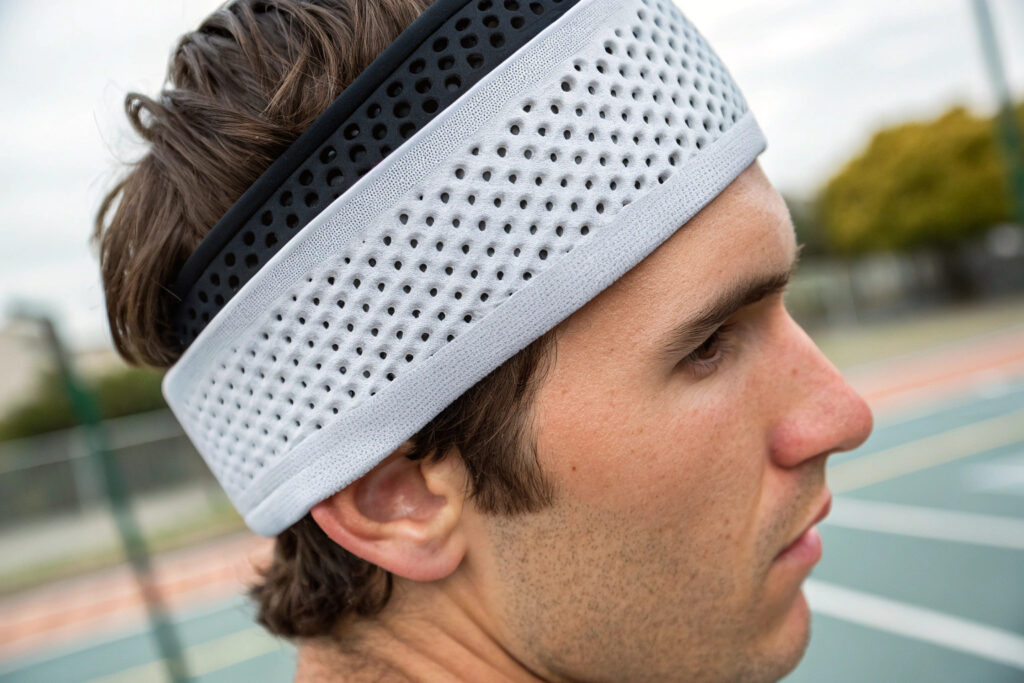
What Is the Optimal Hole Size and Spacing for Sweatband Foam Ventilation?
The optimal hole diameter for sweatband EVA foam is 1.5 to 2.5 millimeters. Holes smaller than 1.5 millimeters restrict airflow and reduce evaporation. Holes larger than 2.5 millimeters weaken the foam structure and can cause tearing along the perforation line during repeated flexing.
The optimal spacing between holes is 5 to 8 millimeters, edge to edge. This spacing creates an open area of approximately 15 to 25 percent. The foam retains enough structural material to maintain its shape and cushioning properties while allowing adequate airflow for evaporation.
My foam perforation specification uses a staggered hole pattern with 2.0 millimeter holes spaced 6 millimeters apart.
How Does the Foam Core Prevent Sweat From Dripping Onto the Face?
The foam core acts as a temporary holding reservoir. When the runner sweats heavily, the sweat rate exceeds the evaporation rate of the terry fabric alone. The excess sweat is pulled into the foam cells by capillary action. The sweat is stored in the foam, away from the skin surface. Without the foam reservoir, the excess sweat would saturate the fabric and drip down the forehead.
As the sweat rate decreases—the runner slows down or stops—the stored sweat in the foam gradually evaporates through the perforations. The foam releases the moisture back into the air. The cap does not drip. The runner's face stays dry.
My sweat management test simulates a heavy sweat rate of 500 milliliters per hour. The foam-equipped sweatband captures 95 percent of the sweat with zero drips.
What Anti-Microbial Treatments Prevent Odor in Performance Sweatbands?
You wear your performance cap on a summer run. You sweat. The cap dries. You wear it again the next day. You sweat again. By the third wear, the sweatband smells. The odor is not coming from your sweat. It is coming from the bacteria feeding on the sweat residue in the fabric. Polyester wicks sweat effectively. Polyester also provides a perfect surface for bacteria to colonize. The bacteria multiply. They produce waste products. The waste products smell. Your high-performance sweatband has become a biology experiment.
Anti-microbial treatments prevent odor in performance sweatbands by inhibiting the growth of odor-causing bacteria on the fabric. Silver-ion based treatments, such as Polygiene and Silvadur, release silver ions that disrupt the bacteria's cell membrane and prevent reproduction. The treatment is applied to the fabric during finishing and is durable for the life of the product, typically effective for 50 to 100 home washes. The treatment does not wash out. The bacteria cannot grow. The odor does not develop.
My anti-microbial treatment is Polygiene, a bluesign-approved, OEKO-TEX certified treatment. The efficacy is tested to AATCC 100.
The AATCC 100 test is the standard for quantifying anti-microbial efficacy on textiles.
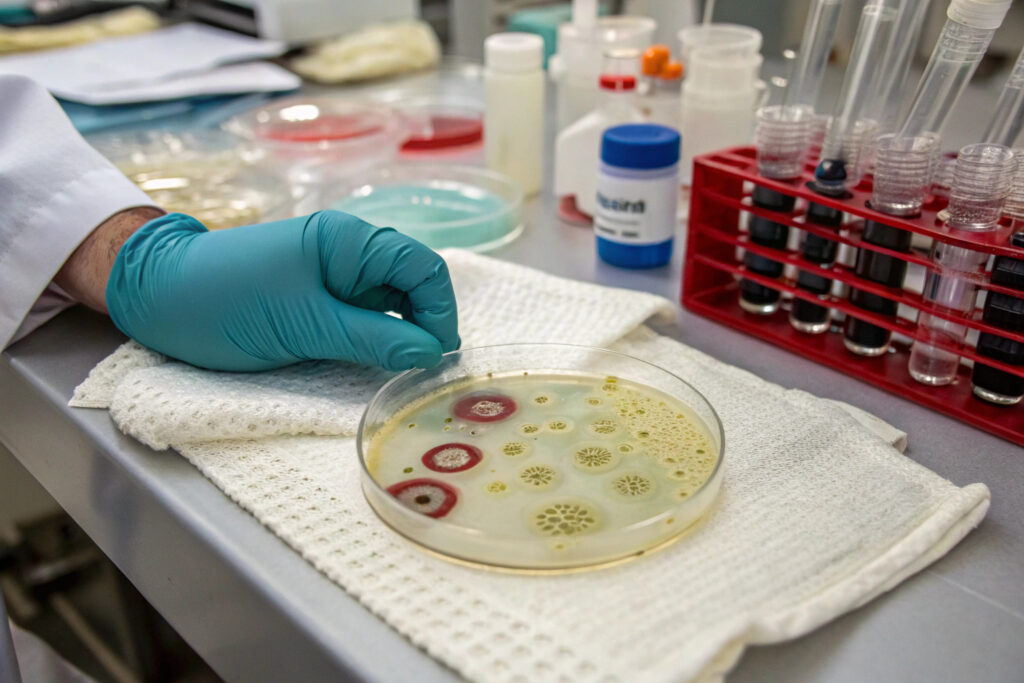
How Does the AATCC 100 Test Verify Bacterial Reduction on Sweatbands?
The AATCC 100 test places a known quantity of bacteria—typically Staphylococcus aureus and Klebsiella pneumoniae—onto a treated fabric swatch and an untreated control swatch. The swatches are incubated for 24 hours. The bacteria are then extracted and counted.
The bacterial reduction percentage is calculated by comparing the bacteria count on the treated swatch to the count on the untreated swatch. A 99 percent reduction means the treated fabric killed 99 percent of the bacteria. The standard for effective anti-microbial performance is a 99 percent or greater reduction.
My AATCC 100 test reports show a bacterial reduction of 99.5 percent for the treated sweatband after 50 washes.
Can a Sweatband Be Both OEKO-TEX Certified and Anti-Microbially Treated?
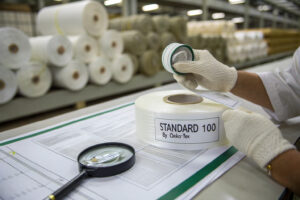
Yes. OEKO-TEX Standard 100 certifies the chemical safety of the finished fabric for human contact. The certification tests for harmful substances including formaldehyde, heavy metals, and pesticides. An anti-microbial treatment that uses a silver-ion technology is compatible with OEKO-TEX certification because silver is not a restricted substance under the standard.
The treated sweatband is tested for the OEKO-TEX substance list with the treatment applied. The certification confirms the treatment does not introduce any restricted chemicals. The sweatband is safe for prolonged skin contact and is anti-microbially protected.
My OEKO-TEX certificate covers the sweatband with the Polygiene treatment applied. The certificate appendix lists the treated sweatband as a certified component.
How Should a Sweatband Be Attached to Maximize Comfort in a Baseball Cap?
You focus on the sweatband material. You choose the best poly-spandex terry. You forget about how the sweatband is attached. The sweatband material is soft. The seam that attaches it to the cap is a thick, rough overlock stitch that rubs against the forehead. The wearer feels the seam, not the sweatband. The attachment method is the interface between the sweatband and the skin. A poorly attached sweatband negates the comfort of the best sweatband material.
The sweatband should be attached using a fold-over binding method where the sweatband fabric wraps around the raw edge of the crown fabric and is topstitched with a flat, smooth seam on both sides. The seam should be positioned away from the forehead contact zone. The sweatband should be attached with a slight tension to lie flat against the crown without wrinkling or buckling. The ends of the sweatband should be finished cleanly at the center back seam or the size adjustment closure. A glued-in sweatband is the least durable and least comfortable attachment method.
My sweatband attachment specification is the fold-over binding method. The seam is positioned 3 millimeters from the edge. The stitch is a flatlock for maximum smoothness.
The fold-over binding is the premium construction method used in high-end athletic headwear.
What Is the Difference Between a Fold-Over Sweatband and a Raw Edge Sweatband?
A fold-over sweatband uses a strip of sweatband fabric that is folded in half lengthwise, wrapped around the raw edge of the crown fabric, and stitched through all layers. The folded edge is the finished edge. There is no raw fabric edge exposed on either the inside or outside of the cap. The seam is smooth and soft against the forehead.
A raw edge sweatband uses a strip of sweatband fabric that is sewn directly to the crown fabric with an overlock stitch. The raw edge of the sweatband and the raw edge of the crown fabric are both exposed on the inside of the cap. The overlock stitch is a raised, textured seam that can chafe the forehead.
My construction standard is the fold-over method for all caps. The raw edge method is not used in my production.
Why Should the Sweatband Seam Be Placed Away From the Forehead Contact Area?
The seam is the thickest, hardest part of the sweatband. If the seam is positioned directly on the forehead—at the center front of the cap—it creates a pressure point that can cause discomfort and a red mark on the skin after extended wear.
The sweatband seam should be positioned at the center back of the cap, aligned with the closure or the back seam of the crown. The forehead contact zone—the front 180 degrees of the sweatband—should be a continuous, seamless piece of sweatband fabric. The wearer feels the soft fabric, not the seam.
My sweatband pattern places the seam at the center back. The front contact zone is seamless.
Conclusion
The optimal sweatband material for hot-weather performance baseball caps is a poly-spandex terry knit, optionally combined with a perforated EVA foam core and an anti-microbial treatment. The polyester wicks moisture away from the skin through capillary action. The spandex provides gentle stretch for a secure fit. The terry loops increase the surface area for rapid evaporation. The perforated EVA foam acts as a sweat reservoir, storing excess moisture away from the skin until it can evaporate. The anti-microbial treatment prevents bacterial growth and odor. The sweatband is attached using a fold-over binding method with the seam at the center back, keeping the forehead contact zone seamless and smooth.
Cotton sweatbands are the wrong choice for hot-weather performance. Cotton absorbs moisture into the fiber, becomes heavy, and dries slowly. The cotton sweatband is a wet rag on the forehead. The poly-spandex terry sweatband is a moisture management system.
At Global-Caps, my performance sweatband is a poly-spandex terry with Polygiene anti-microbial treatment and an optional perforated EVA foam liner. The wicking speed is tested. The absorbency is measured. The bacterial reduction is verified. The attachment is fold-over binding with a back seam. The sweatband is OEKO-TEX certified.
If you need performance baseball caps with sweatbands engineered for hot-weather comfort, contact my Business Director Elaine. She can provide our sweatband material swatch kit, wicking test reports, and a sample cap for your evaluation. Email Elaine at elaine@fumaoclothing.com. Let's keep your customers' foreheads cool and dry.