I got a call at 9 PM on a Thursday from a brand manager in Los Angeles. He had a celebrity collaboration dropping at a music festival in 21 days. He needed a fully customized, structured dad cap with a complex 3D puff embroidery sample approved in under 72 hours so production could start on Monday. He was sweating. His previous factory had quoted a two-week sample turnaround. He was about to lose the entire activation. I told him to send the artwork and stay by his phone. We shipped a finished, approval-ready sample on Saturday morning via express. He approved it on Monday, and we ran the bulk order. The hats landed in LA with 48 hours to spare.
The fastest way to get a custom hat sample approved is to bypass the traditional physical sample loop and use a three-step digital sprint. Step one: submit your artwork as a vector file and approve a digital 3D rendering within hours, not days. Step two: authorize the factory to produce a single physical sample using pre-stocked, house-standard materials that match your spec without waiting for custom fabric sourcing. Step three: approve that physical sample via a live high-definition video call, where the factory walks you through every detail under calibrated lighting, and then sign off by email while the sample is handed directly to the courier. When these three steps are executed without the back-and-forth of courier-based approvals, a sample that normally takes two weeks can be approved in 48 to 72 hours.
I designed our sampling sprint process after watching too many brands miss their launch windows waiting for a piece of fabric in a FedEx box. Speed in sampling is not just about working faster. It is about removing the waiting periods between decisions. I want to show you the exact workflow, the decision shortcuts, and the communication rules that compress a two-week process into two days. This is the playbook for when the calendar is your enemy.
What Artwork Preparation Mistakes Slow Down Sample Approval?
The single biggest source of delay in hat sampling is not the factory's sewing speed. It is the artwork file arriving in an unusable format. A low-resolution JPG pulled from a website, a logo embedded in a Word document, or a request that says "make it look like the attached photo" without a color code. These submissions force the factory's digitizing team to stop, send a clarification email, and wait. That wait is a 12 to 24-hour dead zone because of the time zone difference between the US or Europe and China. Multiply that by three rounds of back-and-forth, and a sample that could take two days takes two weeks.
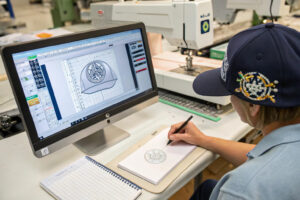
You must submit a vector file in .AI, .EPS, or .CDR format. The file must have all text converted to outlines. The colors must be specified with Pantone TPX or TCX codes, not just "blue" or "navy." The placement size must be stated in millimeters, not "about this big." We also need a clear photo of a hat from a similar angle showing the logo position you want. This is a visual reference, not a technical spec. With a clean vector file, a Pantone code, a size in millimeters, and a position reference photo, our digitizing team can program the embroidery file and stitch a test-out within two hours of receiving the email. No clarifications. No delays. The sample sprint starts clean.
The file format is the entry ticket. But the invisible delay inside the artwork is the gap between screen color and thread color. A buyer approves a bright coral on their MacBook screen, and the factory stitches a muted terracotta because the thread selection was a guess. This color mismatch kills more sample approvals than any other single factor.
Why Must Color Be Specified as a Pantone Thread Code?
Computer screens use RGB light. Thread uses physical pigment. A color that looks vibrant on a backlit screen will look completely different when stitched on matte cotton under daylight. The Pantone TPX or TCX system is a physical color standard for textiles. It bridges the screen-to-fabric gap.
I instruct clients to provide the exact Pantone code from a physical Pantone fashion and home swatch book, not from a digital Pantone picker. If the client does not have a physical book, we offer a shortcut. We email them a digital photo of our physical thread chart under daylight, with each color labeled. They pick from the photo and approve by email. This is not color-accurate, but it is 90% accurate and takes five minutes. For a rush sample, 90% color accuracy with a one-hour turnaround beats 100% accuracy with a three-day wait. You can fine-tune the shade on the bulk order. The goal of the rush sample is to lock the shape, the logo placement, and the overall aesthetic. The Pantone color reference gives you a shared language to start the conversation.
What Is the Ideal File Format for Embroidery Digitizing?
A vector file is mandatory. An Adobe Illustrator .AI file with all text converted to outlines is the industry standard. The file must be scaled to the actual print size in millimeters. Do not send a file where the logo is 100 millimeters wide but you actually want it 50 millimeters wide and expect the digitizer to scale it. The scaling changes the stitch count and the detail density.
A clean vector file allows our digitizing software to map the stitch paths automatically with minimal manual cleanup. A low-resolution raster image forces the digitizer to manually trace the logo, which is slower and less accurate. This vector artwork rule is the single easiest way to shave 24 hours off a sample timeline.
How Does a Digital 3D Sample Accelerate the Approval Process?
The traditional physical sample loop is a time killer. You wait for the factory to cut and sew. You wait for international courier shipping. You wait for the client to open the box, try on the hat, and email feedback. Each loop consumes a week. A digital 3D sample removes the first loop entirely. It allows you to see the hat, rotate it, check the logo placement, and approve the overall silhouette before a single piece of fabric is cut.
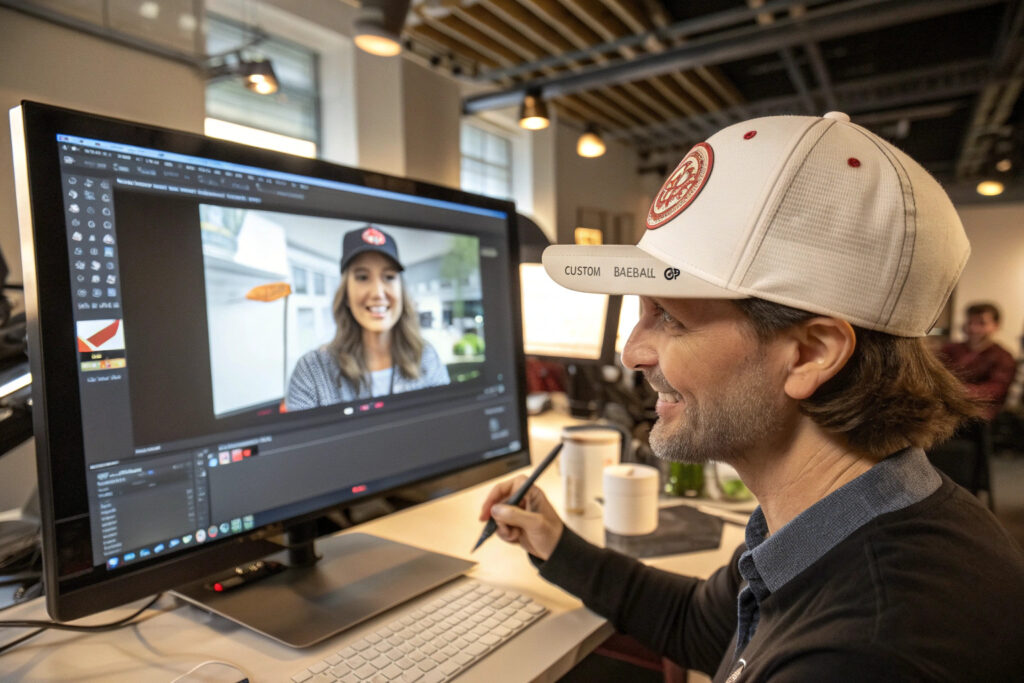
We use a 3D sampling software that builds a digital twin of the hat from our pattern library. We map the client's logo onto the digital hat, apply the Pantone thread color, and render a photorealistic 360-degree image. We send this as a video file within four hours of receiving clean artwork. The client watches a rotating video of their hat. They zoom in on the embroidery. They check the side seam, the back closure, and the sweatband detail. They request changes verbally during a video call, and we adjust the digital model live. A green light on the digital sample means the physical sample is cut with a much higher probability of first-pass approval. We have reduced physical sample rejection rates by over 60% since implementing this digital step.
The digital sample is a visual negotiation tool. It gets the creative conversation completed before the physical work begins. This front-loading of decisions is the single biggest accelerator in the entire sampling process.
What Questions Can a 3D Sample Answer Faster Than a Physical One?
A 3D sample answers the proportional questions instantly. Does the logo look too small against the crown? Is the embroidery placement too high or too low? Does the back closure color clash with the fabric? These are visual, comparative questions that do not require a physical sample to judge.
The client can see the hat on a virtual head form. They can see it from the side, the back, and the top. They can compare two versions side by side on the screen. This comparison would require two separate physical samples, which is a week of extra work. The 3D sampling technology turns a subjective "I think it looks off" into an objective "move the logo down by 10 millimeters." The measurement is exact, and the digital file updates instantly.
How Do You Keep a Digital Sample Realistic to the Final Product?
A digital sample is a representation, not a promise. We photograph our actual fabric swatches in a controlled lightbox and map them as textures onto the 3D model. This texture mapping is critical. A generic digital cotton texture will not look like our specific 260 GSM washed twill.
We also show the digital sample next to a photo of a physical sample made from the same base hat style but with a different logo. This side-by-side view reminds the client that the digital image is a preview, not the final artifact. The physical sample is still the ultimate approval. The digital step simply ensures the physical sample is a confirmation, not a surprise. The client's expectation is already calibrated. This digital prototyping workflow transforms the sample room into a finishing station, not a guessing station.
Which Materials and Components Enable a One-Day Sample Build?
A sample build that waits for custom fabric dyeing is a sample build that cannot be fast. Custom dyeing a specific shade of organic cotton takes five to seven days minimum. If your critical timeline sample requires a custom color, you are already behind. The one-day sample build relies on a strategic constraint: using the factory's house-standard, in-stock materials that match your spec as closely as possible.
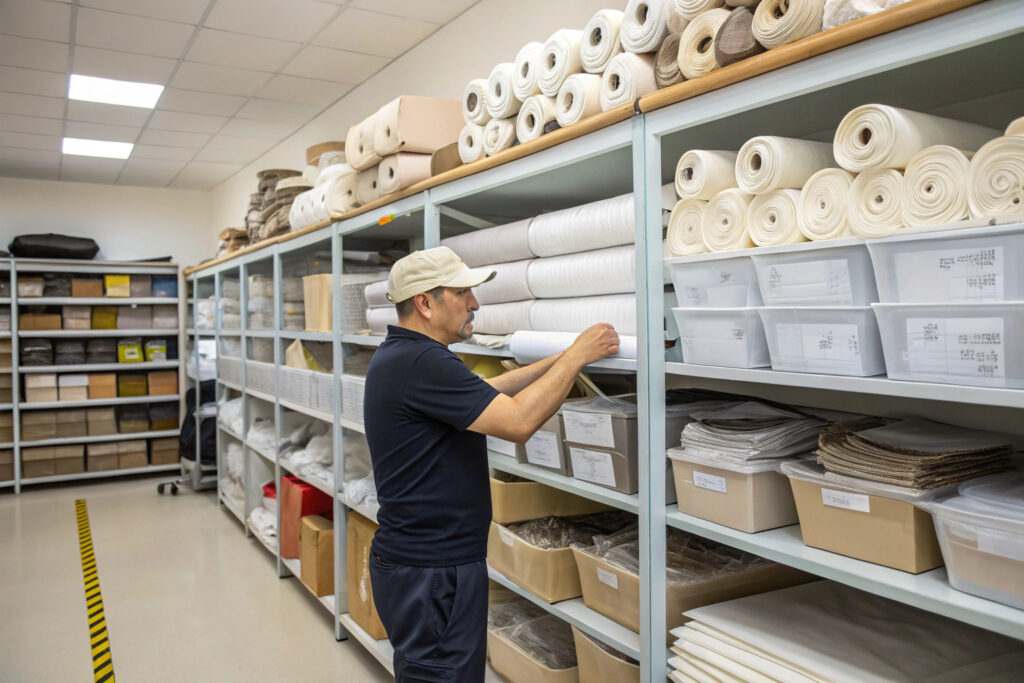
I maintain a sample-ready inventory of our top-selling fabrics and components. This includes pre-washed cotton twill in black, white, navy, and natural beige. It includes structured and unstructured visor boards. It includes plastic snap closures in matte black and white. It includes cotton twill sweatbands in standard black. When a client needs a sample in 24 hours, we do not start a sourcing process. We walk into the sample material library, pull these pre-stocked items, and walk directly to the cutting table. The client accepts that the final bulk order can be in a different, custom-dyed color. The sample's job is to lock the construction, the fit, and the logo application. The color can be approved later from a lab dip swatch. This decoupling of structural approval from color approval is the single most powerful time-saving principle in hat sampling.
The pre-stocked material library is the physical engine of the sample sprint. But the component that most often causes a delay is the one a buyer thinks about least: the closure. A custom metal buckle ordered from a third-party supplier can take two weeks to arrive. The sample sprint uses universal, in-stock closures only.
What Is a "House Standard" Material Kit for Sampling?
Our house standard kit for a structured dad cap sample includes a 260 GSM washed cotton twill shell in natural beige, a black cotton terry sweatband, a black plastic snap closure, and a standard fused buckram front panel. This kit is pre-cut and ready to sew.
When a client accepts this kit for the sample, we can cut the fabric and start sewing within one hour of receiving the artwork approval. The sample will look and feel like a finished, premium hat. The client evaluates the construction quality, the logo execution, and the fit. They approve these fundamentals. The bulk order then uses their custom-dyed fabric, which we start dyeing the same day the sample is approved. This parallel processing, where the sample ships while the custom fabric is in the dye bath, recovers the time lost to custom color development. A sample making process built on a standard kit is the foundation of a one-day turnaround.
How Do You Handle Complex Decorations on a Rush Sample?
Complex techniques like 3D puff embroidery, direct embroidery on leather patches, or multi-location prints add time. The digitizing for 3D puff is more complex because the underlay stitches must raise the top thread. A multi-location design requires the hat to be re-hooped on the embroidery machine multiple times.
For a rush sample with complex decoration, we often simplify the decoration for the structural sample. We stitch a flat embroidery version of the logo for the sample so the client can approve the size, placement, and design integrity. We simultaneously digitize and test the full 3D puff version on a fabric swatch. We ship the sample hat and the swatch together. The client sees the construction on the hat and the final decoration on the swatch. This parallel tracking saves a full day over waiting for the final decoration to be perfected on the hat body before shipping.
How Should You Conduct a Live Video Sample Approval?
The physical sample is ready. It sits on the factory table. The old way is to box it, ship it internationally, and wait three days for an email that says "approved, but can we move the logo up slightly?" That "slightly" just cost you a full week. The new way is to open a video call, walk the client through the sample in real time, and get a conditional approval that triggers production immediately while the physical sample is in transit for final sign-off.
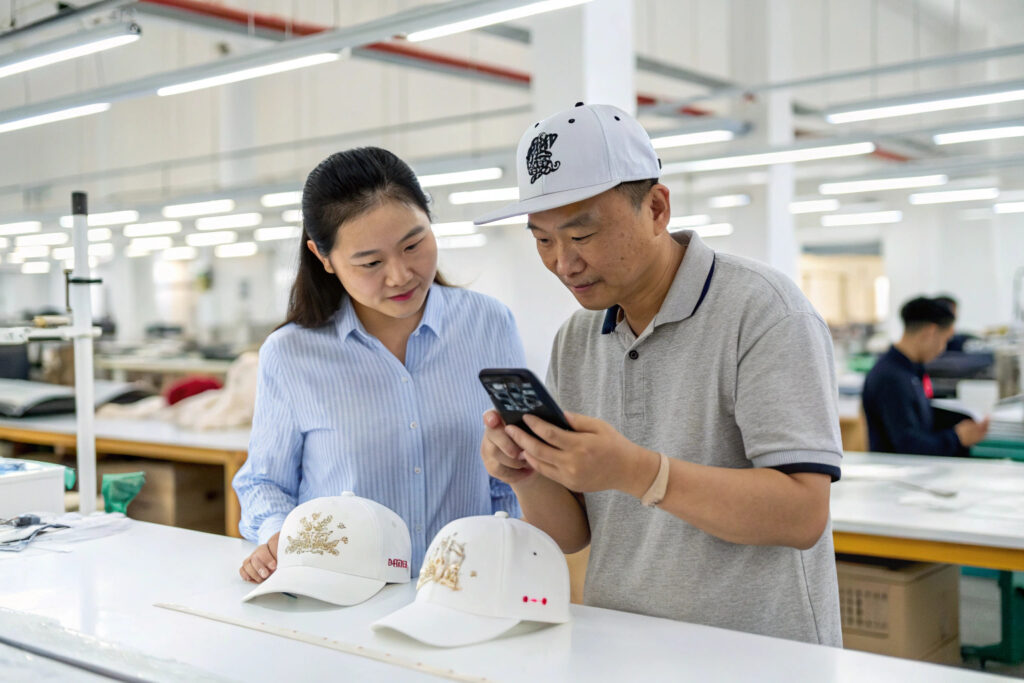
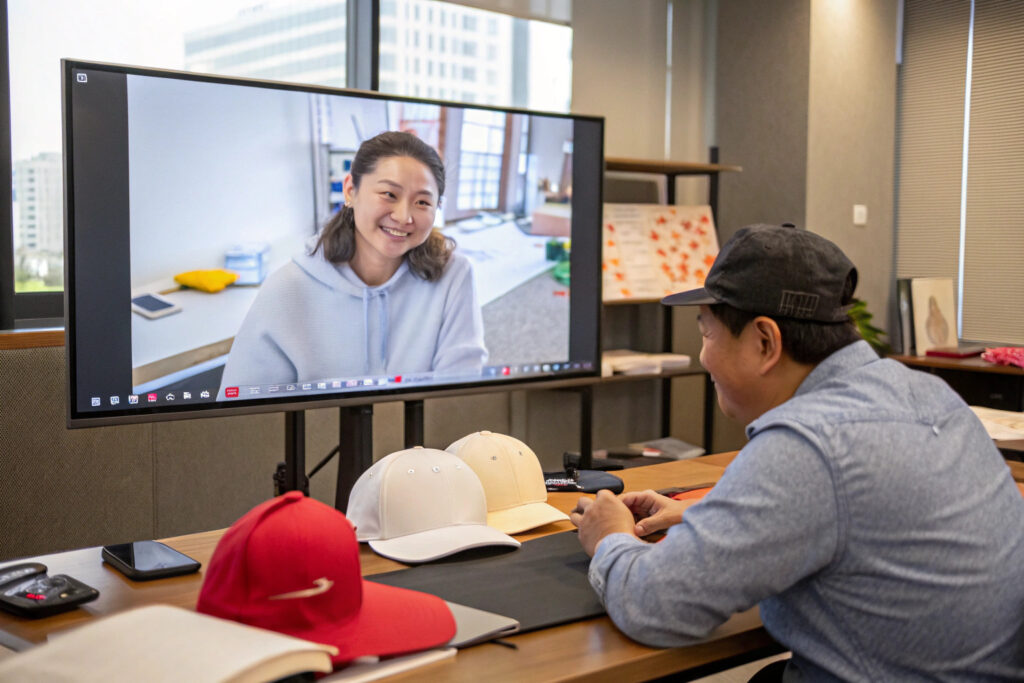
I schedule a 30-minute video call as soon as the sample is pressed and finished. The call is not a casual chat. It follows a strict inspection script. I hold the sample under a daylight-calibrated lamp at 5000K. I start with a full 360-degree rotation, holding the hat at eye level. Then I zoom in on the front embroidery using a macro lens attachment. I place a ruler next to the logo and show the measurement from the center seam to the top of the logo. I check the side seam alignment. I show the back closure in both open and closed positions. I turn the hat inside out and show the sweatband stitching and the internal seam tape. I ask the client to state their approval or changes on the recorded call. If approved, I write a quick email summary, the client replies "confirmed," and I hand the sample to the courier waiting in the shipping office. The production team is authorized to begin cutting fabric based on the video approval, with the written understanding that the final sign-off is pending the physical sample's arrival. This video approval process recaptures the three to five days normally lost to courier transit time.
The video call is the moment of truth. But the approval decision must be structured into clear, limited options. An open-ended "what do you think?" invites subjective dithering. A structured "does this pass our three critical checkpoints?" drives a fast yes or a specific, actionable no.
What Equipment Is Needed for a Professional Video Sample Review?
A laptop with a high-definition webcam is the bare minimum. We use an external 4K webcam mounted on a flexible arm so I can move the camera, not the hat. The camera has a macro focus ring for extreme close-ups of the stitch density.
A daylight-balanced LED lamp is mandatory. The lamp must have a color temperature of 5000K to 6500K and a high color rendering index above 90. This lamp simulates natural daylight and prevents the warm yellow warehouse lights from distorting the fabric color. I also keep a clean white foam board on the table to bounce light and a black velvet board to eliminate glare when showing shiny materials. This video conferencing setup costs under $300 and pays for itself on the first sample that does not need to be reshipped.
How Do You Document a Video Approval for the Production Record?
The verbal approval on the call is the trigger, but the written record is the contract. I record the video call with the client's permission and save the recording to the order's cloud folder. I take a screenshot of the client giving a thumbs-up with the hat visible in the frame.
Immediately after the call, I send a concise email: "Per our video call just now, you approved Sample #GC-2026-089 with the following three notes: 1. Logo placement is correct at 35mm from center seam. 2. Embroidery density approved. 3. Change sweatband from black to white on bulk order only. Please reply 'confirmed' to authorize production start. Physical sample ships today with tracking number attached." This approval process document creates a clean audit trail. The production manager opens the email, sees the confirmed approval, and starts cutting.
Conclusion
A custom hat sample approval in under 72 hours is not a miracle. It is a system. You feed the system with clean vector artwork and Pantone color codes. You remove the first physical loop with a digital 3D sample that locks the visual design. You build the physical sample from a pre-stocked standard material kit, not a custom-dyed fabric that takes a week. You approve the sample on a live high-definition video call with calibrated lighting and a ruler, not by waiting for a courier box. And you document the approval in a single email that releases the bulk production while the sample is still in the air. Every one of these steps removes a waiting period. The cumulative time saved is the difference between a missed launch and a brand-building success.
Our factory has engineered this sprint process because we understand that a brand's calendar is non-negotiable. A music festival date, a trade show opening, a retail launch window, these deadlines do not move. The hat factory must bend its internal processes to meet them. We have pre-stocked materials, a trained sample sprint team, and a video approval studio ready for exactly these moments.
If you are up against a hard deadline and need a custom hat sample turned around faster than you thought possible, let our Business Director, Elaine, know your timeline in your first email. She can confirm our sample room capacity, walk you through the material kit options, and get the artwork to our digitizer within the hour. Email her at elaine@fumaoclothing.com with the subject line "Rush Sample Request." We will respond with a clear, honest assessment of what we can achieve together in the time you have.