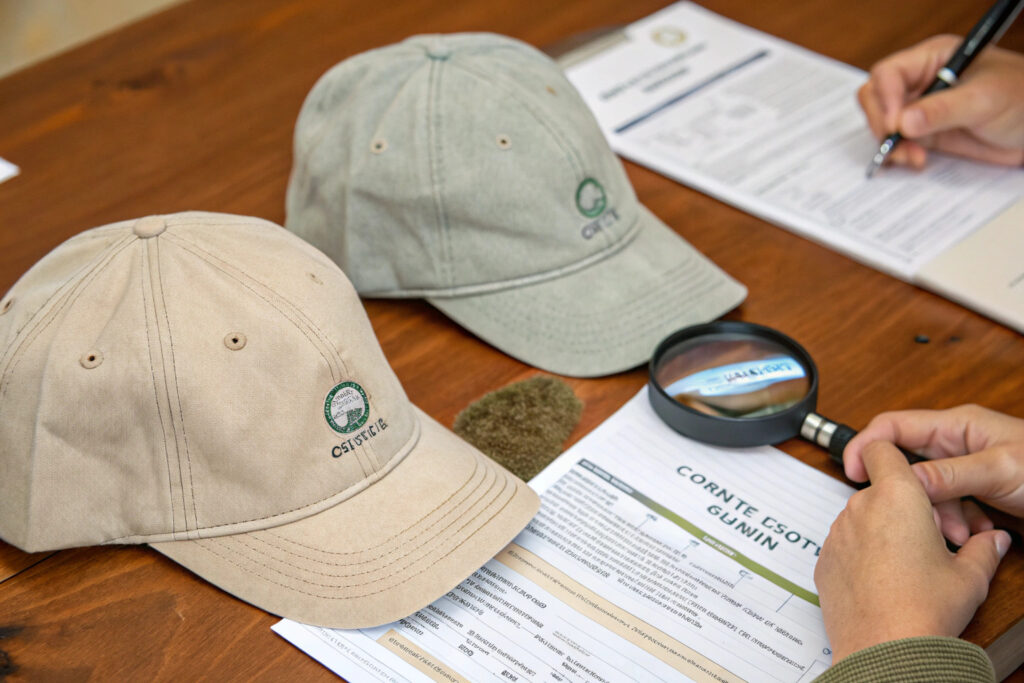
You launch an eco-friendly cap collection. You label it "Sustainable Caps." You use organic cotton for one style and recycled polyester for another. A retailer asks for the certifications. You send the organic cotton cap's GOTS certificate. The retailer asks for the recycled polyester cap's GRS certificate. You don't have one. You assumed "sustainable" was a single category with a single certificate. It is not. Organic cotton and recycled polyester are different materials with different supply chains, different standards, and different certification logos. One certificate does not cover both.
The certification requirements for organic cotton caps and recycled polyester caps are fundamentally different. Organic cotton caps require GOTS or OCS certification, which verifies the organic origin of the natural fiber from farm to finished product. Recycled polyester caps require GRS or RCS certification, which verifies the recycled content of the synthetic fiber from waste source to finished product. GOTS includes strict social criteria and chemical restrictions for the entire processing chain. GRS includes social criteria and chemical restrictions but focuses on the recycled content percentage and the chain of custody. A cap made of both organic cotton and recycled polyester requires dual certification or a blended certification audit.
At Global-Caps, I hold both GOTS and GRS certifications. My factory is audited for both standards. The organic cotton caps carry the GOTS label. The recycled polyester caps carry the GRS label. The blended caps carry both.
What Is GOTS Certification and How Does It Apply to Cotton Caps?
You buy "organic cotton" fabric. The supplier says it is organic. You make caps. You label them "Organic Cotton Cap." A customer asks for the organic certificate. You ask the fabric supplier. They send a document from a certification body you have never heard of. The document is for the raw cotton fiber, not the finished cap. Your label is a false claim. The fiber certificate does not cover the dyeing, finishing, and sewing processes. Organic certification is not a raw material claim. It is a finished product claim.
GOTS certification applies to organic cotton caps by verifying every stage of the supply chain from the organic cotton farm to the finished cap. The standard covers fiber production, yarn spinning, fabric knitting or weaving, dyeing with approved low-impact dyes, cutting and sewing in a socially compliant factory, labeling, and packaging. The finished cap must contain at least 95 percent certified organic fibers to carry the "organic" grade label. Products with 70 to 94 percent organic fibers carry the "made with organic" grade label. The certification requires an annual audit of every processing facility.
My GOTS certification covers my entire organic cotton cap supply chain. The transaction certificates trace each batch.
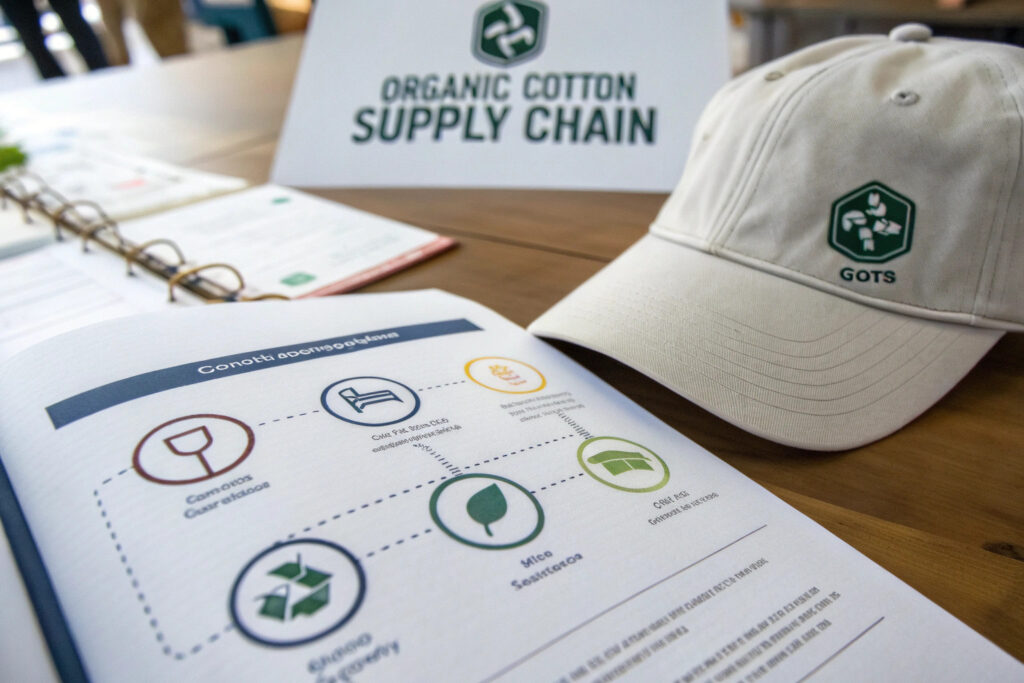
The GOTS standard has two label grades that communicate the organic fiber percentage to the consumer.
What Does the "Organic" vs "Made With Organic" Label Grade Mean?
The "organic" grade label requires that at least 95 percent of the fiber content is certified organic. The remaining 5 percent can be non-organic fibers from an approved list, such as elastane for stretch or polyester sewing thread. The label states "Organic" and the GOTS logo.
The "made with organic" grade label requires that at least 70 percent of the fiber content is certified organic. The remaining 30 percent can be non-organic fibers. The label states "Made with X% Organic Materials" and the GOTS logo.
My organic cotton caps use the "organic" grade label with 100 percent certified organic cotton.
Why Does GOTS Require Social Criteria Audits in Addition to Fiber Traceability?
GOTS is not solely a fiber standard. It includes mandatory social criteria based on the International Labour Organization conventions. The criteria cover no forced labor, no child labor, freedom of association, safe working conditions, no excessive working hours, and fair wages.
A cotton cap cannot carry the GOTS label if the sewing factory violates these social criteria, even if the cotton fiber is perfectly organic. The standard integrates environmental and social responsibility.
My factory undergoes the GOTS social audit annually alongside the environmental audit.
What Is GRS Certification and How Does It Verify Recycled Polyester Content?
You buy "recycled polyester" fabric. The supplier says it is made from bottles. You make caps. You label them "Made from Recycled Plastic Bottles." A customer asks for proof. You ask the supplier. They send a generic environmental statement. No percentage. No certificate number. No audit body. The claim is unsubstantiated. The word "recycled" on a commercial invoice is not a certification. The consumer cannot verify the bottle-to-cap journey.
GRS certification verifies recycled polyester content by auditing the entire chain of custody from the waste source to the finished product. The standard requires that each processing stage is certified and issues a transaction certificate. The finished cap must contain at least 50 percent recycled content to carry the GRS label. The specific percentage must be stated on the label. The standard also includes social criteria, environmental chemical restrictions, and environmental management requirements for the processing facilities.
My GRS certification covers my recycled polyester caps. The transaction certificates verify the recycled content percentage.
The GRS label requires a specific percentage statement, not a generic "recycled" claim.

What Is the Difference Between GRS and RCS Certification for Caps?
GRS is the Global Recycled Standard. It requires a minimum of 50 percent recycled content, a full chain of custody audit, social criteria, environmental chemical restrictions, and environmental management requirements. It covers the entire processing chain.
RCS is the Recycled Claim Standard. It requires a minimum of 5 percent recycled content and a chain of custody audit. It does not include social criteria or chemical restrictions. It is a simpler, less rigorous standard focused solely on verifying the recycled content claim.
I use GRS certification for my caps because it provides the complete sustainability assurance that retailers and consumers demand.
How Does the Mass Balance Approach Track Recycled Polyester Through Production?
Mass balance is the accounting method that tracks the flow of recycled material through the supply chain. The certified facility records the input weight of certified recycled polyester pellets. The facility produces yarn and records the output weight. The output cannot exceed the input minus documented processing loss.
The transaction certificate states the input weight, the output weight, and the calculated recycled content percentage. The next facility in the chain receives the transaction certificate and uses it as the input record for its own mass balance calculation.
My transaction certificates show the mass balance from the bottle flake supplier to the finished cap.
How Do Chemical Restrictions Compare Between GOTS and GRS Caps?
You assume organic and recycled are chemically equivalent. They are not. Organic cotton is a natural fiber but the dyeing and finishing chemicals can be toxic if not controlled. Recycled polyester starts as plastic waste that may contain legacy chemicals from the original bottle inks and adhesives. The chemical risk profile is different. The certification standards address these risks differently.
GOTS chemical restrictions are based on a positive list approach. Only approved chemical inputs listed in the GOTS Positive List may be used. All other inputs are prohibited. The standard restricts formaldehyde to below 16 parts per million, prohibits toxic heavy metals, prohibits all phthalates, prohibits chlorinated phenols, and prohibits azo dyes that release carcinogenic amines.
GRS chemical restrictions are based on a risk assessment approach. The standard requires the processor to have a chemical management system. It restricts the same classes of hazardous substances as GOTS but allows a wider range of chemical inputs provided they meet the GRS limits. The GRS limits are aligned with the ZDHC Manufacturing Restricted Substances List.
I use GOTS approved dyes for organic cotton and GRS compliant dyes for recycled polyester.
The positive list approach of GOTS is fundamentally stricter than the risk assessment approach of GRS.
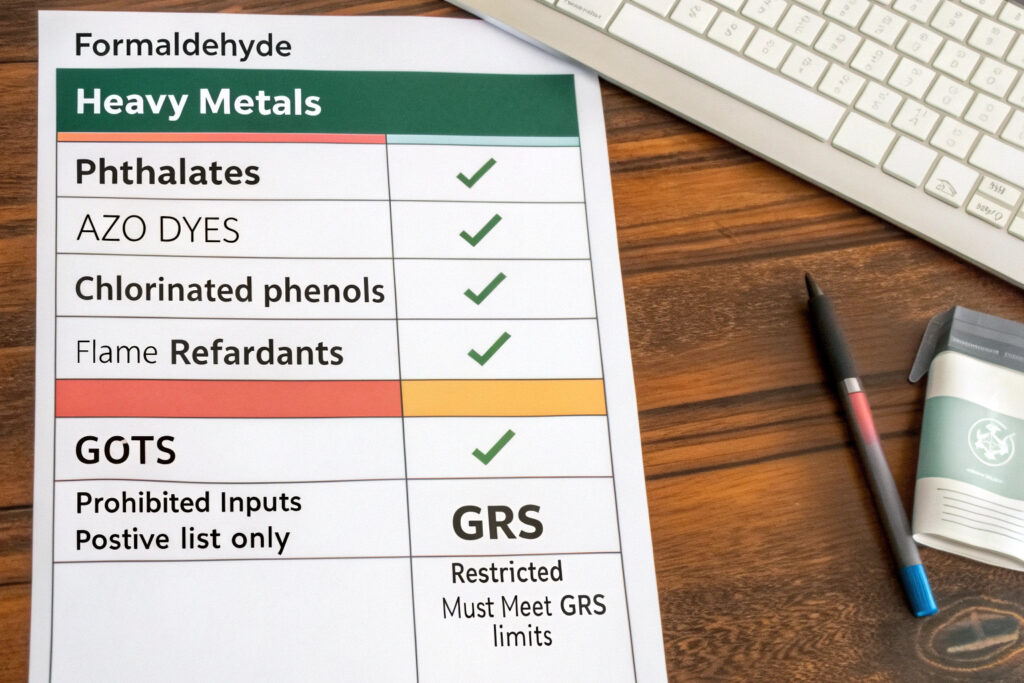
What Is the GOTS Positive List for Approved Chemical Inputs?
The GOTS Positive List is a register of chemical products that have been evaluated and approved by an accredited GOTS certifier. The products are assessed for toxicity, biodegradability, and compliance with the GOTS prohibited and restricted substances criteria.
A dye house processing GOTS-certified organic cotton must use dyes and auxiliaries from the GOTS Positive List. The list is updated regularly. The certifier verifies the chemical inventory during the annual audit.
My dye house maintains a GOTS-approved chemical inventory. The approval letters are on file.
Does GRS Require Testing for Legacy Chemicals in Recycled Bottle Flakes?
Yes. GRS requires the recycling facility to have a chemical management program that addresses the risk of legacy chemicals in the input waste stream. The facility must test the output recycled material for restricted substances at a defined frequency.
Post-consumer PET bottles may contain ink residues, adhesive labels, and cleaning product residues. The washing and flaking process must remove these contaminants. The GRS audit verifies that the testing is conducted and the results meet the GRS limits.
My recycled polyester supplier provides batch-specific test reports for restricted substances.
Can a Single Cap Be Dual-Certified for Both Organic and Recycled Content?
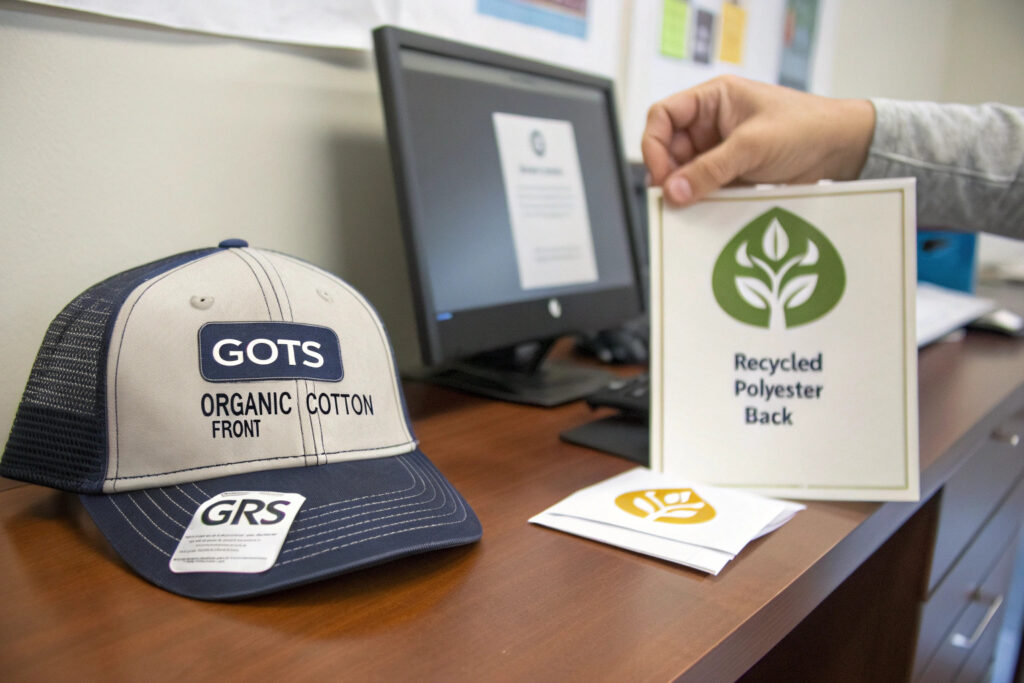
You design a cap with an organic cotton front and a recycled polyester mesh back. It is the best of both worlds. You want one certificate that covers the whole cap. Your certifier says the cap requires two separate certifications because the materials are governed by two different standards. You are frustrated by the paperwork duplication. The frustration is the reality of blended material sustainability.
A single cap can be dual-certified for both organic and recycled content, but the certifications are separate. The organic cotton front panel is certified under GOTS or OCS. The recycled polyester mesh back is certified under GRS or RCS. The finished cap carries two certification labels, or a combined label that clearly states which component carries which certification. The certifier cannot issue a single GOTS certificate that covers the recycled polyester, nor a single GRS certificate that covers the organic cotton. The standards are different in scope.
My dual-certified caps carry a GOTS label for the organic cotton component and a GRS label for the recycled polyester component.
The compliance pack for a dual-certified cap includes both sets of certificates and transaction records.
How Is a Combined Product Label Designed to Meet Both GOTS and GRS Rules?
The combined label must clearly identify which component carries which certification. A typical label states: "Front Crown: 100% Organic Cotton - GOTS Certified. Mesh Back: 100% Recycled Polyester - GRS Certified." The label must include the certification body logos and the license numbers.
The label must not imply that the entire cap is GOTS certified or that the entire cap is GRS certified. The component claim must be specific and accurate.
My label design is reviewed by both certification bodies before printing.
What Documentation Is Needed for a Dual-Certified Cap Shipment to the EU?
The shipment requires both the GOTS transaction certificate and the GRS transaction certificate. The commercial invoice must list the breakdown of certified components. The EU customs entry must reference both certificates.
The importer must maintain both sets of documentation for the required retention period. A retailer audit will request both certificates.
I provide a dual-certification compliance pack with every EU shipment.
Conclusion
The certification requirements for organic cotton caps and recycled polyester caps are governed by different standards. Organic cotton caps require GOTS or OCS certification, verifying the organic fiber from farm to finished product, with GOTS adding strict social criteria and a positive list chemical management system. Recycled polyester caps require GRS or RCS certification, verifying the recycled content from waste source to finished product, with GRS adding social criteria and chemical restrictions based on a risk assessment approach. A blended cap with both materials requires dual certification with component-specific labeling.
The certification is not interchangeable. An organic cotton certificate does not cover recycled polyester. A recycled polyester certificate does not cover organic cotton. The retailer and the consumer need to see the correct logo for the correct material. The compliance documentation must match the fiber content claim on the label.
At Global-Caps, I hold both GOTS and GRS certifications. My organic cotton caps carry the GOTS label. My recycled polyester caps carry the GRS label. My blended caps carry both labels with component-specific claims. The certificates are valid. The transaction certificates trace each batch. The documentation is ready for your retailer's compliance audit.
If you need certified organic cotton caps, certified recycled polyester caps, or dual-certified blended caps, contact my Business Director Elaine. She can provide our GOTS and GRS certificate numbers for verification and share our dual-certification label design. Email Elaine at elaine@fumaoclothing.com. Let's certify your sustainable caps properly.