Your marketing team is finalizing the annual sustainability report. The design is beautiful. The sections on carbon footprint, recycled materials, and ethical labor are robust. Then someone asks about chemical safety. "Do our hats have any certification for harmful substances?" You remember that your factory in Zhejiang holds an OEKO-TEX Standard 100 certificate. You have the PDF somewhere. But how do you frame this in the report? Is it a big deal or a minor footnote? How do you explain it to consumers who have never heard of OEKO-TEX? How do you present it without making claims that could be challenged as greenwashing?
Framing a supplier's OEKO-100 certification in your brand's sustainability report is an exercise in translation. You are translating a technical, factory-level, business-to-business certificate into a consumer-facing, brand-level story that is accurate, compelling, and legally defensible. I run Global-Caps, and I have provided our OEKO-TEX Standard 100 certificate to hundreds of brands for their sustainability communications. I have seen the good, the bad, and the legally questionable ways brands frame this certification. In this article, I will show you the best practice framework for presenting your factory's OEKO-100 certification honestly, impactfully, and in a way that strengthens your brand's credibility rather than exposing it to accusations of greenwashing.
What Is the Core Value of OEKO-TEX Standard 100 That Your Report Should Communicate?
The most common mistake brands make when writing about OEKO-TEX Standard 100 is presenting it as an environmental certification. It is not. OEKO-TEX Standard 100 is a product safety certification. It certifies that every component of the product, the fabric, the thread, the buttons, the labels, the prints, has been tested for harmful substances and is harmless for human health. The certification's focus is on the consumer's body, not the planet. Confusing it with an eco-label undermines the brand's credibility with knowledgeable readers and opens the door to greenwashing accusations.
The core value your report should communicate is that your products have been independently tested and certified to be free from harmful levels of specific chemicals that are known or suspected to be dangerous to human health. This is a consumer protection message. It says, "We care about what touches your skin, and we have paid an independent laboratory to verify that our products are safe." This message is powerful because it addresses a deep, often unspoken consumer anxiety: the fear that the products they wear against their skin, or put on their children, might contain hidden chemical dangers.
You should frame the certification as a rigorous, independent, third-party verification. Emphasize that OEKO-TEX is not a brand's own promise. It is not a factory's own claim. It is an external audit conducted by an accredited testing institute, such as Hohenstein or Testex, against a standardized, scientifically developed criteria catalog that is updated annually. The independent, third-party nature of the certification is its credibility engine. Consumers are increasingly skeptical of brand self-declarations. An independent certification body provides the trust that a brand's own words cannot.
How Should You Distinguish Product Safety From Environmental Sustainability in the Report?
Create a clear structural separation in your report. If your report has an "Environmental Impact" section and a "Product Safety" section, OEKO-TEX Standard 100 belongs in the Product Safety section, alongside other certifications like CPSIA compliance or CE marking. Do not bury it in a general "Sustainability" section that lumps together carbon offsets, recycled polyester, and chemical safety. Each of these topics deserves its own clear, accurate framing.
You can write a bridging sentence that connects product safety to the broader sustainability narrative without conflating the two. For example: "While our environmental sustainability efforts focus on reducing our carbon footprint and sourcing recycled materials, our product safety program, anchored by OEKO-TEX Standard 100 certification, ensures that every hat we sell is tested to be harmless for the person who wears it. We believe true responsibility includes both the planet and the people." This sentence acknowledges the distinction and positions the brand as holistically responsible.
What Specific Language Should You Use and Avoid?
Use specific, accurate language. Say "tested for harmful substances." Say "certified to be harmless for human health." Say "exceeds the legal requirements for chemical safety in textiles." Say "independently audited by an accredited testing institute." These phrases are precise and defensible.
Avoid vague, exaggerated language. Do not say "chemical-free." Nothing is chemical-free. The certification means no harmful chemicals above strict limits, not the absence of all chemicals. Do not say "organic" unless you also have GOTS certification for organic fiber. OEKO-TEX is not an organic certification. Do not say "eco-friendly" or "sustainable certification" when referring to OEKO-TEX Standard 100. It is a safety standard. Using incorrect terminology is a greenwashing red flag that sustainability professionals and regulators recognize immediately.
How Can You Tell the Traceability Story Behind the Certificate?
A static certificate logo on a report page is forgettable. The story of how that certificate came to apply to your specific product is memorable. Traceability is the narrative that brings the certification to life. It answers the consumer's implicit question: "How do I know this specific hat was actually tested, and not just a sample from years ago?"
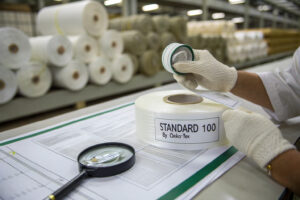
Explain in simple terms what the certification process entails. Describe that the certifying body sent an auditor to the factory. The auditor reviewed the factory's material purchasing records to ensure all components came from certified suppliers. The auditor took random samples of finished caps from the production line and sent them to a laboratory. The laboratory tested the caps for a long list of hundreds of restricted substances, including formaldehyde, heavy metals, pesticides, and carcinogenic dyes. The caps passed. The certificate was issued. It is valid for one year and must be renewed annually with a new audit and new testing.
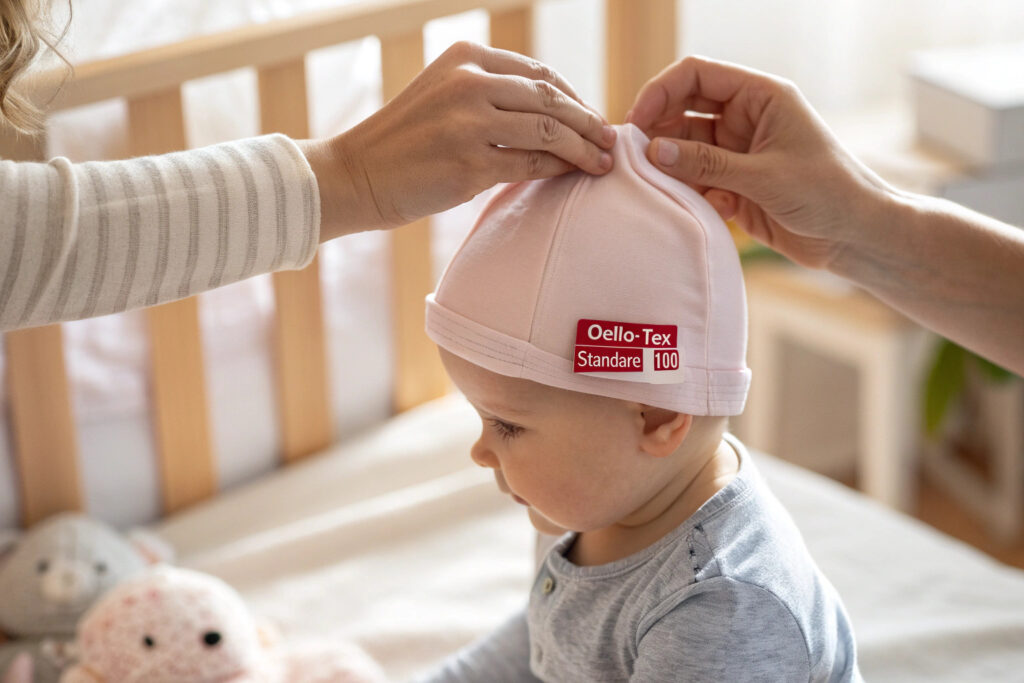
Then, connect this process to your specific product. If possible, show a visual. A photograph of a cap with the OEKO-TEX label, paired with a photograph of the factory's certificate, or a simplified timeline graphic. This demystifies the certification. It transforms it from an abstract logo into a concrete, physical quality assurance process that real people performed on real caps. This traceability story is particularly powerful for direct-to-consumer brands that build their brand identity on transparency.

How Do You Explain the Annual Renewal and Continuous Compliance?
Sustainability reports often present certifications as static achievements, a badge earned once and displayed forever. OEKO-TEX Standard 100 is dynamic. It requires annual renewal. The factory is audited every year. The products are re-tested every year. The criteria catalog is updated every year based on new scientific findings. This is a story of continuous, ongoing commitment, not a one-time accomplishment.
Frame the certification as a living process. "Our factory's OEKO-TEX certification is not a trophy from the past. It is an active, annually renewed commitment. Every year, independent auditors visit the factory, and new product samples are tested against the latest, most rigorous scientific standards. We are currently certified for the 2026 cycle." This framing communicates that the brand's commitment to chemical safety is current, not historical.
How Can You Connect the Certification to the Consumer's Daily Experience?
The most effective sustainability communication translates technical features into consumer benefits. An OEKO-TEX certification is a feature. The benefit is peace of mind. The consumer does not need to understand the details of the testing methodology. They need to understand that when they put the cap on their head, when their child chews on the brim, when they wear the hat against sweaty skin on a hot day, they are not exposing themselves to harmful chemical residues.
Write a consumer-benefit statement. "Our hats are OEKO-TEX Standard 100 certified. In simple terms, this means an independent laboratory has tested them and confirmed they are harmless for your skin. You can wear them with confidence, knowing that no harmful chemicals are lurking in the fabric, the dye, or the label." This statement translates the certification into the language of consumer value.
How Do You Present the Certificate Visually and Legally in the Report?
The visual and legal presentation of the certification in your report must follow specific rules. The OEKO-TEX Association has guidelines for the use of its logo and claims. Violating these guidelines can result in a legal challenge and a public relations problem. You must use the correct, official OEKO-TEX Standard 100 logo artwork, not a homemade version. The logo must be reproduced clearly and with the correct proportions. The certification number should be displayed alongside the logo. This allows any reader to verify the certification independently on the OEKO-TEX website.
The legal framing should include a clear, accurate caption or footnote. An effective caption reads: "Our hats are manufactured in a facility certified to OEKO-TEX Standard 100, Class 1 (Certificate Number: [Number]). This independent certification confirms that every component of the product has been tested for harmful substances and is harmless for human health. Certification is renewed annually." This caption is precise, includes the certificate number for verification, and specifies the product class. Class 1 is the strictest classification, for baby products. If the certification is Class 2, for adult products, state Class 2. Accuracy in the class designation is important.
Do not alter the OEKO-TEX logo. Do not change the colors. Do not combine it with other logos in a way that suggests endorsement. Do not use the OEKO-TEX logo on a page that makes broad, unsubstantiated environmental claims. The logo should appear in the context of specific, accurate statements about chemical safety testing. I recommend that brands submit the draft report page featuring the OEKO-TEX logo to their factory for review before publication. The factory, if it is a responsible certificate holder, can verify that the usage complies with the certification body's guidelines.
What Information Should You Include in a Transparency Box?
A transparency box is a dedicated information panel that gives the reader all the essential details about the certification in a concise, scannable format. It is a best practice for sustainability reporting. The box should include the certification name: OEKO-TEX Standard 100. The certificate number. The issuing body, e.g., Testex AG, Switzerland. The product class, Class 1, Class 2, etc. The date of issue and the expiry date. A brief, one-sentence description of what the certification means. A URL or QR code linking to the OEKO-TEX certificate verification page.
This transparency box serves multiple purposes. It satisfies the sustainability professional who wants to verify the claim. It satisfies the regulator who wants to see substantiation. It satisfies the curious consumer who wants to learn more. It also demonstrates that the brand is not hiding behind the logo. The brand is openly providing the verification data. This is the hallmark of authentic transparency.
How Do You Avoid Overstating the Certification's Scope?
A common reporting error is to imply that the OEKO-TEX certification covers aspects of production that it does not. It does not certify that the factory pays fair wages. It does not certify that the factory has a low carbon footprint. It does not certify that the cotton is organic. It certifies that the finished product has been tested for harmful substances and is harmless for human health. No more, no less.
Your report text must not make claims that exceed the certification's scope. If you want to communicate fair labor practices, you need a separate certification or audit for that, such as SA8000 or a SMETA audit. If you want to communicate organic fiber content, you need GOTS or OCS certification. A sustainability report that accurately scopes each certification and avoids overstatement is a credible report. A report that uses OEKO-TEX as a catch-all "sustainability badge" is a greenwashing risk. I always counsel my clients to treat each certification as a separate, specific tool in their sustainability toolkit, each with its own defined scope and its own story.
Conclusion
Framing your factory's OEKO-TEX Standard 100 certification in your brand's sustainability report is an opportunity to demonstrate genuine, verifiable commitment to consumer safety. The best framing is accurate, specific, and transparent. Position the certification as a product safety certification, not an environmental label. Explain the rigorous, independent, annually renewed testing process in simple, human terms. Connect the technical certification to the consumer's lived experience of safety and peace of mind. Present the certificate visually with the correct logo, the certificate number, and a transparency box that invites independent verification. Avoid overstated claims that exceed the certification's scope.
A well-framed OEKO-TEX certification builds trust. It tells your customers that you have gone beyond the legal minimum to ensure your products are safe for their skin and their children's skin. It tells your retail partners that you have the documentation to back up your claims. It tells regulators and journalists that your sustainability communication is substantiated, not wishful thinking.
If you are preparing your brand's sustainability report and need the complete documentation package for your factory's OEKO-TEX Standard 100 certification, including the valid certificate, the testing scope details, and guidance on logo usage, I invite you to contact Global-Caps. We provide a comprehensive OEKO-TEX compliance kit to all our brand partners, designed specifically to support accurate, impactful sustainability reporting. Reach out to our Business Director, Elaine, at elaine@fumaoclothing.com. We will provide you with the certificate, the certification number for verification, and the technical language you need to tell your chemical safety story truthfully and powerfully. Let's build a report that earns trust, not just attention.