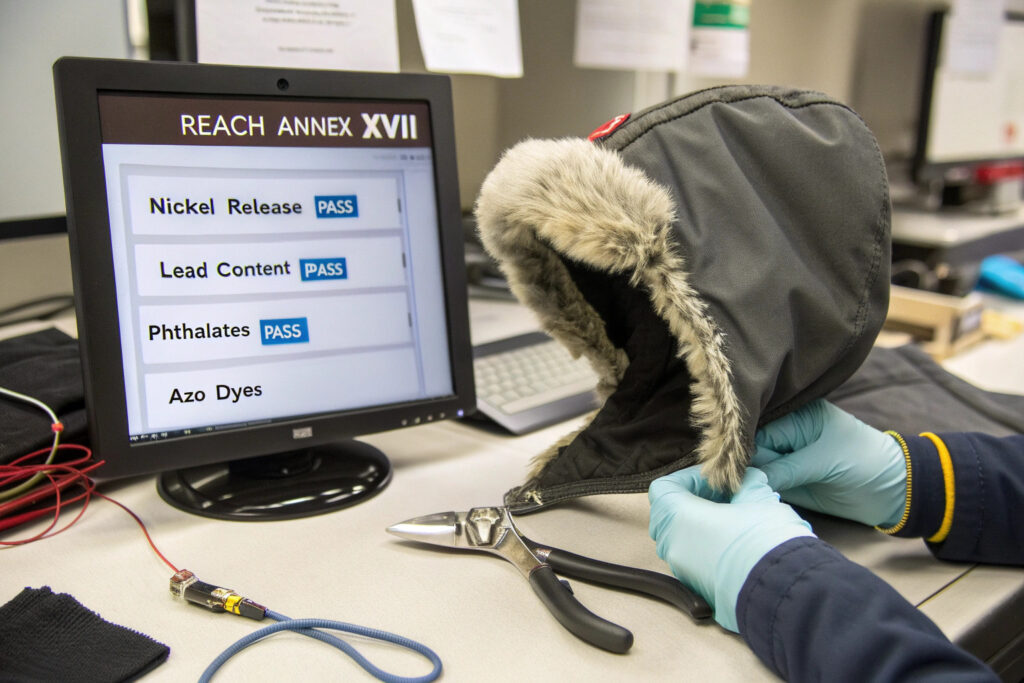
You design a premium winter trapper hat. The wool crown is OEKO-TEX certified. The faux fur lining is REACH compliant. The hat is beautiful, warm, and safe. The shipment arrives at your EU warehouse. A market surveillance authority tests the product. The zipper on the front closure fails the nickel release test. The metal zipper teeth release nickel at 2.5 micrograms per square centimeter per week. The legal limit is 0.5. The entire hat is non-compliant. The hat is seized. The zipper is a component that weighs 15 grams. It contaminated a product that weighs 300 grams. The zipper was an afterthought. The afterthought destroyed the shipment.
The specific REACH testing requirements for zippers on winter trapper hats cover each homogeneous material in the zipper assembly: the metal teeth or coil must be tested for nickel release under EN 1811 if they are made of nickel-containing alloy or have a nickel plating; the metal pull tab and slider must be tested for nickel release and for total lead content if they are metal; the plastic slider and plastic components must be tested for phthalates under Annex XVII Entry 51 at the 0.1 percent limit for each restricted phthalate; the polyester zipper tape must be tested for azo dyes that release restricted aromatic amines under Annex XVII Entry 43 at the 30 milligrams per kilogram limit; and any surface coating or plating on the zipper components must be tested for total lead content at the 90 milligrams per kilogram limit for coatings. Each material is a separate homogeneous material under REACH. Each requires its own test.
At Global-Caps, every component of my winter hats is tested. The zipper is on the component testing checklist. I source zippers from YKK and SBS, who provide REACH compliance certificates. I re-test every new zipper batch with a third-party ISO 17025 accredited laboratory. The zipper is small. The testing is mandatory.
Why Are Zippers on Hats Subject to REACH Regulations?
You think REACH applies to chemicals. Your hat is a textile product. The zipper is a small metal and plastic component. You assume it is exempt from chemical regulations. You are wrong. REACH regulates substances in articles. An article is any object whose shape, surface, or design determines its function more than its chemical composition. A zipper is an article. A hat is an article. The zipper is an article within an article. The metal in the zipper, the plastic in the slider, the dye in the tape—each is a substance or mixture within an article. REACH regulates them all.
Zippers on winter trapper hats are subject to REACH regulations because the zipper is an article, or an assembly of articles, that comes into prolonged and direct contact with the wearer's skin. The zipper on a trapper hat typically contacts the chin, neck, and lower face. The contact is prolonged—the hat is worn for hours in cold weather. REACH Annex XVII restricts specific substances in articles that come into contact with the skin: nickel in metal components, azo dyes in textile components, phthalates in plastic components, and lead in surface coatings. The zipper contains all of these material types. The regulation applies to each material individually.
My zipper compliance protocol treats the zipper as a multi-material assembly. Each material is tested to the applicable REACH Annex XVII entry.
The legal definition of "prolonged contact with the skin" is the trigger for most REACH restrictions on apparel components.

What Is the Legal Definition of "Prolonged Skin Contact" Under REACH?
REACH defines prolonged skin contact as continuous contact with the skin for more than 10 minutes, or intermittent contact over a period of 30 minutes or more, under normal or reasonably foreseeable conditions of use. A winter trapper hat is worn for extended periods outdoors. The zipper is in continuous contact with the chin and neck for the duration of wear. The contact easily exceeds 10 minutes. The article falls squarely within the scope of the skin contact restrictions.
Articles with only occasional or brief skin contact, such as a zipper on a luggage bag, may fall outside the scope of certain restrictions. The zipper on a hat is not in this category.
My product use assessment for trapper hats documents the intended use and the expected skin contact duration. The assessment confirms the applicability of the skin contact restrictions.
How Does the "Article" Definition Apply to a Zipper Assembly?
Under REACH, an article is an object that is given a special shape, surface, or design during production that determines its function to a greater degree than its chemical composition. A zipper tape is an article. A zipper tooth is an article. A slider is an article. A pull tab is an article. When assembled, they form a complex article—the zipper assembly—which is itself a component of a larger complex article—the hat.
Each individual article within the assembly must comply with the applicable REACH restrictions for its material type. The metal teeth must comply with the nickel restriction. The plastic slider must comply with the phthalate restriction. The textile tape must comply with the azo dye restriction. The compliance is assessed at the level of each homogeneous material.
My material breakdown for each zipper purchase order lists every homogeneous material and the applicable REACH test requirement.
What Specific Chemical Tests Are Required for Metal Zipper Components?
You buy a zipper with "nickel-free" on the specification. You trust the label. The zipper is made of brass with a nickel plating. The nickel plating is not a coating. It is a separate metallic layer. The "nickel-free" claim referred to the brass alloy, not the plating. The plating releases nickel above the legal limit. The claim was technically true and practically useless. The zipper fails the nickel release test. The claim was not a test result.
Metal zipper components require the nickel release test according to EN 1811, and a total lead content test if the metal is an alloy that may contain lead or if the surface has a coating. The nickel release test places the metal component in an artificial sweat solution for seven days at 30 degrees Celsius. The solution is analyzed for dissolved nickel. The limit is less than 0.5 micrograms per square centimeter per week. The total lead content test for metal substrates follows CPSC-CH-E1001-08.3 or an equivalent ISO method. The limit for lead in metal components that contact skin is not explicitly set by REACH Annex XVII for adult articles, but lead in metal is covered under REACH if the metal is a substance that may be released. In practice, a lead content of less than 100 milligrams per kilogram is the industry benchmark.
My metal component testing includes EN 1811 for nickel release and total lead content by ICP-MS for every metal zipper batch.
The nickel release test is specific to metal components that are intended to come into direct and prolonged contact with the skin.

How Does the EN 1811 Nickel Release Test Work for Zipper Teeth and Pull Tabs?
The EN 1811 test method simulates the release of nickel from a metal article during prolonged skin contact. The metal component—a zipper tooth, a pull tab, a slider body—is placed in a container with a precisely measured volume of artificial sweat solution. The artificial sweat is composed of sodium chloride, lactic acid, urea, and ammonia, adjusted to pH 6.5.
The container is placed in an oven at 30 degrees Celsius for 7 days. The solution is gently agitated. After 7 days, the solution is analyzed by inductively coupled plasma optical emission spectrometry or mass spectrometry to measure the concentration of dissolved nickel. The result is calculated as micrograms of nickel released per square centimeter of the component's surface area per week. The limit is less than 0.5 µg/cm²/week.
My EN 1811 test reports show the nickel release value for each metal component. A value below 0.5 is a pass.
What Are the Acceptable Limits for Lead and Cadmium in Metal Zipper Parts?
For metal zipper parts on adult winter trapper hats sold in the EU, there is no specific REACH Annex XVII entry that sets a lead or cadmium limit for metal articles in skin contact for adults. However, lead and cadmium are on the REACH Candidate List as Substances of Very High Concern. If the metal component contains more than 0.1 percent by weight of lead or cadmium, the supplier must communicate this to the buyer and, upon request, to the consumer under Article 33 of REACH.
For practical compliance and to meet the requirements of major EU retailers' Restricted Substances Lists, the industry standard is a lead content of less than 100 milligrams per kilogram (0.01 percent) and a cadmium content of less than 100 milligrams per kilogram in metal components that contact the skin.
My metal zipper specification requires lead and cadmium content below 100 milligrams per kilogram. The supplier provides a batch-specific test report.
What Phthalate and Azo Dye Tests Apply to Plastic and Textile Zipper Parts?
You test the zipper tape for azo dyes. It passes. You assume the zipper is fully compliant. The plastic slider was not tested. The slider contains DEHP phthalate at 8 percent as a plasticizer. The phthalate restriction applies. The zipper tape is compliant. The zipper assembly is not. The plastic slider was a separate homogeneous material. It required a separate test. The assumption of compliance was a gap in the testing scope.
Plastic zipper components—the slider body, the pull tab if plastic, any plastic coating on the tape—must be tested for phthalates according to REACH Annex XVII Entry 51. The test method is CPSC-CH-C1001-09.4 or an equivalent solvent extraction followed by GC-MS analysis. The limit is 0.1 percent by weight for each of the four restricted phthalates: DEHP, DBP, BBP, and DIBP. Textile zipper tape must be tested for azo dyes that release restricted aromatic amines according to REACH Annex XVII Entry 43. The test method is EN 14362-1 and EN 14362-3. The limit is 30 milligrams per kilogram for each of the 22 restricted amines.
My plastic and textile zipper testing covers all phthalates and all azo amines. The test report lists each substance and the result.
The four restricted phthalates are the regulatory minimum. Testing for all eight CPSIA phthalates provides broader compliance coverage.

Why Must Plastic Zipper Sliders Be Tested for Phthalates Under Annex XVII Entry 51?
Plastic zipper sliders are made from molded thermoplastic polymers—often polyoxymethylene, nylon, or polypropylene. To improve flexibility, durability, or processing characteristics, manufacturers may add plasticizers, including phthalates. Phthalates are not chemically bonded to the polymer. They can migrate out of the plastic over time, especially with skin contact and body heat.
Annex XVII Entry 51 restricts DEHP, DBP, BBP, and DIBP in plasticized materials in articles that come into contact with the skin. The limit is 0.1 percent by weight, individually or in combination. A plastic zipper slider on a trapper hat contacts the chin and neck. It is within the scope of the restriction.
My plastic component specification requires phthalate-free plastic. The supplier provides a phthalate test report with every batch.
How Is the Azo Dye Test Performed on Dyed Polyester Zipper Tape?
The azo dye test for dyed polyester zipper tape follows EN 14362-1 and EN 14362-3. The test involves a reductive cleavage step. The dyed tape sample is placed in a citrate buffer solution at pH 6.0 with sodium dithionite, a reducing agent, at 70 degrees Celsius for 30 minutes. The reducing agent breaks any azo bonds present in the dye molecules, releasing the component aromatic amines.
The solution is extracted and analyzed by gas chromatography-mass spectrometry. The instrument quantifies each of the 22 restricted amines. The detection limit is typically 5 to 10 milligrams per kilogram. Any amine detected above 30 milligrams per kilogram constitutes a failure.
My azo dye test reports for zipper tape show a result of "Not Detected" for all 22 amines.
How to Request and Verify a REACH Compliance Certificate for Zippers?
You email the zipper supplier: "Are your zippers REACH compliant?" The supplier replies: "Yes, all our products comply with REACH." You file the email as your compliance documentation. This is not documentation. It is a sentence. A REACH compliance certificate is a set of third-party test reports from an ISO 17025 accredited laboratory, each testing a specific component to a specific test method with specific numerical results. The email is a marketing claim. The test reports are the evidence.
You request a REACH compliance certificate for zippers by specifying the exact components to be tested, the exact test methods, and the required laboratory accreditation. You request the EN 1811 nickel release test report for metal components, the phthalate test report for plastic components per CPSC-CH-C1001-09.4, the azo dye test report for textile components per EN 14362, and the total lead content test report for metal components. You verify each report by entering the report number on the testing laboratory's online verification portal.
My zipper compliance request template includes all required test methods and laboratory accreditation requirements.
The supplier's scope certificate tells you the supplier is certified for something. The transaction certificate tells you the specific batch is certified.

What Is the Difference Between a Zipper Supplier's Scope Certificate and a Batch Test Report?
A scope certificate is a standing document issued by a certification body stating that the supplier's facility and products have been audited and found to comply with the applicable standard. It is valid for one year. It lists the product categories covered. It does not prove that the specific zippers shipped in your order comply.
A batch test report is a test performed on a sample taken from the specific production batch that is being shipped to you. The report lists the batch number, the test date, the test methods, and the numerical results. It is the proof that your zippers comply.
My documentation requirement for every zipper purchase order is a batch-specific test report, not just a scope certificate.
How Can You Use the OEKO-TEX Label Check to Verify a Zipper Certificate?
If the zipper supplier holds an OEKO-TEX Standard 100 certificate, you can verify the certificate number on the OEKO-TEX Label Check website. You enter the certificate number. The database returns the certificate holder name, the product scope, and the validity dates. You confirm the product scope includes zippers or textile accessories. You confirm the certificate is active. The OEKO-TEX certification covers a broad range of REACH substances and can serve as supporting evidence for REACH compliance.
My verification protocol for zipper certifications includes the Label Check database check plus a review of the appendix to confirm zippers are listed as a certified article group.
Conclusion
The specific REACH testing requirements for zippers on winter trapper hats apply to each homogeneous material in the zipper assembly. Metal teeth, sliders, and pull tabs must be tested for nickel release according to EN 1811 at the 0.5 µg/cm²/week limit. Metal components with coatings must be tested for lead in the coating at 90 mg/kg. Plastic sliders and components must be tested for phthalates at 0.1 percent for each restricted phthalate. Polyester zipper tape must be tested for azo dyes at 30 mg/kg for each restricted aromatic amine. Each test must be performed by an ISO 17025 accredited laboratory. The test reports must be batch-specific.
The zipper is a small component. It is not exempt from REACH. The zipper contacts the skin for prolonged periods. The metal, plastic, and textile materials in the zipper are each subject to specific REACH Annex XVII entries. A non-compliant zipper contaminates the entire hat. The zipper compliance must be documented with batch test reports, not supplier marketing emails.
At Global-Caps, my zipper supply chain is tested and documented. I source from YKK and SBS. I require batch-specific REACH test reports. I verify the reports through the laboratory portals. The zipper compliance file is included in the product technical documentation. The zipper is small. The testing is thorough.
If you need winter trapper hats with fully REACH-compliant zippers, contact my Business Director Elaine. She can provide our zipper test report package, our zipper supplier compliance certificates, and a sample technical file for your review. Email Elaine at elaine@fumaoclothing.com. Let's make sure your zipper is as compliant as your hat.