You have just received the proforma invoice for your first bulk order. 50,000 custom caps. The unit price is right where you need it. The delivery date works for your launch window. You scroll down to the payment terms. It says "100% T/T before shipment." You pause. Your company's finance policy prohibits 100% prepayment to a new supplier. You barely know this factory. You have visited them once on a video call. You approved a sample. But wiring the full amount, tens of thousands of dollars, to a company in another country before a single cap has been boxed is a risk you cannot take. You email the factory asking for 30% deposit, 70% against a copy of the bill of lading. The factory replies, "For new clients, our policy is 100% payment before shipment. The material costs are too high."
This is the negotiation standoff that defines the first order with a new supplier. The payment terms are not just a financial detail. They are the balance of risk between you and the factory. You are afraid of poor quality, late shipment, or outright fraud. The factory is afraid of producing 50,000 customized caps with your logo and being left with worthless inventory if you cancel or refuse to pay. I run Global-Caps, and I have sat on the factory side of this negotiation hundreds of times. I understand both fears. In this article, I will walk you through the psychology of payment terms from the factory's perspective, the standard structures you can propose, the security tools available to both parties, and how to build a compromise that protects your cash while giving the factory confidence to start production.
Why Do Factories Demand Heavy Upfront Payments From First-Time Buyers?
When a factory asks for 100% upfront payment or a very high deposit from a new buyer, it is not greed. It is fear. A 50,000-piece custom cap order is not a generic product. Every single cap in that order will carry your brand's logo, your custom color combination, your specific fabric weight, and your packaging design. The moment the factory cuts the fabric and begins embroidery, the caps become yours and only yours. If you cancel the order after production has started, the factory cannot sell those caps to anyone else. They cannot even donate them without legal risk of diluting your trademark. The caps are a total loss. The material cost alone on a 50,000-piece cap order is substantial. The fabric, the buckram, the sweatband, the visor board, the plastic snaps, the embroidery thread. These materials are purchased and cut early in the production cycle. The factory pays its suppliers within 30 to 60 days. If the factory finances your entire order and you fail to pay, they have not lost their profit margin. They have lost the actual cash they spent on raw materials. This loss can cripple a small or medium-sized factory.
The second fear is quality dispute risk. A first-time buyer and a new factory have no shared history. There is no established trust. The factory worries that when the caps arrive, the buyer will find minor, subjective quality issues and use them as leverage to demand a discount or refuse payment entirely. With a 100% prepayment, the factory is protected from this post-shipment negotiation. The buyer has already paid, so the factory holds the financial power. I have seen factories burned by buyers who rejected entire shipments over acceptable commercial tolerances simply to force a price reduction. These experiences travel through the factory community. A factory that has been burned once will erect strong payment barriers for all new clients. Your negotiation must acknowledge this history and address the factory's fear directly.
The third factor is the factory's own cash flow. A 50,000-piece order ties up production capacity for weeks. The factory must pay its workers, its suppliers, and its utility bills during that period. If the factory is small or financially tight, they simply cannot afford to lend you the working capital for a large first order. They need your deposit to buy the materials and cover the direct labor. This is especially true for specialized materials. If your cap uses a custom-dyed fabric color or a special reflective yarn, the minimum order quantity for that material might be high, and the factory has to purchase it all upfront. They cannot return unused special material to their supplier. Your payment terms must provide the factory with enough cash to cover these hard, non-refundable costs before they commit to production.
How Do Custom Components Increase the Factory's Financial Exposure?
A custom cap order is not a stock item. The level of customization directly multiplies the factory's risk. A cap with a custom woven label, a custom-printed size tag, a custom-colored snap closure, and a custom silicone logo patch requires five separate pre-production purchases. Each of these components has a minimum order quantity that often exceeds the exact quantity needed for your 50,000 caps. The label supplier might require a minimum run of 10,000 labels. The patch mold might cost a flat tooling fee. The factory must pay these vendors before a single cap is sewn. If you walk away, the factory is left holding specialized components that have zero resale value. Your deposit must at minimum cover 100% of these custom component costs. When I explain our payment requirements to a new client, I break down the invoice into material costs, trim costs, and labor costs. I show them that the deposit is not arbitrary. It is calculated to cover the exact, verified cost of the materials and custom trims we are ordering on their behalf. This transparency turns a demand into a justification.
How Does Order Size Magnify the Risk for Both Parties?
50,000 pieces is a volume that sits in a specific risk zone. It is too large for a factory to easily absorb a loss, but it is too small for some of the more sophisticated trade finance instruments like letters of credit to be cost-effective. At this volume, the financial exposure for both sides is significant. For the buyer, the total invoice might be a six-figure sum. Wiring that amount upfront to an unproven supplier feels reckless. For the factory, the material and labor cost might consume their working capital for an entire quarter. A default would be catastrophic.
This is why payment term negotiation for a 50,000-piece order is a genuine conflict of legitimate interests. Both parties are rationally protecting themselves. A successful negotiation does not ignore this conflict. It builds a structure that manages the risk sequentially, releasing money to the factory as the factory demonstrates progress and releasing security to the buyer as the buyer commits to payment.
What Are the Standard Payment Structures for Large First-Time Orders?
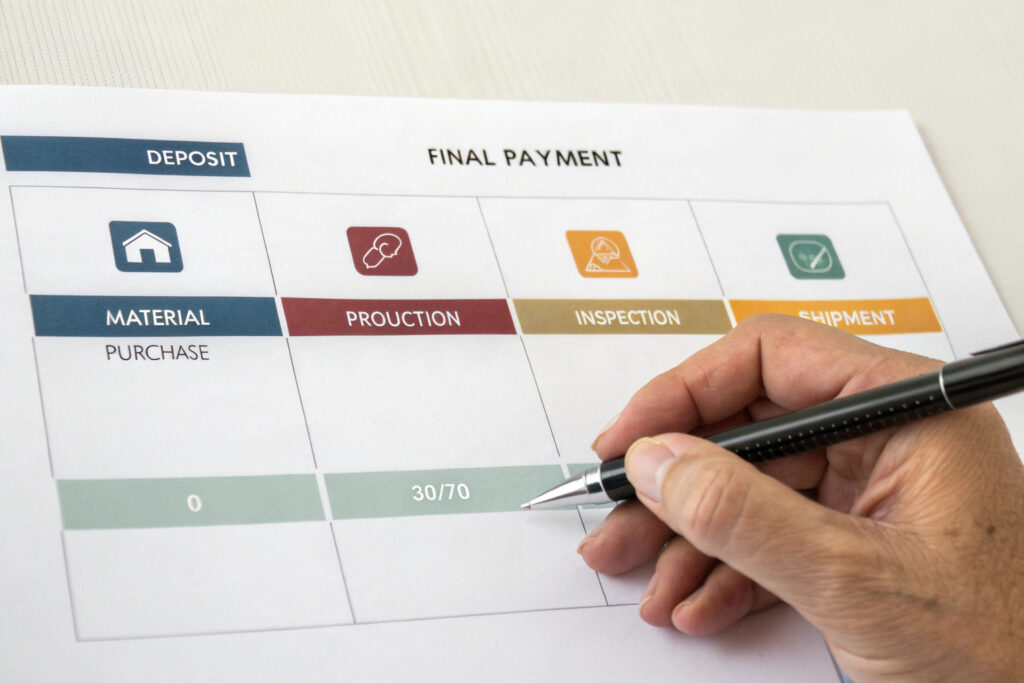
The standard payment structure for international trade in apparel is some variation of a deposit against the balance. The most common starting point for negotiation is 30% deposit with 70% balance paid against a copy of shipping documents. This is called T/T 30/70, telegraphic transfer. For a first-time order of 50,000 pieces, this standard may or may not be acceptable to the factory. You need to understand the variations and when each is appropriate.
The deposit percentage is the factory's risk coverage. A 30% deposit typically covers the material cost for standard caps. A 50% deposit covers materials plus some labor, giving the factory more comfort. The balance payment trigger is your risk control. Paying the balance before shipment gives the factory maximum security but gives you minimum leverage if the caps are defective. Paying the balance against a copy of the bill of lading means you pay when the goods are on the vessel. You have proof that the caps were made and shipped. However, you are still paying before you can physically inspect the caps. Paying the balance after receiving a third-party inspection report that confirms quality is a stronger position for you. Paying the balance a certain number of days after the goods arrive at your warehouse, called net payment terms, is the strongest buyer position but is rarely granted to a first-time buyer without some form of credit insurance.
A more structured approach that I have used successfully with new clients is a milestone-based payment schedule. The total invoice is broken into three or four payments, each tied to a verifiable production milestone. Payment 1 is a deposit to cover materials, paid upon order confirmation. Payment 2 is a progress payment, paid when the fabric is cut and the embroidery is running, verified by photos or a live video call. Payment 3 is the balance, paid after a third-party inspection passes and before shipment. This structure spreads the risk across the production timeline. The factory receives cash to fund each phase. The buyer retains the right to withhold the final payment if the inspection fails. This is a collaborative risk-sharing model that requires transparency from the factory and commitment from the buyer.
How Does a Letter of Credit Work for a Cap Order?
A letter of credit is a bank-guaranteed payment instrument. The buyer's bank issues an LC in favor of the factory. The LC states that the bank will pay the factory a specified amount upon presentation of specified documents, which typically include the commercial invoice, the bill of lading, the packing list, and an inspection certificate. The LC shifts the payment risk from the buyer to the buyer's bank, and it guarantees the factory that the money is available and will be released upon compliant documentation.
For a 50,000-piece cap order, an LC can be an excellent solution for both parties. The factory knows the money is in the bank, irrevocable, and payable upon shipment. The buyer knows the factory will only be paid if they ship the correct quantity on time and present clean documents, including an inspection certificate if the LC requires one. The downside of an LC is cost and complexity. Bank fees for opening an LC, amendment fees, and document examination fees can add several hundred dollars to the transaction. The factory must present documents that match the LC terms exactly. A minor typo can cause a discrepancy and delay payment. For a 50,000-piece order, these costs are usually a small percentage of the total value and are worth the risk mitigation. I welcome LC payment from new clients. It signals that the buyer is serious and that the payment is secure. It allows me to focus on production quality rather than worrying about whether the buyer will pay.
What Is a Bank Payment Guarantee and When Is It Used?
A bank payment guarantee, also called a standby letter of credit, is a guarantee from the buyer's bank that if the buyer fails to pay according to the agreed terms, the bank will pay the factory. It is a backup, not the primary payment method. The primary payment is still a T/T transfer from the buyer to the factory. The guarantee sits in the background, giving the factory the confidence to accept open account terms or a lower deposit.
This instrument is more common for established relationships, but a first-time buyer with a strong banking relationship and a substantial order volume can sometimes negotiate its use. The factory is protected if the buyer defaults, but the buyer retains the normal payment flow and the opportunity to inspect goods before payment if the terms allow. The cost to the buyer is a bank fee, typically a percentage of the guaranteed amount. This is an advanced negotiation tool, but it is worth raising with your bank if you are committing to a large, multi-order program with a new factory.
How Can You Use Inspection and Shipping Terms to Reduce Payment Risk?
Payment is not just about money. It is about information. The factory wants information that you are good for the money. You want information that the caps are good enough to pay for. You can use independent inspection and shipping terms to bridge this information gap and create a payment trigger that protects both parties. The most powerful tool in a first-time negotiation is the pre-shipment inspection, conducted by a neutral third party like SGS, Intertek, or Bureau Veritas. You, as the buyer, commission and pay for this inspection. The inspector goes to the factory after production is complete, but before the goods are packed into the container. They randomly sample the caps according to the AQL standard you have specified in the contract. They check the quantity, the workmanship, the embroidery quality, the color, the labeling, and the packaging. They issue an inspection report with a pass or fail result.
This inspection report can be the trigger for your balance payment. The payment terms in your contract can state, "70% balance payable within 5 business days of receipt of a passed third-party pre-shipment inspection report." This clause aligns the factory's incentive perfectly. The factory knows that a clean inspection report means fast payment. They are motivated to produce quality caps and to cooperate with the inspector. You, as the buyer, know that you are not paying for a container of unknown contents. You are paying for a container that an independent professional has verified meets your specifications. This is the single most effective payment clause for first-time orders. I proactively suggest it to new clients because it removes the quality anxiety from the payment decision.
The shipping terms, the Incoterms, also interact with payment risk. FOB, Free On Board, is the most common term for Chinese exports. Under FOB, the factory delivers the goods to the named vessel. The risk of loss or damage transfers to you when the goods are on board. The factory's responsibility ends there. Payment against the bill of lading under FOB is standard. If you want more control, you can negotiate Ex Works terms. Under Ex Works, you arrange and pay for the entire logistics chain, from factory pickup to final delivery. The advantage for you is that your freight forwarder collects the goods directly from the factory. The forwarder can act as an informal checkpoint, confirming that cartons exist and are loaded. The disadvantage for the factory is that they lose control of the goods before receiving the balance payment if the payment terms are not structured correctly. If you want Ex Works with a balance payment after pickup, the factory will likely resist unless you have a strong inspection certificate or a bank guarantee in place.
How Does a "Production Inspection" Milestone Protect Your Deposit?
A pre-shipment inspection checks the finished goods. A production inspection, also called an inline inspection or DUPRO, checks the goods while they are still on the sewing line. The inspector visits the factory when about 20% to 50% of the order is finished. They can catch systemic quality problems early, before the entire 50,000 caps are made wrong.
You can link a progress payment to a successful inline inspection. The contract can state, "30% deposit, 30% progress payment upon successful DUPRO inspection, 40% balance upon successful pre-shipment inspection." This structure releases funds to the factory mid-production, helping their cash flow, while giving you the assurance that quality is being verified at the point where corrections are still possible. The inline inspection also builds trust. The factory sees that you are engaged and that your inspector is reasonable. The inspector sees that the factory is capable. This mutual observation reduces the fear on both sides and makes the final payment negotiation smoother.
How Can You Use the Bill of Lading to Control Payment Timing?
The bill of lading is a document of title. It represents ownership of the goods. Under a standard T/T arrangement, the factory releases the original bill of lading to you after you have paid the balance. You need the original B/L to claim the goods from the shipping line at the destination port. This gives the factory powerful leverage. They hold the title document until you pay.
You can negotiate a variation called a telex release. Under a telex release, the factory surrenders the original B/L at the port of origin and instructs the shipping line to release the cargo to you at the destination without the original document. This speeds up the process, as you do not have to wait for a courier document. However, the factory loses their physical leverage. A telex release is a sign of high trust from the factory. It is not typically granted to a first-time buyer on a large order unless the balance payment has been confirmed as received in the factory's bank account. You can propose a telex release after the funds have cleared as a way to speed up your logistics, but you should not expect the factory to issue a telex release before receiving payment.
What Creative Compromises Can Satisfy Both Factory and Buyer?
When the standard structures do not work, creative compromises can unlock the negotiation. These compromises require both parties to think beyond the usual formulas and to focus on the underlying needs. The factory needs cash security and assurance that the order will not be cancelled. The buyer needs quality assurance and payment leverage. A package of small concessions can satisfy both.
One effective compromise is a graduated deposit structure over multiple orders. The buyer agrees to 50% deposit on the first 50,000-piece order, with the written commitment that on the second order, the deposit drops to 30%, and on the third order, to 20%. This gives the factory heavy protection on the first, highest-risk transaction, but gives the buyer a clear path to standard terms as the relationship proves itself. This structure acknowledges that trust is built over time, not demanded upfront. Another compromise is splitting the 50,000 pieces into two or three smaller shipments. Instead of one 50,000-piece order with one payment schedule, you place three sequential 16,000-piece orders. The first order uses a conservative payment structure. The factory performs well. The second order uses slightly more favorable terms. The third order uses standard terms. This reduces the risk quantum for both parties. The factory's maximum exposure is 16,000 caps, not 50,000. The buyer's maximum prepayment exposure is also smaller. The shipping cost per unit is higher with smaller volumes, but the risk reduction can be worth it for a first engagement.
A third creative option is the use of an escrow service. An independent third party holds the balance payment in escrow. The factory ships the goods. The buyer inspects the goods upon arrival. The buyer releases the funds from escrow to the factory. This provides near-perfect protection for both parties but adds escrow fees and time. Specialized trade escrow services exist for this purpose. I have used escrow for very large first orders where both sides were nervous. It is not an everyday tool, but it exists and works.
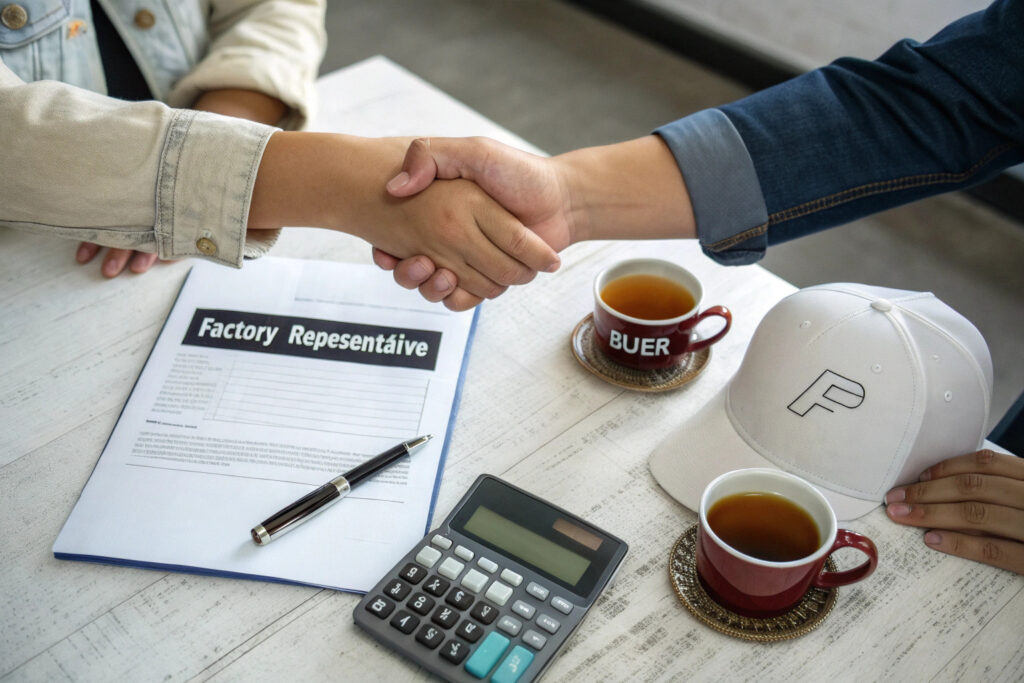
How Can a Factory Tour or Video Verification Reduce the Perceived Risk?
A significant part of the factory's fear with a new buyer is the fear of the unknown. They do not know if you are a legitimate, established business or a fly-by-night operator. You can reduce this fear, and potentially negotiate better payment terms, by voluntarily sharing information about your business. Provide your company's business license or registration. Provide a reference from another supplier you have worked with, ideally a factory in a non-competing product category. Share your website, your social media, your retail presence.
A live video tour of your office or warehouse, reciprocating the factory's own video tour, humanizes your business. It shows you are a real company with real operations. This transparency is disarming. When a new client takes the time to show me their warehouse, their team, and their previous product line, my perception of their risk profile drops significantly. I am more willing to offer flexible payment terms to a buyer who has revealed themselves as a serious, established business. This is a negotiating tactic that costs you nothing but can be worth a 10% or 20% shift in the deposit percentage.
How Can You Build a Long-Term Payment Relationship From the First Order?
The first order is not just one transaction. It is the foundation of a supply relationship that could last for years. You should negotiate with the long game in mind. If the factory insists on 50% deposit and you need 30%, consider accepting the 50% on a smaller trial order of 10,000 pieces. Prove your payment reliability. Pay on time, or even early. Provide a testimonial they can use. Then, on the 50,000-piece order, you are no longer a first-time buyer. You are a returning client with a payment history. You can negotiate from a position of proven trust.
I have clients who started with a cautious 3,000-piece trial, paid 70% deposit, and now, five years later, they enjoy open account net-30 terms on 100,000-piece orders because their payment record is flawless. This progression is natural and healthy. It aligns the payment terms with the actual, demonstrated risk. Your goal in the first negotiation should not be to extract the maximum possible concession from the factory. It should be to establish a fair, sustainable structure that allows both parties to feel secure and sets the stage for a long-term, increasingly flexible partnership.
Conclusion
Negotiating payment terms for a 50,000-piece first-time custom cap order is a negotiation of mutual fear. You fear losing your money to a bad shipment. The factory fears losing its material investment to a cancelled order. Neither fear is irrational. The solution is not to overpower the other party into accepting all the risk. The solution is to build a payment structure that manages the risk sequentially, releasing funds as trust is earned and quality is verified.
The most robust structure I recommend is a milestone-based schedule: a deposit that covers 100% of documented material costs, a progress payment upon a successful inline production inspection, and a balance payment upon a passed pre-shipment inspection by a recognized third party. This structure funds the factory's costs, gives you verified quality at each stage, and creates a clear, documented trigger for each payment. It is fair, transparent, and defensible to both your finance department and the factory's management.
If you are preparing to negotiate your first bulk cap order and you want a factory that understands the need for balanced, transparent payment terms, I invite you to start a conversation with Global-Caps. We structure our payment proposals around the actual cost breakdown and the verified progress of the order. We welcome third-party inspections at any stage. We will walk you through our material costing, show you the custom component invoices, and agree on a schedule that protects your capital while allowing us to deliver on time and on quality. Reach out to our Business Director, Elaine, at elaine@fumaoclothing.com with your order specifications. Let's build a payment agreement that makes both of us confident to proceed, and let's lay the foundation for a partnership that grows more efficient with every order.