A buyer once asked me during a factory audit, "Can I see your cutting room inspection records from last Thursday?" I watched a competitor's factory manager freeze at that exact question three years ago. He had no records. He had only a vague memory and a thumbs-up from a line supervisor. The buyer walked. That factory lost a $200,000 annual account not because they made bad hats, but because they could not prove they made good ones.
A hat factory should document its quality checks at each production stage using a traceable, four-gate system: raw material inspection records, in-line cutting and sewing audit sheets, a final pre-shipment inspection report, and a corrective action log tied to each batch number. Each document must reference the specific purchase order, the production date, the inspector's name, and a pass or fail verdict against the agreed AQL standard. A digital photograph of the defect must accompany every fail entry. When these four document sets are archived in a searchable system, you can reconstruct the entire production history of a single cap three years after it shipped.
Our facility in Zhejiang runs on this documentation framework. It is not extra paperwork. It is the operating system of a trustworthy factory. I want to walk you through the exact records we generate at each stage, what they look like, and how you can use them to verify quality even if you are halfway across the world. This is the paper trail that separates a professional manufacturer from a workshop.
What Raw Material Inspection Records Should a Factory Keep?
The first quality gate is not at the sewing machine. It is at the receiving dock. A roll of fabric or a carton of sweatbands that enters the factory already defective will produce defective hats, no matter how skilled the sewing operators are. You cannot inspect quality into a product. You must start with quality raw materials. The documentation at this stage is the foundation of every downstream claim.
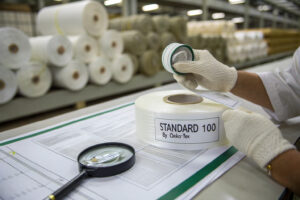
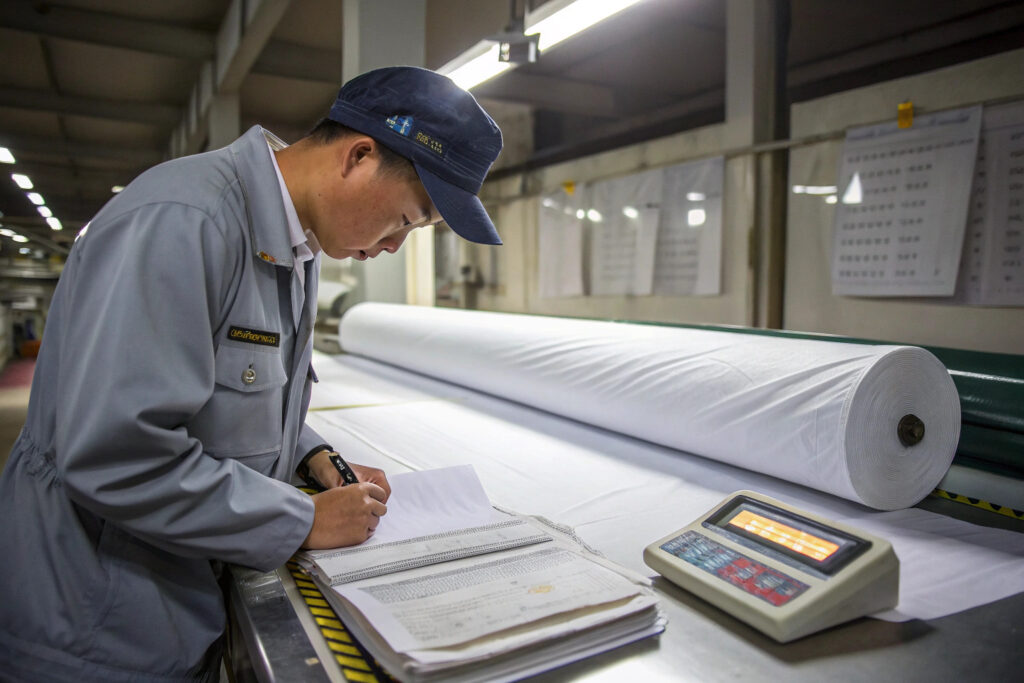
I require my incoming QC team to generate three documents for every raw material batch. First, the "Fabric Inspection Report." This records the roll number, the supplier name, the purchase order reference, and the results of a 10-point inspection using a 4-point system defined by ASTM D5430. The inspector checks for holes, dye stains, barre marks, and width variations. Second, the "Shade Band Continuity Check." The inspector cuts a swatch from the beginning, middle, and end of each roll and tapes them to a single card under a daylight lamp. This card proves the roll had consistent color from end to end. Third, the "Trim Component Verification Record." For snap closures, sweatbands, and visor boards, the inspector checks the shipment against the approved reference sample and records the lot number and the incoming quantity. If any of these documents shows a fail, the material is quarantined in a red-tagged area and the purchasing manager is notified within the hour. This quarantine system prevents a bad roll of fabric from silently entering the cutting room.
Documenting the incoming material is a defensive move. It protects the factory from supplier disputes and protects the buyer from hidden substitutions. The most useful record in this set is the one that proves a material was tested for safety before it touched a worker's hands.
How Do You Record Chemical Compliance at the Receiving Stage?
An OEKO-100 or GOTS certified hat requires a certified input. You cannot rely on a supplier's generic certificate that may be two years old. We generate a "Batch Chemical Certification Log." For every incoming dye lot of sweatband or shell fabric, we request a valid, current OEKO-TEX certificate that matches the lot number on the shipment. We file this certificate digitally with the purchase order number.
If a supplier cannot provide a lot-specific certificate, we cut a swatch and send it to our partner lab for a rapid azo dye and formaldehyde scan. The lab report is uploaded to our ERP and linked to the raw material record. This chemical compliance documentation proves to a downstream auditor that the finished hat's safety claim began at the receiving dock, not at the final inspection table.
What Should a Fabric Inspection Form Actually Contain?
A real fabric inspection form is not a blank sheet of paper with "OK" scrawled on it. It is a structured template. The header must have the supplier name, the PO number, the roll number, the fabric type, and the date. The body has a defect table with columns for the defect type, the yardage location, the point value, and the action taken. The footer has the total points per 100 square yards, the pass/fail grade, the inspector's signature, and a digital photo attachment reference.
We use a digital tablet-based system now, but the principle is the same. The fabric inspection form creates a permanent link between a specific roll and a specific production run. If a finished cap in a retail store has a hidden weaving flaw, we can trace it back through the cutting report to the exact roll and yardage marker within minutes.
How Are In-Line Production Audits Properly Logged?
The cutting and sewing stages are where dimensional errors and stitching defects are born. An unchecked error in panel cutting multiplies across 500 units before the final inspection catches it. By then, the fabric is wasted and the delivery date is blown. In-line audits catch the error at patient zero.
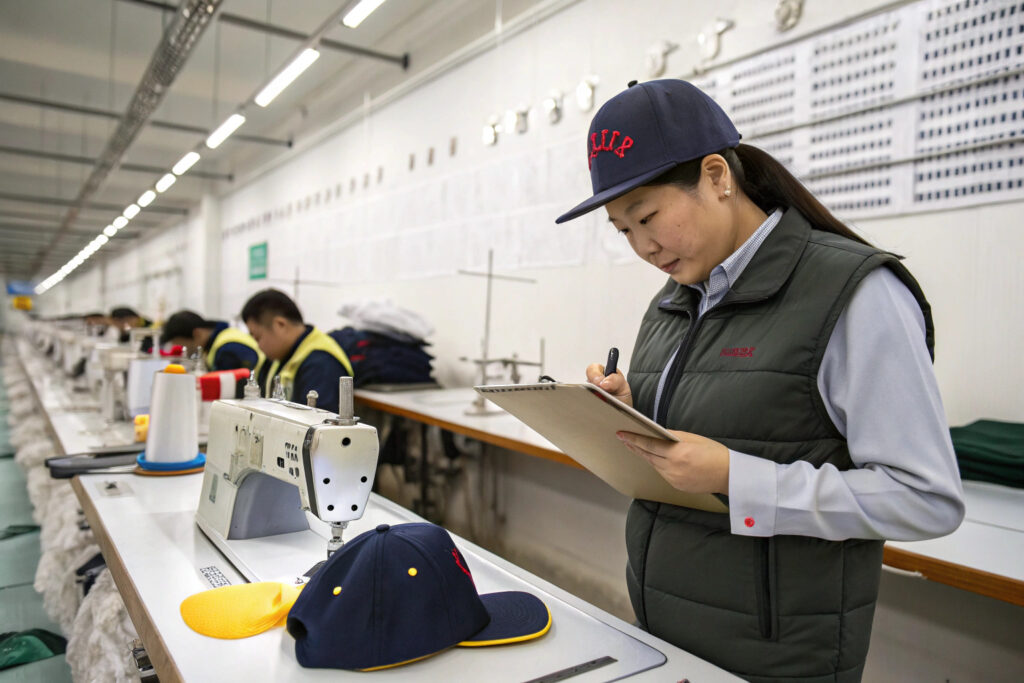
We deploy a roaming QC auditor who covers specific production zones on a fixed hourly circuit. This auditor uses a one-page "In-Line Production Audit Sheet." The sheet covers five checkpoints per station. For the cutting station, she checks the ply height, the blade sharpness, the pattern alignment, the cut edge cleanliness, and the shade grouping. For the embroidery station, she checks the thread tension, the digitized file version, the backing stability, the needle heat, and the color match against the lab dip. For the sewing station, she checks the seam allowance, the stitch density per inch, the seam puckering, the sweatband alignment, and the closure attachment strength. Each checkpoint gets a simple pass or fail tick. If a checkpoint fails, the auditor logs the defect with a photo and notifies the line supervisor immediately. The supervisor signs the sheet to acknowledge the corrective action. This sheet is time-stamped to the hour. A buyer can look at the audit log and see that at 10:15 AM on Tuesday, the embroidery tension was checked on Station 4 and passed.
The hourly audit log is a real-time health monitor of the production line. But the auditor's most valuable tool is not the clipboard. It is the physical measuring instrument that generates an objective number rather than a subjective judgment.
How Do You Document Seam Strength and Stitch Density Tests?
A visual inspection of a seam can miss a loose bobbin thread that will unravel after three washes. We perform a destructive seam test at a frequency of one test per 100 units on the sewing line. The auditor takes a randomly pulled cap from the line, cuts a seam section, and mounts it on a manual tensile tester.
The tester pulls the seam apart. The digital gauge records the force in Newtons at the point of rupture. The auditor writes this force reading on the In-Line Audit Sheet next to the seam specification. If the reading falls below the minimum threshold, the auditor logs the failure and the sewing machine is immediately flagged for re-tuning. The torn sample and the tensile test printout are stapled to the back of the audit sheet. This physical evidence is undeniable in a post-shipment quality dispute.
Why Must Embroidery Tension Tests Be Recorded Separately?
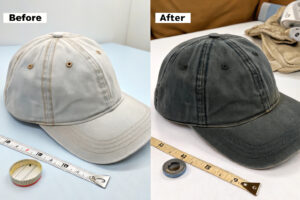
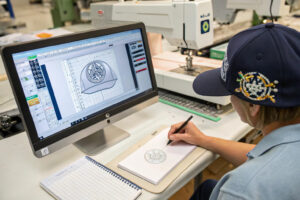
Embroidery is the most visible quality marker on a hat. A logo with loose top threads or tight bobbin threads looks cheap. The bobbin tension is sensitive to temperature and machine speed. We require our embroidery auditors to run a standard "H-test" pattern on a scrap of the actual shell fabric at the start of every shift and after every bobbin change.
The H-test pattern stitches a series of block letters in both satin and fill stitches. The auditor peels off the backing, holds the test stitch-out against a light, and checks for even coverage and bobbin pull-through. The test stitch-out is then stapled to a dated "Embroidery Tension Log" sheet. If the logo on a finished cap looks inconsistent, we pull the log sheet for that shift and examine the test stitch-out. This embroidery quality log isolates a mechanical problem from an operator error in under a minute.
What Goes Into a Final Pre-Shipment Inspection Report?
The final pre-shipment inspection is the last line of defense. It is not a casual glance at a few hats. It is a statistically valid sampling procedure performed against the sealed approval sample. The documentation generated at this stage is the legal basis for the buyer's acceptance or rejection of the shipment.
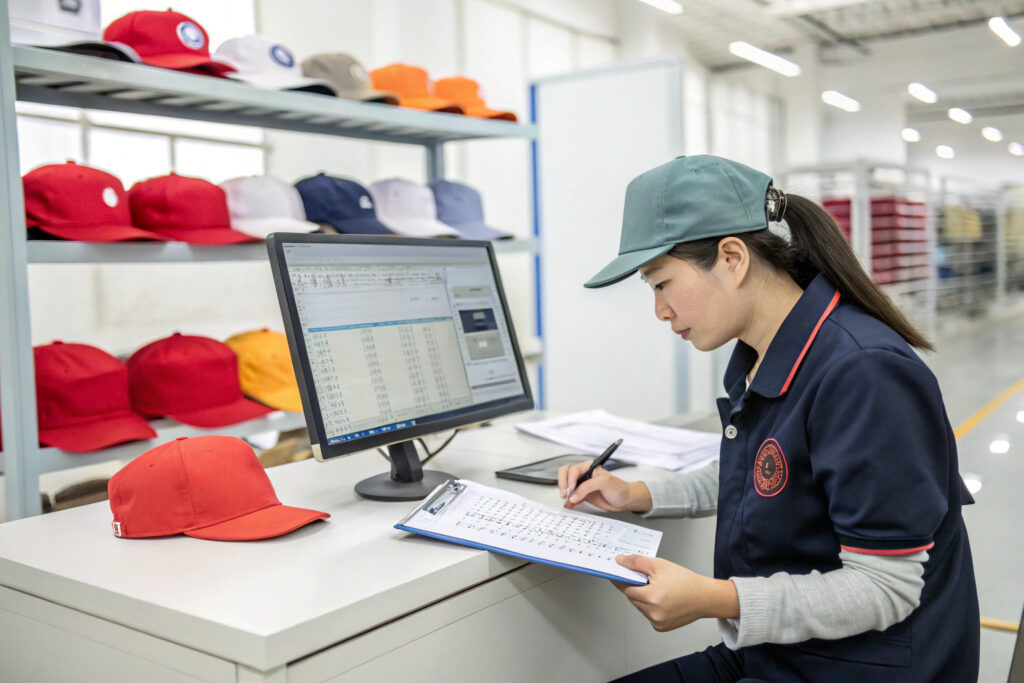
Our final QC report follows the ISO 2859-1 AQL 2.5 standard for a Level II inspection. The report header lists the PO number, the style number, the total order quantity, the sample size drawn, and the inspection date. The body of the report is divided into three defect categories. Critical defects, like exposed needle tips or mold stains, with an AQL of zero. Major defects, like a broken snap, a misaligned brim, or a color shade outside the Delta E 1.5 tolerance, with an AQL of 2.5. Minor defects, like a loose thread tail or a slightly wrinkled sweatband, with an AQL of 4.0. The inspector records the quantity of each defect type found in the sample. The report concludes with a clear "Pass" or "Fail" verdict based on the tally. If the lot fails, the report specifies the required rework operation and the date of the mandatory re-inspection. This report is emailed to the buyer along with a ZIP file of photographs showing each defect next to a ruler for scale. The buyer does not receive an invoice for the final balance until this report is approved.
A final report that only lists defects is incomplete. It must also demonstrate that the approved reference sample was physically present at the inspection and that every measurement was taken against that standard, not against a memory.
How Is the Golden Sample Used During the Final Inspection?
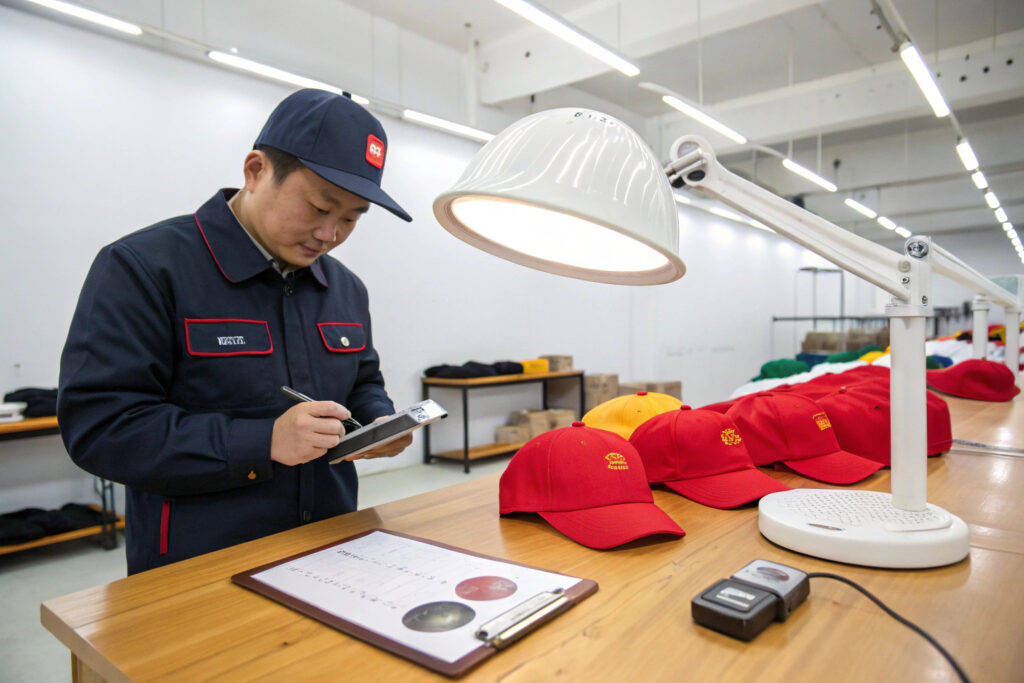
The sealed Golden Sample is not a decoration in a display case. It is a working tool. Our final inspector places the Golden Sample on the inspection table next to the randomly drawn bulk samples. The report form includes a "Golden Sample Verification" section.
The inspector checks the sample's seal and signature integrity before starting the inspection. She then uses a digital caliper to measure the crown height, visor width, and sweatband circumference of the Golden Sample. She records these reference measurements. She measures the same points on the bulk samples and records the deviation for each. The pre-shipment inspection report visually demonstrates that the bulk product falls within the agreed tolerance of the approved sample. This eliminates the "but I thought it looked fine" argument.
What Photographic Standards Should a QC Report Meet?
A photograph of a defect without scale is useless. A thread tail looks the same whether it is 2 millimeters or 2 centimeters long. Our inspectors use a small magnetic ruler that sticks to the hat. Every defect photo includes the ruler, the hat's internal barcode label, and a card with the PO number and defect code written in marker.
The photos are taken under a daylight-balanced LED lamp, not under the yellow warehouse ceiling lights. The camera's flash is disabled to prevent color washout. These standards ensure the buyer sees exactly what the inspector saw. A photo documentation protocol this strict protects both the factory and the buyer in a PayPal or trade assurance dispute.
How Should Corrective Action Logs Be Structured and Stored?
A defect found and not analyzed is a defect destined to recur. The corrective action log closes the loop. It transforms a QC report from a rearview mirror into a headlight. Without this log, a factory makes the same stitching error on your next order because no one solved the root cause the first time.
We structure our Corrective and Preventive Action log as a numbered, searchable database. Each CAPA entry begins with a unique ID number that matches the defect code on the original inspection report. The entry contains five fields. Field one is the "Defect Description," which includes the PO number, the style, and a photo of the defect. Field two is the "Root Cause Analysis," which uses a simple 5-Whys format. Why did the brim detach? The glue seam failed. Why did the glue seam fail? The adhesive was past its pot life. Why was the adhesive past its pot life? The mixing operator did not check the batch date. Why did the operator not check the batch date? The incoming adhesive container was not labeled with the date. Why was it not labeled? The warehouse procedure did not require a date label on opened adhesive containers. The root cause is a missing warehouse label procedure, not a bad operator. Field three is the "Immediate Correction," which describes the rework or sorting action taken on the affected lot. Field four is the "Preventive Action," which describes the system change, such as adding a date-label step to the warehouse SOP. Field five is the "Verification," signed and dated by the QA manager 30 days later, confirming the preventive action is still in place and effective. This CAPA log is reviewed with every client during their annual factory audit.
A CAPA log filled with "operator retrained" entries is a red flag. The root cause is almost never a single careless worker. It is almost always a missing tool, an unclear specification, or a broken feedback loop.

How Often Should a Factory Review Its CAPA Log?
We review our CAPA log monthly in a meeting chaired by the production director, the QC manager, and the maintenance chief. We sort the log by defect frequency and build a Pareto chart. If broken snaps are the number one defect for the month, we do not just check snaps more often. We audit the snap supplier or change the snap attachment press maintenance schedule.
This monthly review is documented in a "Management Review Minutes" document. The minutes list the top three defects, the agreed corrective actions, and the responsible person for each. This document is filed in a binder that is available for client audits. A corrective action system that includes management review proves the factory leadership is engaged in quality, not just the QC department.
Can a Digital ERP System Replace Paper QC Logs?
A digital system does not replace the discipline of logging. It enhances the accessibility and searchability of the records. We use a cloud-based ERP where the raw material inspection, in-line audits, final inspection reports, and CAPA logs are all linked to a single production job number. A buyer can log into a portal and see the real-time QC status of their order.
But the digital record is only as honest as the physical input. The auditor must still physically measure the hat, take the photo, and enter the truth. I have seen factories with beautiful digital dashboards and dirty production floors. The ERP is a tool. The quality management system is the culture. The culture is documented in the logs, whether they are paper or digital.
Conclusion
Documenting quality checks at every production stage is not about pleasing an auditor. It is about building a factory memory. A raw material inspection report from last year can settle a supplier dispute today. An in-line audit sheet from Tuesday can stop a bad batch before it becomes a rejected shipment on Friday. A final inspection report with scaled photographs can defend your payment terms against an unfair chargeback. And a CAPA log that digs into root causes prevents the same mistake from eating your margin on the next purchase order.
I treat our quality documentation system as a living archive of our promises to clients. Every signed checklist, every tensile test printout, and every corrective action verification is a brick in the wall of trust between our factory floor and a retail store shelf somewhere in Chicago or Berlin. Without the paper trail, quality is a slogan. With it, quality is a provable fact.
If you are evaluating a new hat manufacturing partner and want to see samples of our raw material logs, in-line audit sheets, and final inspection report formats before you place an order, our Business Director, Elaine, can walk you through our documentation package. She can share redacted examples that show exactly how we trace a hat from fabric roll to finished carton. Email her at elaine@fumaoclothing.com to request our QC documentation overview. We want you to see the proof before you pay the deposit.