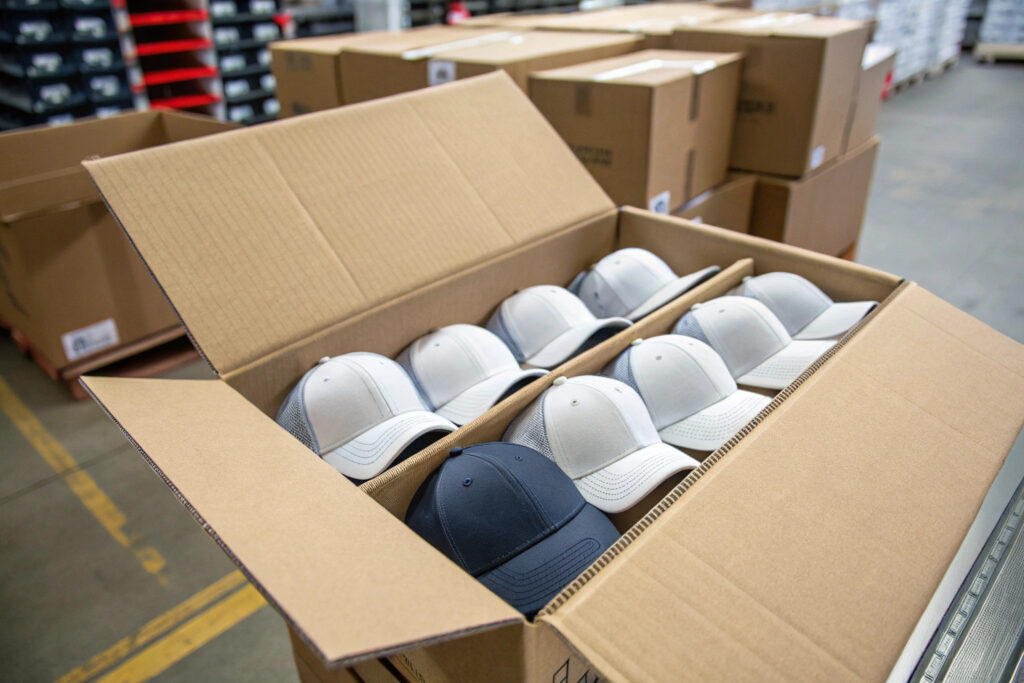
I stood in a warehouse in humid Miami five years ago. My client had just opened a container of 3,000 custom snapbacks. The front of every cap was beautiful. The embroidery was perfect. But when he pulled the caps out, the pre-curved visors were completely flat. The ocean heat and the crushing weight of the cartons had pressed the brims into a lifeless pancake. He couldn't sell them as "pre-curved." He had to steam and reshape every single brim by hand. It cost him three days of labor and a delayed launch. I took full responsibility and paid for the rework, but I also went back to my packing team and redesigned our entire ocean freight protocol for structured brims. It will never happen again.
A custom hat supplier must pack and protect pre-curved visors for ocean freight using a rigid brim guard insert that maintains the curve, a breathable polybag to prevent moisture entrapment, a correct stacking orientation that avoids direct pressure on the brim, and a moisture-controlled carton with desiccant packs. The pre-curved visor is the most vulnerable part of a structured cap during ocean transit. It faces three enemies: compression from stacked cartons that flattens the curve, humidity that softens the visor board and allows it to deform, and heat that accelerates both processes inside a sealed container. A factory that simply folds the cap and drops it into a polybag is packing for a short domestic truck ride, not a 30-day ocean voyage. Ocean freight requires a different packing standard.
I redesigned our packing protocol after Miami and I have refined it across hundreds of container shipments to North America, Europe, and Australia. I want to share the specific packing materials, the carton configuration, the moisture control strategy, and the quality verification steps that ensure a pre-curved visor arrives at your warehouse with the exact same curve it had when it left our finishing room. This is the engineering of safe hat delivery.
Why Are Pre-Curved Visors Especially Vulnerable During Ocean Freight?
A pre-curved visor is a shaped component. It gets its curve from a visor board, a thin sheet of plastic or pressed fiber, that has been heat-molded into a specific arc. This board is sewn between the outer brim fabric and the inner brim lining. The curve is not inherent to the fabric. It is held by the board. The board is the structural element. If the board deforms, the curve is lost. The ocean freight environment attacks the board in three ways: sustained heat, high humidity, and prolonged compression. These three forces act together to permanently alter the board's shape.
The heat inside a shipping container is the primary destructive force. A container sitting on a ship deck under equatorial sun can reach internal temperatures of 55 to 65 degrees Celsius. The visor board, typically made of polyethylene or a similar thermoplastic, has a heat deflection temperature. When the container temperature approaches or exceeds this threshold, the board softens. It loses its rigidity. It becomes plastic, in the physical sense of being moldable. The humidity is the secondary force. Moisture absorbed by the brim fabric and the cardboard packaging can wick into the visor board, further reducing its stiffness. A fiber-based board is particularly vulnerable to moisture. The compression is the shaping force. The weight of the cartons stacked above presses down on the softened board. The board, now warm and flexible, conforms to the flat pressure of the carton. It loses its curve and takes a flat set. When the container cools, the board re-hardens in the flat position. The curve is gone. The process is not reversible without steam and manual reshaping. The visboard thermal properties are the key material science factor in ocean freight survivability.
The heat, humidity, and compression form the triangle of visor destruction. The packing method must break this triangle. It cannot control the container temperature. It can control the humidity around the cap. It must control the physical pressure on the brim. The brim guard is the primary tool for pressure control.
What Happens to a Visor Board When It Exceeds Its Heat Deflection Temperature?
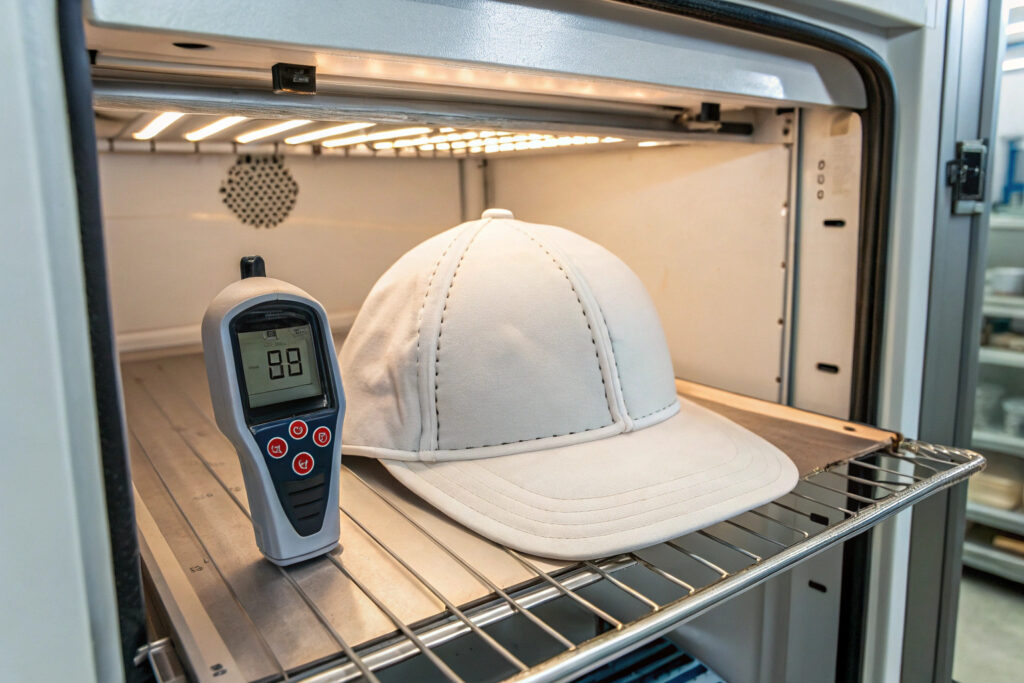
The heat deflection temperature is the temperature at which a plastic material begins to soften and deform under a specified load. For a standard polyethylene visor board, this temperature can be as low as 45 to 55 degrees Celsius, depending on the specific polymer grade. A container interior in a tropical shipping lane can easily reach 55 to 60 degrees Celsius. The visor board enters its softening range. The board does not melt into a liquid. It becomes pliable, like a sheet of warm wax. The curve it holds is no longer fixed. It is now subject to external forces. The weight of the caps above it provides that force. The board flattens. When the container cools at night or upon arrival, the board re-hardens in the new, flat shape. The heat deflection is a material property. The plastic material thermal properties are a critical specification for visor board selection.
How Does Stacking Pressure Directly Flatten a Softened Visor?
The stacking pressure in an ocean container is significant. A standard 40-foot container can be loaded with cartons stacked over two meters high. The cartons at the bottom of the stack bear the weight of all the cartons above them. If the caps inside are packed flat, with the brims laid horizontally, the stacking weight presses directly down on the flat surface of the brim. This compression force is constant for the entire duration of the voyage, which can be 21 to 35 days. When the visor board is softened by heat, this constant pressure is the forming force. It molds the brim into a flat shape. The pressure is not an impact. It is a slow, steady, relentless squeeze. The container stacking loads are a standard consideration in export packaging design.
What Specific Packing Materials Maintain the Curve of a Pre-Curved Visor?
The internal brim guard is the most important piece of packing material for a pre-curved visor. It is a rigid, shaped insert, typically made of molded cardboard or a thin, formed plastic sheet, that matches the exact curvature of the visor. The guard is placed inside the cap, against the underside of the brim. Its function is to resist the stacking pressure and maintain the brim's curve. When a carton above presses down, the force is transferred through the cap stack to the brim guard. The guard, because it is a rigid arch, transfers the force around the curve to the cap's crown or the carton floor. The brim itself is shielded from the direct pressure. The guard is the structural defender of the curve.
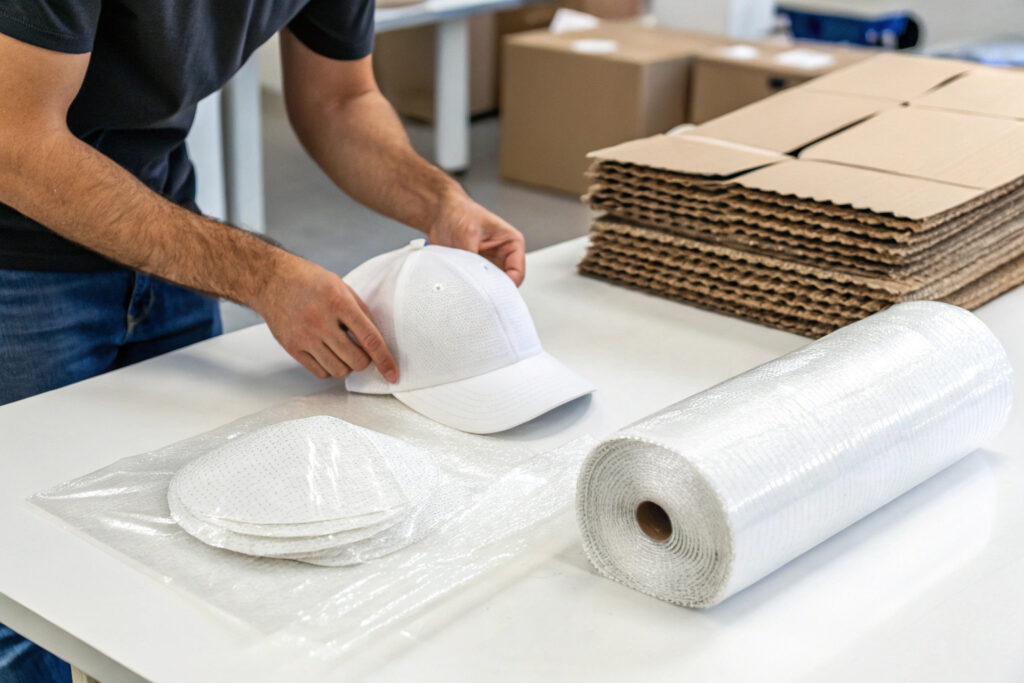
I specify a brim guard made from a die-cut, molded pulp cardboard. This material is rigid, lightweight, inexpensive, and biodegradable. The guard is shaped to the exact radius of our standard pre-curved brim. It fits snugly inside the cap. For caps with a deeper or shallower curve, a custom guard is cut to match. The guard is inserted into every cap before it is placed in the polybag. In addition to the guard, we use a sheet of acid-free tissue paper to fill the crown cavity. This tissue ball prevents the crown from collapsing under pressure and provides additional structural support to the cap. We also use a breathable, micro-perforated polybag. The perforations allow moisture to escape, preventing the steam-chamber effect inside the bag. The protective packaging design for shaped products uses rigid internal supports as the primary defense against compression deformation.
The brim guard is the primary internal defense. The carton itself is the external defense. A single-wall carton is not sufficient for ocean freight. The carton must be a double-wall corrugated structure that resists crushing. The carton is the fortress. The brim guard is the armor inside the fortress.
What Is the Correct Way to Insert a Brim Guard Without Scratching the Visor?
The brim guard is inserted from the inside of the cap. The cap is turned slightly inside out, or the sweatband is folded back to expose the interior of the brim. The guard is slid into the pocket between the brim lining and the sweatband. It should seat against the underside of the visor board. The guard should be smooth and free of burrs or rough edges. Any roughness on the guard can scratch the brim lining or, over time and under vibration, wear a hole through the fabric. I specify guards with a smooth, calendared surface. The insertion process is gentle. The technician checks the fit. The guard should not be forced. If the guard is too tight, it can stretch the brim fabric. If it is too loose, it will shift during transit and lose its protective function. The packing insertion procedures are part of the standard operating procedure for the packing station.
Why Is Double-Wall Corrugated Cardboard Essential for Ocean Freight?
Single-wall corrugated cardboard consists of one fluted layer between two flat liner sheets. Double-wall consists of two fluted layers between three flat liner sheets. Double-wall has significantly higher stacking strength and puncture resistance. It resists the crushing force of the cartons above it. It resists the puncture force of a corner of another carton. It also provides slightly better thermal insulation, though this is a minor effect. The cost difference between single-wall and double-wall is small, typically $0.10 to $0.20 per carton. The protection difference is enormous. For ocean freight, double-wall is the minimum standard. I use a C-flute double-wall carton with an edge crush test rating of at least 44 pounds per inch. The corrugated cardboard specifications are standardized. The carton strength is a specified, measurable property, not a guess.
How Should Caps With Pre-Curved Visors Be Oriented Inside the Carton?
The orientation of the caps inside the carton determines how the stacking force is distributed. The wrong orientation concentrates the force on the brim. The correct orientation transfers the force through the strongest part of the cap. A cap packed flat on its side, with the brim parallel to the carton floor, exposes the entire brim surface to the full stacking pressure. This is the worst orientation. The brim will flatten. A cap packed with its brim vertical, perpendicular to the carton floor, transfers the stacking force through the crown and the sweatband, which are more structurally resilient. The brim is shielded.
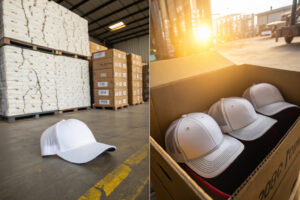
I use an alternating vertical orientation method. The caps are packed in rows. Within each row, the caps alternate direction. One cap faces forward, the next cap faces backward. The brims of adjacent caps nestle against each other or against the crowns. The crowns provide a rigid structural column that bears the stacking weight. The brims, protected by their internal guards, are not load-bearing. The caps are packed snugly, but not so tightly that the brims are compressed against each other. The carton is filled to capacity to prevent the caps from shifting during transit. A shifting cap can end up in a flat orientation. The carton is sealed and labeled with a "This Side Up" arrow, although this instruction is often ignored in container loading. The internal orientation is the real protection. The carton packing configuration for shaped products is a standard logistics engineering problem.
The orientation resists the downward stacking force. The polybag prevents moisture damage. But moisture does not only come from outside the carton. It can come from inside the cap itself if the cap was not properly dried before packing. The pre-packing moisture check is the final quality gate.

What Is the Best Way to Pack Caps to Prevent the Brims From Shifting During Transit?
The alternating vertical orientation prevents brim loading. To prevent shifting, the carton must be packed tightly. The caps should fill the carton without empty space. If the carton is not completely full, use void fill. Do not use crumpled newspaper or loose peanuts. Use a rigid cardboard spacer or a block of foam that is cut to fit the exact gap. The void fill must be rigid enough to prevent the caps from shifting into the empty space. A cap that shifts in a partially filled carton can end up resting on its brim. The tight pack and the rigid void fill immobilize the caps. The cargo immobilization techniques are standard in export packaging.
How Many Caps Should Be Packed Per Carton to Avoid Over-Compression?
The carton should not be so heavy that the bottom layer of caps is crushed by the weight of the caps above it within the same carton. For a standard 6-panel structured cap, I pack 36 to 48 caps per carton, arranged in two or three layers. Each layer is separated by a sheet of corrugated cardboard that distributes the weight evenly. The total carton weight is kept under 15 kilograms. A heavier carton increases the risk of internal crushing and makes manual handling more difficult and dangerous. The carton weight limits are both a product protection consideration and a worker safety consideration.
How Should Moisture Be Controlled Inside the Carton During a 30-Day Ocean Voyage?
Moisture is the silent enemy of pre-curved visors. It weakens the visor board. It promotes mold growth on cotton fabric. It softens cardboard cartons, reducing their stacking strength. Controlling moisture inside the carton is a multi-layered defense. The first layer is the pre-packing moisture check. The caps must be dry before they are packed. The second layer is the desiccant pack inside each carton. The desiccant absorbs moisture that enters the carton during transit. The third layer is the moisture barrier in the carton or pallet wrap. This barrier reduces the rate at which external moisture enters the carton.
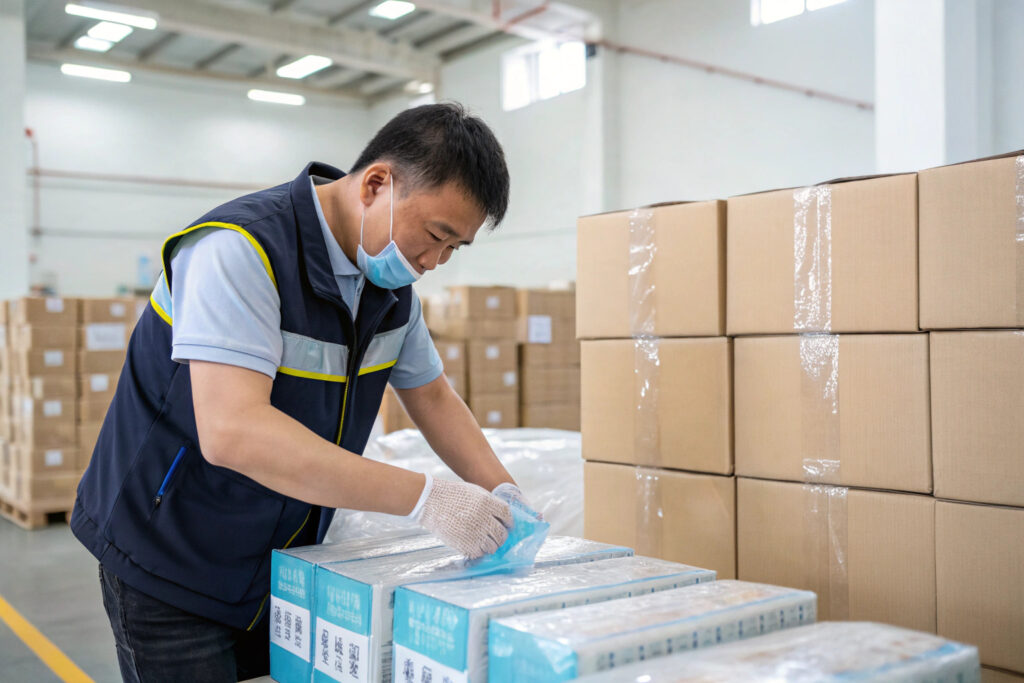
I implement a strict moisture control protocol for all ocean freight shipments. Every carton receives a 50-gram silica gel desiccant pack. The desiccant is placed in a breathable pouch and tucked into a corner of the carton, away from direct contact with the caps. The carton is sealed with water-activated tape that forms a stronger, more moisture-resistant seal than standard pressure-sensitive tape. The cartons are placed on plastic pallets, not wooden pallets that can harbor moisture and mold. The entire pallet is wrapped in a moisture-barrier stretch film. This creates a secondary moisture barrier around the cartons. For high-value or long-duration shipments, we also use a container desiccant system, hanging large desiccant bags along the container walls to absorb moisture from the container air. The moisture control in shipping containers is a specialized logistics function.
The desiccant pack absorbs moisture. The pre-packing moisture check prevents moisture from being sealed into the carton in the first place. A cap that is packed damp will mold, regardless of how much desiccant is in the carton. The moisture check is a quality gate that must be passed before the carton is sealed.
What Is the Correct Amount of Desiccant to Use Per Carton of Caps?
The amount of desiccant required depends on the carton volume, the moisture sensitivity of the contents, the expected voyage duration, and the ambient humidity conditions. For a standard carton of caps with internal dimensions of approximately 60 centimeters by 40 centimeters by 30 centimeters, which is a volume of 0.072 cubic meters, a 50-gram silica gel desiccant pack is generally sufficient for a 30-day voyage under normal conditions. For voyages through tropical regions or during monsoon season, I increase the desiccant to 100 grams per carton. The desiccant is specified to absorb a minimum of 20% of its weight in moisture at 40% relative humidity. The desiccant sizing calculation is based on the carton's water vapor transmission rate and the desired internal humidity level.
Why Should Pre-Curved Visors Be Checked for Internal Moisture Before Packing?
A cap that has been steamed, pressed, or washed during finishing may retain moisture inside the visor board or the fabric layers. If this cap is packed into a sealed carton, the trapped moisture will equilibrate with the air inside the carton, raising the relative humidity to near 100%. The desiccant will be overwhelmed. The moisture will condense on the cooler surfaces, such as the polybag and the cardboard. The visor board will absorb moisture and soften. Mold will grow on the cotton sweatband. This entire chain of destruction begins with a damp cap being packed. I use a pin-type moisture meter to spot-check caps coming off the finishing line. The moisture content of the fabric should be below 7% before packing. Caps that exceed this threshold are sent to a drying rack before packing. The textile moisture content measurement is a standard quality control procedure.
Conclusion
A pre-curved visor is a precision-shaped product that requires engineered protection for ocean freight. The defense system has four layers. Layer one is the internal brim guard, a rigid, shaped insert that maintains the curve and bears the stacking load. Layer two is the carton orientation, an alternating vertical pack that transfers weight through the crown, not the brim. Layer three is the double-wall corrugated carton and the rigid void fill, which provide external structural integrity and immobilize the caps. Layer four is the moisture control system, consisting of pre-packing moisture checks, desiccant packs, and moisture-barrier pallet wrap. These four layers, working together, ensure that a cap that leaves our factory with a perfect curve arrives at your warehouse with the same perfect curve.
The Miami shipment taught me a lesson I carry with me every day. A beautiful cap that is poorly packed is a defective cap upon arrival. The packing is part of the product. The customer pays for a pre-curved visor. The factory's job is to deliver it. At Global-Caps, we treat the packing process with the same engineering rigor as the sewing process. We measure the moisture content. We specify the desiccant weight. We test the carton crush strength. We train the packing technicians. The result is a shipment that survives the ocean and arrives ready for the retail shelf.
If your current supplier's pre-curved caps are arriving flat or deformed, and you want a factory that packs specifically for ocean freight survivability, let us show you our protocol. Our Business Director, Elaine, can send you a packing sample kit with our brim guard, our desiccant pack, and a sample carton configuration, along with our packing standard operating procedure document. Email her at elaine@fumaoclothing.com and request the Ocean Freight Packing Protocol. We will show you how we pack a cap to survive the sea.