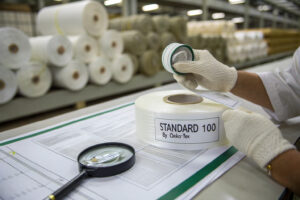
I was sitting in a buyer's showroom in Copenhagen three years ago when the brand founder, a mother of two, asked me a question that stopped me cold. She held one of our infant sun hats in her hand, turned it inside out, and pointed at the binding tape. "My customers Google everything," she said. "They Google the foam in the mattress, the dye in the onesie, the plastic in the teething toy. They are terrified of hidden chemicals. If I tell them this hat is certified, but I can't explain what that means in plain language, they won't trust me. And if they don't trust me, they won't buy." She was right. A certification without a story is just a logo. A certification with a clear, honest, parent-centered story is a powerful sales tool.
To pitch a supplier's OEKO-TEX Standard 100 Grade 1 status to safety-conscious parents, a brand must translate a complex chemical safety standard into a simple, emotionally resonant promise. The pitch is not about parts per million or chromatographic analysis. It is about the moment a parent puts a hat on their newborn's head and feels peace instead of worry. Grade 1 is the strictest certification level in the OEKO-TEX system. It certifies that every component of the product, the fabric, the thread, the sweatband, the label, the plastic adjuster, has been tested and found free of harmful levels of over 100 regulated substances. This is the same standard applied to baby clothing, crib bedding, and cloth diapers. When a hat carries this certification, it is legally and scientifically classified as safe for the most sensitive skin on earth, a newborn's skin.
The pitch must live everywhere the parent encounters the brand. On the product page, on the hangtag, on social media, and in the unboxing experience. It must answer the unspoken question every parent has: "Is this safe for my baby to put in their mouth?" Because parents know that babies put hats in their mouths. They chew on the brim. They suck on the chin strap. A Grade 1 certification answers that question with a definitive yes before the parent even asks it.
What Does OEKO-TEX Standard 100 Grade 1 Certification Actually Mean for Baby Hat Safety?
Parents are bombarded with safety claims. Organic. Natural. Chemical-free. Non-toxic. Most of these terms have no legal definition in the textile industry. OEKO-TEX Standard 100 is different. It is not a marketing claim. It is a third-party certification backed by a defined list of regulated substances, published test methods, and independent laboratory verification. When a parent sees the OEKO-TEX label on a hat, they are seeing evidence of a testing process, not an advertising slogan.
Grade 1, formally called Product Class I, is the most stringent category within the standard. It applies to textile items intended for babies and toddlers up to 36 months of age. The testing requirements for Grade 1 are dramatically stricter than for adult clothing. Formaldehyde limits are lower. Heavy metal limits are near zero. Certain flame retardants are prohibited entirely, not just limited. The standard also tests for substances that are not yet regulated by governments but are considered potentially harmful by the scientific community. This includes specific phthalates, organotin compounds, and pesticide residues that can remain on conventionally grown cotton fibers through the manufacturing process.
For a baby hat, the certification covers every single component. The outer fabric, the inner sweatband, the sewing thread, the binding tape on the seams, the printed label, the size tag, and any plastic components like chin strap toggles or back adjusters. A hat is only Grade 1 certified if all of these components pass individually. If the outer fabric is organic cotton but the sweatband contains a non-certified elastic, the hat fails. This comprehensive scope is what makes the certification meaningful. A parent cannot inspect every component. The certification does the inspection for them.
The certified product is also traceable. Every OEKO-TEX certificate has a unique number that can be checked on the OEKO-TEX website. A parent who wants to verify the claim can enter the number and see the certificate details. This transparency transforms the certification from a passive label into an active trust tool. Brands that educate parents about the label check feature demonstrate a level of confidence that generic "non-toxic" claims cannot match.
How Do OEKO-TEX Grade 1 Limits Differ from Standard CPSIA Requirements for Children's Products?
CPSIA, the Consumer Product Safety Improvement Act, is U.S. federal law. It sets mandatory limits on lead in surface coatings, lead in substrates, and certain phthalates in children's products. It is a legal floor, not a best-practice standard. OEKO-TEX Grade 1 is a voluntary certification that in many cases goes significantly beyond the CPSIA legal requirements.
For lead, CPSIA limits surface coating lead to 90 parts per million and substrate lead to 100 parts per million. OEKO-TEX Grade 1 limits total lead content to well below these levels and also tests for extractable heavy metals, which simulates what happens when a baby sucks on the fabric. A product can pass CPSIA but still fail OEKO-TEX because the standard tests for more substances and under more rigorous simulated-use conditions.
For phthalates, CPSIA restricts a specific list of phthalates in children's toys and child care articles, with a limit of 0.1 percent for each restricted phthalate. OEKO-TEX Grade 1 restricts a broader list of phthalates and applies the limit to every component of the textile product, not just plasticized parts. The standard also regulates substances completely absent from CPSIA, such as chlorinated phenols, allergenic disperse dyes, and pesticide residues. A brand pitching Grade 1 to parents can truthfully say that the certification meets and exceeds all legal requirements for children's product safety in both the United States and the European Union. This dual compliance is a powerful selling point for brands selling across multiple markets.
Why Does Product Class I Matter Specifically for Items Worn on a Newborn's Head?
A newborn's skin is structurally different from adult skin. The stratum corneum, the outer protective layer, is thinner. The skin-to-body-weight ratio is much higher, meaning a baby absorbs a proportionally larger dose of any chemical they contact. A newborn's head is particularly vulnerable because the skin is covered by fine hair that traps substances, and the scalp has a rich blood supply that rapidly transports absorbed chemicals into the bloodstream. A hat worn for hours in a warm crib environment creates a microclimate of heat and moisture that can accelerate the transfer of chemicals from fabric to skin.
Newborns also have an immature blood-brain barrier and developing organ systems that are less capable of metabolizing and excreting foreign chemicals. A dose of a neurotoxic heavy metal or an endocrine-disrupting phthalate that an adult body can process and eliminate may accumulate in a newborn. This is the scientific basis for the stricter Grade 1 limits. The standard accounts for the unique vulnerability of the infant physiology.
Parents may not know the medical terminology, but they intuitively understand that a baby's skin is more delicate. They see rashes and irritation appear from seemingly harmless sources. A brand that explains that Grade 1 certification specifically accounts for the thinness and absorbency of infant skin, using simple, non-alarmist language, connects with the parent's protective instinct. The hat is not just a fashion accessory. It is a protective barrier that should not itself be a source of chemical exposure.
How Can I Use the OEKO-100 Grade 1 Story to Build Trust on My Product Page?
The product page is where the trust closes the sale. A parent searching for a baby hat on a mobile phone is making a split-second decision between your brand and a cheaper alternative. The OEKO-TEX certification must be visible and understandable within seconds of landing on the page. Burying the certification in a specifications table at the bottom of the page wastes its persuasive power.
The first principle is visual prominence. Place the OEKO-TEX logo, which is a green and white circular badge, near the product title or the price. This badge is globally recognized. Parents who have researched baby products will recognize it instantly. For those who do not, the badge creates a curiosity gap. "What is that green label? This brand must be doing something different."
The second principle is specific, benefit-focused language. Do not write "OEKO-TEX certified." That is vague and meaningless to most parents. Write "OEKO-TEX Standard 100 Grade 1 certified: safe for newborn skin, tested for over 100 harmful substances." The phrase "Grade 1" and the reference to "newborn skin" instantly communicate the highest level of safety. The number "100 harmful substances" provides a concrete, impressive scope that "chemical-free" cannot match.
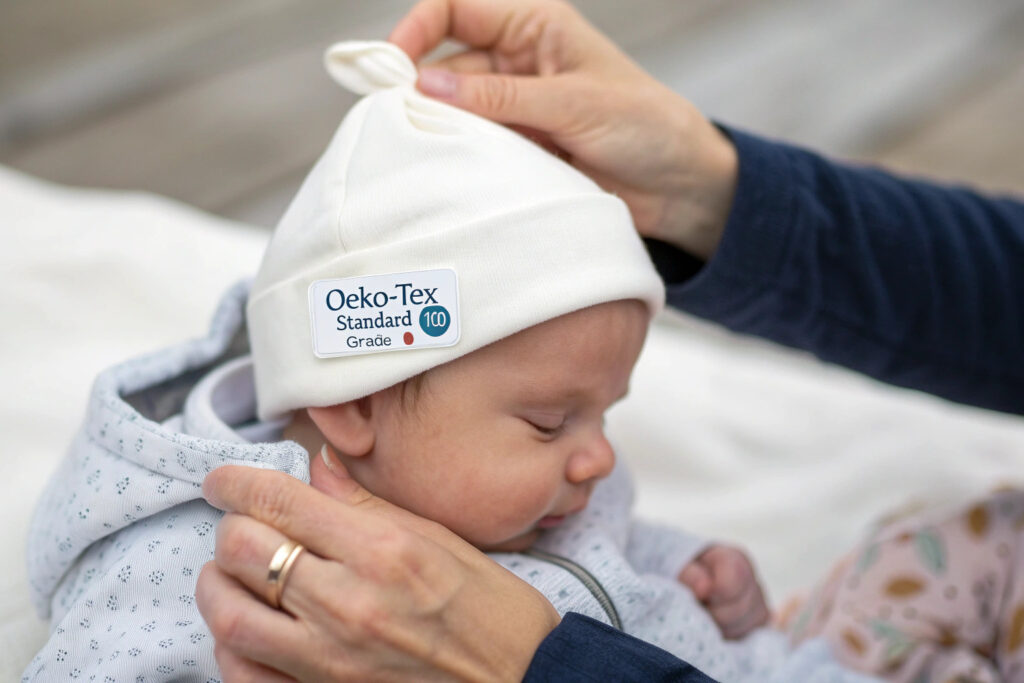
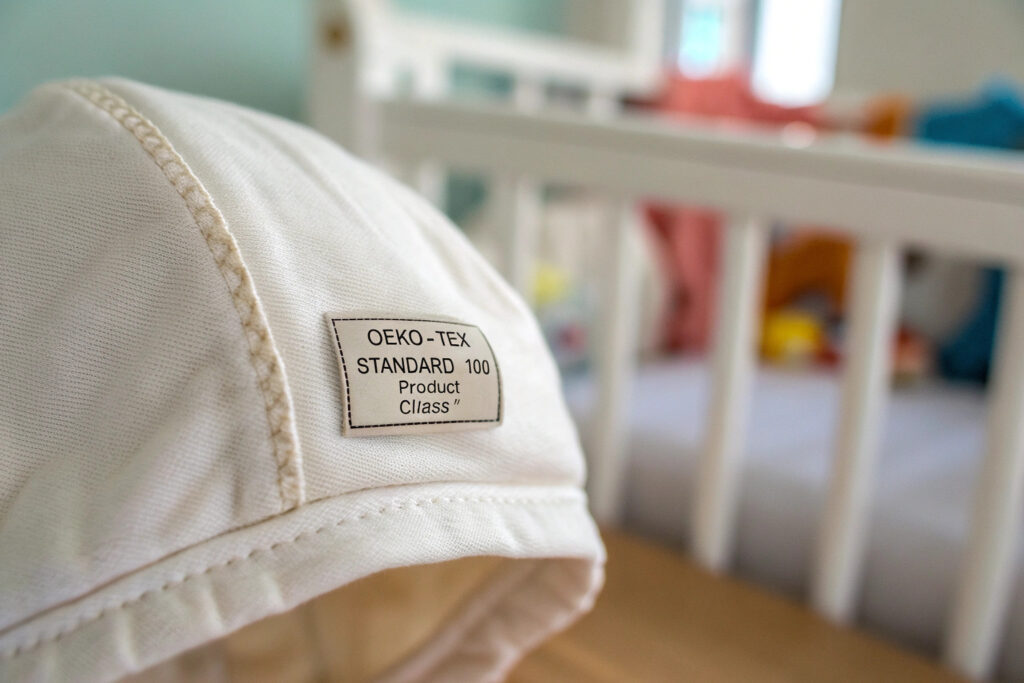
The third principle is layered information. Provide a short trust statement near the buy button. Offer an expandable section or a linked page with deeper detail for the research-oriented parent who wants to understand formaldehyde limits and saliva-resistance testing. Include a photo of the actual hangtag or sewn-in label on the hat. A photograph of the label on the physical product is far more credible than a digital badge added in Photoshop. It shows the certification is real and attached to the specific hat the parent is considering.

What Specific Phrases Resonate Most With Parents Researching Baby Hat Safety?
The language must be concrete, benefit-oriented, and free of jargon. Parents are not textile chemists. They are tired, busy, and protective. The phrases that resonate answer the specific fears they carry from reading parenting forums and social media threads about product safety.
"Safe for mouthing and chewing" is a powerful phrase because it addresses the behavior parents observe but rarely see acknowledged in product descriptions. Babies chew on hat brims and chin straps. Acknowledging this reality and certifying that the hat is safe for this specific use builds immediate trust.
"No hidden chemicals, just cotton and thread" appeals to the desire for simplicity and transparency. It implies that the brand has nothing to hide. The certification backs up the claim.
"Tested against a list of over 100 harmful substances" provides a concrete number that makes the safety claim tangible. It is not a vague promise. It is a specific, audited process.
"Meets the strictest OEKO-TEX standard reserved for baby clothing and crib bedding" places the hat in a category of products parents already associate with the highest safety requirements. It creates a halo effect. If the same standard applies to crib sheets and baby hats, then the baby hat is as safe as the crib sheet.
"Dermatologist-recommended standard for sensitive infant skin" connects the certification to medical authority. Parents trust dermatologists and pediatricians more than they trust brands. Associating the certification with medical expertise adds credibility.
How Should I Display the OEKO-TEX Label on My Hat's Hangtag and Packaging?
The hangtag is the first physical touchpoint in a retail or unboxing setting. It must communicate certification clearly without overwhelming the brand's own design. I recommend a dual-tag approach. The main brand tag carries the hat's branding, size, and style information. A secondary, smaller tag carries the OEKO-TEX certification information. This secondary tag should feature the official OEKO-TEX logo prominently, the certificate number, and a short explanatory sentence: "This product is OEKO-TEX Standard 100 Grade 1 certified, tested for harmful substances and safe for baby's sensitive skin."
The packaging interior can extend this story. A printed card inside the hat crown or tissue paper can feature a QR code linked to the brand's certification explanation page. This page can show the actual test report summary and the certificate verification link. A parent who scans the QR code and sees the certificate verified on the official OEKO-TEX website experiences a moment of deep trust. The brand did not just claim certification. The brand invited verification.
For online-only brands, the unboxing experience is the only physical touchpoint. The certification story should be part of that experience. A tissue paper wrap printed with the OEKO-TEX logo and a short message, a card with the certificate number and the label check URL, and a thank-you note that references the safety testing all contribute to a cohesive trust narrative. The parent opens the package, sees the safety evidence, and feels validated in their purchase decision before they even try the hat on their child.
Why Should I Highlight My Hat Factory's OEKO-100 Grade 1 Capability in B2B Wholesale Meetings?
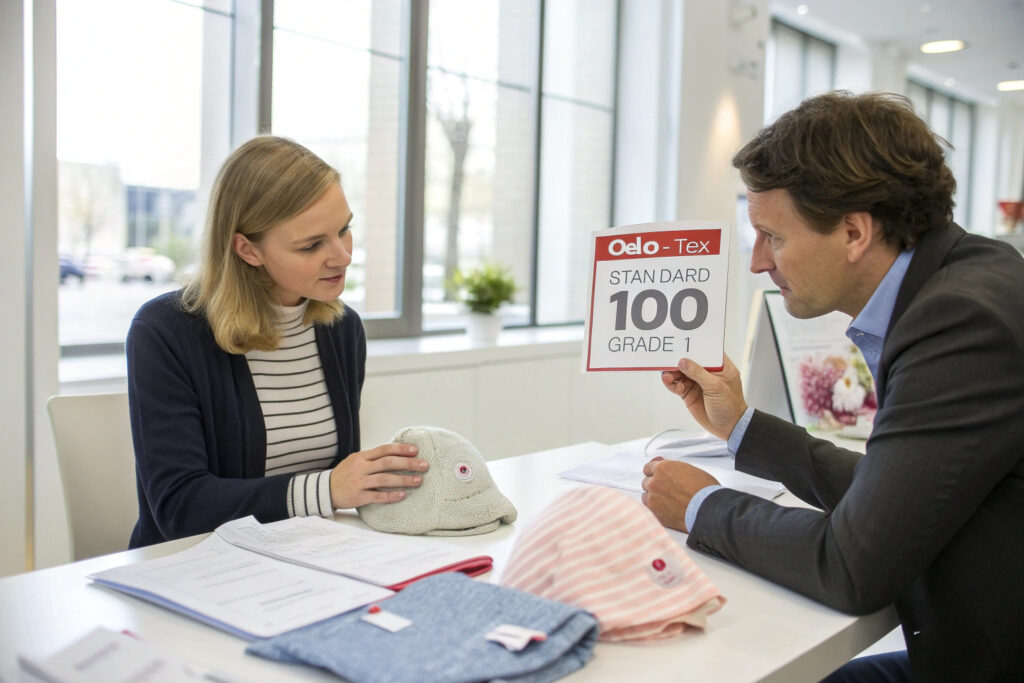
Wholesale buyers for children's boutiques, department stores, and specialty e-commerce platforms have a different decision framework than direct-to-consumer parents. They are gatekeepers. A buyer for a high-end children's store is personally responsible for the products that enter their curated environment. If a product is later found to contain a harmful substance, their professional reputation and their store's brand suffer. They need to justify their buying decisions to their managers and their customers.
Grade 1 certification is a buyer's defense. It provides documented, third-party evidence that the buyer conducted due diligence on product safety. In a wholesale meeting, the certification should be positioned not as a nice-to-have feature, but as a risk mitigation asset. The brand can say, "We manufacture at a facility that maintains active OEKO-TEX Standard 100 Grade 1 certification. This means every component in our baby hats is tested and certified. Your store is protected from the regulatory and reputational risk of a chemical safety incident."
The factory capability angle is particularly powerful. Many brands source baby hats from general suppliers who do not specialize in infant products and do not maintain the Grade 1 certification. A brand that can demonstrate a direct relationship with a factory holding current Grade 1 certification has a competitive moat. The buyer cannot easily replicate the product by going to a cheaper, non-certified supplier. The factory certification becomes a barrier to commoditization. The brand is selling a product backed by a verified safe supply chain, not just a design.
Having the physical certificate available in the meeting, either printed or on a tablet, adds concrete weight to the conversation. The buyer can see the certificate, note the validity dates, and verify the factory name. This transparency separates the serious supplier from the pretender.
How Does a Certified Factory Give My Baby Hat Brand a Competitive Advantage Over Uncertified Importers?
The competitive advantage operates on multiple levels. The most immediate is retail access. Major children's retailers, including the large European chains and the premium U.S. boutiques, increasingly require OEKO-TEX certification as a vendor qualification criterion. Without it, a brand cannot even submit products for consideration. The certification opens doors that remain closed to uncertified competitors.
The second advantage is speed to market. A brand working with an already-certified factory does not need to go through the initial certification process, which can take months and cost thousands of dollars in testing fees. The factory's certification covers the production environment. New products developed within the certified scope can leverage the existing certificate, often needing only a transaction certificate rather than a full new audit. This allows certified brands to bring new designs to market faster than competitors who must certify from scratch.
The third advantage is pricing power. Parents of infants and toddlers are demonstrably willing to pay a premium for certified safe products. The baby care market analysis consistently shows that safety certifications rank among the top purchase drivers, alongside material quality and brand reputation. A hat that costs $14.99 at retail without certification can often command $19.99 or $22.99 with the Grade 1 certification clearly communicated. The certification provides a rational justification for the price premium. The parent is not paying more for a logo. They are paying more for documented, laboratory-verified safety for their child.
What Documentation Should I Request From My Factory to Show Buyers During Line Reviews?
Line reviews are the critical sales moments where buyers commit to seasonal programs. The documentation you present must be credible, current, and specific to the products you are pitching. I recommend preparing a compliance packet for each meeting.
The core document is a copy of the factory's current OEKO-TEX Standard 100 certificate. This certificate lists the factory name, address, certificate number, certified product descriptions, and validity dates. Ensure the certificate is unexpired and that the product descriptions cover the specific hat types you are presenting. A certificate for woven cotton fabric does not cover knit hats or hats with plastic components unless those are specifically listed.
The second document is a transaction certificate or a conformity letter that links your specific purchase order or product style to the factory's base certificate. This proves that the specific hats in your line review were produced under the certified system.
The third document is a summary of the restricted substance testing scope. A one-page document listing the substance categories tested, including formaldehyde, heavy metals, pesticides, phthalates, and allergenic dyes, with a simple pass status for each. This document translates the dense certificate into a buyer-friendly overview.
The fourth document is the factory audit report if available. Some factories undergo additional social compliance or quality management audits. Including these demonstrates a broader commitment to responsible manufacturing, which reinforces the safety message.
Present these documents organized in a branded folder, physical or digital. The buyer can take the folder back to their compliance team for review. A brand that walks into a line review with a complete, organized compliance packet signals professionalism and makes the buyer's job easier. That ease translates into orders.
How Do I Communicate the Value of Grade 1 Certification on Instagram and TikTok Without Sounding Technical?
Social media is where the safety conversation happens informally among parents. Facebook mom groups, Instagram parenting influencers, and TikTok parenting communities are the modern equivalents of the playground bench. The communication style on these platforms must be radically different from the product page. Technical language, even the phrase "OEKO-TEX Standard 100 Grade 1," can sound corporate and alienating in a social feed. The message must be translated into the native language of the platform.
The first rule is to lead with the emotional benefit, not the technical specification. A TikTok video that starts with "OEKO-TEX Standard 100 is a globally recognized textile certification..." will lose viewers in the first second. A video that starts with "I was so scared to put a hat on my newborn because I didn't know what chemicals were in the fabric. Then I found out about this green label..." hooks the viewer with a shared emotional experience. The certification is introduced as the solution to a fear, not as a feature.
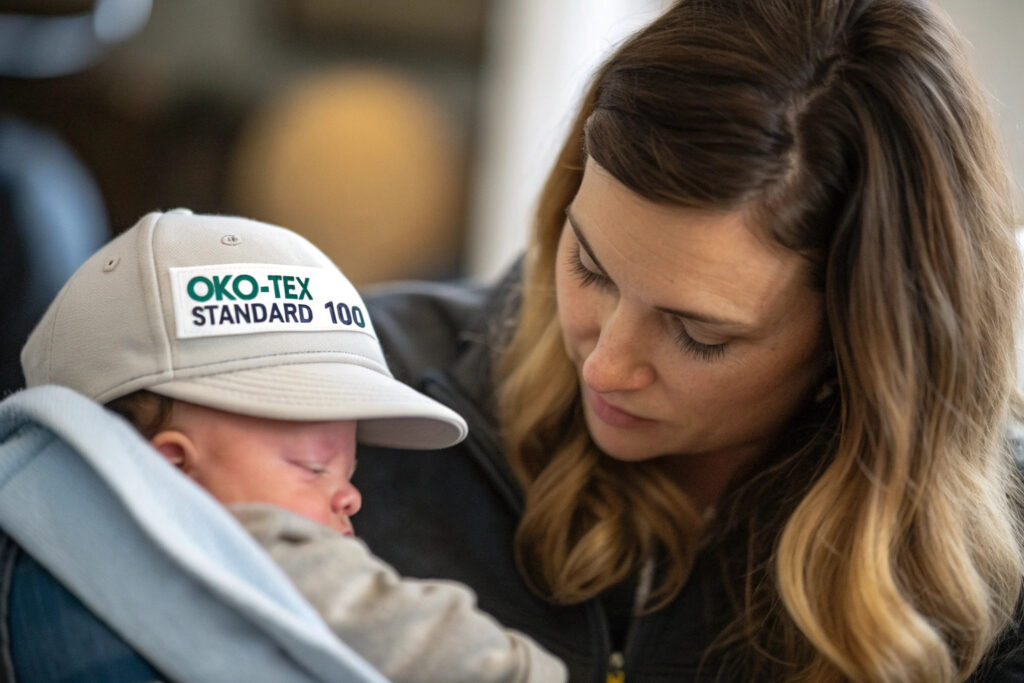
The second rule is to use visual demonstration. Show the hangtag on the actual hat. Show the inside seam with the certification label. Film yourself entering the certificate number on the OEKO-TEX label check website and showing the verification result. This visual proof is far more convincing than a text overlay. It demonstrates that the certification is real and verifiable, not a marketing claim.
The third rule is to use simple, memorable analogies. "This hat is tested to the same standard as crib sheets and baby pajamas" is an analogy that parents understand instantly. "We tested for over 100 bad chemicals and found none" is a simple, declarative statement that communicates the outcome without jargon. "It's safe if your baby chews on the brim, and trust me, they will" is a relatable, slightly humorous acknowledgment of real baby behavior.
What Short-Form Video Hooks Work Best for Explaining Baby Product Safety Certifications?
The hook is the first three seconds that determines whether the viewer scrolls past or stays to watch. Effective hooks for baby product safety content leverage parental anxiety, curiosity, or relatability.
"The one thing I check before buying any hat for my baby..." creates a curiosity gap. The viewer wants to know the one thing, stays to watch, and learns about the certification.
"I tested my baby's hat for chemicals, and here is what the lab found..." implies a personal investigation and a reveal. The viewer expects a story, not a lecture.
"Stop buying baby hats on Amazon until you check for this label..." is a direct, slightly confrontational hook that implies inside knowledge. The viewer feels they are about to learn something most parents do not know.
"Three baby hat brands I would never buy, and one I trust completely..." uses a listicle and comparison format that performs well on both platforms.
"Your baby is going to chew on their hat brim. Make sure it is safe when they do." addresses a specific behavior with a protective, caring tone.
The hook must deliver on its promise in the video content. If the video does not actually show the certification or explain what the label means, the viewer feels clickbaited and distrusts the brand. The video must provide genuine educational value in exchange for the viewer's attention.
How Can I Turn Customer Questions About Hat Safety Into Engaging Content?
Customer questions are a content goldmine. A question asked by one customer represents the unasked question of a hundred others. When a parent emails or DMs asking, "Is this hat safe for my baby who has eczema?" or "Can my baby sleep in this hat?" or "What does the green label mean?", the answer should become public content.
Film a series of short videos answering one customer question each. Start the video by displaying the question as a text overlay. "A customer asked us: Is the brim safe if my baby chews on it?" Then answer the question directly, showing the hat and the certification evidence. Thank the customer by first name if they consent. This demonstrates that the brand listens and responds to real parents.
Use Instagram Stories to run informal polls and Q&A sessions about product safety. "Do you check for safety certifications when buying baby clothes? Yes or No?" The poll engages the audience and provides market research. Follow up with a Story explaining the OEKO-TEX certification for those who answered No, and a thank-you for those who answered Yes.
Save these Q&A videos to a dedicated "Product Safety" highlight on Instagram. A parent visiting the brand's profile can immediately see a collection of safety-related content. This curated highlight functions as an ongoing trust-building resource. It demonstrates that safety is a permanent priority for the brand, not a temporary marketing campaign.
Conclusion
Pitching OEKO-TEX Standard 100 Grade 1 certification to safety-conscious parents is fundamentally an exercise in translation. The certification itself is a dense, technical document built on laboratory science and chemical nomenclature. The parent does not need to understand the science. The parent needs to feel the safety. The brand's job is to build a bridge between the laboratory result and the parent's emotional need for reassurance.
The pitch appears in different forms at different touchpoints. On the product page, it is a clear trust statement with a recognizable badge and a specific, jargon-free explanation. On the hangtag, it is a physical label with a verifiable certificate number. In a wholesale meeting, it is a documented risk mitigation asset that protects the retailer. On social media, it is a relatable, visual story that leads with the parent's fear and resolves it with the certification evidence.
At every touchpoint, the message must be consistent. This hat is certified to the strictest standard for baby products. Every component has been tested. The certification is independently verifiable. The hat is safe for newborn skin, safe for mouthing, and safe for the peace of mind that parents deserve.
At Global-Caps, our factory maintains the OEKO-TEX Standard 100 Grade 1 certification because we understand the gravity of manufacturing products for the most vulnerable consumers. We know that a baby hat is not just a fashion accessory. It is a product that sits directly against a newborn's developing skin for hours at a time. Our quality control team verifies every component batch against the certified standard. Our documentation is organized and ready for brands to present to their retail buyers and their end customers.
If you are a children's brand looking to launch or expand a certified baby hat line, we can support you with the manufacturing capability and the compliance documentation you need to tell a credible safety story. Contact our Business Director Elaine. She can provide you with our current certification documentation, discuss component-level certification for your specific designs, and help you build a product that parents will trust and buy with confidence. Reach her at elaine@fumaoclothing.com. Let's make hats that keep babies safe from the sun, and safe from everything else too.