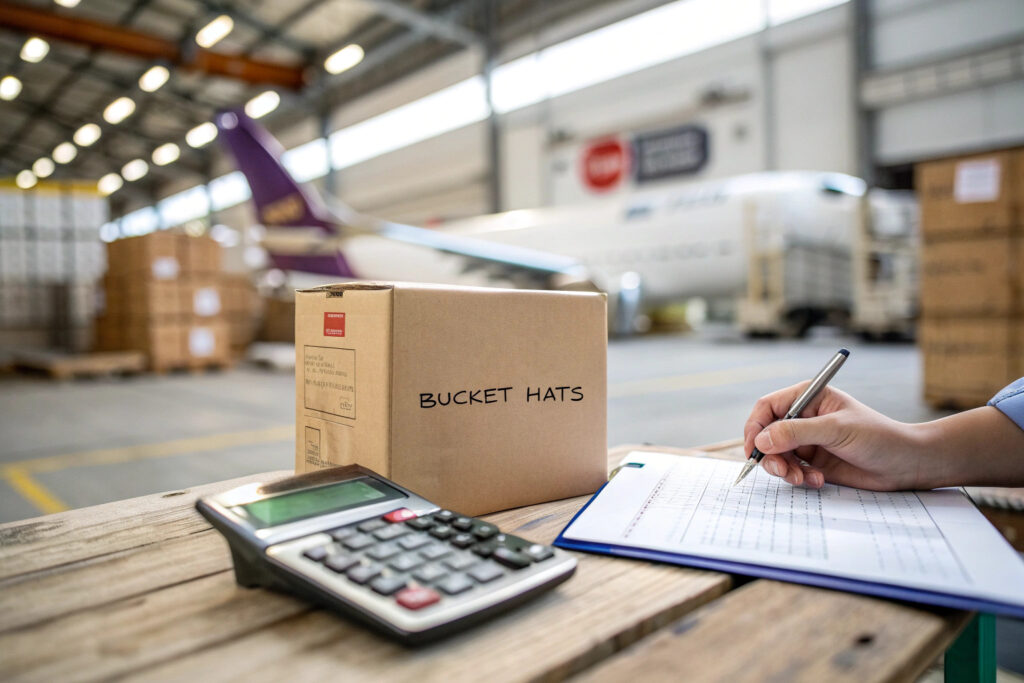
You negotiate a great unit price. The factory says "We handle shipping." You pay the invoice. Six weeks later, UPS holds your box hostage. They demand $800 in duties and customs fees before delivery. Your budget is blown. You scramble to pay it. The customer launch is delayed. I have rescued too many new brand owners from this exact nightmare. The "DDP" promise was a lie. It was actually DAP.
Real DDP (Delivered Duty Paid) shipping for a bulk order of bucket hats to the USA currently ranges from $4.50 to $7.00 per kilogram for air express, or $3,500 to $5,800 for a 20-foot sea freight container door-to-door. The total cost depends on the commercial invoice value and the tariff rate for the specific material. A pure cotton bucket hat carries a different duty rate than a nylon ripstop one. The freight consolidator adds a customs bond fee, a disbursement fee, and a brokerage handling charge. When I quote DDP, I include every single one of these invisible fingers that reach into your pocket.
You deserve a final price that holds. No hidden fees. No surprise calls from a warehouse dock. I want to show you exactly how DDP works for bulk bucket hat shipments. The price is broken down into components you can check and verify.
What Is the Difference Between DDP, DAP, and FOB for Hat Imports?
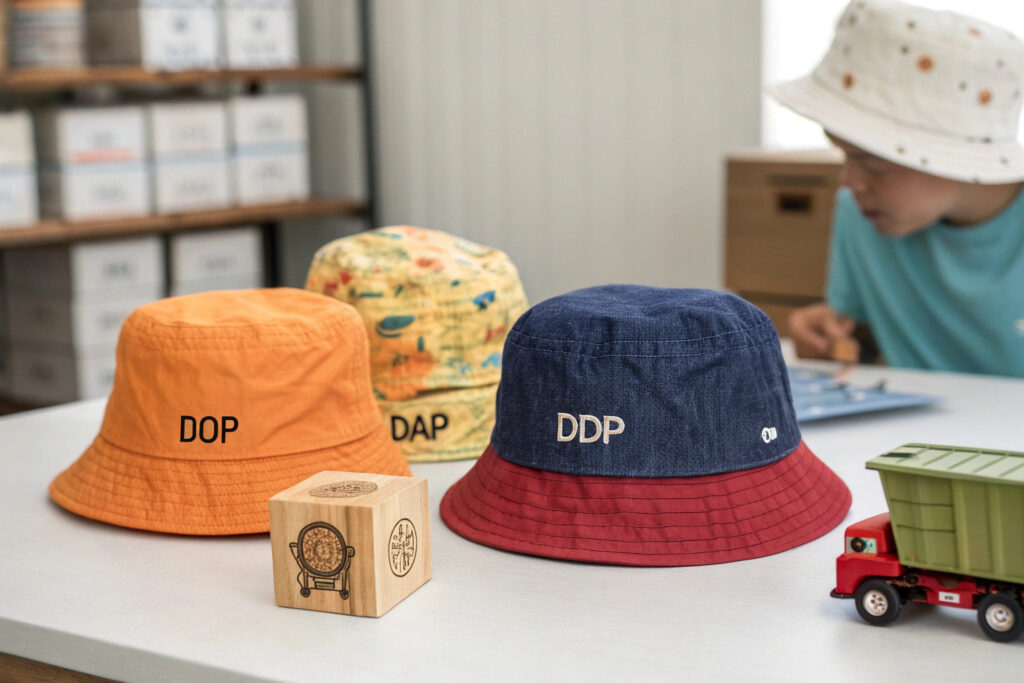
The wrong shipping term is a financial trap. You think you bought peace of mind. You bought a headache instead. FOB means the factory abandons the goods at the Shanghai port. The rest is your problem. DAP means they deliver to your door, but you pay the tax. DDP means they pay everything. When a supplier confuses these terms, you pay twice.
DDP puts all risk on the seller until the box touches your warehouse floor. The seller pays the ocean freight, the customs duty, the brokerage fee, the port charges, and the last-mile trucking. DAP splits the risk. The seller pays the freight to the door, but you, the buyer, must clear the customs and pay the duties. FOB splits it at the origin port. We load the bucket hats onto the vessel. You take over from there.
Most "surprise cost" emails I see happen because a trader quoted FOB but the buyer assumed it was DDP. You must look at the Incoterm on the Proforma Invoice.
Let's really get into the moment of truth. The transfer of risk is not abstract. It happens at a specific GPS coordinate. Your insurance coverage depends on this point.
When Does the Risk Transfer From Supplier to Buyer Under DDP?
DDP sounds like the supplier does everything. But the risk of loss or damage still has a precise transfer moment. If you don't know it, you might be uninsured when a forklift drops the pallet.
Under DDP, the risk transfers when the goods are made available to the buyer at the named destination place, typically your warehouse address. The truck arrives. The driver opens the door. That moment, the risk jumps to you. The seller is responsible for the entire carriage. If the truck crashes on the highway in Kansas, the seller bears that loss. They must file the claim with their insurer. This is different from FOB. Under FOB, the risk jumps to you the second the container hits the ship's rail in China. If the ship sinks, you fight the insurance company.
I ask my clients to check the "Place of Delivery" on the DDP contract. Is it your curb or your dock? If it's a residential curb, the driver might refuse to lower the pallet. We specify "tailgate delivery" in the contract. For bucket hats packed in heavy cartons, this matters. The other risk point is Customs clearance. Under DDP, the seller acts as the Importer of Record. That is a huge deal. The seller assumes the legal liability for the import. They must have a US-based entity or a licensed customs broker acting for them. If the broker files the ISF wrong, the fine is on the seller.
How Do DDP Terms Affect Your Cash Flow and Import Duty Recovery?
DDP simplifies the invoice. One price. But it hides the duty amount. If you later want to do a duty drawback—claiming a refund for re-exported goods—you need the exact duty sum from the entry summary. DDP often obscures this.
When I ship DDP, I provide a separate customs entry breakdown to the client. It shows the assessed value, the HTS code, and the paid duty. Without this, you cannot file a drawback claim. If you plan to store the bucket hats in a Foreign Trade Zone or bonded warehouse, DDP is messy. You already paid the duty. You lose the tax deferral benefit.
For high-volume importers, I often recommend switching to DAP after the first order. You establish your own continuous Customs bond. You pay the duty directly to the government. You get the cash flow float between the duty payment and the retail sale. With DDP, the supplier finances the duty. They will charge you a markup on that financing cost. It's usually a hidden percentage of about 2-3 percent. If you have strong credit, you beat that rate by paying it yourself. I tell my project managers to price DDP shipping clearly as a separate line item. Do not let it be a black box.
What US Customs Duties Apply to Imported Cotton Bucket Hats?
You assume the duty is zero. The supplier said "no tax." The shipment arrives. It's flagged. You get a bill for 20% duty. A bucket hat is not just a hat. Under Customs law, the material, the brim length, and even the gender labeling trigger different tax rates. The revenue agency does not care about your margin.
The general duty rate for knitted or crocheted cotton bucket hats under HTS 6505.00.25 ranges from free to 7.5% ad valorem depending on trade agreements. Most woven cotton bucket hats fall under 6505.00.30 or 6505.00.40 with similar rates. If the cap has a nylon lining or a polyester shell, the classification shifts. A reversible bucket hat creates a classification argument. The product must be classified by its "essential character."
Don't let a supplier guess your code. A wrong HTS code is a time bomb. You underpay. You get audited. You pay penalties and interest.
You have to be a bit of a lawyer here. The tariff schedule is a thick book. But for bucket hats, we can focus on two main branches of the tree.
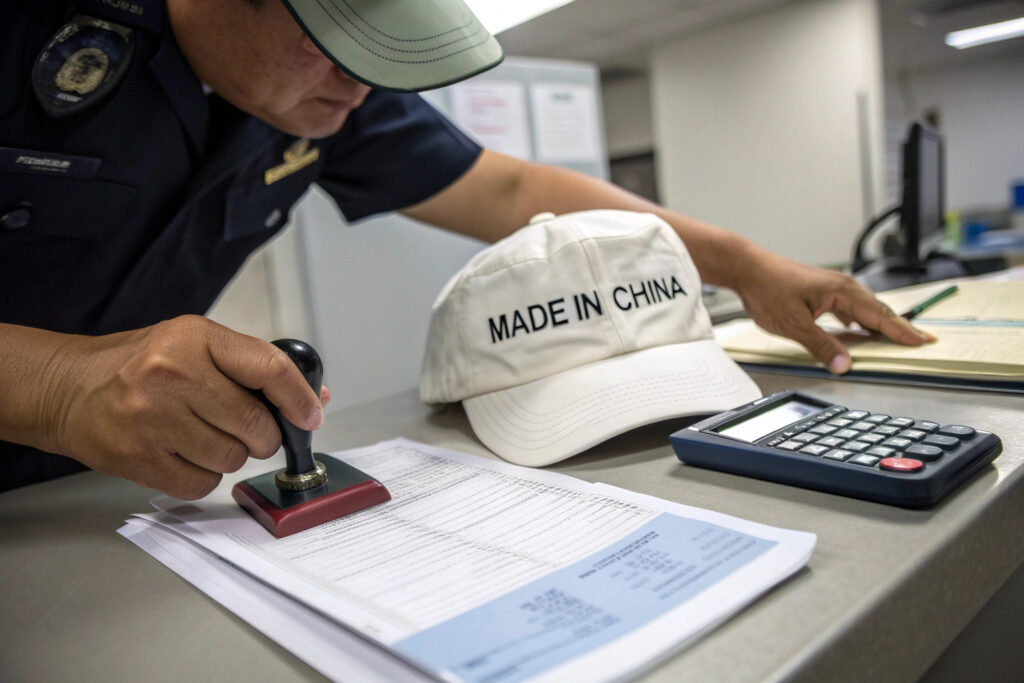
What Is the Correct HTS Code for a 100% Cotton Twill Reversible Bucket Hat?
A reversible hat has two visible sides. One side is printed cotton. The other is solid cotton. Customs sees two potential classifications. You have to pick the primary fabric or treat it as a composite good.
I always classify reversible cotton bucket hats under HTS 6505.00.40 if the primary marketing feature is the printed side. The "essential character" rule applies. If both sides are 100% cotton, the duty rate is generally 6.8% to 7%. You need to check the General Rate of Duty in column 1. For imports from China, we check column 2 unless there is a Section 301 exclusion. Currently, hats from China under these HTS codes do not carry the massive Section 301 tariffs that electronics face. This is a big relief for headwear importers.
Your invoice must describe both sides. "100% Cotton Woven Bucket Hat, Reversible." The CBP officer will look at the accompanying literature. If your packing slip says "Solid Hat," they might miss the reversible nature and over-classify it. We use a customs broker that specializes in textiles. For a recent shipment, we submitted a pre-entry classification ruling request. It took 30 days. It binds the government to that rate. It saved the client the anxiety of a random port inspection.
How Do Drawstring Closures and Chin Cords Affect Tariff Classification?
A simple drawstring changes the game. A bucket hat with a functional chin cord or toggle might be reclassified as "headgear with adjustable features." This can shift the duty rate if the cord is made of a synthetic fiber.
Customs looks at the components. If the hat is cotton but the cord is nylon, the cord might be considered a "trimmings" item. Generally, if the cord is ornamental, it doesn't change the classification. If it's a safety feature, it can. I always test the cord. If we advertise it as a "windproof chin strap," we are marketing a functional feature. The cotton hat with a plastic cord could fall under a basket provision.
I recommend listing the cord separately on the commercial invoice as a trimming with a zero-value allocation. "100% Cotton Bucket Hat with Polyester Trimming." This keeps the essential character with the cotton. Also, check the lead content on the cord toggle. If the hat is for kids and has a chin cord, it must comply with the drawstring safety standard ASTM F1816. A functional cord on a kids' bucket hat is a strangulation hazard. We often use a breakaway clasp that pops open under 5 pounds of pressure. This avoids a recall and keeps the classification clean.
Why Is Air Freight DDP Faster But Riskier for Bucket Hats?
You need 500 bucket hats for a festival next week. Sea freight is too slow. You choose air express DDP. It lands in 3 days. But the customs broker flags the shipment. The invoice value looks low. They demand proof of payment. Your caps sit in a DHL cage for 5 days. You miss the festival. Speed is an illusion if the paperwork is weak.
Air freight DDP for bucket hats costs about $5 to $7 per kilo. It is the fastest way to restock. But the risk is the strict scrutiny of air cargo manifests. Air customs look for undervaluation and counterfeit brand marks. A bucket hat is bulky. The volumetric weight often kills you. A 500-piece shipment can balloon to 80 kilos volumetric.
You have to balance the urgency against the compliance risk. I never rush a first order through air freight DDP without sending the documentation to the broker for a pre-check.
Let's dig into the two silent killers of air freight profits. The first is the way you pack the hat. The second is the way you declare the value.
How Does Volumetric Weight Calculation Affect Hat Shipping Costs?
Bucket hats are puffy. You cannot fold a structured bucket hat flat without damaging the brim. It takes up more space than its actual weight. Air freight charges for the space, not the scale weight.
The formula is Length x Width x Height (cm) divided by 5,000. That gives you the chargeable weight in kilos. A carton of 50 unstructured floppy bucket hats weighs 6 kilos actual. But the box is large to avoid crushing the brims. It measures 60x40x40 cm. The volumetric weight is (60x40x40)/5000 = 19.2 kilos. You pay for 19.2 kilos, not 6. That triples the cost.
I have a solution. We use a vacuum press for soft unstructured hats. We apply gentle pressure to the crown before packing. It reduces the height of the carton by 30 percent. We also ship the hats in a "nested" position. One hat sits inside the cavity of the next. For a 500-hat air order, reducing the carton height by 10cm saves $200. We also use a smaller export carton specifically for air freight. It is double-wall for crush resistance but sized exactly to the hat. You should ask your supplier for the volumetric weight estimate before they print the label. Don't accept a surprise DHL bill for dimensional weight.
What Happens When US Customs Flags a DDP Air Shipment for Undervaluation?
The supplier wants to save you duty. They write the invoice for $0.50 per hat. You think they are helping. Customs knows the average value of a cotton hat. They flag it. They seize the goods.
Under a DDP air shipment, the seller is the Importer of Record. If they declare a false value, they commit fraud. The cargo is detained. The buyer is left without inventory. The brand owner's name is linked to a seized shipment. Your future imports get stopped for intensive exams.
I always insist on declaring the true transaction value. The invoice must match the wire transfer. If the bucket hat costs $2.80 FOB, the invoice says $2.80. Yes, you pay a bit more duty. But duty is a business expense. A seizure is a business termination.
I also provide a manufacturing cost breakdown if requested. If Customs doubts the price, we show the fabric cost, the labor, and the accessories. This legitimate paperwork satisfies the Import Specialist. We also use the CBP Form 5106 to ensure our broker is on file. Air freight is too fast for compliance errors. Once the plane lands, the clock starts. You need immediate clearance. Lying about the value guarantees a delay.
What Are the Best Bulk Packing Methods for Long-Haul Bucket Hat Shipments?
The container door opens in Miami. The cartons are wet. The bucket hats are moldy. The sea salt air and condensation ruined 2,000 units. Your insurance claim is denied because the cartons were single-wall and not sealed. You lose the season. This is a packing problem, not a hat problem.
The best bulk packing for long-haul bucket hat shipments uses double-wall corrugated cartons, individual polybags for moisture protection, and desiccant sachets inside every box. The cartons are strapped onto fumigated wooden pallets with corner protectors. We stuff the hat crowns with crumpled kraft paper to keep the shape during the 30-day ocean journey. The stacking strength of the carton must hold 200 kg of top pressure.
The cheapest box is the most expensive mistake you will ever make. I learned this the hard way.
You cannot just drop hats in a box and tape it shut. The supply chain is violent. The box gets thrown, stacked, and rained on. Let's look at the specific materials.
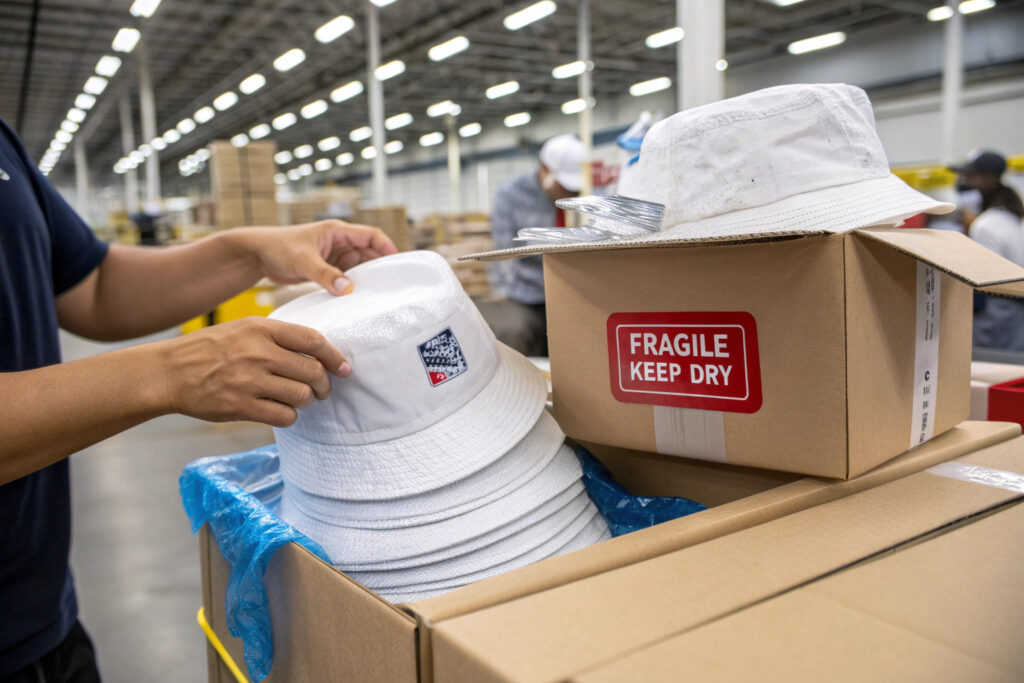
How Many Bucket Hats Fit in a Standard Export Carton Without Damage?
The carton dimensions must match the hat diameter. A standard adult bucket hat has a brim diameter of about 18 inches. You can fold the brim down, but not crease it. A standard export carton is 60x40x40 cm.
If we alternate the direction of the hats—crown facing up, then crown facing down—we fit 50 to 72 bucket hats per carton. We do not exceed 12 kilos of weight per carton. This is for the safety of the warehouse workers. We use a standard packing density chart. An order of 5,000 bucket hats requires about 80 cartons. These 80 cartons stack 10 high on a pallet.
We use a slip sheet between every 12 hats. The slip sheet prevents color transfer from the dark hat to the light hat inside the next row. We also insert a corrugated divider for premium bucket hats with stiff brims. The divider creates a separate cell for each hat. It adds 20 cents to the unit cost. But it eliminates returns for crushed brims. For cotton bucket hats, we roll the soft crown gently to save space, but we never fold the brim. A folded brim memory is permanent.
Why Are Desiccant Packs and Moisture Barriers Critical for Ocean Freight?
Ocean freight is a steam bath. A container travels through equatorial heat. The day is hot. The night is cold. The air inside the container sweats. This is "container rain." It drips from the ceiling onto your cartons.
The cartons get wet. The mold spores grow. The organic cotton bucket hat is a food source for mold. We add 50 grams of desiccant silica gel inside every carton. We also line the carton with a PE moisture barrier liner. This is a big plastic envelope inside the box. It seals the hats from the ambient moisture.
We also treat the wooden pallets. The ISPM 15 standard requires the wood to be heat treated or fumigated. We stamp the pallet with the ISPM 15 mark. This stops the shipment from being rejected at the destination port. We also use a container desiccant pole for a 40-foot container. It is a long strip that hangs from the roof. It absorbs liters of water during the voyage. It costs $80. It saves $8,000 in mold claims. I also specify "Below Deck" stowage on the bill of lading if possible. This avoids the harsh direct sun on the top of the deck stack. Packing for the sea is a science. It is not just putting things in boxes.
Conclusion
DDP shipping for bucket hats is a powerful tool. It gives you one invoice and one delivery. But you must understand the price components. The cost runs from $4.50 per kilo for air up to $5,800 for a full container by sea. The difference between DDP, DAP, and FOB is the risk transfer point. DDP makes the seller legally responsible for the duties and trucking. Under DDP, watch out for the volumetric weight trick on air freight. Confirm the box dimensions before you pay.
You must also master the tariff codes. A 100% cotton bucket hat fits under a specific HTS heading. A reversible hat or a hat with a chin cord changes the rules. The customs value must be true. Never let a supplier undervalue the goods. The seizure risk is worse than the tax bill. Once the hats arrive, the packing quality shows. Double-wall cartons, silica gel, and slip sheets prevent the mold and crush damage that destroy your margin.
This is a lot to manage. You shouldn't have to coordinate the trucker, the broker, the fumigator, and the vacuum packer all by yourself. At Global-Caps, we bundle all of this into our DDP service. We own the logistics chain from our clean factory floor in Zhejiang to your front door in the USA.
If you want a genuine DDP quote for your next bucket hat collection, without hidden fees and with full transparency on the duty breakdown, let's talk. Contact our Business Director Elaine. She can crunch the numbers for your specific design and your nearest port. Email Elaine at elaine@fumaoclothing.com. We will get your hats there safely, dry, and on time.