You have a best-selling bucket hat style. The cotton twill version sells out every summer. Buoyed by this success, you decide to expand the range. You source a beautiful lightweight linen for a beach version and a rugged heavyweight canvas for an outdoor workwear version. The sample photos look great. You order bulk. The lightweight linen version arrives, and the brim has no structure at all. It flops down around the face like a sad flower petal. The heavyweight canvas version arrives, and the brim sticks out horizontally like a shelf. It looks nothing like the relaxed, casual bucket hat silhouette your customers expect. You now have two inventory problems, and both trace back to one variable you did not fully consider: fabric weight.
Fabric weight is the single most decisive factor in how a bucket hat drapes and holds its silhouette. It is more influential than the sewing construction, more influential than the brim stitching, and in many ways more influential than the design pattern itself. I run Global-Caps, and I have engineered bucket hats in fabrics ranging from 100 grams per square meter ultralight nylon to 400 GSM heavyweight waxed canvas. Each weight class creates a completely different hat from the same pattern. In this article, I will walk you through the physics of how fabric weight controls drape and silhouette, how to match weight to the intended look, and how to specify weight in your tech pack so your bulk production matches your design vision.
What Is the Relationship Between Fabric Weight and Drape Mechanics?
Drape is the way fabric hangs under its own weight. It is a mechanical property governed by the fabric's bending stiffness and its areal density, which is its weight per unit area, measured in GSM or ounces per square yard. A fabric with low bending stiffness and low weight drapes easily. It conforms to gravity with soft, fluid folds. A fabric with high bending stiffness and high weight resists gravity. It stands away from the body and holds its own shape. The drape of a bucket hat brim is essentially a cantilever beam problem. The brim extends outward from the crown seam. The fabric's own weight pulls it downward. The fabric's internal stiffness resists this pull. The balance between these two forces determines the brim angle.
Lightweight fabrics, typically under 150 GSM, have low internal stiffness. The gravitational pull dominates. The brim droops downward, often at a steep angle close to vertical. This can create a soft, romantic, bohemian silhouette, like a floppy beach hat. But it can also create a functional problem: the brim falls into the wearer's eyes. Medium-weight fabrics, between 150 and 250 GSM, have a balanced relationship between stiffness and weight. The brim holds a gentle angle, typically between 30 and 45 degrees from horizontal. This is the classic bucket hat silhouette, a relaxed but defined brim that frames the face without obscuring vision. Heavyweight fabrics, above 250 GSM, have high internal stiffness. The stiffness dominates over gravity. The brim projects outward nearly horizontally. This creates a bold, architectural silhouette, like a structured utility hat, but it can feel stiff and formal rather than casual.
The fabric's bending stiffness is not solely determined by weight. The fiber type, the yarn structure, and the weave density all contribute. However, weight is a reliable proxy because heavier fabrics are generally thicker, and thickness is a cubic multiplier in the bending stiffness equation. A fabric that is twice as thick is roughly eight times as stiff in bending, all else being equal. This is why a small increase in fabric weight can produce a disproportionately large change in brim behavior. Moving from an 8-ounce cotton twill to a 10-ounce cotton twill may not sound significant, but the brim angle change can be visibly noticeable.
How Does Fabric Weight Interact With the Brim's Curved Geometry?
A bucket hat brim is not a flat piece of fabric. It is a curved, conical section. The curve introduces a geometric stiffness that interacts with the fabric weight. A flat circle of lightweight fabric will droop uniformly. The same fabric cut into a curved bucket hat brim and sewn to a crown will behave differently because the inner circumference is constrained by the crown seam. This constraint creates a hoop tension that helps support the brim.
In lightweight fabrics, this geometric support is often insufficient. The brim collapses because the hoop tension is too weak to counteract the gravitational pull on the outer edge. The brim develops a wavy, uneven droop rather than a smooth angle. In medium-weight fabrics, the geometric stiffness and the material stiffness work together. The brim holds a smooth, even curve because the fabric is stiff enough to distribute the hoop tension evenly around the circumference. In heavyweight fabrics, the geometric stiffness is overpowered by the material's own rigidity. The brim does not conform to the intended curve. It wants to return to its flat, pre-sewn shape. This can cause the brim to pucker at the seam or to develop a faceted, polygonal appearance rather than a smooth circle. Understanding this interaction is essential for matching the fabric weight to the pattern design.
Why Does the Same Pattern Produce Different Silhouettes in Different Weights?
A sewing pattern is a two-dimensional template for a three-dimensional shape. It is engineered for a specific fabric thickness and drape. When you cut the same pattern from a different fabric weight, the three-dimensional outcome changes because the fabric takes up space differently at the seams and bends differently between the seams. The seam allowance on a heavyweight fabric consumes more of the pattern's width because the thicker fabric has a larger bend radius at the fold. The finished brim is slightly narrower than designed.
More significantly, the pattern's brim angle, the angle at which the brim pattern piece flares outward from the crown, is designed with a specific drape assumption. A pattern designed for a medium-weight twill assumes that the brim will droop by a certain number of degrees under its own weight. If you use a lightweight fabric, the droop will be greater, and the effective brim angle, the angle the consumer sees, will be steeper. If you use a heavyweight fabric, the droop will be less, and the effective brim angle will be shallower. The silhouette changes because the fabric is not cooperating with the pattern's assumptions. This is why a professional development process tests each fabric weight with a physical sew-out sample and adjusts the pattern as needed.
How Does Fabric Weight Determine the Functional Performance of a Bucket Hat?
A bucket hat is not just a visual object. It is a functional piece of headwear. It must stay on the head in wind, provide shade, pack into a bag, and survive washing. The fabric weight directly determines how the hat performs on all these functional dimensions. A beautiful silhouette that collapses in a light breeze is a design failure.
Wind resistance is a critical functional requirement for outdoor bucket hats. A lightweight brim, under 150 GSM, acts like a sail. A gust of wind catches the underside of the brim and flips it upward. The hat becomes a wind sock. This is not only annoying but exposes the face to the sun, defeating the hat's purpose. A medium-weight brim, 180 to 220 GSM, has enough mass and stiffness to resist moderate breezes. The brim may flutter at the edge but will not flip entirely. A heavyweight brim, over 300 GSM, is essentially windproof. It stays put in strong gusts, but the trade-off is that the hat is heavy on the head and can feel tiring to wear for long periods. The functional sweet spot for a general-purpose outdoor bucket hat is typically a tightly woven cotton or poly-cotton twill in the 180 to 220 GSM range.
Packability is another functional dimension. A lightweight nylon or polyester bucket hat can be crushed into a pocket, and it will spring back with minimal creasing. This is ideal for travel and festival hats. A heavyweight canvas hat cannot be truly crushed. It will develop permanent crease lines if folded. It requires a dedicated packing space. The consumer's use case determines the appropriate weight. A hat marketed as "packable" must use a fabric under 150 GSM with natural resilience, typically a synthetic or a synthetic-rich blend. A hat marketed as "rugged" or "workwear" can use a heavyweight fabric because packability is not a selling point.

How Does Fabric Weight Interact With Sun Protection and Shade Coverage?
The primary function of a bucket hat is to shade the face and neck from the sun. The amount of shade provided depends on the brim width and the brim angle. Fabric weight indirectly affects shade by controlling the brim angle. A lightweight fabric that droops steeply provides excellent shade to the sides of the face but reduces the forward projection of the brim. The shade over the forehead and eyes is diminished because the brim is hanging down, not projecting out.
A medium-weight fabric that holds a 45-degree angle provides a balanced shade profile. The brim projects forward enough to shade the eyes while angling down enough to shade the ears and the sides of the neck. A heavyweight fabric that projects nearly horizontally provides maximum shade at high sun angles, when the sun is directly overhead, but provides less shade to the sides of the face when the sun is lower on the horizon. The choice of weight should align with the intended sun protection use. A hiking hat for high-altitude, midday sun might benefit from a more rigid, horizontal brim. A casual summer hat for all-day wear benefits from the balanced angle of a medium-weight fabric.
What Is the Relationship Between Fabric Weight and Sweatband Comfort?
The sweatband is the interface between the hat and the wearer's forehead. The fabric weight of the hat body affects how the sweatband functions. A heavyweight hat exerts more downward pressure on the sweatband due to its greater mass. This can cause the sweatband to dig into the forehead, especially if the sweatband is thin or the hat fit is snug. A lightweight hat exerts minimal pressure, which is comfortable, but the hat may feel insecure on the head, as if it could blow away at any moment.
The ideal combination is a medium-weight hat body with a substantial, cushioned sweatband. The hat has enough mass to feel securely planted on the head, but the sweatband distributes the weight comfortably. I often advise clients who want a very lightweight hat to add a subtle silicone grip strip inside the sweatband. This compensates for the lack of mass-based stability with friction-based stability. The consumer perceives the hat as secure without the weight penalty.
How Should I Specify Fabric Weight in a Tech Pack to Ensure Consistent Silhouette?
Specifying fabric weight for a bucket hat is not enough. You must specify the weight as part of a connected set of performance requirements that lock in the silhouette. A supplier can deliver a 200 GSM cotton twill that drapes beautifully or a 200 GSM cotton twill that is stiff and boardy, depending on the yarn twist, the finishing chemistry, and the weave density. Weight is a necessary specification, but it is not sufficient on its own.
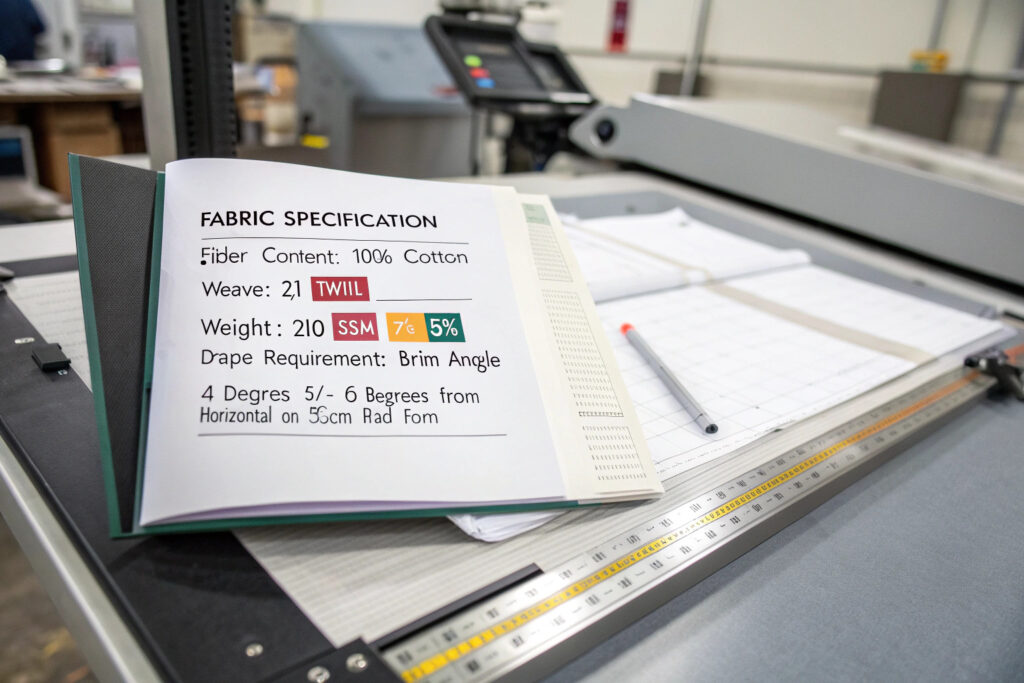
Your tech pack should specify the fiber content, the weave type, the weight in GSM with a tolerance, typically plus or minus 5%, the fabric finish, such as washed, peached, or water-repellent, and critically, a drape performance requirement. The drape performance requirement translates the subjective "look" into a measurable, testable criterion. I use brim angle measured on a standard head form. The spec reads, "Finished hat, when placed on a 58cm circumference head form, shall have a brim angle of 40 degrees plus or minus 5 degrees measured from horizontal at the front center point." This measurement is taken with a simple protractor or a digital angle finder. It is objective. The factory's QC department can measure it. The buyer's inspector can verify it. The specification directly links the fabric weight to the visual outcome.
In addition to the brim angle, the spec should include a brim deflection test. A small weight, say 20 grams, is hung from the front edge of the brim. The vertical deflection is measured. This test quantifies the brim's stiffness independently of the head form. It catches variations in fabric stiffness that weight alone does not capture. Together, the brim angle on head form and the brim deflection under load provide a complete, objective picture of the drape behavior. I include both measurements in the quality control plan for every bucket hat order.
What Are the Standard Weight Ranges for Classic Bucket Hat Fabrics?
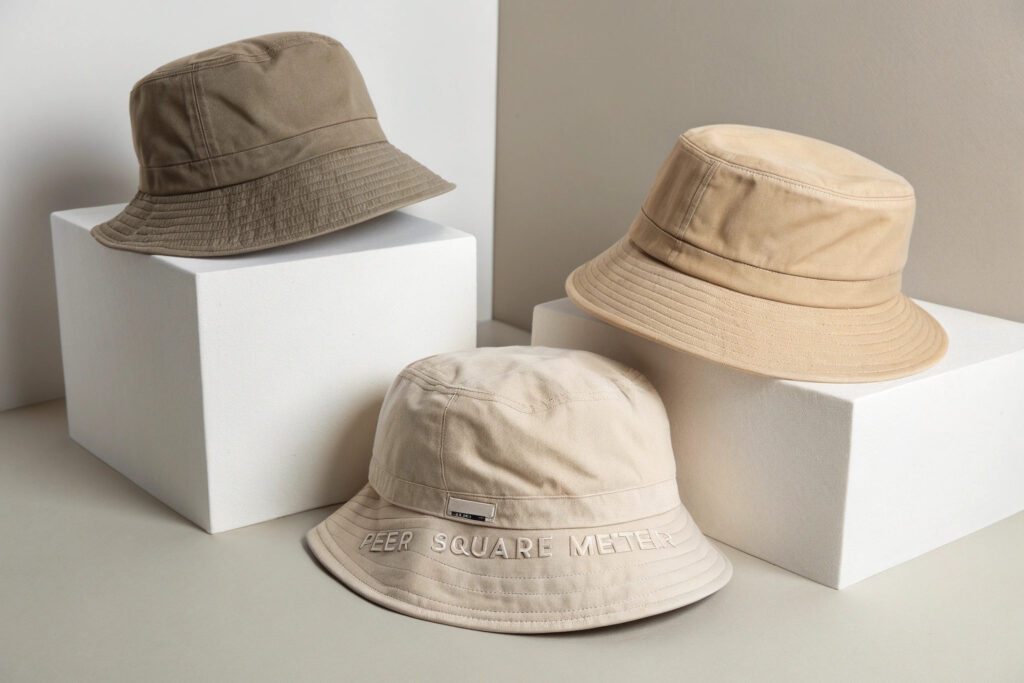
It is useful to know the conventional weight ranges for common bucket hat fabrics. A classic cotton twill bucket hat typically falls between 200 and 240 GSM. This is the reference standard. A lightweight cotton poplin or voile for a summer floppy hat is between 100 and 140 GSM. A medium-weight linen is between 160 and 200 GSM. A heavyweight canvas or duck cloth is between 280 and 350 GSM. A denim bucket hat is usually between 300 and 400 GSM. A nylon packable hat is between 80 and 120 GSM. A waxed cotton utility hat is between 240 and 320 GSM, with the wax coating adding weight and stiffness.
These ranges are starting points. The specific drape outcome within a range depends on the mill's finishing process. A garment-washed 220 GSM twill will drape much more softly than a loom-state 220 GSM twill with a stiffener finish. Always request a fabric drape sample, a hand-cut swatch of the exact fabric, before approving the bulk. A weight specification on a paper sheet is an abstraction. A physical swatch in your hand tells you the truth.
How Can I Test Fabric Weight and Drape on a Pre-Production Sample?
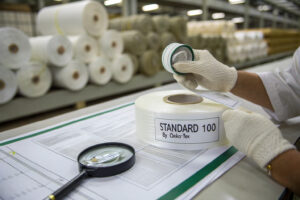
When you receive a pre-production sample, do not just look at it. Measure it. Weigh it. Test it. A simple kitchen scale can verify the fabric weight if you know the area of the fabric. Cut a 10 centimeter by 10 centimeter square from an inconspicuous area inside the crown, if the sample construction allows, or request a fabric swatch from the same roll used for the sample. Weigh the swatch on a gram scale. Multiply by 100 to get GSM. Compare to the spec.
Test the drape by placing the hat on a rigid head form or a ball of the correct circumference. Use a protractor app on your smartphone to measure the brim angle at the front, sides, and back. Compare to the spec. Perform the manual drape test. Hold the hat in your hand. Does the brim hold its shape, or does it collapse under its own weight when you hold it by the crown? The pre-production sample is your final chance to correct the fabric weight before 50,000 units are cut and sewn. I always tell my clients to spend a full day with the sample. Wear it outside in the wind. Pack it in a bag. Wash it. The sample is a physical contract. It is the standard to which the bulk production will be compared. Make it prove itself.
How Does Fabric Weight Interact With Washing and Long-Term Shape Retention?
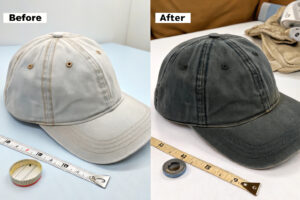
The bucket hat you ship is not the bucket hat your customer will be wearing six months later. Fabric weight changes with washing. The mechanical agitation of a washing machine relaxes the fabric structure. Yarns swell and contract. Finishing chemicals wash out. The fabric almost always becomes softer and more drapey after the first few washes. A hat that was borderline too stiff out of the box may relax into perfection after three washes. A hat that was perfect out of the box may become too soft and floppy. You must design for the washed state, not the unwashed state.
The weight loss from washing is usually minimal, a few percent as residual sizing and finishing agents are removed. The stiffness loss, however, can be significant, up to 30% or 40% depending on the fabric and the finishing. A fabric that relies heavily on starch or resin finishing for its stiffness will experience a dramatic softening after the first wash. This is the "one-wash wonder" problem. The hat looks amazing on the retail shelf, crisp, structured, and substantial. The customer washes it once, and it becomes a limp rag. This is a quality failure. The fabric weight specification should be based on the washed state. The fabric should be pre-washed, or the construction should be engineered to account for the anticipated softening.
The long-term shape retention strategy differs by fabric weight. Lightweight fabrics have less internal memory. They rely on the seam geometry to hold their shape. Once the seams relax from washing, the shape can be lost permanently. Lightweight bucket hats often require a fusible interlining in the brim to provide a permanent, wash-resistant skeleton. Medium-weight fabrics have enough internal memory to retain their shape through multiple washes, provided the fabric was properly pre-shrunk and the seams are stable. Heavyweight fabrics retain their shape almost too well. They can become stiff and unyielding after washing if the fabric shrinks and compacts. The key is to specify the post-wash performance, not just the out-of-box appearance.
How Does Pre-Washing the Fabric Affect the Final Hat Weight and Drape?
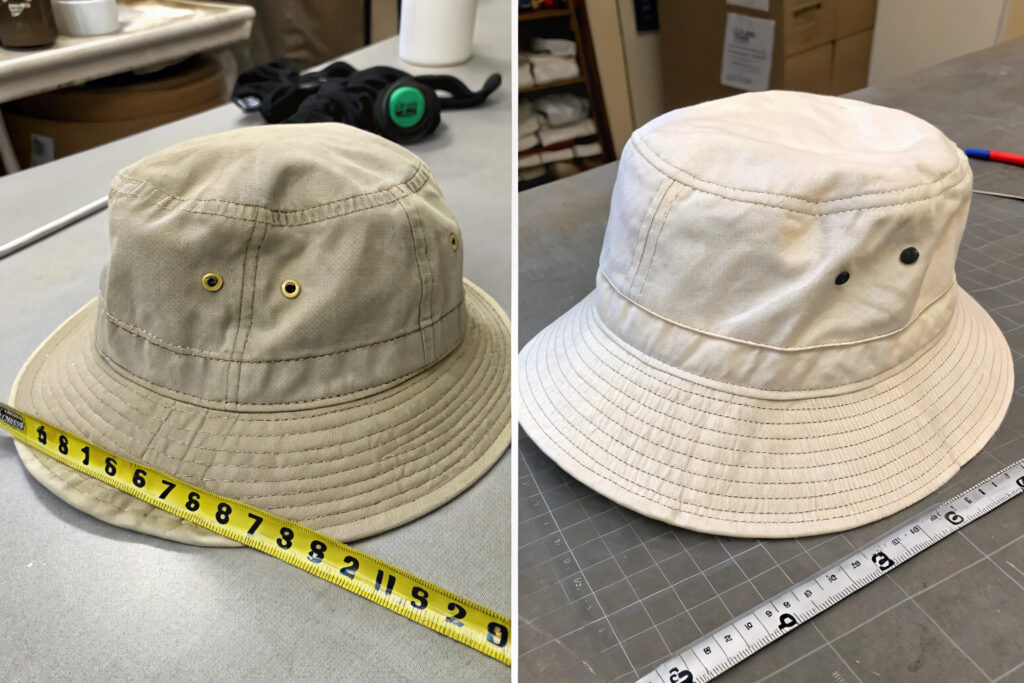
Pre-washing the fabric at the mill, or garment-washing the finished hat, stabilizes the fabric dimensions and removes the temporary finishing agents. A pre-washed 220 GSM twill will have a true, stable weight of 220 GSM. An unwashed 220 GSM twill might weigh 230 GSM out of the box due to sizing, but it will stabilize at 210 GSM after the consumer washes it. The washed weight is the real weight.
Garment-washing the finished hat produces the most honest product. The hat is washed in industrial machines, dried, and pressed. It is sold in its relaxed, post-wash state. The customer experiences no dramatic change after their own wash. The downside of garment-washing is the additional cost and the slight, controlled shrinkage that must be accounted for in the pattern grading. At Global-Caps, we recommend garment-washing for all cotton bucket hats. The resulting product has a softer hand feel, a more authentic drape, and no hidden surprises for the consumer. The silhouette the customer sees on day one is the silhouette they will have on day one hundred.
What Construction Techniques Can Compensate for the Wrong Fabric Weight?
Sometimes the fabric weight is dictated by the design, a specific printed linen or a vintage deadstock canvas, and it is not ideal for the desired silhouette. Construction techniques can partially compensate. A brim that is too soft can be stiffened with a hidden fusible interlining or a layer of lightweight buckram. The interlining adds bending stiffness without changing the visible fabric. A brim that is too stiff can be mechanically relaxed by adding a row of single-needle stitching around the brim edge, creating a hinge line that encourages a controlled droop.
The crown-to-brim seam can also be engineered to influence drape. A heavier, reinforced seam at this junction adds hoop strength, which supports a droopier fabric. A lighter, more flexible seam allows a stiffer fabric to bend more naturally at the junction. These are advanced pattern-making and construction techniques. They require a factory that understands the physics of fabric drape, not just a factory that can sew a seam. When a client brings me a difficult fabric with a specific silhouette requirement, these are the conversations we have. The right construction can expand the workable weight range for a given design.
Conclusion
The weight of a bucket hat's fabric is the invisible hand that sculpts its silhouette. Lightweight fabrics, under 150 GSM, yield to gravity, creating soft, floppy, romantic shapes that prioritize packability and breathability over structure. Medium-weight fabrics, between 150 and 250 GSM, find the balance point where material stiffness and gravitational pull negotiate a relaxed but defined brim angle, the classic bucket hat look that frames the face without obscuring it. Heavyweight fabrics, above 250 GSM, impose their will on gravity, projecting a bold, architectural brim that stands firm in wind and wear but demands a wearer who values statement over softness.
The specification of fabric weight must be accompanied by a performance specification of drape. Weight alone is not enough. The brim angle on a head form and the brim deflection under a test load are the objective, measurable criteria that lock in the silhouette and hold the factory accountable. The pre-production sample must be tested, washed, and lived with before it becomes the gold-seal standard for bulk production. The fabric's true character is revealed after the third wash, not on the showroom shelf.
If you are developing a bucket hat and want a factory that treats fabric weight as an engineering parameter, not just a cost variable, I invite you to contact Global-Caps. We will walk you through our fabric library, show you the drape test data for different weight classes, and engineer a silhouette that matches your design vision and your customer's functional needs. Reach out to our Business Director, Elaine, at elaine@fumaoclothing.com with your concept. Let's build a bucket hat that drapes exactly how you imagined it, every time, wash after wash.