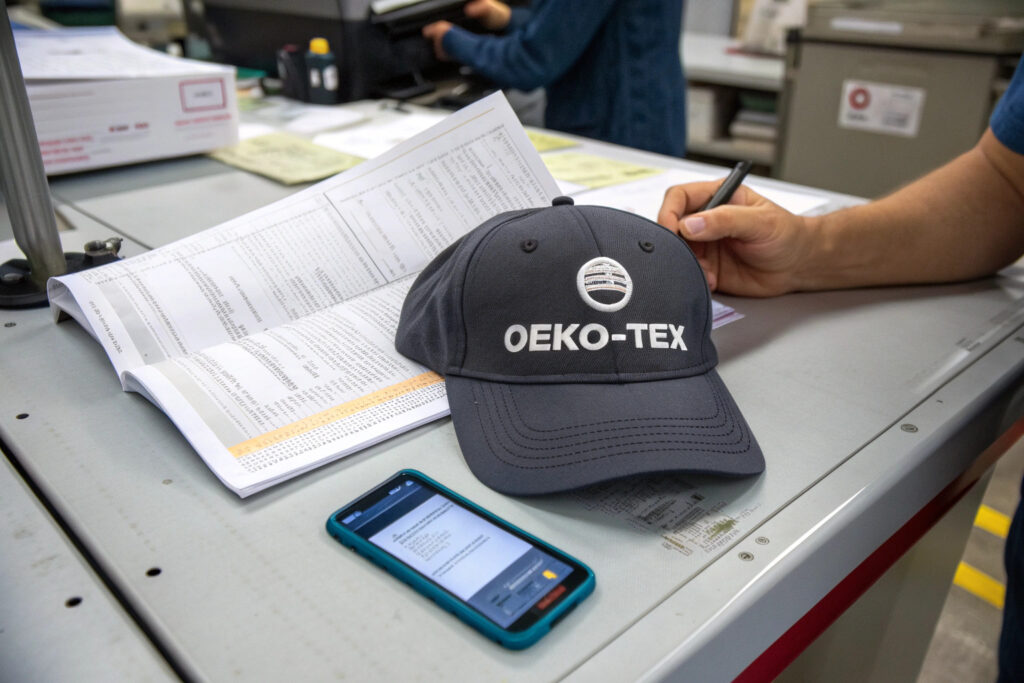
You receive the OEKO-TEX certificate from your supplier. The cover page looks official. The logo is correct. The certificate number is valid. You file it. You assume the whole hat is certified. Three months later, your EU retailer's compliance team audits your product. They ask: "Is the plastic snap closure covered? Is the embroidery thread covered? Is the sweatband covered?" You cannot answer. You never checked. The certificate you filed was just the cover page. The appendix—the document that actually lists which components are certified—was never sent to you. The cover page is a summary. The appendix is the certification. You approved a hat with a certified crown and uncertified everything else.
You confirm that your supplier's OEKO-TEX certificate covers every component of your custom hat by requesting the full certificate appendix, identifying every individual material and accessory in your hat, and cross-referencing each component against the appendix list. The appendix is a multi-page document that enumerates every certified article group. Your crown fabric must be listed. Your sweatband material must be listed. Your embroidery thread must be listed. Your plastic visor board, your snap closure, your woven label, and any other component that touches the skin must each be listed individually. If a component is not on the appendix, it is not certified. A component cannot be "covered by association." The certification is component-specific.
At Global-Caps, I provide my clients with the complete certificate package—the cover page and the full appendix—before the first sample is sewn. I highlight the specific appendix line items that apply to their design. The client knows exactly which components carry the certification and which do not. There are no surprises.
What Is the OEKO-TEX Certificate Appendix and Why Does It Matter More Than the Cover Page?
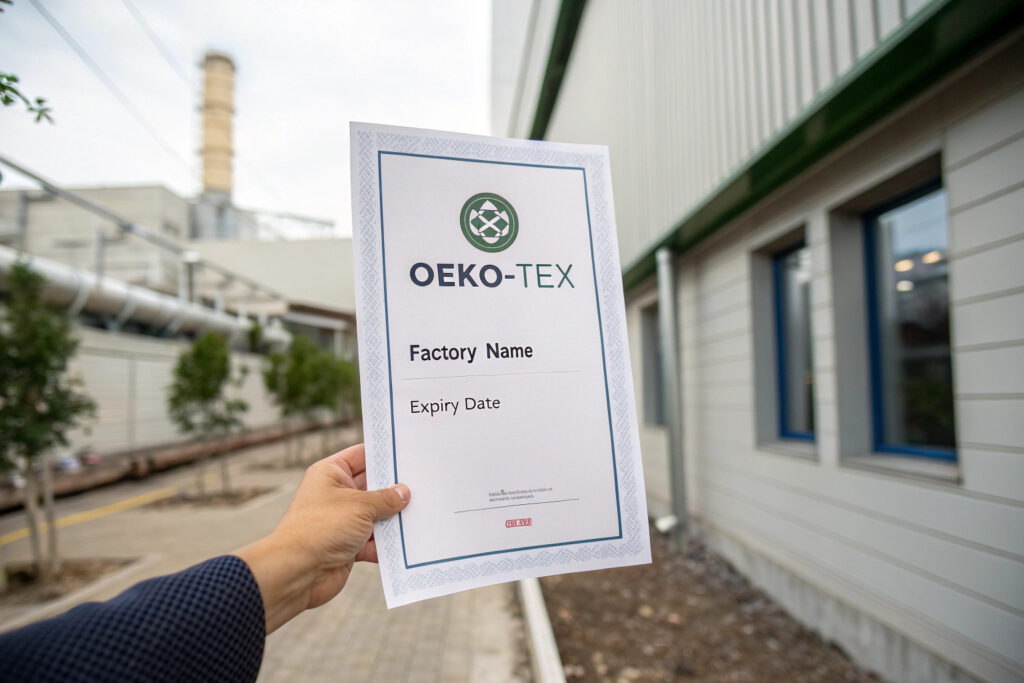
You receive a one-page certificate. It has the OEKO-TEX logo, the factory name, and an expiry date. You think this is the full certification. You are wrong. The one-page document is the certificate cover page. It states that the named company holds a valid OEKO-TEX certification. It does not state which products or materials are certified. The appendix is the legally binding document that lists every certified article group, every certified component, every certified fiber composition, and every certified color. Without the appendix, you have proof that the factory is certified for something, but no proof that the factory is certified for your hat.
The appendix matters more than the cover page because it defines the legal scope of the certification. A certification body auditor has verified that the specific materials listed in the appendix meet the OEKO-TEX requirements. Any material not listed in the appendix is outside the scope of the certification. The cover page is the license. The appendix is the product list. You need both.
I provide the complete certificate package—cover page, appendix, and any supplementary annexes—to every client. I do not send the cover page alone.
The article group structure in the appendix is organized by material type and processing stage. You must understand this structure to find your components.
How Are Article Groups Organized in a Standard OEKO-TEX Appendix?
The appendix is organized into article groups. Each article group represents a category of materials with similar fiber composition and manufacturing process. Article Group 1 might be "Cotton Woven Fabrics - Dyed and Finished." Article Group 2 might be "Polyester Knitted Fabrics - Dyed." Article Group 3 might be "Sewing Threads - Continuous Filament Polyester." Article Group 4 might be "Accessories - Plastic Injection Molded Parts." Article Group 5 might be "Labels and Hangtags."
Each article group lists the specific fiber composition, the processing stages covered, and the color range. The article group number is referenced on the cover page. The appendix is signed by the certification body auditor.
My appendix is updated annually and reviewed with every client during the product development phase.
What Happens If a Component Is Added After the Certificate Was Issued?
If a new component is added to the hat design after the certificate was issued—for example, a new type of snap closure or a new sweatband material—the new component is not covered by the existing certificate. The factory must submit the new component to the certification body for testing and approval. The certification body issues an updated appendix that includes the new component.
The factory cannot self-certify a new component. The component must go through the full OEKO-TEX testing and approval process. The updated appendix is the only valid documentation for the new component.
My material change protocol requires a new component submission to the certification body at least four weeks before the component is needed for production.
How to Map Every Hat Component to Its Corresponding Appendix Line Item?
You look at your hat. You see a hat. The OEKO-TEX appendix sees a list of article groups. The hat must be mentally disassembled into its individual components. Each component must be located in the appendix. The crown fabric is one component. The sweatband is a separate component. The embroidery thread is a separate component—and the white thread and the red thread may be covered by different article groups. The plastic snap is a separate component. The woven label is a separate component. The mapping is the bridge between the physical product and the certification document.
You map every hat component to its corresponding appendix line item by first creating a complete component list of your hat, then reading each article group description in the appendix, and matching each component to an article group based on material composition and processing. A cotton twill crown fabric matches an article group for "Cotton Woven Fabrics." A polyester sweatband matches an article group for "Polyester Knitted Fabrics." An HDPE visor board matches an article group for "Accessories - Plastic Sheets." A polypropylene snap matches an article group for "Accessories - Injection Molded Parts."
My component-to-appendix mapping is documented in a specification sheet that I share with every client. The mapping is verified by the QC manager before production begins.
The component list is the foundational document. It must be exhaustive. Every material, every accessory, every trim must be listed.
Which Components Are Most Commonly Missing From a Hat's Certification Appendix?
The most commonly missing components are the embroidery thread, the sweatband, the plastic snap closure, the woven label, the visor board, and the internal seam binding tape. Factories often certify the main crown fabric but overlook the smaller components that are purchased from third-party suppliers.
The embroidery thread is the most frequently uncertified component because it is sourced from a separate thread supplier and the factory assumes the thread is "standard" and therefore safe. The thread supplier may or may not have their own OEKO-TEX certification. If the thread supplier does not have certification, and the hat factory has not submitted the thread for testing, the thread is uncertified.
My high-risk component checklist specifically flags embroidery thread, sweatbands, and plastic closures as requiring explicit appendix verification.
Does the Certification Cover the Visor Board, Sweatband, and Thread Separately?
Yes, if each component is listed in the appendix as a separate article group. The visor board made of HDPE plastic must be listed under an accessories article group. The sweatband made of polyester/spandex must be listed under a knitted fabrics article group. The embroidery thread must be listed under a sewing threads article group.
If the appendix only lists "Cotton Woven Fabrics" and "Polyester Knitted Fabrics," the visor board, the plastic snap, the thread, and the label are not covered. The hat is partially certified. The crown fabric is certified. The rest is not.
My appendix verification protocol requires a line-item match for every component. Partial certification is documented and disclosed to the client.
What Red Flags Indicate an Appendix Is Incomplete or Fraudulent?
You receive an appendix. It is one page. It lists one article group: "Textile Fabrics." That is the entire appendix. You have a hat with six different materials. A one-line appendix covering "Textile Fabrics" is not a detailed certification of your hat's components. It is a vague document that provides no component-level assurance. The appendix should be as detailed as your hat is complex.
Red flags indicating an incomplete or fraudulent OEKO-TEX appendix include article groups with vague, non-specific descriptions like "Textile Fabrics" without fiber composition details, the absence of an accessories article group for plastic and metal components, a missing or photocopied certification body auditor signature, an issue date more than one year old with no re-certification, and an appendix that is significantly shorter than expected for a complex multi-component product. A genuine appendix is detailed, specific, and signed by the auditor.
I provide my clients with appendix authenticity training. I show them what a genuine appendix looks like and teach them to spot the red flags.
The date and signature are the simplest red flags to check. An expired certificate is immediately invalid.

Why Is a Vague "Textile Fabrics" Listing Insufficient for a Hat With Multiple Materials?
A listing that says "Textile Fabrics" without specifying cotton, polyester, nylon, or the blend ratio is insufficient because the OEKO-TEX test parameters are fiber-specific. The formaldehyde limit for cotton is different from the formaldehyde limit for polyester. The azo dye test is relevant for cotton and not for undyed polyester. A vague listing does not confirm that the specific fiber in your hat was tested.
A proper listing specifies the fiber composition exactly: "100% Cotton Woven Twill," "100% Polyester Knitted Mesh," "60% Cotton / 40% Polyester Woven Canvas." The specificity is the evidence that the exact material was evaluated.
My appendix review checklist requires exact fiber composition matches for every component.
Should the Appendix Be Dated and Signed by the Certification Body Auditor?
Yes. The appendix must be dated with the issue date and the expiry date. The validity period for an OEKO-TEX certificate is one year. An appendix without a date, or with an expired date, is invalid. The appendix must be signed by an authorized representative of the certification body. The signature confirms that the auditor reviewed and approved the specific article groups listed.
A photocopied signature, a typed name without a signature, or a missing signature altogether are red flags. The signature should be an original ink signature or a verified digital signature from a known certification body representative.
My certificate package includes the original digital document with a verifiable digital signature from the certification body.
How to Align Your Spec Sheet With the OEKO-TEX Appendix Before Production?
You approve the spec sheet. The factory orders the materials. Production starts. Three weeks later, you discover the thread is not certified. It is too late. The hats are sewn. The uncertified thread is inside the sweatband seam. The hats cannot be labeled OEKO-TEX certified. The entire production run is downgraded. The pre-production phase is when the certification alignment must happen. After the cutting table starts, the cost of a certification gap multiplies.
You align your spec sheet with the OEKO-TEX appendix before production by creating a component certification matrix that lists every component from the spec sheet, maps it to the appendix article group, and identifies any gaps where a component is not covered by the appendix. The gap components must be resolved before production begins: the factory must either submit the component for certification, source the component from a certified supplier with a valid certificate, or you must accept that the component and therefore the hat will not be fully OEKO-TEX certified.
My pre-production compliance gate includes a mandatory spec-to-appendix alignment review. No material is ordered until the matrix is complete and all gaps are resolved.
The component certification matrix is the single most important document for managing multi-component hat certification.

What Is a Component Certification Matrix and How Do You Create One?
A component certification matrix is a table with four columns. Column one lists every component of the hat, taken from the spec sheet. Column two lists the material composition of each component. Column three lists the corresponding OEKO-TEX appendix article group number and description. Column four states the certification status: "Covered," "Covered by Supplier Certificate," or "Not Covered."
The matrix is created by the product developer or the compliance manager before the purchase order is issued. The matrix is reviewed and approved by the brand's compliance contact and the factory's QC manager.
My matrix template is a standardized document that I complete for every custom hat order. The client receives the matrix as part of the pre-production approval package.
What Should You Do If a Component Is Not Listed in the Appendix?
You have three options. Option one: the factory submits the component to the certification body for testing and inclusion in the appendix. This takes two to four weeks. Option two: the factory sources the component from an alternative supplier who holds a valid OEKO-TEX certificate for that specific component. The supplier's certificate is added to the compliance file. Option three: you accept that the component is not certified and decide whether to proceed without full certification or to redesign the hat to eliminate the uncertified component.
The decision depends on the component's skin contact level and the brand's marketing claims. A sweatband is high risk. An internal seam tape is lower risk.
My gap resolution protocol presents the three options to the client with a recommendation. The client makes the final decision.
Conclusion
Confirming that your supplier's OEKO-TEX certificate covers every component of your custom hat requires the complete certificate appendix, a detailed component list, and a systematic cross-reference between the two. The appendix is the legally binding document that defines the certification scope. The cover page alone is insufficient. Every component—crown fabric, sweatband, embroidery thread, visor board, plastic snap, woven label—must appear in the appendix as a separate article group or be covered by a valid supplier certificate.
Red flags include vague article group descriptions, missing accessories coverage, expired dates, and absent auditor signatures. A component certification matrix aligns the spec sheet with the appendix before production begins. Any gaps are identified and resolved through component submission, alternative sourcing, or informed acceptance.
The certification is not a blanket coverage. It is a component-by-component guarantee. The appendix is the evidence. The matrix is the management tool. The pre-production review is the gate.
At Global-Caps, I provide the full certificate package with the appendix. I create the component certification matrix for every custom order. I identify certification gaps before materials are ordered. I present the gap resolution options. The client makes informed decisions. The final hat carries a certification that is complete, verified, and documented.
If you need to verify that your custom hat is fully OEKO-TEX certified down to the last stitch and snap, contact my Business Director Elaine. She can provide our current appendix, build your component certification matrix, and walk you through the alignment process. Email Elaine at elaine@fumaoclothing.com. Let's certify every component, not just the cover page.