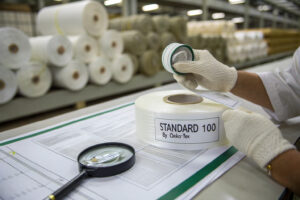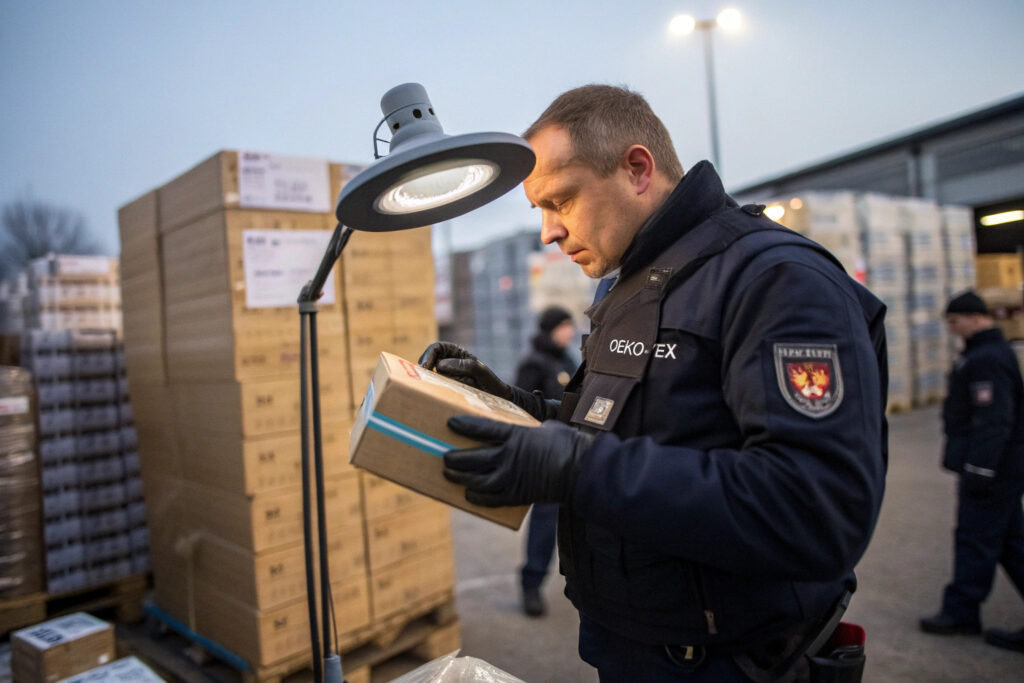
A German distributor called me in a panic last March. His container of 10,000 cotton bucket hats had been flagged for a documentary check at the port of Hamburg. The customs officer had pulled the OEKO-TEX certificate from the shipment documentation, entered the certificate number into the public label-check database, and found that the certificate had expired four months earlier. The entire container was placed under customs detention. The distributor could not clear the goods. He could not deliver to his retail clients. He could not sell a single hat until the certification was resolved. The hats were physically in Germany, but legally they were in limbo.
EU countries enforce OEKO-TEX claims on imported hats through a multi-layered system of documentary checks, physical inspections, and market surveillance. The enforcement begins at the border with an automated risk assessment that flags consignments for review based on the product category, the country of origin, and the importer's compliance history. A customs officer then conducts a documentary check, verifying that the OEKO-TEX certificate number on the shipment documentation matches a valid, current certificate in the public OEKO-TEX database. If the certificate is invalid, expired, or does not cover the specific product category of the imported hats, the goods are detained. A physical inspection may follow, where the officer examines the actual OEKO-TEX hangtags and labels on the hats against the certificate details. If the goods are released, the enforcement continues inside the EU market through national market surveillance authorities. These authorities can randomly purchase hats from retail stores, test them in accredited laboratories, and issue recall orders or fines if the product fails the OEKO-TEX standards that the label claims. The OEKO-TEX claim on a hat is not a marketing slogan. It is a legally significant declaration of conformity that is actively policed at the border and inside the market.
I hold our OEKO-TEX certification as a core business asset. I ensure it is renewed before it expires. I ensure the certificate annex lists the specific product categories we manufacture. I provide a valid, verified certificate with every shipment. I do this because I know the enforcement system is real, and a detention at the border is a commercial disaster that no factory can afford to cause its clients. I want to share exactly how the enforcement works, what documents are checked, what happens during a detention, and how you can ensure your hats clear customs without a single day of delay.
What Happens During a Customs Documentary Check for an OEKO-TEX Claim?
The documentary check is the first and most common enforcement action. It does not require the customs officer to open a single carton. It requires them to read the documents that accompany the shipment and verify the claims made on those documents against public databases. When a hat shipment enters the EU, the importer of record must file a customs declaration. That declaration includes the commodity code for headwear, which is typically 6505 or 6506, and may include a claim of OEKO-TEX certification as part of the product description or the supporting compliance documentation. The customs automated risk management system scores the shipment. Factors that increase the risk score include the product category of textiles and apparel, which has a high rate of chemical safety violations. The country of origin, with certain countries flagged for higher scrutiny. The importer's compliance history, with first-time importers and importers with prior violations flagged. And random selection, because a percentage of all shipments are checked regardless of risk profile. If the shipment is flagged, a customs officer reviews the documents.
The officer looks at the commercial invoice and the packing list to confirm the product description. The officer then looks for the OEKO-TEX certificate. If the certificate is included in the documentation package, the officer records the certificate number and the issuing institute. The officer opens the OEKO-TEX Label Check website on a separate screen. The officer enters the certificate number. The database returns the current status of the certificate. The officer checks four things. Is the certificate valid and within its expiration date? Does the certificate holder name match the manufacturer or exporter on the commercial invoice? Does the product scope in the certificate annex include the specific product category of the imported goods, such as headwear? And is the product class correct for the intended end user, with Class 1 for baby hats, Class 2 for adult hats with skin contact? If all four checks pass, the documentary check is cleared. The shipment proceeds to physical release or to a physical inspection if the risk score also flagged a physical check. If any check fails, the documentary check is failed. The shipment is detained pending resolution.
The documentary check is purely administrative. It does not verify whether the physical hats actually meet the OEKO-TEX chemical limits. It verifies whether the paper claim is backed by a valid paper certificate. The physical verification happens in a different type of inspection.

What Specific Documents Must Accompany an OEKO-TEX Claim at the Border?
The minimum documentation package for an OEKO-TEX claim on imported hats includes the commercial invoice, the packing list, the bill of lading or airway bill, and a copy of the valid OEKO-TEX certificate. The certificate must be the full document, not just the first page. The annex pages that list the product scope and the certified product categories are the most important pages for customs verification.
I also include a Certificate of Conformity that explicitly references the OEKO-TEX certificate number, the product style numbers covered, and the product class. This document bridges the gap between the certificate, which is issued to the manufacturer, and the specific shipment, which contains specific products. The customs documentation requirements for textile products are published by the EU Directorate-General for Taxation and Customs Union. A complete documentation package reduces the probability of a documentary check failure to near zero.
How Does the OEKO-TEX Label Check Database Work for Customs Officers?
The OEKO-TEX Label Check is a free, public, online tool. Any person with an internet connection and a certificate number can verify the validity of an OEKO-TEX certificate in real time. The customs officer enters the certificate number into the search field. The database returns the certificate holder's name, the issuing institute, the product scope, the product class, the valid-from date, and the valid-until date.
The officer compares this information against the commercial invoice and the physical labels on the hats. The database is the single source of truth. A certificate that has been revoked by the issuing institute will show as invalid in the database, even if the paper certificate looks perfect. The OEKO-TEX label check tool is the enforcement backbone for the entire certification system. I check every certificate I receive from a component supplier using this tool before I accept the material into our inventory.
What Triggers a Physical Inspection of Hats for OEKO-TEX Compliance?
A documentary check verifies the paper. A physical inspection verifies the product. Customs authorities conduct physical inspections when the documentary check raises a question that cannot be resolved on paper, when the risk assessment score is high enough to warrant a physical check, when the shipment is part of a targeted enforcement operation on a specific product category, or when a competitor or consumer has filed a complaint alleging false certification claims. A physical inspection for an OEKO-TEX claim is not a full chemical laboratory test. That takes weeks and is not practical at a border checkpoint. The physical inspection is a forensic examination of the physical product and its labeling to determine if the product matches the documented claim.
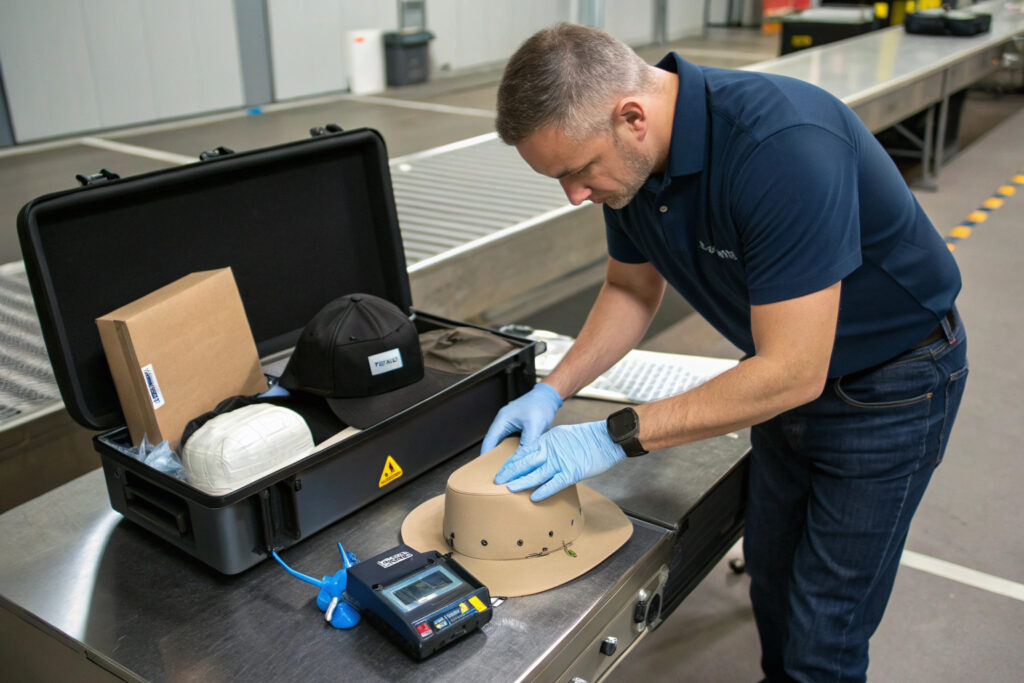
The inspecting officer opens a statistically selected number of cartons from the shipment. The officer examines the physical hats. The officer looks for the OEKO-TEX hangtag or label. The officer checks that the certificate number printed on the hangtag matches the certificate number on the documentation. The officer checks that the product class printed on the hangtag is appropriate for the product. A baby hat with a Class 2 hangtag is a mismatch that triggers a detention. The officer may also cut a small fabric swatch for laboratory testing if the inspection is part of a targeted enforcement action. The officer may use a handheld XRF analyzer to screen for heavy metals on the fabric surface. A positive XRF screen for lead or cadmium triggers an immediate detention and a mandatory laboratory test. The physical inspection is the enforcement layer that catches counterfeit OEKO-TEX labels and products that claim certification but do not match the certificate scope.
The physical inspection checks the label against the certificate. But the most aggressive enforcement tool is not the label check. It is the laboratory test of the physical product. Market surveillance authorities use this tool extensively after the goods have entered the market, but customs can also initiate it at the border.
Can Customs Chemically Test a Hat at the Border?
Customs laboratories are equipped to perform a range of chemical tests on textile products. The most common border-level test is a formaldehyde spot test. A few drops of a reagent solution are applied to the fabric. A color change indicates the presence of formaldehyde above a certain threshold. This is a screening test, not a definitive quantitative test. A positive screening test triggers a detention and a full quantitative test at an accredited laboratory.
Customs can also test for azo dyes using a similar spot test methodology. The full quantitative testing for OEKO-TEX compliance, including the full heavy metal panel, the phthalate panel, and the specific banned amine list, is conducted at an accredited laboratory. The sample is cut from the detained goods, sealed in an evidence bag, and sent to the lab. The lab report is the definitive evidence. If the lab report confirms a failure against the OEKO-TEX limits, the goods are refused entry. The customs laboratory testing capability for textiles is part of the EU Joint Research Centre's network of national reference laboratories.
What Is the Role of the RAPEX System in OEKO-TEX Enforcement?
RAPEX is the EU Rapid Alert System for dangerous non-food products. When a national market surveillance authority finds a product that fails OEKO-TEX chemical limits, it issues a RAPEX notification. The notification is circulated to all EU member states. The notification includes the product description, the brand name, the country of origin, the test results, and the corrective action taken.
A RAPEX notification is a commercial death sentence for a product in the EU market. Every member state's customs authority is now on alert for that product. Every major retailer checks RAPEX before onboarding a new brand. A brand that has a RAPEX notification against its hats will struggle to sell to any European retailer for years. I monitor RAPEX notifications for headwear products to stay aware of the specific chemical risks that are being enforced. The RAPEX system is a public database. Any importer, brand, or manufacturer can search it and learn from the enforcement actions against other products.
What Happens When a Hat Shipment Is Detained for an Invalid OEKO-TEX Claim?
Customs detention is a legal holding pattern. The goods are physically in the custody of the customs authority. They cannot be moved, sold, or used. Storage charges, called demurrage, accrue daily. The importer is notified of the detention reason, the required corrective action, and the deadline for response. The clock is ticking. Every day of detention costs money and pushes the delivery date further past the retail deadline. The importer must act quickly and correctly.
The detention notice will state the specific reason. The most common reasons for an OEKO-TEX detention are an expired certificate, a certificate that does not cover the imported product category, a mismatch between the certificate holder name and the manufacturer, or a failed physical label check. The corrective action depends on the reason. If the certificate has expired, the manufacturer must provide a renewed, valid certificate. If the certificate does not cover headwear, the manufacturer must provide a certificate that does, or the importer must accept that the goods cannot be sold with an OEKO-TEX claim. If the certificate holder name does not match, the supply chain relationship must be documented and explained. If the label check failed, the importer must explain the discrepancy or remove the non-compliant labels. The corrective action must be completed within the deadline specified in the detention notice, typically 10 to 30 days. If the corrective action is not completed, the customs authority may order the re-export of the goods at the importer's expense, or the destruction of the goods at the importer's expense. Both outcomes are financially catastrophic. The detention is resolved by the importer or their customs broker submitting the required corrective documentation to the customs officer who issued the detention. The officer reviews the new documentation. If it resolves the issue, the detention is lifted and the goods are released. If it does not, the detention continues or escalates to a seizure.
The detention is a crisis that can be resolved with the right documentation. The more dangerous long-term consequence is not the detention itself. It is the entry of the violation into the importer's compliance record. This record follows the importer and increases the risk score of every future shipment.

How Can an Importer Resolve an Expired Certificate Detention Quickly?
The fastest resolution is a direct contact with the manufacturer requesting an immediate certificate renewal. If the manufacturer has maintained its OEKO-TEX compliance and simply failed to renew the certificate on time, the issuing institute can often expedite a renewal within a few business days, especially if the factory contacts them and explains the customs detention urgency. The renewed certificate, with a current valid-until date, is emailed to the importer. The importer forwards it to the customs officer. The detention is lifted.
If the manufacturer has not maintained its compliance and cannot obtain a renewal quickly, the importer has a harder choice. They can either accept that the goods cannot be sold with an OEKO-TEX claim and request the removal of the claim from the customs declaration, which may allow the goods to be released as non-certified products, or they can re-export the goods to a non-EU market. The customs detention resolution process is managed through the customs broker. A knowledgeable broker is the importer's most valuable asset in this situation.
What Are the Financial Penalties for a False OEKO-TEX Claim?
A false claim is a claim made on a product that does not have a valid OEKO-TEX certificate. This is a violation of EU consumer protection law and, in some member states, a criminal offense. The financial penalties vary by member state but can include a fine of up to €50,000 per product line, the confiscation and destruction of the goods, and the importer's liability for the costs of the investigation and the laboratory testing.
Beyond the direct financial penalty, the indirect costs include the loss of the goods, the loss of the customer order, the demurrage charges accrued during the detention, and the reputational damage with the retailer and the customs authority. I have seen small brands destroyed by a single false OEKO-TEX claim enforcement action. The cost of a valid certification is a fraction of the cost of a false claim penalty. The product safety penalties in the EU are among the most stringent in the world.
How Can You Ensure Your Hat Shipment Passes OEKO-TEX Customs Verification?
The customs verification is a test that you know is coming. You have the questions in advance. You can prepare the answers before the shipment leaves the factory. A prepared shipment clears customs without drama. An unprepared shipment is a gamble. The preparation is a checklist of actions that the manufacturer and the importer complete together before the container is loaded onto the vessel.
I complete a seven-point pre-shipment OEKO-TEX compliance checklist for every EU-bound order. Point one: I verify that our OEKO-TEX certificate is valid and will remain valid for at least six months beyond the shipment date. If the certificate expires within six months, I renew it before shipping. Point two: I verify that the product scope in the certificate annex explicitly lists the product category of the shipment, such as "woven headwear" or "knitted headwear and accessories." Point three: I verify that the product class is correct. Adult hats are Class 2. Baby hats are Class 1. I do not ship a baby hat under a Class 2 certificate. Point four: I prepare a Certificate of Conformity that references the OEKO-TEX certificate number, the product style numbers, the product class, and the shipment commercial invoice number. Point five: I attach a physical OEKO-TEX hangtag to every hat. The hangtag includes the certificate number and the product class. Point six: I include a copy of the full OEKO-TEX certificate, including the annex pages, in the shipment documentation pouch attached to the master carton and in the electronic documentation sent to the importer. Point seven: I email the importer a digital copy of all compliance documents one week before the vessel sails. The importer reviews the documents and confirms they are complete. This checklist transforms the customs verification from a risk into a formality.
The checklist is the manufacturer's responsibility. The importer has an additional verification responsibility that is often overlooked. The importer should independently verify the certificate number on the OEKO-TEX Label Check database before the goods arrive. This catches any last-minute certificate revocation that the manufacturer may not be aware of.

Why Should the Importer Independently Verify the Certificate Before the Goods Arrive?
The manufacturer provides a certificate. The certificate may be valid at the time the manufacturer sends it. But between the time the container sails and the time it arrives at the EU port, the certificate could expire or be revoked. The importer should perform an independent Label Check verification two weeks before the estimated arrival date.
If the check shows the certificate is no longer valid, the importer has a two-week window to contact the manufacturer, obtain a renewed certificate, and have the new documentation ready for customs clearance. This proactive check converts a potential detention into a resolved issue before the customs officer ever looks at the documents. The pre-arrival compliance check is a simple, free action that can save tens of thousands of euros in demurrage and lost sales.
What Should You Do If Your Factory's Certificate Does Not Cover Headwear?
A factory that offers you OEKO-TEX certified hats but has a certificate that only covers "woven fabrics" or "piece goods" is not providing certified hats. The certificate scope is specific. It must list headwear or a category that includes finished headwear. If the certificate does not cover headwear, the hats cannot legally carry the OEKO-TEX label.
You have two options. Option one is to ask the factory to extend their certification scope to include headwear. This requires a new audit and testing, which takes weeks to months. Option two is to find a factory whose certificate already covers headwear. I have invested in maintaining a headwear-specific OEKO-TEX certification for exactly this reason. When a buyer asks for our certificate, the annex clearly lists "headwear." The customs officer sees this and the documentary check passes in minutes. The OEKO-TEX certification scope is the most important page of the certificate. Read it before you ship.
Conclusion
The EU border is not a passive boundary. It is an active enforcement zone where OEKO-TEX claims are verified against public databases and physical products are inspected against their paper certificates. The system is automated, risk-based, and increasingly aggressive. A hat with an expired certificate, a mismatched product scope, or a counterfeit hangtag will be detained. The detention will cost money, delay delivery, and potentially result in the destruction of the goods. The enforcement does not stop at the border. Market surveillance authorities inside the EU test products from retail shelves and issue RAPEX notifications that can destroy a brand's European market access.
The defense against this enforcement system is not luck. It is a systematic pre-shipment compliance checklist that verifies the certificate validity, the product scope, the product class, and the hangtag accuracy before the container is sealed. It is a manufacturer who understands the enforcement mechanism and treats the certification as a continuous obligation, not a one-time marketing expense. It is an importer who independently verifies the certificate before the goods arrive and has a customs broker who knows the textile product safety regulations.
I complete this checklist for every EU shipment because I have seen the alternative. The German distributor whose container was detained in Hamburg eventually cleared his goods after I expedited a certificate renewal. The delay cost him three weeks and €4,200 in demurrage and penalty fees. He still orders from us, but he now asks for the compliance documents a month before the ship date. That is the lesson. Prepare the documents early. Verify them independently. Do not gamble with a customs officer who has a database and a legal mandate.
If you are importing hats into the EU and want a manufacturing partner whose OEKO-TEX certification is current, headwear-specific, and backed by a pre-shipment compliance checklist, let us provide our documentation package for your review. Our Business Director, Elaine, can send you our valid OEKO-TEX certificate with the headwear annex, a sample Certificate of Conformity, and a photo of our OEKO-TEX hangtag. Email her at elaine@fumaoclothing.com and request the EU Customs Compliance File. We will help you clear your hats through customs without a single day of detention.