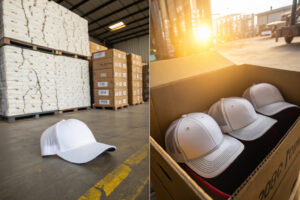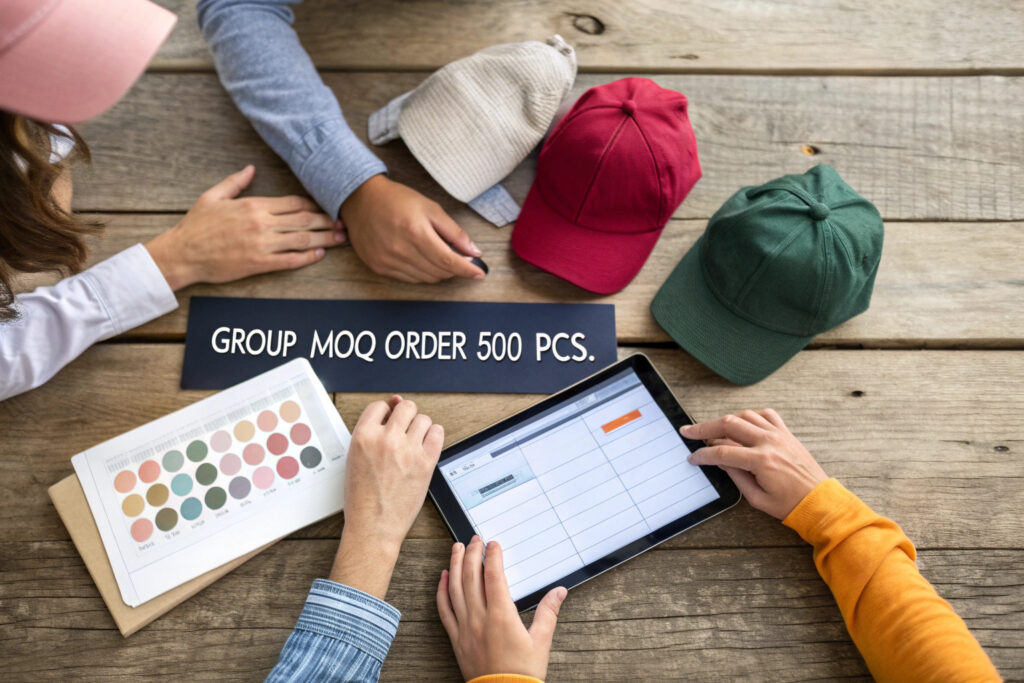
You have found the perfect hat factory. The samples are stunning. The communication is excellent. The pricing is within your budget. You are ready to place your first order. Then the project manager sends the proforma invoice with a note: "Minimum Order Quantity per style per color: 500 pieces." Your boutique sells curated, small-batch collections. You need 50 pieces of the blush pink dad cap and 75 pieces of the sage green bucket hat. You do not need 500 of anything. You feel the familiar frustration of being a small buyer in an industry built for large volumes. The factory is not being difficult. Their production line is simply not economically viable for runs smaller than 500 pieces of an identical SKU.
This is the MOQ barrier, and it is the single biggest hurdle facing small boutique brands, start-up labels, and niche promotional buyers in the headwear industry. I run Global-Caps, and I work with brands of all sizes. I understand the factory economics that create the MOQ, and I have developed flexible frameworks that allow small buyers to meet it without ordering inventory they cannot sell. In this article, I will show you the practical strategies for combining orders, the specific options you can request from your factory, and the negotiation language that turns a "no" into a "yes, we can make that work."
What MOQ Combination Strategies Can a Boutique Buyer Propose to a Factory?
The factory's MOQ is driven by production efficiency. Setting up an embroidery machine for a new design, changing thread colors, cutting a new fabric lot, and reconfiguring the sewing line for a different style all take time. The factory needs enough volume of identical operations to amortize these setup costs. Your goal is to propose an order structure that minimizes the factory's setup costs while allowing you to order multiple styles and colors in small quantities. The key principle is to find commonality across your order and present it as a single, efficient production run.
The most straightforward strategy is the single-style, multi-color combination. You order one cap style, say the classic unstructured dad cap, in multiple colors. The cap construction, the panel pattern, the seam types, the sweatband, the closure, are identical across all colors. The only variable is the fabric color. This drastically reduces setup complexity. Many factories will accept a total MOQ of 500 pieces across multiple colors, with a per-color minimum, often 50 or 100 pieces. You propose 500 pieces total, 5 colors, 100 pieces each. This is a clean, efficient production run that the factory can schedule easily.
The second strategy is the multi-style, common-base combination. You order two or three different cap styles that share the same base construction and materials. For example, a dad cap and a bucket hat made from the same fabric, with the same sweatband material and the same label set. The cutting and sewing operations differ, but the material procurement, the embroidery setup, and the finishing processes are shared. You propose a total MOQ of 500 pieces, with a minimum per style of 150 to 200 pieces. This is more complex than a single-style run, but it is feasible for a factory that values long-term relationships with growing brands.
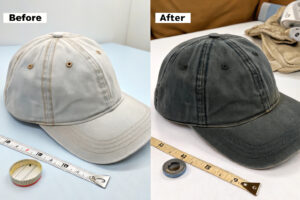
The third and most creative strategy is the blank-plus-embroidery split. You order 500 blank, unembellished caps in a single style and color. This meets the factory's base production MOQ cleanly. You then have only 100 of those blanks embroidered with your first design, 100 with your second design, and you keep 300 as blank inventory for future drops. The factory's sewing line runs efficiently on the 500 blanks. The embroidery machines handle the smaller, variable runs. This is an extremely effective strategy for brands that plan to release multiple small drops over a season.
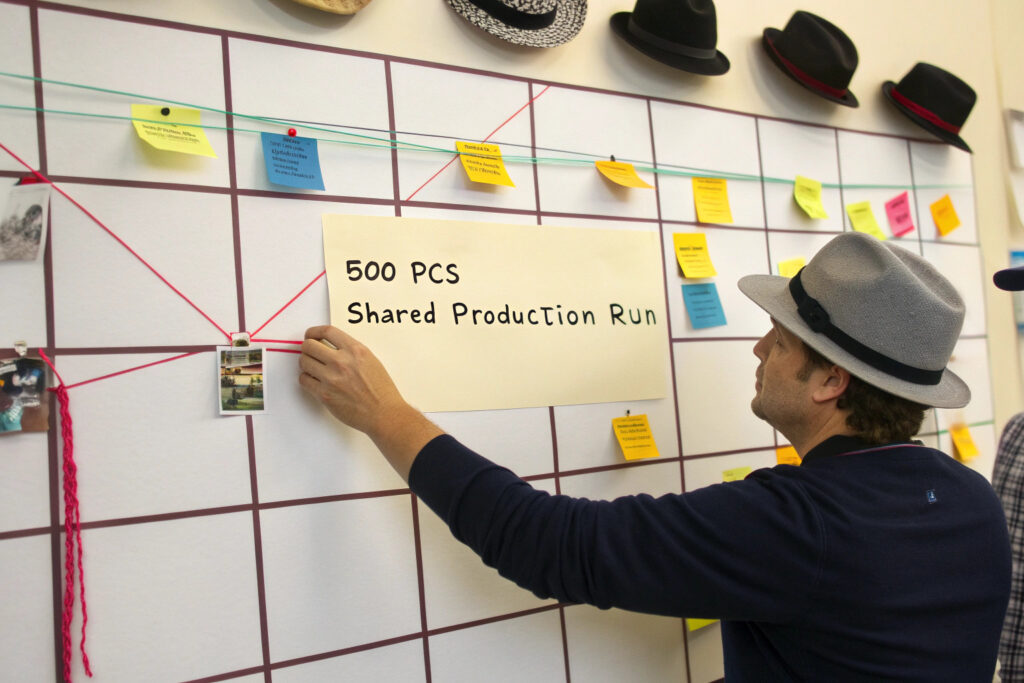
How Does the Blank Order Plus Embroidery Strategy Work?
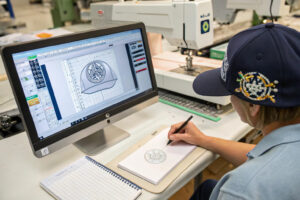
The blank order strategy separates the cap construction MOQ from the decoration MOQ. Cap construction has the higher setup cost. Cutting, sewing, and finishing 500 identical caps is efficient. Embroidery has a lower setup cost. The digitizing file is made once, and the machine runs small batches efficiently.
You negotiate with the factory to produce 500 blank caps. You take delivery of, for example, 200 caps immediately with your current season's embroidery designs. The remaining 300 blank caps are held at the factory, or shipped to you, for embroidery with future designs. The factory benefits from a single, efficient 500-piece production run. You benefit from a lower per-unit cost and the flexibility to order small embroidered batches as needed. I offer this blank inventory program to my boutique clients. It builds a strategic inventory buffer and smooths out the production peaks and valleys.
Yes, if the fabric is the dominant cost and setup driver. If you are using a custom-dyed or specialty fabric, the fabric MOQ is often higher than the cap construction MOQ. The fabric mill requires a minimum order of, say, 500 meters of your custom lavender cotton twill. The factory must purchase the entire 500 meters. You can then use that fabric across multiple cap styles, a dad cap, a bucket hat, a visor, all cut from the same fabric roll. The fabric MOQ is met. The factory's material waste is minimized. You get a coordinated collection in your exclusive color, with small quantities per style. I recommend this strategy to clients who are developing a signature color palette for their brand.
How Can Multiple Boutique Brands Legally and Logistically Pool Their Orders?
Sometimes your brand alone cannot reach the MOQ, even with creative combination strategies. The solution is to collaborate with other non-competing boutique brands to pool your orders into a single, factory-ready production run. This is called group purchasing or order pooling. It requires trust, organization, and a clear legal agreement, but it is a proven model for small brands.
The pooling model works best when the brands share a common base product. For example, three boutique fitness studios each want a dad cap in their own brand colors with their own logo. They agree on a single cap style, a single fabric quality, a single cap construction. The factory produces 500 caps total, with the only variable being the embroidery design and possibly the cap fabric color. The brands split the 500 pieces, 170 each, and each pays their share of the production cost. The per-unit cost is dramatically lower than if each brand ordered 170 pieces alone, which would likely be rejected or priced punitively.
The logistics require a single point of contact for the factory. One brand, or a designated third-party coordinator, places the master order, manages the communication, and receives the consolidated shipment. The caps are then split and distributed to the individual brands. The legal framework should be a simple group purchasing agreement that outlines each brand's commitment, the quantity, the cost share, the payment schedule, and the dispute resolution process. The agreement should also address what happens if one brand withdraws, the remaining brands absorb the shortfall or the order is cancelled with shared costs.
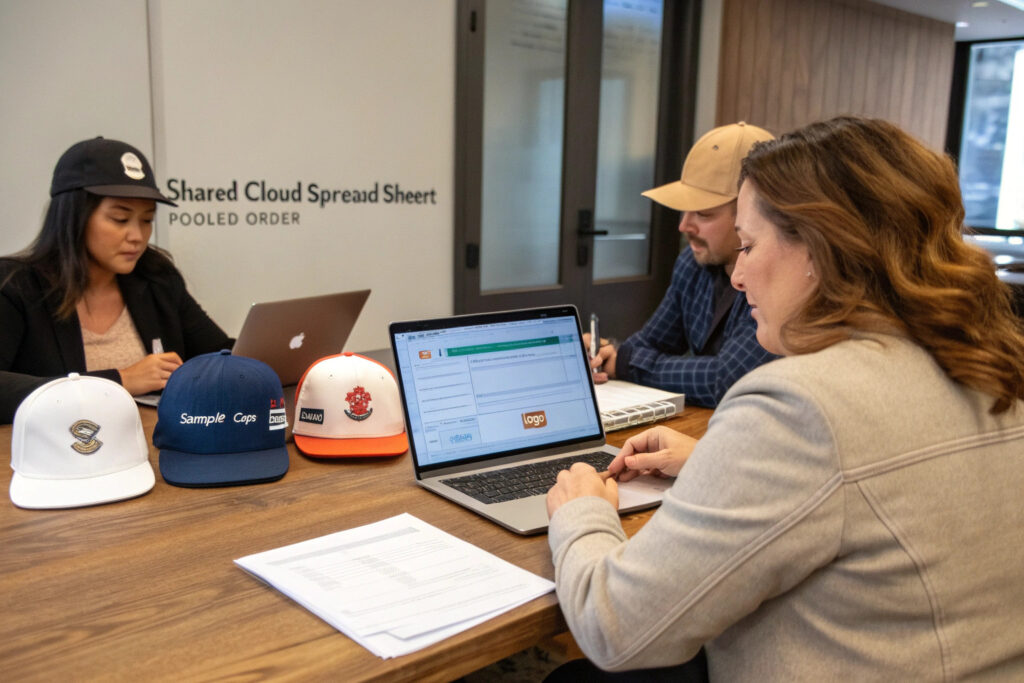
What Should a Group Purchasing Agreement Include?
A group purchasing agreement does not need to be a 50-page legal document. A simple, clear contract of two to three pages is sufficient. It should include the names and contact information of all participating brands. The specification of the common base product, the cap style, fabric, construction. The total quantity and the quantity allocated to each brand. The total cost and the cost share per brand. The payment schedule, with a non-refundable deposit from each brand before the order is placed. The shipping and distribution plan. A withdrawal clause: if a brand withdraws after the deposit, their deposit is forfeited and the remaining brands must either cover the shortfall or cancel the order with shared cancellation costs. A quality dispute clause: if the caps arrive with a quality issue, the lead brand manages the claim with the factory on behalf of the group.
I recommend that the group appoint one brand as the lead purchaser. That brand communicates with the factory, receives the shipment, and handles the initial quality inspection. The other brands rely on the lead brand's judgment. Choosing a lead brand with some sourcing experience is wise. The lead brand may charge a small coordination fee, which is fair given the administrative burden.
How Can You Find Other Boutique Brands to Pool Orders With?
Industry networking is the most effective way to find pooling partners. Attend trade shows, join fashion and accessories industry associations, participate in online communities for small brand founders. Look for brands that are at a similar stage of growth, sell to a similar customer demographic, and have a complementary but non-competitive aesthetic. A children's hat brand and a women's fashion hat brand can pool a basic cap order without competing directly.
Transparency is essential. Share your factory contacts, your price quotes, and your quality expectations openly with potential pooling partners. Build the relationship before you build the purchase order. A pooled order is a partnership. It requires aligned values and clear communication. I have introduced compatible boutique clients to each other with their permission, and several of those introductions have led to successful, ongoing pooling arrangements.
What Negotiation Language Should a Small Buyer Use When Discussing MOQ Flexibility?
How you frame your MOQ request to the factory is as important as the request itself. A demand for a lower MOQ without any compensating value to the factory will be refused. A proposal that acknowledges the factory's constraints and offers a structure that protects their efficiency will be seriously considered. The language you use signals your understanding of the manufacturing business and your intention to be a long-term partner.
Start the conversation by acknowledging the factory's position. "I understand that your standard MOQ is 500 pieces per style, and I respect the production efficiencies that require. I want to find a structure that works for both of us as we build a long-term relationship." This establishes you as a reasonable, professional buyer. Then, present your specific proposal with clear, defined terms. Do not say, "Can you do a lower MOQ?" Instead, say, "I propose an initial order of 500 total pieces across three colors of the same dad cap style, with 100 pieces per color. The cap construction is identical across all colors. This is a single, efficient production run for your team. We can place this order quarterly." This proposal respects the factory's 500-piece run efficiency while giving you the color variety you need.
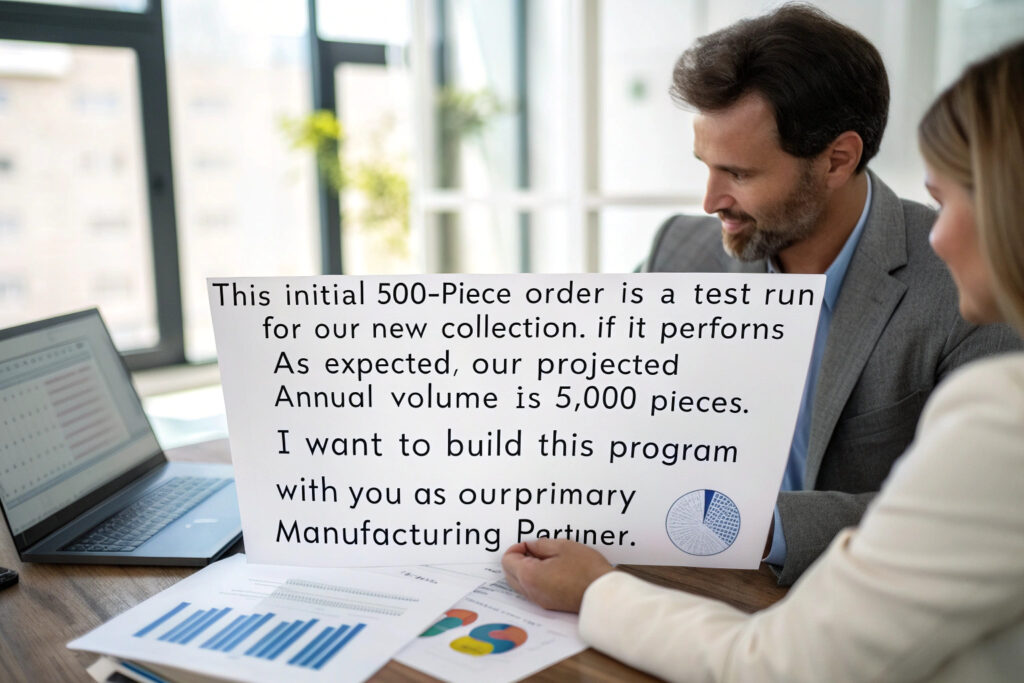
Offer a phased growth plan. The factory's MOQ resistance is partly about the profitability of a single small order. If you can demonstrate that the small order is the first step in a larger, long-term purchasing relationship, the factory may accept a lower margin on the first order. "This initial 500-piece order is a test run for our new collection. If it performs as expected, our projected annual volume is 3,000 to 5,000 pieces. I want to build this program with you as our primary manufacturing partner." This language turns a one-time, low-margin transaction into a strategic partnership opportunity.
How Can You Offer to Offset the Factory's Reduced Efficiency?
If the factory is still hesitant, you can offer specific concessions that offset their efficiency loss. Offer a slightly higher unit price for the first order, with a written commitment to reduce to the standard price when volumes increase. Offer to pay the digitizing setup fee for your embroidery designs, which the factory might normally absorb. Offer a higher deposit percentage, such as 50% instead of 30%, to reduce the factory's financial risk. Offer to accept a longer production lead time, allowing the factory to schedule your small run during a natural gap in their production schedule rather than disrupting a larger order. These offers demonstrate your commitment and your understanding of the factory's business realities.
What Is a Phased Production Agreement and How Does It Work?
A phased production agreement is a formal structure that commits you to a total volume over a defined period, fulfilled in smaller, more frequent shipments. For example, you commit to 1,500 pieces over 12 months. The factory produces the entire 1,500 pieces in one efficient run. The blank caps are stored at the factory. You release them in monthly shipments of 125 pieces, with embroidery applied to each batch as needed. You pay for each batch upon shipment. The factory benefits from the single, efficient production run and the committed annual volume. You benefit from the MOQ price and the ability to manage your cash flow and inventory with small, regular deliveries. This is a sophisticated, mutually beneficial arrangement. I offer phased production agreements to my boutique clients who have predictable, ongoing demand. It is an excellent framework for building a stable, long-term supply relationship.
Conclusion
Meeting a 500-piece custom hat MOQ as a small boutique buyer is not a matter of simply asking for a discount on the minimum. It is a matter of creatively restructuring the order to align with the factory's production efficiencies while serving your need for variety and manageable inventory. The strategies available to you include combining multiple colors within a single style, splitting blank cap production from embroidery decoration, pooling orders with non-competing brands under a group purchasing agreement, and negotiating phased production agreements that commit to annual volumes in exchange for small, frequent shipments.
The key to success in these negotiations is to approach the factory as a partner, not an adversary. Understand their cost drivers. Present proposals that are efficient for them. Offer compensating value: a higher price, a higher deposit, a longer lead time, a growth commitment. And always put the agreement in writing, with clear specifications, quantities, prices, and timelines.
If you are a small boutique brand struggling with headwear MOQs and looking for a factory partner who understands your needs and offers flexible, creative production solutions, I invite you to contact Global-Caps. We have developed specific MOQ flexibility programs for emerging brands, including blank-plus-embroidery splits, phased production agreements, and multi-color combination orders. We want to grow with you. Reach out to our Business Director, Elaine, at elaine@fumaoclothing.com with your collection concept and your quantity requirements. Let's design an order structure that gets your first batch of caps into your customers' hands without overloading your inventory, and let's build a partnership that scales as you grow.