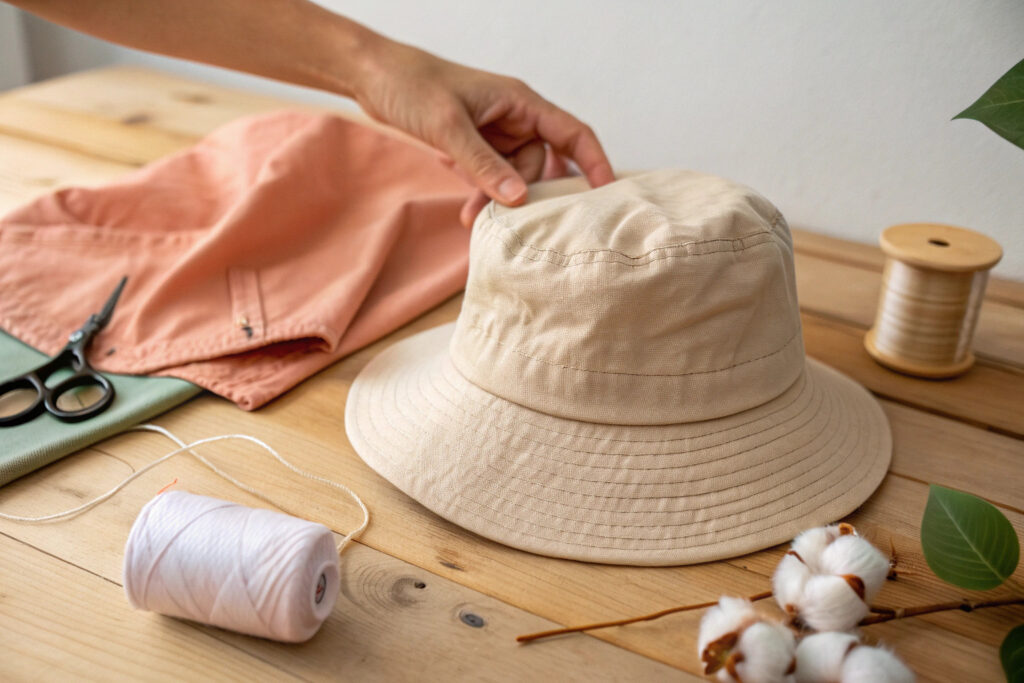
You find a bucket hat at a vintage market. It is made of plain cotton, but it feels completely different from the stiff, crunchy bucket hats you see in stores. The fabric is plush, almost velvety. The brim drapes softly without collapsing. The hat feels like it has been worn and washed for years, even though it looks new. You check the label. It is 100% cotton. You realize the magic is not in the fiber content. It is in the finishing. You decide this is the signature hand feel for your next collection. You contact a factory and ask for "soft brushed cotton." The sample arrives. It is slightly fuzzy but still stiff. It does not have that vintage, broken-in, super-soft character. You wonder what went wrong.
Sourcing a super-soft, broken-in hand feel in a cotton bucket hat is a technical specification exercise, not a vague style request. The softness is engineered through a sequence of decisions: yarn selection, fabric weave, brushing and peaching processes, and garment washing. I run Global-Caps, and I have developed brushed cotton bucket hats for brands that compete on tactile experience. In this article, I will show you exactly how to specify, evaluate, and source a bucket hat that feels like a favorite old garment from the very first wear.
What Is the Difference Between Brushed, Peached, and Garment-Washed Cotton?
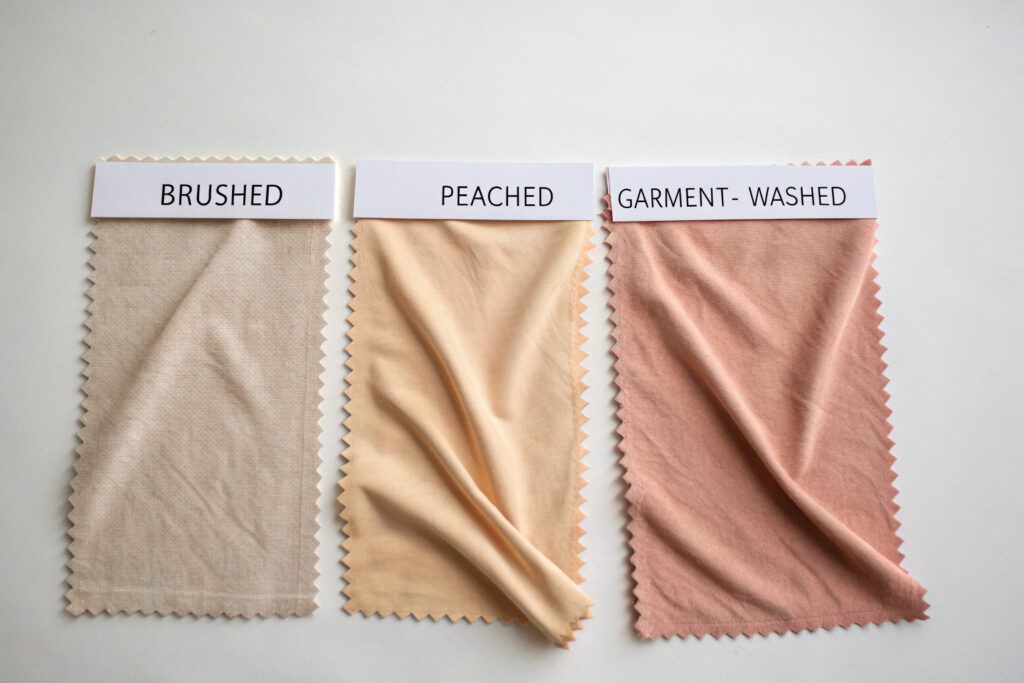
The terms brushed, peached, and garment-washed are often used interchangeably by brands, but they are distinct mechanical and chemical processes that produce different hand feels. Understanding these differences is the first step to specifying exactly what you want.
Brushed cotton is created by passing the fabric over rotating cylinders covered with fine wire bristles. These bristles pull individual fibers from the yarns to the surface, creating a raised, fuzzy nap. The brushing can be applied to one or both sides of the fabric. A heavily brushed cotton has a flannel-like, soft, and warm hand feel. The nap can be directional, meaning it feels smooth when you run your hand in one direction and rough in the other. Brushed cotton is ideal for a cozy, cold-weather bucket hat. The brushing process does weaken the fabric slightly because fibers are physically torn from the yarns, so the base fabric must be of sufficient quality to withstand the process without losing structural integrity.
Peached cotton is a gentler process. The fabric is passed over rollers covered with emery cloth or sandpaper-like material. This lightly abrades the surface fibers, creating a very fine, short, suede-like nap. The hand feel is smooth and velvety, not fuzzy. Peach finishing does not create a directional nap. It is a more subtle, luxurious softness. It is often used on high-end shirting and lightweight fashion fabrics. A peached cotton bucket hat has a refined, sophisticated softness rather than a rustic, cozy softness. The fabric retains more of its original strength because the abrasion is superficial.
Garment washing is a completely different category. It is applied to the finished hat, not the raw fabric. The sewn hat is washed in industrial machines, often with enzymes or softeners, and then tumble-dried. This process relaxes the fibers, removes residual sizing and stiffness from the manufacturing process, and creates a soft, lived-in drape. The fabric surface may not be visibly fuzzy, but the overall hand feel is soft and the hat body is pliable. Garment washing can be combined with brushing or peaching. A brushed and garment-washed hat is the ultimate in softness: it has the surface nap of brushing and the relaxed drape of washing.
How Do You Achieve a "Washed for Years" Softness?
The broken-in feel of a vintage garment comes from repeated washing and wearing. This mechanical action progressively breaks down the surface fibers and relaxes the internal stresses in the fabric and seams. To simulate this in production, we use a combination of enzyme washing and silicone softener treatment. Cellulase enzymes eat the microscopic fuzz and pilling on the cotton surface, leaving it smooth and clean. A silicone-based softener is then applied in the final rinse. The silicone molecules bond to the cotton fibers and provide an extremely slick, soft, almost lubricated hand feel. The combination of enzyme wash and silicone softener can make a new cotton hat feel like it has been washed fifty times. This is a proprietary process that each factory develops over time. The chemistry, the wash duration, and the mechanical action are all variables. When I work with a client on a super-soft hat, I produce a series of wash-down samples with different enzyme levels and softener concentrations so the client can select the exact hand feel they want.
What Is the Role of Fabric Weight in Perceived Softness?
Fabric weight is closely tied to perceived softness. A heavy, dense cotton canvas will never feel as soft as a lightweight cotton voile, even with aggressive finishing. The weight and weave structure set the baseline. For a super-soft brushed bucket hat, I recommend a fabric weight between 180 and 240 GSM. This is medium weight, substantial enough to hold the bucket hat silhouette but light enough to drape softly. A twill weave, specifically a 3/1 or 2/1 twill, brushes better than a plain weave because the floating yarns provide more fiber for the brushing rollers to lift. A plain weave can be brushed, but the result is less plush. I advise clients on the optimal fabric weight and weave for their desired hand feel and silhouette. A hat that is too lightweight will lack structure. A hat that is too heavyweight will not drape softly regardless of finishing. The sweet spot is a medium-weight twill, heavily brushed on the face, garment-washed with enzyme and softener.
What Should I Look for in a Pre-Production Sample to Verify the Hand Feel?
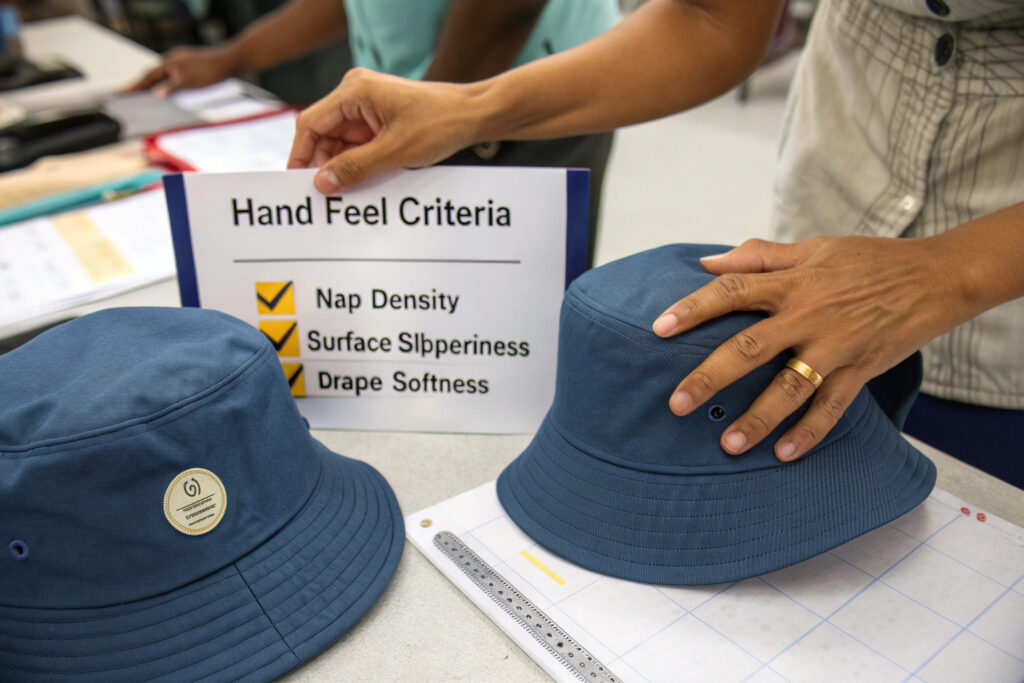
A specification document can describe the fabric weight, the brushing process, and the wash recipe, but hand feel is ultimately a sensory experience. You must physically touch and evaluate a pre-production sample before releasing the bulk order. The sample is the physical standard against which all bulk production will be compared. Your evaluation must be systematic, not just "it feels soft."
The evaluation criteria for a super-soft brushed cotton bucket hat include surface nap density and uniformity. Run your hand over the fabric surface in multiple directions. The nap should be dense, even, and free of bald spots or streaky lines where the brushing was uneven. The color should be consistent. Heavy brushing can lighten the apparent color because the raised fibers scatter light. The sample should represent the final color after all finishing. Squeeze the fabric in your fist. Release it. It should recover its shape without deep creases. The fabric should feel pliable and supple, not stiff or papery. Hold the hat by the brim and let the crown hang. The crown should drape softly, not stand rigidly. Turn the hat inside out. Check the interior seams. A garment-washed hat will have slightly puckered seams due to differential shrinkage between the thread and the fabric. This is acceptable and contributes to the lived-in look. The seam puckering should be even and not excessive.
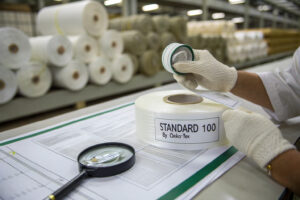
The most critical test is the comparative touch test. The factory should provide the pre-production sample along with a hand feel reference swatch, a small piece of the exact finished fabric. You keep this swatch as the gold standard. When the bulk production arrives, you or your inspector compares the bulk hats against the reference swatch, not against your memory of the sample. This objective comparison catches drift in the finishing process. A factory that is serious about hand feel will provide a sealed reference swatch with every bulk shipment.
How Can I Describe Hand Feel Objectively to a Factory?
Words like "soft" and "cozy" are subjective. One person's "soft" is another person's "flimsy." To communicate hand feel objectively, use measurable parameters. Specify the fabric weight in GSM. Specify the brushing process as "single-side heavy brush" or "double-side light brush." Reference a known commercial standard. "Hand feel should be similar to a well-worn flannel shirt after 20 washes." This creates a shared reference point. Better yet, provide a physical reference sample to the factory. Send them a piece of fabric or a garment that has the exact hand feel you want. I encourage clients to send me their favorite worn-in cotton shirt, a vintage hat, or a swatch from a competitor's product. I can reverse-engineer the finishing process. A physical reference is the most precise communication tool available.
What Are the Common Defects in Brushed Cotton Finishing?
Brushed cotton finishing is prone to specific defects that you should inspect for in the sample and in bulk. Streakiness occurs when the brushing rollers have worn unevenly or when the fabric feed speed varies. This creates visible lines in the nap direction. Pilling occurs when the raised fibers entangle into small balls. This indicates that the fibers were too short or the brushing was too aggressive without adequate fiber removal. A good brushing process includes a shearing or singeing step after brushing to trim loose fibers. Color unevenness occurs because brushed fabric reflects light differently from different angles. The brushing direction must be consistent across all panels. If some panels are cut with the nap running up and others with the nap running down, the hat will show a visible color split. This is a cutting-room error. The cutting marker must specify the nap direction for all panels.
How Does Garment Dyeing and Washing Contribute to the Broken-In Character?
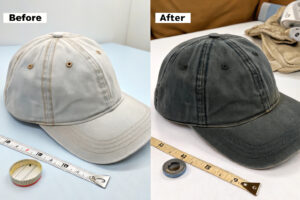
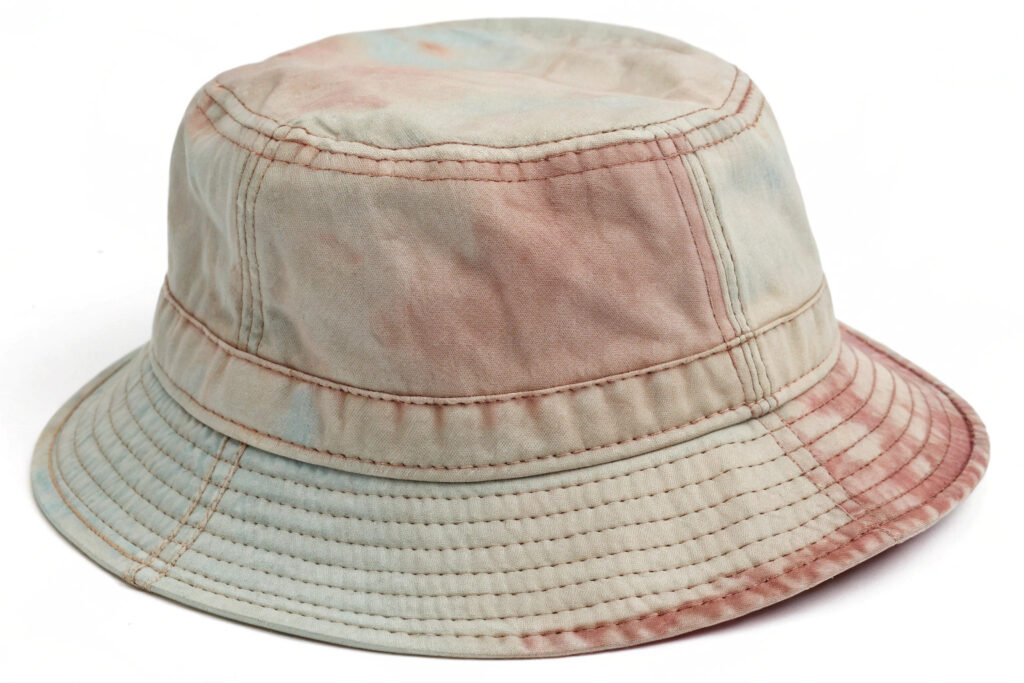
The softest, most broken-in bucket hats are often garment-dyed, not piece-dyed. Piece-dyeing means the fabric is dyed in roll form before it is cut and sewn. Garment-dyeing means the hats are sewn first, from greige or prepared-for-dye fabric, and then the finished hats are dyed in a batch dyeing machine. Garment-dyeing has a transformative effect on hand feel. The dyeing process, with its prolonged tumbling in hot water, thoroughly relaxes the fabric, the seams, and the construction. The hat emerges from the dye bath with a uniformly soft, worn-in character that piece-dyeing cannot replicate.
The garment-dyeing process also creates subtle, desirable variations. The seams take dye slightly differently, creating a gentle contrast that adds depth. The fabric develops a soft, irregular crinkle. The overall look is less "factory new" and more "artisan crafted." This aesthetic is highly valued in fashion and lifestyle brands. The dye chemistry can include a softener in the same bath, combining dyeing and softening into a single step. The hat is then tumble-dried, which further enhances the softness and drape. A garment-dyed, enzyme-washed, silicone-softened brushed cotton bucket hat represents the pinnacle of broken-in softness. I produce hats with this exact finishing sequence for brands that want the ultimate vintage feel.
The challenge of garment-dyeing is color consistency. Each dye batch may vary slightly due to differences in the cotton fiber's dye uptake. The shrinkage is also greater because the entire hat, including the seams and the brim insert, is subjected to the dyeing temperature. The pattern must be adjusted to account for this shrinkage. The brim insert material must be compatible with the dyeing temperature. A plastic brim insert can warp in the hot dye bath. I use a heat-resistant brim board or a fabric-only brim construction for garment-dyed hats. These technical adjustments require a factory with specific garment-dyeing expertise.
How Does the Dye Chemistry Affect the Final Hand Feel?
Reactive dyes, which chemically bond to cotton fibers, require an alkaline environment and high salt concentrations. These conditions can leave the fabric feeling harsh and dry if the dyeing process is not followed by a thorough neutralization and softening rinse. Direct dyes are simpler but have lower colorfastness. For a premium hand feel, the dyehouse must use high-quality reactive dyes with a proper post-dyeing soaping and softening sequence. The soaping removes unfixed dye and residual chemicals. The softening, as described earlier, applies a lubricating finish. I audit my dyehouse partners on their post-dyeing wet processing. A dyehouse that cuts corners on soaping and softening will produce a hat that looks great initially but feels dry and harsh after the first consumer wash.
Can Synthetic Fibers Be Added for Softness Without Losing the Cotton Feel?
A small percentage of a synthetic fiber can enhance softness and durability without sacrificing the natural cotton character. A 95% cotton, 5% elastane blend provides gentle stretch and recovery, which contributes to a comfortable, forgiving fit and a soft drape. A 90% cotton, 10% cashmere or wool blend adds extraordinary softness and warmth for a premium winter bucket hat. A 70% cotton, 30% Tencel lyocell blend produces an incredibly smooth, silky hand feel with excellent drape. Tencel is a regenerated cellulose fiber made from wood pulp, and it is exceptionally soft. I offer these blend options to clients who are seeking a specific, differentiated hand feel. The key is to keep the cotton content high enough that the hat still reads as a cotton product. The synthetic or regenerated fiber is an invisible enhancer, not the main character.
Conclusion
Sourcing a super-soft brushed cotton bucket hat that feels broken-in already is a journey into the textile finishing arts. The softness is not an accident. It is the result of deliberate, sequenced decisions: selecting a medium-weight twill fabric with good brushing potential, applying a heavy brushing or peaching process to create surface nap, constructing the hat with proper seam engineering, and finishing it with enzyme washing, silicone softening, and ideally garment-dyeing. The pre-production sample must be evaluated objectively against a hand feel reference swatch, and the specification must be locked into the purchase contract.
A hat that feels like a beloved old garment from the first wear is a powerful product. It communicates comfort, authenticity, and quality. It invites the consumer to touch it, try it on, and buy it. It builds brand loyalty because it feels good every single time it is worn. This is the level of product development that separates commodity hats from signature pieces.
If you are ready to develop a super-soft brushed cotton bucket hat with a genuinely broken-in hand feel, I invite you to work with Global-Caps. We have the in-house fabric development, brushing, and garment washing capabilities to engineer the exact tactile experience you want. We can produce a series of hand feel development samples on your chosen fabric, and we provide a sealed reference swatch with every bulk order. Reach out to our Business Director, Elaine, at elaine@fumaoclothing.com with your design concept and your ideal hand feel description. Let's create a bucket hat that feels like it has been a favorite for years, starting on day one.