You open your Pantone book. You pick Pantone 19-4052 Classic Blue. You send the code to the factory. They say "Noted." Four weeks later, the lab dip arrives. The color is a muted navy, not the vibrant classic blue you selected. You send it back. "Please match Pantone 19-4052." The second lab dip arrives. It is slightly different, still not right. You approve it in frustration. The bulk caps arrive. The color looks different under the retail store lighting. It looks different in the sunlight. It does not match your brand's other products. You started with a precise Pantone code. You ended with a color that is "close enough." The gap between the Pantone book and the recycled polyester cap is the color matching challenge. The Pantone chip is printed on paper. Your cap is dyed polyester made from recycled bottles. The substrate is different. The dye chemistry is different. The light reflection is different. An exact match is a scientific process, not a simple code transfer.
You match a Pantone color on recycled polyester cap fabric through a disciplined lab dip process that accounts for the specific characteristics of recycled polyester: its slightly off-white base color from the recycled bottle flake, its different dye uptake compared to virgin polyester, and its unique surface reflectance. You start by providing the factory with a physical Pantone chip or a spectrophotometer reading, not just the Pantone code. You specify the light source under which the color must match. You evaluate the lab dip on the actual fabric, not on a paper card. You measure the color difference with a spectrophotometer and accept a Delta E of 1.0 or less as a commercial match. You understand that an "exact" match—Delta E 0.0—is physically impossible between a paper chip and a textile fabric. The goal is a commercially acceptable match that looks identical to the human eye under the specified lighting conditions.
At Global-Caps, my dye house specializes in recycled polyester color matching. I understand the base color shift from the recycled content. I evaluate lab dips under D65 daylight and TL84 store light. I use a spectrophotometer to measure Delta E. The goal is not perfection. The goal is a match that your customer cannot distinguish from your brand standard.
Why Is Exact Color Matching on Recycled Polyester More Difficult Than Virgin Polyester?
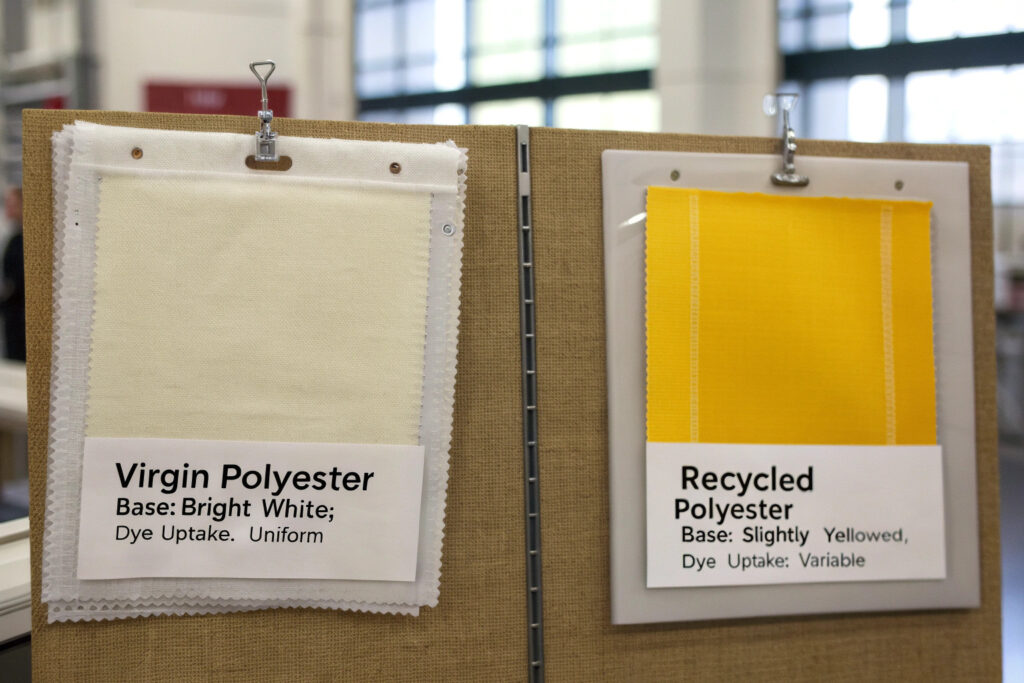
You assume polyester is polyester. Virgin or recycled, it is the same polymer, the same dye process, the same color result. You are wrong. Virgin polyester starts as a clear, bright white polymer chip. Recycled polyester starts as a mix of clear, light blue, and slightly yellowed bottle flakes. The base color of the recycled polymer is not pure white. It has a subtle warmth, a slight yellow or grey undertone depending on the bottle feedstock. When you dye virgin polyester with a specific formula, the color is bright and true. When you dye recycled polyester with the exact same formula, the color is slightly duller, slightly warmer. The dye formula that produced a perfect match on virgin polyester will miss on recycled polyester.
Exact color matching on recycled polyester is more difficult than on virgin polyester because the recycled base polymer has an inherent color cast from the post-consumer bottle feedstock that shifts the final dyed color. Virgin polyester is optically white and chemically uniform. Recycled polyester has slight color variations between batches of bottle flakes, requiring the dye master to adjust the dye formula for each lot. The molecular weight distribution of recycled polyester can be slightly broader than virgin polyester, affecting the dye uptake rate and the final color depth. The dye master cannot use the standard virgin polyester dye recipe and expect the same result on recycled polyester.
My dye house maintains separate dye recipe databases for virgin and recycled polyester. A Pantone match request on recycled polyester starts from the recycled recipe database, not the virgin database.
The base color of the recycled polyester is the hidden variable that shifts every dye formulation.
How Does the Base Color of Recycled Bottle Flakes Affect Dye Formulation?
Recycled polyester is made from post-consumer PET bottles. The bottles are collected, sorted, washed, and ground into flakes. The flakes are a mix of clear, light blue, light green, and slightly yellowed material. The flake mixture is melted and extruded into new polyester chips or directly into fiber. The resulting polymer has a base color that is not optically white.
When a dye formula is applied to this base, the dye color mixes with the base color. A light pastel dye on a slightly yellow base produces a slightly warmer, slightly dirtier pastel than the same dye on a pure white base. The dye master must compensate for the base color by adjusting the dye formula—adding a small amount of blue or violet dye to neutralize the yellow undertone, or increasing the dye concentration to overcome the base dullness.
My recycled polyester yarn supplier provides a batch-specific base color measurement. The dye house adjusts the formula for each yarn lot.
Why Does the Molecular Weight of Recycled Fibers Influence Dye Absorption?
The molecular weight of a polymer affects how tightly the polymer chains are packed and how readily dye molecules can penetrate the fiber. Recycled polyester may have a slightly broader molecular weight distribution than virgin polyester due to thermal degradation during the initial processing, the mechanical recycling process, and the re-extrusion. Some polymer chains are shorter. Some are longer.
Shorter polymer chains create a looser fiber structure that absorbs dye more quickly. Longer chains create a tighter structure that absorbs dye more slowly. The uneven molecular weight distribution in recycled polyester can cause uneven dye uptake, resulting in a color that is slightly less uniform than on virgin polyester. The dye master must use a slower dyeing cycle and a more careful temperature ramp to achieve uniform dye penetration.
My dyeing protocol for recycled polyester uses an extended dyeing cycle with a slower temperature ramp compared to virgin polyester.
How to Submit a Pantone Color Request for Recycled Polyester Cap Fabric?
You email the factory: "Color: Pantone 19-4052 Classic Blue." You think you have communicated the color. You have communicated a code. The code is a reference to a printed paper chip that the dye master may or may not have. The dye master does not have your specific Pantone book, with your specific lighting, with your specific expectations. You gave the minimum information. You will get the minimum result.
You submit a professional Pantone color request by providing the physical Pantone chip or a spectrophotometer reading of the target color, specifying the exact fabric substrate and weight, defining the primary and secondary light sources for color evaluation, stating the acceptable Delta E tolerance, and providing a physical reference sample if you have one. The request form should be accompanied by a digital spectral data file if available. The more data you provide, the closer the first lab dip will be to your target.
My lab dip request form captures all of these data points. Clients who submit complete requests receive first-round lab dips that are, on average, Delta E 1.2 from target. Clients who submit only a Pantone code receive first-round lab dips that are Delta E 2.5 from target.
The physical Pantone chip is the gold standard reference. A code alone is insufficient.

Why Should You Send a Physical Pantone Chip Rather Than Just a Code?
A Pantone code is a name for a color standard. The physical Pantone chip is the color standard. Printed chips can vary slightly between editions of the Pantone book due to printing tolerances. A chip from an older book may have faded slightly from light exposure. The dye master needs the specific chip that you are using as your reference.
By sending the physical chip, you eliminate the variability of screen displays and printer outputs. The dye master places your chip under the lightbox next to the lab dip. The comparison is direct. There is no translation error.
I recommend clients purchase a fresh Pantone chip from the current edition and send it to the dye house with the lab dip request.
What Information Should the Lab Dip Request Form Include for Recycled Polyester?
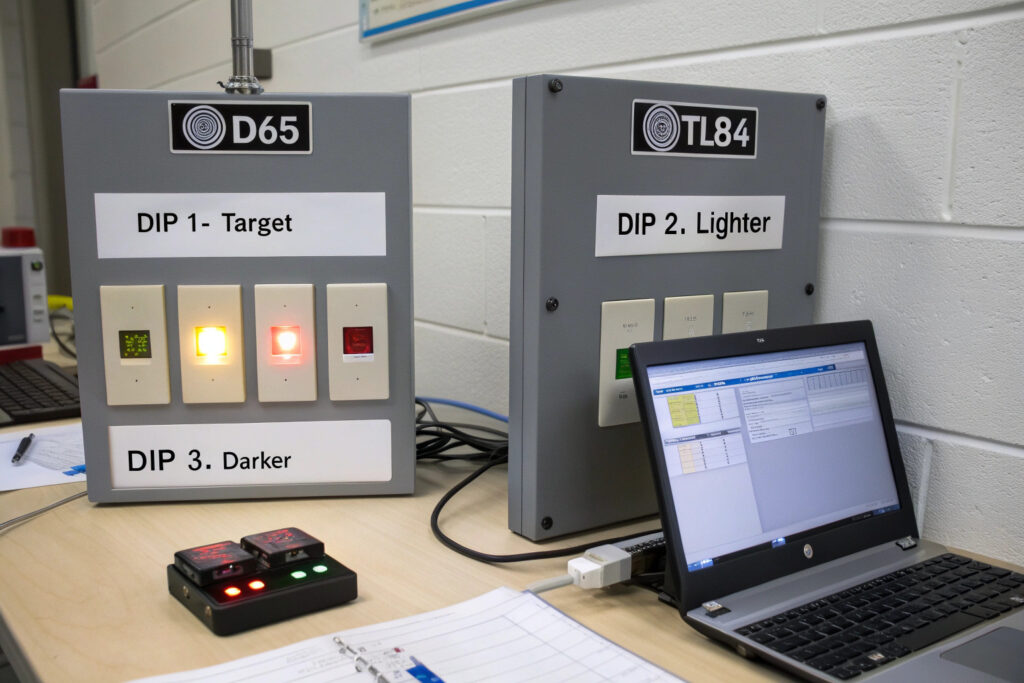
The lab dip request form should include the Pantone code and the physical chip, the fabric specification including fiber content (100% recycled polyester), fabric construction (twill, knit, etc.), and fabric weight (gsm), the primary light source for matching (D65 daylight recommended), the secondary light source (TL84 or store light), the acceptable Delta E tolerance (1.0 or less recommended), the end use of the product (caps, which indicates the importance of colorfastness to light and perspiration), any special finishing requirements (brushed, anti-microbial, water repellent), and the required number of lab dip swatches (three recommended: one on-target, one slightly lighter, one slightly darker).
My recycled polyester lab dip form includes all of these fields. The form is available in English and Chinese.
What Is the Role of the Spectrophotometer in Achieving a Delta E ≤ 1.0 Match?
You approve the lab dip by looking at it under the factory's fluorescent light. It looks close. You sign the approval form. The bulk fabric arrives. Under your office daylight, the color is visibly off. Your eye was fooled by the factory's lighting. Your visual approval was subjective. The factory's light was different from your light. The metamerism tricked you. The spectrophotometer would have caught the mismatch.
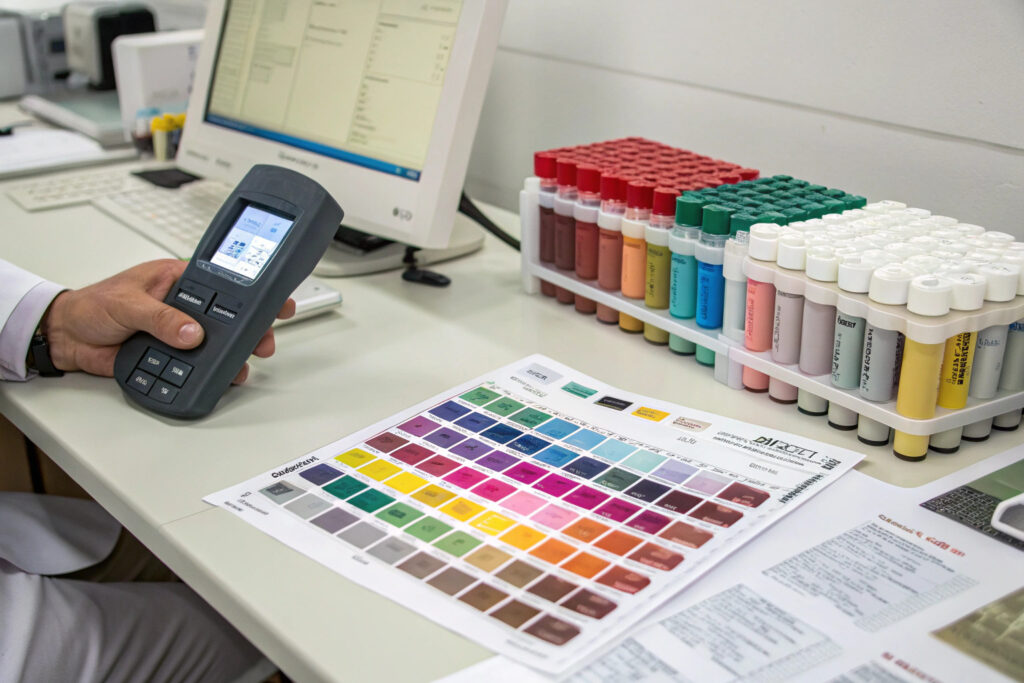
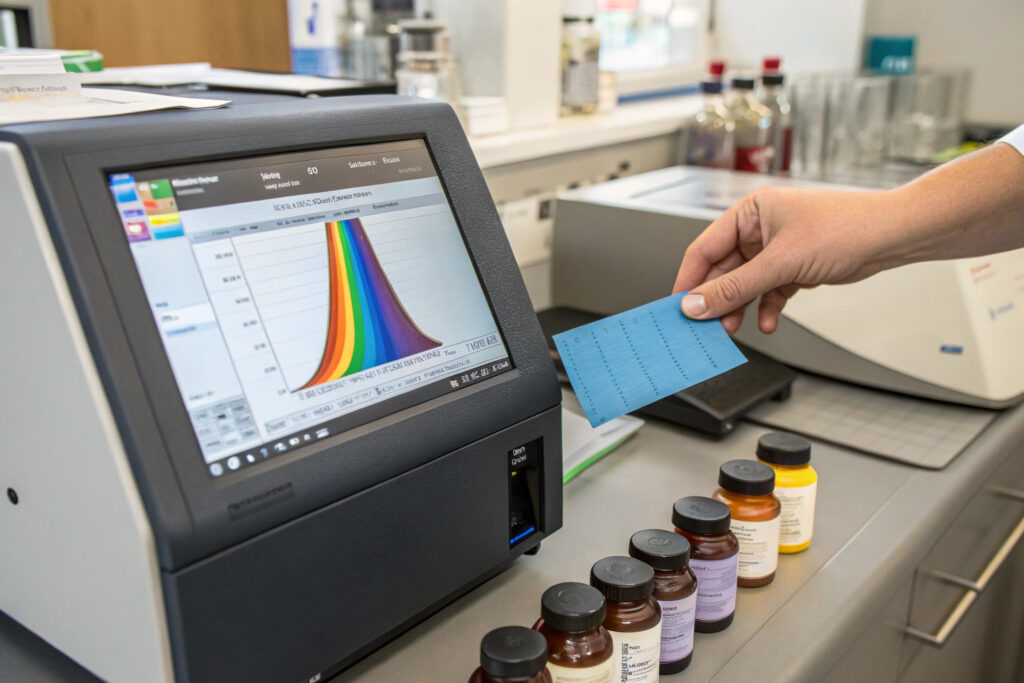
The spectrophotometer achieves a Delta E of 1.0 or less by providing an objective, numerical measurement of the color difference between the lab dip and the target standard. The instrument measures the spectral reflectance of both samples across the visible spectrum, calculates their coordinates in the CIELAB color space, and computes the Delta E value—the mathematical distance between the two colors. A Delta E of 1.0 or less represents a difference that is imperceptible to the human eye under standard lighting conditions. The spectrophotometer removes the subjectivity of human color perception, the variability of ambient lighting, and the fatigue of the human eye after evaluating multiple samples.
My color approval protocol requires a spectrophotometer reading of every lab dip. The Delta E value is recorded on the lab dip report. A dip with Delta E greater than 1.0 is automatically rejected, regardless of how it looks to the eye.
The CIELAB color space is the mathematical language of color. Delta E is the distance in that space.
How Does the CIELAB Color Space Quantify Color Differences Numerically?
The CIELAB color space describes every color with three coordinates. L represents lightness on a scale from 0 (black) to 100 (white). a represents the green-to-red axis. Negative a is green. Positive a is red. b represents the blue-to-yellow axis. Negative b is blue. Positive b* is yellow.
The Delta E value is calculated as the Euclidean distance between the Lab* coordinates of the sample and the standard. The formula accounts for the non-uniformity of human color perception. The CMC version of Delta E applies weighting factors that adjust for the fact that the human eye is more sensitive to hue differences in oranges and less sensitive to chroma differences in deep blues.
My spectrophotometer uses the Delta E CMC formula with a 2:1 weighting ratio. The tolerance for approval is Delta E CMC ≤ 1.0.
Why Should You Require the Lab Dip Measurement Under D65 and TL84 Light Sources?
D65 is the international standard for natural daylight with a color temperature of 6500 Kelvin. It simulates noon daylight in Northern Europe. TL84 is a fluorescent store light with a color temperature of 4000 Kelvin, commonly used in retail environments. A color that matches under D65 may not match under TL84 due to metamerism—the two materials have different spectral reflectance curves that intersect under D65 but diverge under TL84.
By measuring the lab dip under both D65 and TL84, the spectrophotometer calculates the Delta E under each light source. A lab dip that passes under D65 but fails under TL84 is metameric and should be reformulated. A lab dip that passes under both light sources is a robust commercial match.
My lab dip measurement protocol requires Delta E readings under both D65 and TL84. Both must be ≤ 1.0 for approval.
How to Evaluate a Lab Dip on Recycled Polyester for Final Approval?
You receive one lab dip swatch. It is a small square of fabric. You hold it up to your office window. It looks close. You approve it by email. You have evaluated the color under one light source, at one time of day, with your eyes. The bulk fabric arrives. The color looks different on an overcast day. It looks different under the store lights. You approved a metameric match. The evaluation was incomplete.
You evaluate a lab dip on recycled polyester for final approval by examining the swatch in a lightbox under both D65 daylight and TL84 store light, comparing it directly against your physical Pantone chip, measuring the Delta E with a spectrophotometer, and checking for metamerism by viewing the match under both light sources. You request three swatches—one on-target, one slightly lighter, one slightly darker—to understand the dye formulation range. You make the approval decision based on the spectrophotometer data, not just your visual impression.
My lab dip evaluation kit includes a grey evaluation board, a D65/TL84 lightbox, and a lab dip evaluation form. I guide every client through the evaluation process.
The metamerism check is the most important and most frequently skipped evaluation step.
What Is the Metamerism Check and Why Is It Critical for Recycled Polyester?
The metamerism check evaluates whether the lab dip matches the Pantone standard under two or more different light sources. The evaluator views the dip and the standard side by side in the lightbox, first under D65 daylight, then under TL84 store light, and optionally under incandescent home light.
If the colors match under D65 but appear different under TL84, the match is metameric. The dye formulation uses a different combination of dyes than the Pantone ink formulation. The spectral reflectance curves are different shapes that happen to intersect under D65. A metameric match will look wrong in a retail store. Recycled polyester, with its slightly different base color, is more prone to metamerism with Pantone standards than virgin polyester.
My lab dip report includes a metamerism index value. An index greater than 1.0 indicates a metameric match that should be reformulated.
Should You Approve a Lab Dip That Looks "Close Enough" by Eye?
No. "Close enough" by eye is a subjective judgment made under uncontrolled lighting. The human eye is excellent at detecting small color differences in a side-by-side comparison under controlled lighting. The human eye is poor at remembering colors and comparing them from memory. A lab dip that looks "close enough" in the factory may look wrong when the bulk cap is worn with your brand's other products.
The approval decision should be based on the spectrophotometer data—Delta E ≤ 1.0 under both D65 and TL84—supplemented by a visual confirmation that the match looks correct. If the spectrophotometer says pass and your eye says fail, trust the instrument but investigate the lighting conditions. If the spectrophotometer says fail, reformulate. Do not approve a lab dip that fails the Delta E tolerance.
My approval policy requires a Delta E ≤ 1.0 for approval. No exceptions. The policy protects the brand.
Conclusion
Matching a Pantone color on recycled polyester cap fabric is a scientific process that accounts for the unique characteristics of the recycled material. The base color of the recycled polymer shifts the final dyed color. The molecular weight distribution affects dye uptake. The dye master cannot use a virgin polyester recipe. The process starts with a professional color request that includes a physical Pantone chip, a spectrophotometer reading, and a specification of the light sources for matching.
The spectrophotometer is the objective judge. Delta E CMC of 1.0 or less is the target. Measurements under both D65 and TL84 light sources detect metamerism. The lab dip is evaluated in a lightbox, compared against the physical standard, and approved based on the spectrophotometer data, not a subjective visual impression.
An exact, zero-delta match between a paper Pantone chip and a textile fabric is physically impossible. The goal is a commercially acceptable match—Delta E of 1.0 or less—that looks identical to the human eye under the specified lighting conditions. The process requires discipline, data, and a dye house with specific experience in recycled polyester.
At Global-Caps, my recycled polyester color matching process is built on spectrophotometer data, controlled lighting, and a dye house that understands the recycled base color. I measure every lab dip. I check metamerism. I approve only Delta E 1.0 or less.
If you need custom caps in recycled polyester with a precise Pantone color match, contact my Business Director Elaine. She can provide our lab dip request kit, a spectrophotometer-calibrated color evaluation guide, and a recycled polyester lab dip for your target Pantone. Email Elaine at elaine@fumaoclothing.com. Let's match your color with data, not guesswork.