A brand owner from Stockholm once sent me a sample of a competitor's reflective beanie and a frustrated note. His customers loved the safety feature of reflective yarn, but they hated the fit. The reflective stripes were stiff, the cuff barely stretched, and the hat felt like it was made from plastic tape rather than soft knit fabric. He asked me a direct question: "Can you make a beanie that glows at night but still stretches like a normal hat?" I told him yes, but it required a completely different approach to how the reflective yarn was integrated.
You can integrate reflective yarn into a custom beanie without affecting its stretch by using a high-stretch reflective yarn as an accent rather than a structural component, knitting it in a plated or intarsia technique rather than as a rigid stripe, and selecting a base yarn with strong recovery properties. The key is to keep the reflective yarn from dominating the fabric's mechanical behavior. It should add visibility and style without locking the knit into a stiff, unyielding structure.
At AceAccessory, we have developed specific knitting programs and yarn combinations for reflective beanies that solve the stiffness problem. We supply these to brands in Scandinavia, Germany, and North America, where reflective accessories are a practical safety feature as much as a fashion statement. Let me walk you through exactly how the reflective yarn works, what techniques prevent the stiffness, and how to test that your beanie will stretch properly.
What Types of Reflective Yarn Are Suitable for Stretchy Beanies?
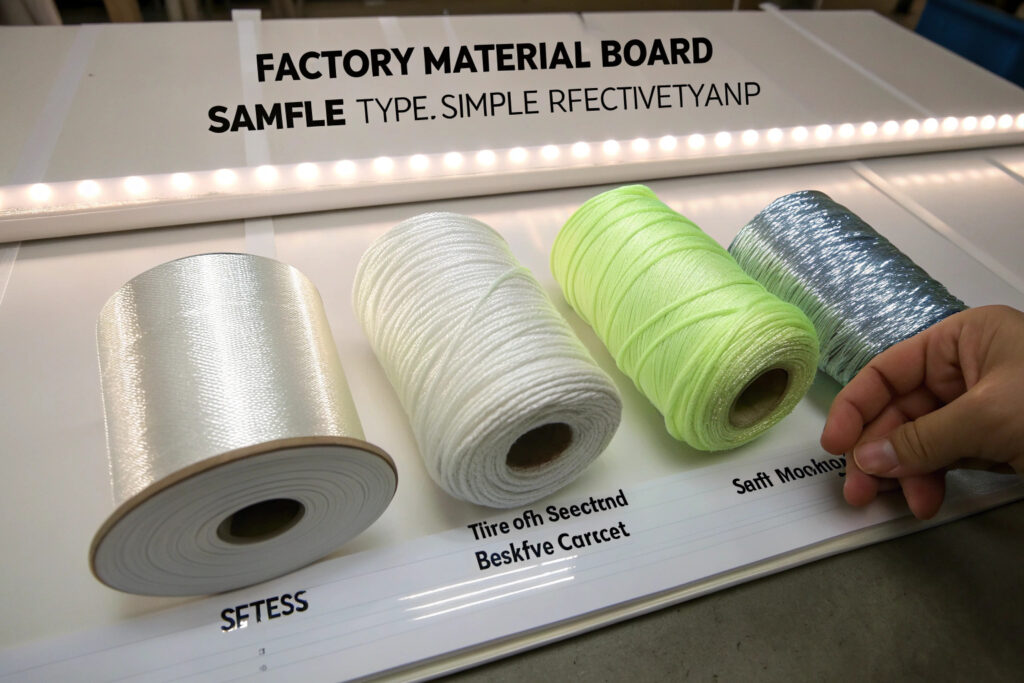
Not all reflective yarn is the same. Some reflective materials are designed for rigid applications like safety vests and industrial webbing. These are stiff, plasticky, and completely unsuitable for a stretchy beanie. Other reflective yarns are engineered specifically for knitwear. They combine the reflective element with a stretchy synthetic base fiber. Choosing the right type of reflective yarn is the first and most important decision.
Why Do Rigid Reflective Tapes Kill the Stretch of a Knit?
Rigid reflective tapes are made from a plastic film with millions of tiny glass beads bonded to the surface. The plastic film is not elastic. When you knit this tape into a beanie, it acts like a stiff band that resists every stretch. The knit fabric around it can stretch, but the reflective tape cannot. The result is a hat that feels tight in exactly the spots where the reflective element is placed. The tape also creates an uncomfortable ridge on the inside of the hat that presses against the skin. This is the problem the Stockholm buyer experienced. The solution is to avoid reflective tapes entirely for stretchy applications. They are designed for flat, non-stretch surfaces like jacket backs and bag panels, not for a knit tube that needs to expand and contract around a head.
What Is Retroreflective Yarn and How Does It Maintain Flexibility?
Retroreflective yarn is a completely different material. It is made by twisting a core of stretchy synthetic filament, such as nylon or polyester, with a coating that contains reflective glass microbeads or a reflective metallic layer. The yarn itself is soft, pliable, and slightly elastic. It can be knitted, purled, and stretched without cracking or losing its reflective properties. The retroreflective effect works by reflecting light directly back toward its source. When a car headlight hits the beanie, the light bounces back toward the driver, making the wearer visible from a long distance. This is the same principle used in road signs and high-visibility clothing. Because the reflective element is integrated into the yarn structure rather than applied as a rigid film, the yarn can move with the knit fabric. A well-made retroreflective yarn is the only choice for a stretchy beanie.
What Knitting Techniques Preserve Stretch While Adding Reflective Accents?
The way the reflective yarn is introduced into the knit is just as important as the yarn itself. A technique that traps the yarn under tension will create a stiff fabric. A technique that allows the reflective yarn to float or stretch with the base yarn will preserve the elasticity. Professional knitting factories have several methods for this, and the choice depends on the design you want to achieve.
How Does Plating Reflective Yarn Keep the Inside Soft and Stretchy?
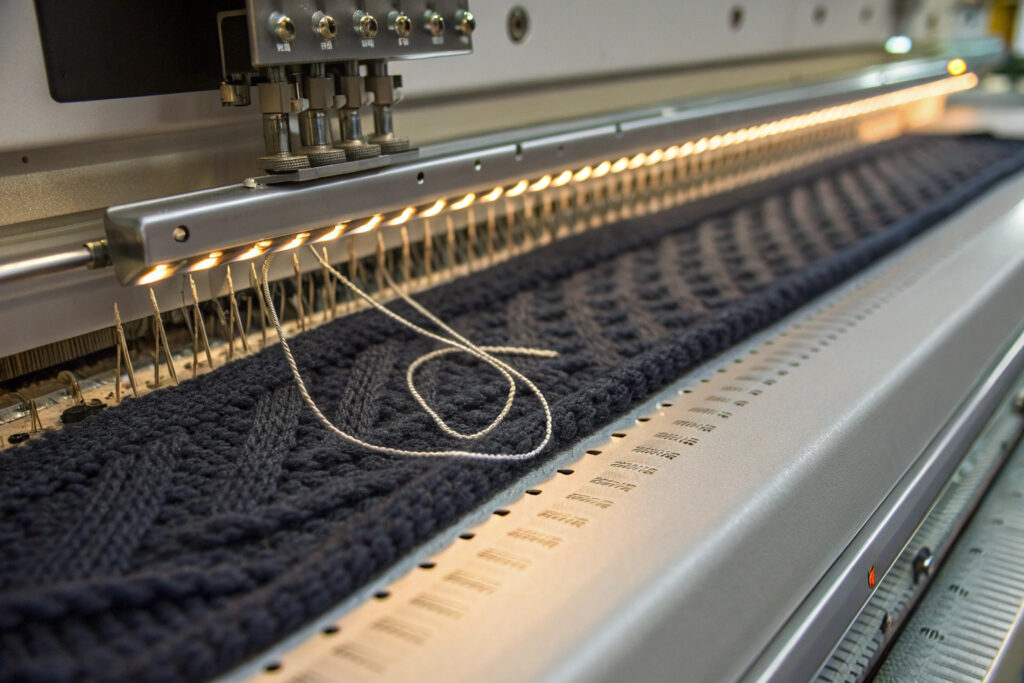
Plating is a knitting technique where two yarns are fed into the same knitting needle simultaneously, but one yarn is positioned to appear on the face of the fabric while the other appears on the back. In a reflective beanie, the reflective yarn is plated onto the outside surface, and a soft, stretchy base yarn like cotton or bamboo is positioned on the inside surface. The inside of the hat, the part that touches the skin, is soft and non-reflective. The outside of the hat has the reflective effect. Because the reflective yarn is only on the surface and is carried along with the stretchy base yarn, the fabric retains most of its natural elasticity. The reflective yarn does not form a rigid structural band. It is simply a surface accent that stretches along with the base. This is the most common technique for reflective cuffs on beanies.
How Does Intarsia Create Reflective Patterns Without a Stiff Backing?
Intarsia is a knitting technique used to create blocks of color or pattern in a specific area of the fabric, without carrying the yarn across the back of the work. In a reflective beanie, intarsia could be used to knit a reflective logo, a reflective stripe, or a geometric pattern into a specific section of the hat. The reflective yarn is only present in the pattern area. It is not carried behind the rest of the fabric. This means the reflective area stretches with the surrounding knit because it is knit at the same gauge and tension as the base fabric. The transition between the reflective yarn and the base yarn is smooth, with no thick floats or rigid bands on the inside. Intarsia allows for more complex reflective designs than simple plated stripes, but it requires more programming time on the knitting machine and produces more yarn waste. It is the premium option for a fully customized reflective beanie.
How Do You Test the Stretch and Recovery of a Reflective Beanie?
A beanie is only as good as its ability to fit heads of different sizes comfortably. A reflective beanie that does not stretch is not a beanie. It is a rigid tube. Testing the stretch and recovery is the only way to know whether the reflective yarn integration has been done correctly. This testing should be part of the standard QC protocol for any reflective beanie production.
What Are the Standard Stretch and Recovery Benchmarks for Knit Beanies?
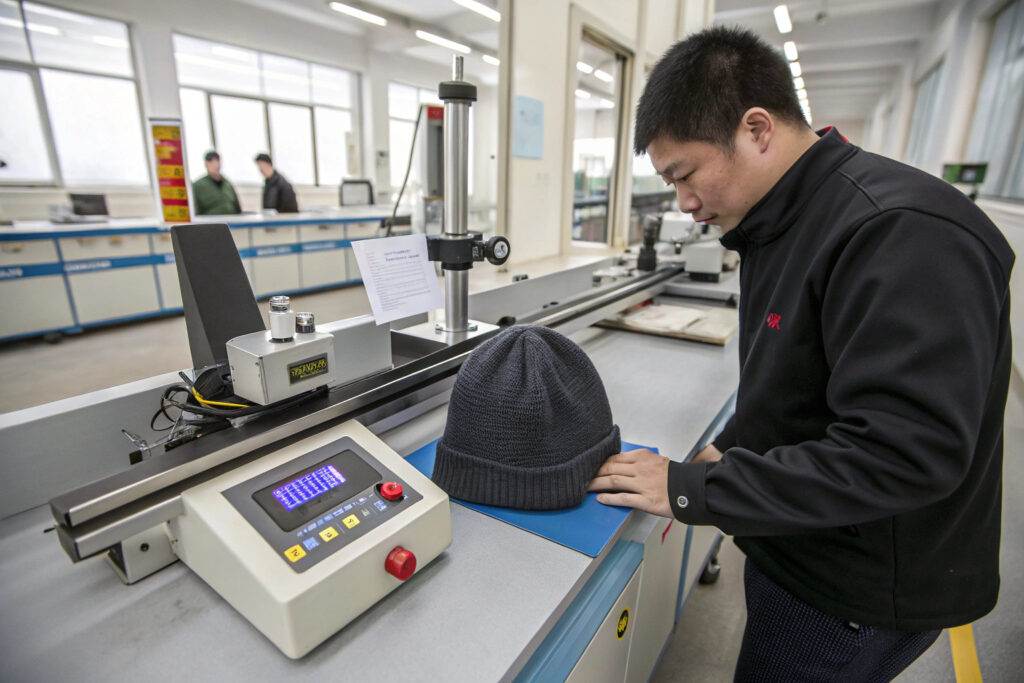
We test the stretch of a finished beanie by measuring the force required to extend the cuff to a specific percentage of its resting circumference. A standard beanie cuff should be able to stretch to at least 150 percent of its resting width with minimal force. This means a cuff with a resting width of 20 centimeters should stretch easily to 30 centimeters. The recovery test measures how well the cuff returns to its original width after being stretched. The cuff is stretched to 150 percent, held for 30 seconds, and then released. After 5 minutes, the cuff width is measured again. A good recovery is when the cuff returns to within 5 percent of its original width. A reflective beanie with plated or intarsia reflective yarn should meet the same benchmarks as a non-reflective beanie. If it does not, the reflective yarn is too stiff or the knitting tension is too tight. These test methods are based on textile testing standards that are documented by organizations like ASTM International.
How Do You Simulate Real-World Washing and Wearing Conditions?
Stretch performance must survive washing. A reflective beanie that stretches well when new but becomes stiff or deformed after washing is a failed product. We perform a wash test on reflective beanie samples, using a cold water gentle cycle and air drying, then re-test the stretch and recovery. We also check that the reflective yarn has not lost its retroreflective performance after washing. Some reflective yarns degrade after repeated washing, especially if they are coated with a water-soluble finish. We require our reflective yarn supplier to provide a wash fastness test report, and we perform our own verification on finished samples. The reflective effect should remain clearly visible after at least 25 wash cycles. This durability testing is essential for a product that is marketed as a safety accessory.
What Design Patterns Work Best for Reflective Beanies?
The design of the reflective element affects both the aesthetics and the stretch. A design that places too much reflective yarn in one concentrated area can create a stiff spot, even with a high-quality yarn. A design that distributes the reflective yarn more evenly allows the fabric to stretch uniformly. The smart design choice balances visibility, style, and mechanical performance.
Why Does a Thin Reflective Stripe Often Outperform a Wide Reflective Band?
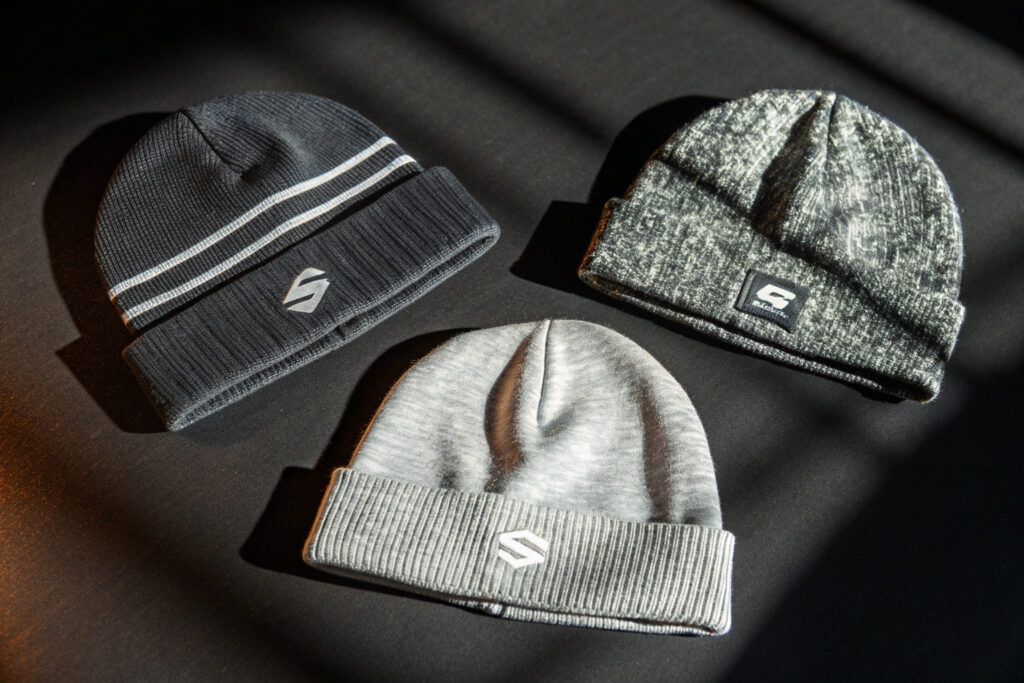
A wide reflective band looks dramatic, but it concentrates a large amount of reflective yarn in one horizontal line. This creates a section of fabric where the reflective yarn dominates the knit structure, and the stretch in that section is reduced. A thin reflective stripe, typically 1 to 2 centimeters wide, provides a clear visible accent without creating a rigid band. The stripe is integrated into the rib structure of the cuff, where the natural elasticity of the rib helps mask the reflective yarn's lower stretch. The eye sees a clear reflective line, but the hand feels a soft, stretchy cuff. This is the most reliable design for maintaining comfort while adding visibility. It is also the most economical in terms of reflective yarn usage.
How Can Reflective Fleck Yarn Provide All-Over Visibility Without Stiffness?
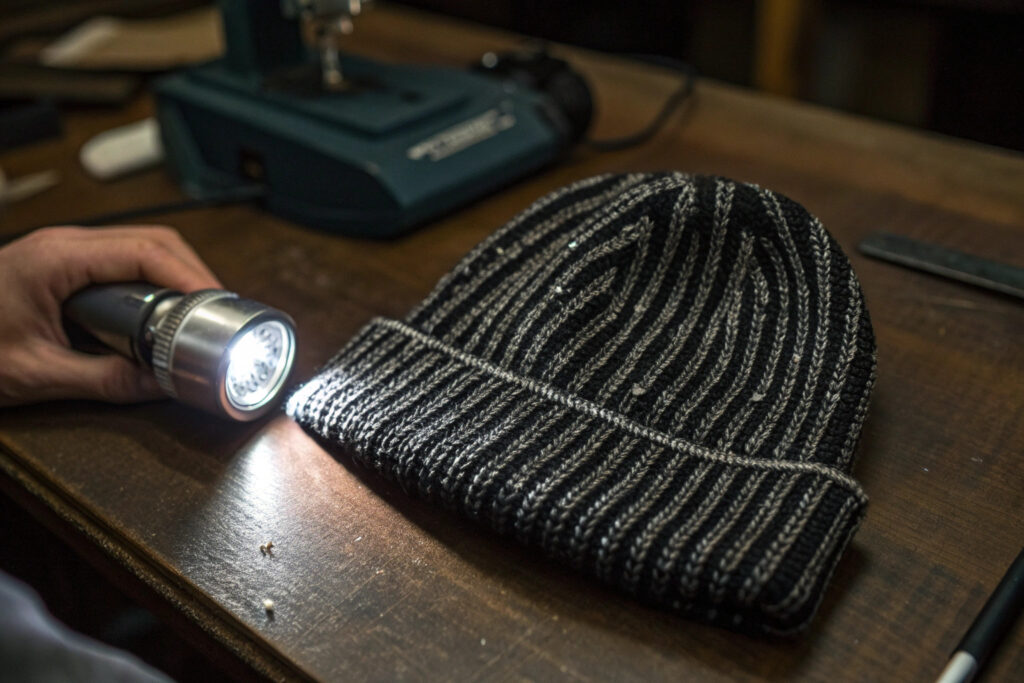
For a more subtle and premium effect, a twisted reflective fleck yarn can be used as a small percentage of the base yarn blend. This creates a beanie that looks like a normal dark knit in daylight, but when a light hits it at night, tiny reflective points sparkle across the entire surface. Because the reflective fleck is distributed evenly and makes up only a small fraction of the yarn, it has almost no effect on the fabric's stretch or softness. This is the perfect solution for brands that want a safety feature without a visible, high-tech look. It is also excellent for fashion beanies where the reflective function is a hidden bonus rather than the main selling point. The cost is higher than a simple stripe because the entire yarn needs to be custom blended, but the effect is unique and highly marketable.
Conclusion
Integrating reflective yarn into a custom beanie without affecting its stretch is a matter of material selection, knitting technique, and design restraint. You must choose a high-stretch retroreflective yarn designed for knitwear, not a rigid reflective tape made for flat applications. You must use a knitting method like plating or intarsia that carries the reflective yarn as a surface accent rather than a structural element. You must design the reflective element as a thin stripe, a small logo, or an all-over fleck rather than a wide, rigid band. And you must test the finished beanie for stretch, recovery, and wash durability to ensure the reflective yarn has not compromised the comfort.
A reflective beanie that stretches well and glows brightly in the dark is a rare and valuable product. It satisfies a real safety need for cyclists, runners, and pedestrians, and it does so without sacrificing the comfort and fit that make a beanie a pleasure to wear. The brand that gets this right owns a niche that is both practical and premium.
At AceAccessory, we have developed the knitting programs, the yarn sourcing relationships, and the QC protocols to produce stretchy, comfortable reflective beanies at scale. Our samples have been tested for stretch recovery and wash fastness, and we can provide the test reports to back up our claims.
If you are considering adding a reflective beanie to your line and want a factory that understands the technical requirements, I invite you to contact us. We can send you a sample with a plated reflective stripe and one with a reflective fleck blend so you can compare the stretch and the effect yourself.
To discuss your reflective beanie project, please contact our Business Director, Elaine. You can reach her directly at elaine@fumaoclothing.com. Let us make a beanie that keeps your customers seen and comfortable.