You finalize a vibrant, playful design for a kids' baseball cap. The front panel features a cartoon character printed in bright, opaque inks. The sample looks fantastic. Your retail buyer loves it. Just before the purchase order is signed, their compliance team sends a document: "Please provide chemical migration test reports for all printed components per EN 71-3." You forward the request to your cap supplier. They reply, "Our inks are safe. We have used them for years." You press for a test report. They go silent for three days, then send a generic ink safety data sheet from their ink supplier. It is not a migration test report on the finished cap. It does not meet the standard your retail buyer specified. Your order is now stalled.
Chemical migration testing on printed designs for children's products is not an optional extra. It is a legal requirement in the European Union, the United Kingdom, and increasingly in other major markets. The test measures whether toxic elements, heavy metals like lead, cadmium, chromium, and other restricted substances, can migrate from the printed ink into a child's body if the cap is sucked, chewed, or worn against sweaty skin. I run Global-Caps, and I have guided many clients through the process of demanding and obtaining valid, accredited migration test reports. In this article, I will explain exactly what chemical migration testing is, what standards apply, what documentation you must demand from your supplier, and how to write the testing requirement into your purchase contract so it is non-negotiable.
What Is Chemical Migration Testing, and Why Is It Mandatory for Kids' Caps?
Chemical migration testing is a laboratory procedure that simulates the exposure of a printed or coated textile to the body fluids of a child. The test is not about whether the ink contains a toxic substance. It is about whether that toxic substance can migrate, move, out of the ink and into the child's body. A heavy metal that is tightly bound within a polymer matrix and cannot be extracted by sweat or saliva is less of a health risk than the same metal in a soluble form that leaches out easily. The test measures the bioavailable fraction, not the total content.
The test method involves cutting the printed areas of the cap into small pieces, immersing them in a simulated body fluid, typically an acidic solution that mimics stomach acid or an alkaline solution that mimics saliva, and agitating the mixture at body temperature for a specified time. The liquid is then analyzed using inductively coupled plasma optical emission spectrometry or a similar technique to measure the concentration of nineteen specific elements, including lead, cadmium, mercury, chromium VI, arsenic, and antimony. The results are reported in milligrams per kilogram of material. These results are compared against the legal migration limits defined in the relevant standard.
For kids' baseball caps sold in the European Union, the mandatory standard is EN 71-3: Migration of Certain Elements. This standard is part of the Toy Safety Directive, and it applies to any product that is intended for use by children under 14 years of age. The limits are tiered by material type. For dry, brittle, powder-like materials, for liquid or sticky materials, and for scraped-off materials, the printed ink on a cap falls into the scraped-off materials category. The limits are extremely low, in the range of milligrams per kilogram. Lead is limited to 23 mg/kg. Cadmium to 1.9 mg/kg. Chromium VI to 0.05 mg/kg. These are trace levels. An ink formulation that contains a lead-based pigment or a cadmium-based colorant will fail spectacularly, even if the pigment constitutes only a small fraction of the ink.

How Does EN 71-3 Differ From Other Chemical Safety Standards?
EN 71-3 is a migration standard. It is distinct from total content standards like CPSIA in the United States, which limits total lead in surface coatings to 90 parts per million, and total lead in substrates to 100 parts per million. A printed cap for the US market must comply with CPSIA total lead limits. A printed cap for the EU market must comply with EN 71-3 migration limits. The two tests are different, the sample preparation is different, the extraction fluid is different, and the limits are expressed differently. A test report that shows compliance with CPSIA does not demonstrate compliance with EN 71-3. You cannot substitute one for the other. If your cap is sold in both markets, you need both tests.
REACH, the EU regulation on chemicals, adds another layer. REACH restricts specific substances, such as certain phthalates in plastics, azo dyes that release carcinogenic amines, and organotin compounds. A printed kids' cap must also comply with the relevant REACH restrictions. A comprehensive compliance package for a printed kids' cap includes EN 71-3 migration tests, REACH SVHC screening, and for the US market, CPSIA lead and phthalate compliance certificates. I help my clients navigate this complex regulatory landscape by providing a complete test package from an accredited laboratory.
What Specific Risks Do Printed Inks Pose for Children?
Children interact with caps differently than adults. They take them off and play with them. They chew on the brim. They suck on the adjustable strap. They handle the cap and then put their fingers in their mouths. The printed ink is in direct contact with saliva, sweat, and the mechanical abrasion of chewing. This is why migration testing is critical.
The historical risk comes from certain pigments. Lead chromate was widely used as a bright yellow and orange pigment. Cadmium sulfide was used for brilliant reds and yellows. These pigments are now banned in children's products in most developed markets, but they still appear in the supply chains of unregulated, low-cost manufacturers. A printed design that uses a vibrant, opaque yellow or orange is a higher risk for lead and cadmium than a dark blue or black. This does not mean all yellow prints are dangerous, but it means the risk is higher and the testing is essential. I am particularly vigilant about the pigment chemistry of yellow, orange, red, and green prints on kids' caps. These colors historically have the most problematic pigment chemistries.
What Documentation Must You Demand From Your Hat Supplier?
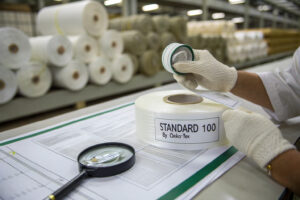
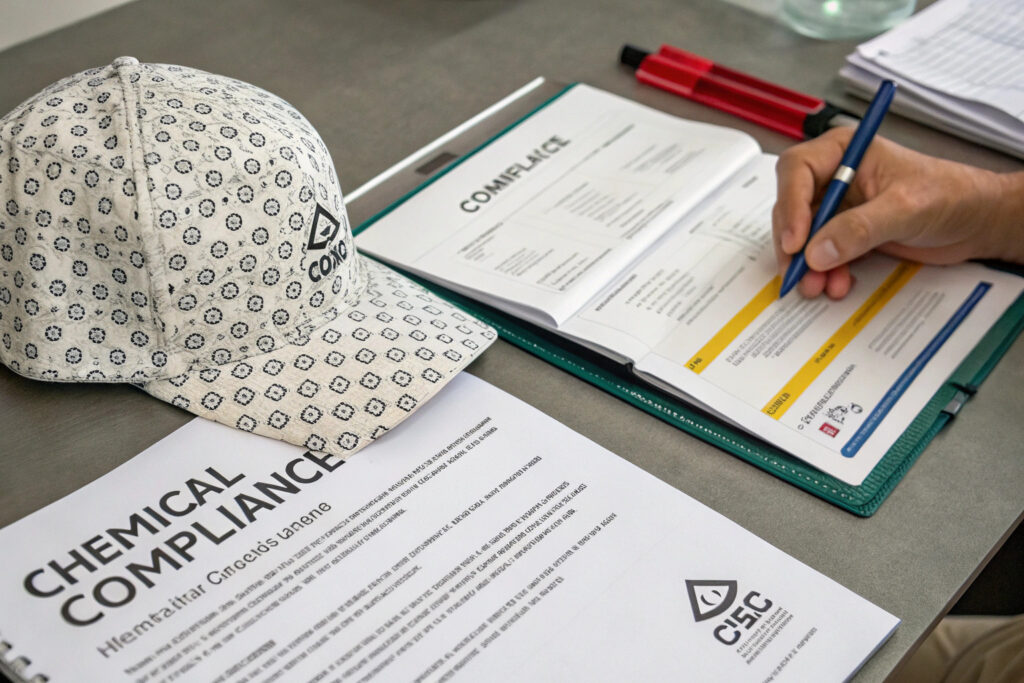
A verbal assurance from your supplier that "our inks are safe" is legally worthless. You need objective, verifiable documentation from an independent, accredited third party. The specific document you must demand is a chemical migration test report that covers the exact printed design on the exact cap you are ordering, tested by a laboratory that is ISO 17025 accredited for the EN 71-3 test method. This report must be less than one year old, or the supplier must provide a valid ongoing testing program certificate.
The test report must clearly identify the test sample. It should include a photograph of the tested cap, a description of the printed design, and the specific ink colors tested. A report that simply says "textile sample" with no identification is not acceptable. The report must state the test method, EN 71-3: Migration of Certain Elements, with the year of the standard, such as EN 71-3:2019+A1:2021. It must state the extraction conditions, the analytical method, and the test results for each of the nineteen restricted elements. The results must be compared against the legal limits, and a clear pass or fail conclusion must be stated. The report must be on the letterhead of the accredited laboratory, with the laboratory's accreditation number and the signature of the authorized signatory.
In addition to the test report, you should demand a Declaration of Conformity signed by an authorized representative of the supplier. This declaration states that the supplied caps are in conformity with the relevant EU legislation, including the Toy Safety Directive 2009/48/EC and the REACH Regulation (EC) No 1907/2006. It lists the specific standards applied, including EN 71-3. This declaration transfers legal responsibility to the supplier. If the caps are later found to be non-compliant, the declaration is evidence that the supplier explicitly warranted compliance.
What Is the Difference Between an Ink Supplier SDS and a Finished Product Test Report?
This is a critical distinction that many buyers miss. A Safety Data Sheet from the ink manufacturer describes the chemical composition and hazards of the ink as a raw material. It is a useful document for understanding the ink chemistry, but it is not a migration test report on the finished cap. The SDS tells you what is in the ink can. It does not tell you whether the ink, after printing, curing, and application to the fabric, will release toxic elements when chewed by a child.
The curing process, the interaction with the fabric, the application of a topcoat or overprint, all affect the migration behavior. The only way to know the migration behavior of the printed design on the finished cap is to test the printed design on the finished cap. I always advise clients to reject an ink SDS offered as a substitute for a finished product test report. The SDS is supporting documentation in the technical file. It is not the compliance evidence.
How Can You Verify That a Test Report Is Genuine and Valid?
Counterfeit test reports exist. A factory may take an old report, change the date and the product name in a PDF editor, and present it as a new report. You can protect yourself by verifying the report directly with the issuing laboratory. Every legitimate test report has a unique report number. Go to the laboratory's website. Find their report verification portal. Enter the report number. The portal will confirm whether the report is genuine and will show the original report details. If the details on the portal do not match the report in your hand, the report has been falsified.
You can also verify the laboratory's accreditation. The report will state the accreditation body, for example, UKAS in the United Kingdom, DAkkS in Germany, or A2LA in the United States. Go to the accreditation body's website and search for the laboratory's accreditation certificate. Confirm that the accreditation scope includes EN 71-3 chemical testing. This verification takes ten minutes and is the single most effective way to avoid being defrauded by a fake test report.
How Should You Structure Your Purchase Contract to Mandate Migration Testing?
A purchase contract that does not explicitly mandate chemical migration testing is a contract that leaves you exposed. The testing requirement must be written into the contract as a condition of acceptance, not as a post-shipment hope. The contract language must be specific, referencing the exact standard, the exact test, and the required documentation.
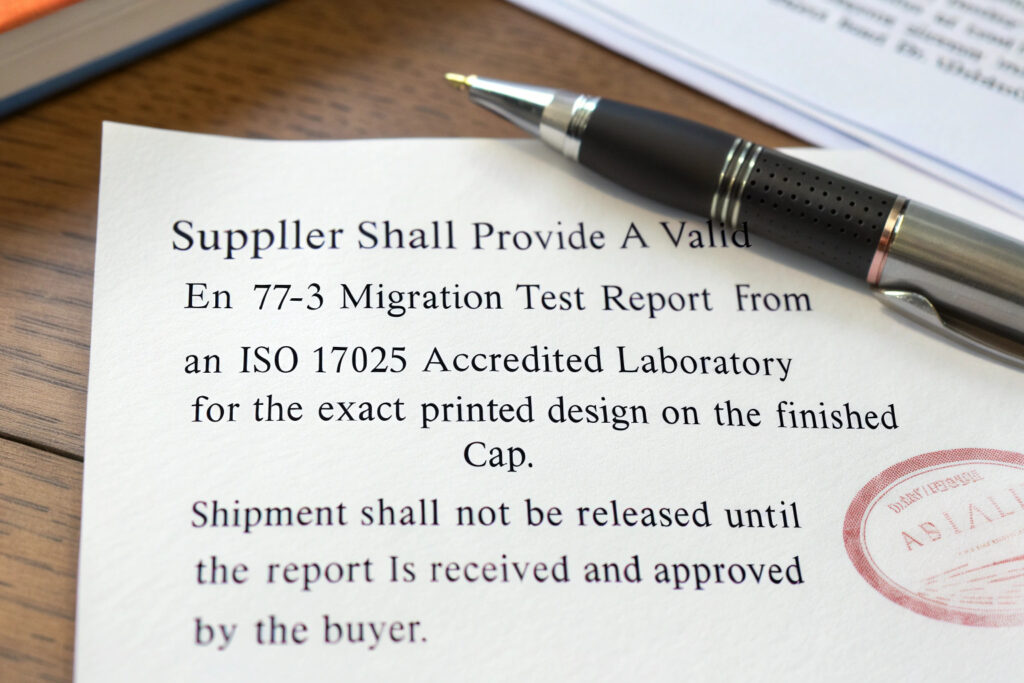
The contract clause should read substantially as follows: "Chemical Migration Testing: For all orders of children's headwear, the Supplier shall, at the Supplier's expense, provide a chemical migration test report from an ISO/IEC 17025 accredited laboratory demonstrating compliance with EN 71-3: Migration of Certain Elements. The test shall be performed on a finished product sample representing the exact printed design, ink formulations, and fabric substrates of the bulk production order. The test report shall be less than twelve months old at the time of shipment. The Supplier shall provide the test report to the Buyer for approval no less than fourteen days prior to the scheduled shipment date. Shipment shall not proceed without the Buyer's written approval of the test report. Failure to provide a satisfactory test report constitutes a material breach of this agreement, entitling the Buyer to cancel the order without penalty." This clause ties the testing to the shipment release. The factory cannot ship the caps until you have reviewed and approved the test report.
The contract should also address the consequences of a failed test. "If the test report shows any element migration exceeding the EN 71-3 limits, the Supplier shall, at its own cost, reformulate the print, re-produce the order, and re-test. The Buyer shall have the right to terminate the order and receive a full refund of any deposit paid." This clause creates a powerful financial incentive for the supplier to use compliant inks from the start.
What If the Supplier Claims Testing Is Too Expensive?
Chemical migration testing according to EN 71-3 for a single sample typically costs a few hundred dollars. This is a negligible cost compared to the order value of a bulk kids' cap order. A supplier who claims the testing is too expensive is signaling that their profit margin is razor-thin, or that they do not have an established relationship with a testing laboratory, or that they are concerned the product will fail. None of these are acceptable positions for a supplier of children's products.
I include the cost of chemical migration testing in our standard pricing for kids' caps. It is a fixed overhead, like thread or fabric. I want my clients to have the test report. It protects them, and it protects me. If a supplier is unwilling to absorb or pass on a few hundred dollars for a safety test, walk away. The risk of receiving non-compliant, potentially dangerous children's products is not worth the savings.
How Can You Audit the Supplier's In-House Chemical Management System?
Beyond the test report, you can audit the supplier's chemical management system to ensure that the compliant test result was not a one-time accident. During a factory audit, ask to see the approved ink and chemical inventory. The factory should have a positive list of approved inks, each with a valid SDS and a compliance statement from the manufacturer. The factory should have a procedure for ensuring that only approved inks are purchased and used in production. The incoming QC process should include verification that the ink delivered matches the approved ink.
Ask to see the printed design application process. The curing temperature and dwell time affect the cross-linking of the ink and the migration behavior. An ink that passes migration testing when cured at 150 degrees Celsius for three minutes may fail if cured at 120 degrees Celsius for one minute. The curing parameters must be documented and controlled. An audit that verifies these details confirms that the test report represents the actual production process, not a carefully prepared special sample.
Conclusion
Demanding chemical migration tests for printed designs on kids' baseball caps is a legal obligation, a moral responsibility, and a non-negotiable business practice. The test, per EN 71-3, simulates the extraction of toxic elements by a child's saliva or stomach acid. It measures the bioavailable hazard, not just the total chemical content. The documentation you require is a finished product test report from an ISO 17025 accredited laboratory, not an ink supplier's SDS, not a generic material certification. This report must be verified for authenticity with the issuing laboratory. The testing requirement must be written into the purchase contract as a condition of shipment, with clear consequences for non-compliance.
A children's cap with a printed design is a product that will be chewed, sucked, and worn against sensitive skin. The inks that make it beautiful must also make it safe. There is no trade-off between aesthetics and safety. There is only a choice between suppliers who understand and manage chemical risk, and suppliers who hope no one asks.
If you are developing a kids' baseball cap line and need a manufacturing partner who has established chemical compliance testing as a standard process, not an expensive exception, I invite you to work with Global-Caps. We maintain an approved ink palette tested to EN 71-3 and REACH standards. We provide finished product test reports from accredited laboratories with every kids' order. We will walk you through our chemical management system on a live video audit. Reach out to our Business Director, Elaine, at elaine@fumaoclothing.com with your design concept. Let's make a cap that is as safe as it is colorful, and let's provide the test reports to prove it.