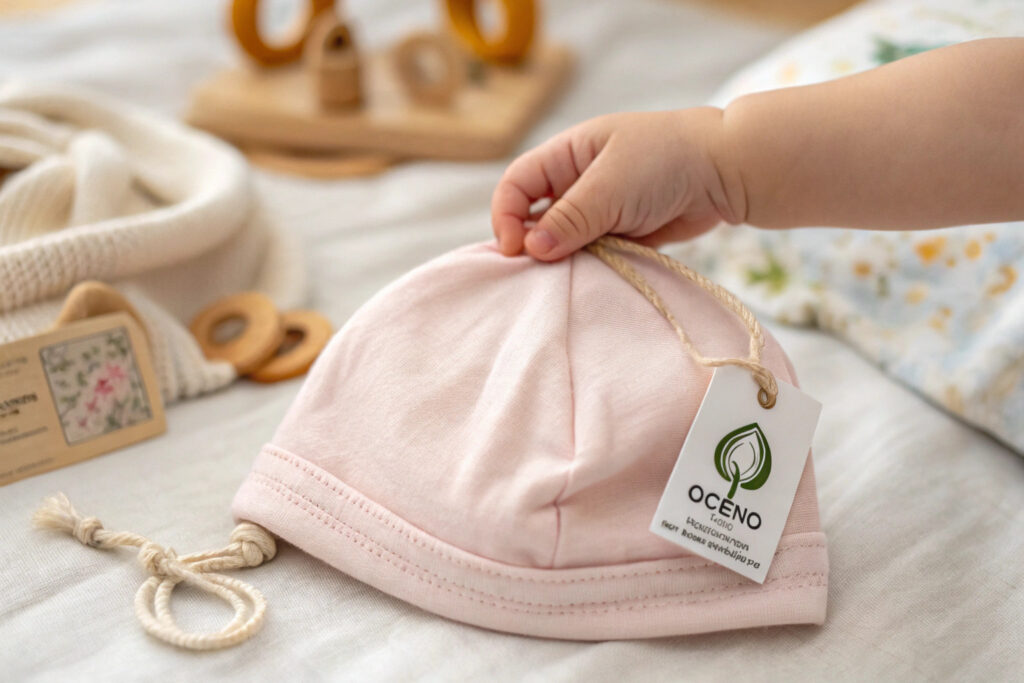
You open an email from your biggest retail partner. Subject line: "Urgent: Chemical Compliance Audit – Your Recent Shipment." Your stomach drops. They have randomly tested a batch of your infant caps from their warehouse shelves. The report shows trace levels of formaldehyde above their restricted substance list threshold. The entire shipment is now on hold. They are demanding a full recall plan, a root cause analysis, and a penalty chargeback for shelf downtime. You call your supplier. They say they used standard materials, nothing special. They offer no paperwork, no test reports, no accountability. The liability is now entirely yours.
I have seen this crisis unfold for brands that chose factories based on price alone. The chemical safety of a hat is not visible. You cannot smell it, touch it, or see it in a photo. It is a hidden liability that sits dormant until a test reveals it. The only real protection is a systemic, factory-level commitment to certified safe chemistry, and the highest standard for textile accessories like hats is OEKO-TEX Standard 100, specifically the Grade 1 certification, which covers articles for babies and toddlers. At Global-Caps, we invested in this certification years ago, not because a client demanded it for one order, but because we understand that when a brand partners with us, they are handing over their legal safety obligations. In this article, I will explain exactly how a Grade 1 certified factory reduces your liability exposure across the entire product lifecycle, from design to customs clearance to the retail shelf.
What Is the Legal Liability Risk of Non-Certified Headwear Products?
Liability in the textile industry is not limited to obvious defects like a broken snap button that a child chokes on. The deeper, more insidious liability is chemical. Headwear products sit directly against the skin, the forehead, the sweat glands. Heat and moisture from the scalp can accelerate the migration of chemical residues from the fabric, the sweatband, the dye, the embroidery thread, and even the plastic size adjuster into the wearer's skin. For babies and children, the risk is magnified. Their skin is thinner, their sweat rate relative to body size is higher, and they have a tendency to mouth objects, including hat brims and chin straps. If your product, even unintentionally, contains a restricted substance above the legal limit, you are responsible. The fact that you did not know is not a legal defense.
The legal frameworks are strict and getting stricter. In the European Union, the REACH regulation governs the registration, evaluation, and authorization of chemicals. It maintains a Candidate List of Substances of Very High Concern. If your hat contains an SVHC above 0.1% by weight, you have a legal duty to inform your customer and, upon request, the consumer. Failure to do so can result in fines and a forced product withdrawal. In the United States, the Consumer Product Safety Commission enforces limits on lead in surface coatings and substrates under the Consumer Product Safety Improvement Act, specifically for children's products. Individual states, like California with Proposition 65, add another layer. Prop 65 allows private citizens to sue brands for failing to warn about chemical exposures. These lawsuits are common and expensive to settle. Your brand name is on the public lawsuit for anyone to find online. The cost of a single Prop 65 settlement can wipe out the profit from an entire year of hat sales.
Beyond the legal penalties, the retail liability is equally severe. Major retailers in the US and Europe have their own Restricted Substance Lists that often go beyond government regulations. If you are selling to a supermarket chain or a large department store, they will have a vendor compliance manual that mandates chemical testing. If your product fails their random audit, you face a chargeback, a cancelled purchase order, and potentially a permanent delisting as a vendor. The retailer protects their own brand first. They will publicly distance themselves from you. The liability cascades down to your business. This is the hard reality of modern retail. A non-certified factory is a liability time bomb. You just do not know when it will go off.

How Does Product Liability Insurance Interact With Chemical Certifications?
Product liability insurance is your financial safety net, but insurance companies are not in the business of covering negligence. If a claim arises from a chemical injury, the insurer will investigate your sourcing due diligence. They will ask for your test reports, your factory audit records, and your material certifications. If you sourced from a non-certified factory and cannot demonstrate a rigorous quality assurance process, the insurer may deny the claim or raise your premiums to unaffordable levels.
On the other hand, when you present a complete compliance package from an OEKO-TEX Grade 1 certified factory, you are demonstrating a proactive risk management system. You are showing the insurer that you selected a supplier who meets a rigorous, independently audited standard. This can positively influence your insurability and your premium negotiations. I have had clients tell me that their insurance broker specifically asked about OEKO-TEX certification during the underwriting process. The certification is a shorthand for "this brand takes chemical safety seriously." It makes the insurer's risk assessment easier and more favorable. This is a hidden financial benefit of choosing a certified factory that few buyers consider until they are filling out the insurance paperwork.
What Are the Long-Term Brand Reputation Consequences of a Chemical Recall?
A recall is a public event. The CPSC publishes recalls on its website. The European RAPEX system does the same. These databases are permanent and searchable. A journalist writing about sustainable fashion can pull up your brand's recall notice from five years ago and use it as an example of industry failures. The internet has a long memory. Your brand's association with chemical danger, however brief, will be documented forever.
The trust cost is even higher. Parents talk to each other. If a mother finds out that a baby hat she bought had formaldehyde residue, she will tell every parent in her network. She will post about it in parenting forums. That organic customer trust, built over years of careful marketing and product quality, evaporates instantly. Rebuilding it is exponentially more expensive than the cost of manufacturing with certified materials from the start. I tell my brand clients that the premium they pay for a Grade 1 certified factory is not a cost of goods sold. It is an insurance premium on their brand equity. It protects the intangible value of their logo, which is often the single most valuable asset their company owns.
What Does the OEKO-TEX Standard 100 Grade 1 Certification Actually Test?
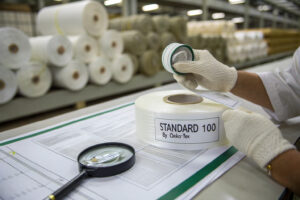
The phrase "OEKO-TEX certified" is often used loosely in the market. You must understand the specificity of the standard. OEKO-TEX Standard 100 is a globally standardized, independent testing and certification system for textile raw materials, intermediate products, and end products. It is not a generic "eco" label. It is a chemical safety label. The certification ensures that every component of the article, from the fabric to the thread to the button to the printed label, has been tested for harmful substances and is harmless for human health.
The critical distinction for headwear brands is the product class. The standard has four classes. Class 1 is for articles for babies and toddlers up to 36 months. It has the strictest limit values and the broadest test parameter list. Class 2 is for articles with direct and prolonged skin contact, like adult caps, scarves, and t-shirts. Class 3 is for articles with no or minimal skin contact, like jackets. Class 4 is for decoration materials. When a factory holds an OEKO-TEX Standard 100 certification, you must check the appendix of the certificate. It will list the specific product classes the factory is certified to produce. A factory certified for Class 2 adult headwear cannot legally apply the Class 1 label to a baby hat. The certification is product-class specific. At Global-Caps, we maintain a valid Class 1 certification for our baby and kids hat production line, which means our materials, processes, and QC systems have been audited and approved for the most vulnerable consumer group.
The test criteria are exhaustive and updated annually based on new scientific findings and regulatory changes. The standard tests for legally banned substances like azo dyes that can release carcinogenic amines. It tests for regulated substances like formaldehyde, heavy metals such as lead, cadmium, and mercury, and pentachlorophenol, a pesticide residue. It also tests for substances that are not yet legally regulated but are considered potentially harmful to health by the OEKO-TEX association, based on a precautionary principle. This proactive parameter list is what sets OEKO-TEX apart from basic regulatory compliance. A factory simply following the legal minimums might miss a chemical that OEKO-TEX has already flagged and restricted. A Class 1 certified factory is tested against a moving target of the highest global safety standards.

What Specific Substances Are Tested for Baby Headwear?
For a baby cap, the testing is extremely detailed. The sweatband, which is in constant contact with a baby's forehead, is tested for formaldehyde, which can be present in finishing agents used to make cotton wrinkle-resistant or shrink-proof. The limit for Class 1 is non-detectable, essentially 16 ppm, which is the analytical detection limit. The dye on the fabric is tested for forbidden azo dyes that can break down into aromatic amines, some of which are known carcinogens. The metal snap buttons or buckles are tested for extractable heavy metals like nickel, which is a common allergen, and lead, which is neurotoxic.
The printing inks on the label are tested for PVC and phthalates, which are endocrine disruptors. The elastic cord in a sun hat chin strap is tested for chlorinated phenols. Even the polyester sewing thread is tested for antimony, a catalyst used in polyester production that can be a skin irritant. The testing is component-based, not just fabric-based. A hat is disassembled in the lab, and each component is tested separately under worst-case extraction conditions. This component-level rigor is crucial because a common failure point is a cheap imported label or a non-certified plastic strap adjuster that contaminates the entire product. Our certification ensures that every single component entering our baby hat production line has been vetted by our OEKO-TEX auditor.
How Often Is the Certification Updated and Audited?
The OEKO-TEX Standard 100 certificate is valid for 12 months. After that, the factory must undergo a full renewal audit and retesting of products. The testing institute, such as Hohenstein or Testex, sends auditors to the factory. They review the material purchasing records, the incoming quality control logs, and the production workflow. They take random samples of finished products and send them to the laboratory for analysis. This is not a one-time paper exercise. It is an annual verification.
Additionally, the certification body can conduct unannounced audits. If a factory is suspected of substituting certified materials with cheaper, non-certified ones, the auditor can show up without notice and take samples. This enforcement mechanism is what makes the certification trustworthy. It is an ongoing, enforced commitment. For a brand, this annual renewal cycle provides a continuous compliance safety net. You know that the factory's chemical management system is being scrutinized by a third party at least once a year. You do not have to rely solely on your own QC budget to police the factory's chemistry.
How Does an OEKO-100 Grade 1 Factory Manage Supply Chain Chemistry?
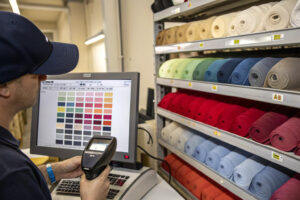
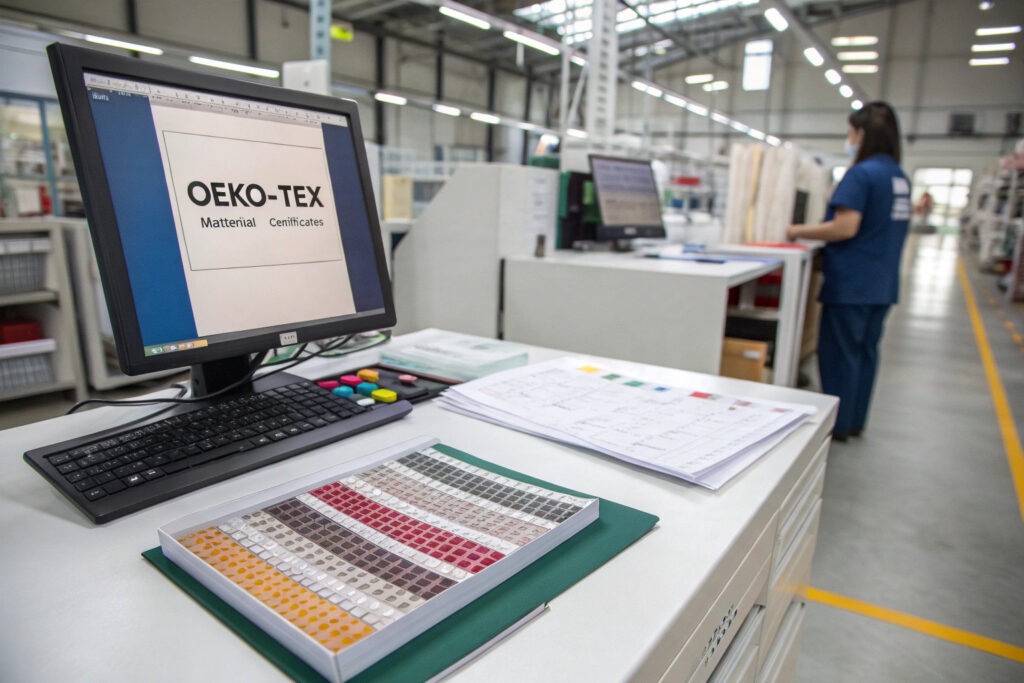
The certification is not just a test of the final hat. It is a certification of the factory's chemical management system. The OEKO-TEX auditor does not just check the hat. They check how the factory buys, stores, and controls every material that enters the production floor. This system is the true shield against your brand's liability. It prevents the contamination from occurring in the first place. An OEKO-100 Grade 1 certified factory operates a documented, audited incoming material control process. Every new fabric batch, every new spool of thread, every new delivery of sweatband material arrives with a material safety declaration from the supplier. Our QC team logs the batch number, cross-references it with our approved supplier list, and quarantines the material until it passes an incoming inspection. We do not simply trust the supplier's own certificate. We require the supplier's OEKO-TEX certificate to be valid and to cover the specific material they are selling us. We verify this in the OEKO-TEX online certificate check tool.
Then, we conduct our own risk-based incoming testing. For high-risk components like printed labels, dyed fabrics, and plastic hardware, we send samples to an independent lab for random verification testing. This creates a secondary layer of defense. A supplier's certificate could be fraudulent or expired. Our own incoming test catches this before the material is cut and sewn. This dual verification, supplier certificate plus factory incoming test, is the standard operating procedure that a non-certified factory typically does not maintain. It costs money. It takes time. But it is the barrier that stops a contaminated snap button from becoming a recalled baby hat.
The chemical management extends to the production process itself. We use only OEKO-TEX approved auxiliaries, such as cutting oils and machine lubricants, that are formulated to be compatible with textile safety. In a non-certified factory, a maintenance worker might use a standard industrial lubricant on the knitting machine, and that lubricant can transfer onto the yarn. That single point of contamination can introduce a restricted substance that the OEKO-TEX test will detect. Our entire production line is cleaned and managed with the product class in mind. This is a cultural discipline, not just a technical requirement.
How Are Production Chemicals and Auxiliaries Controlled?
Every chemical that touches the hat, from the dye in the dye bath to the soap used to wash the finished cap, must be pre-approved. We maintain a positive list of approved chemical products, each with its own OEKO-TEX Eco Passport or a similar safety data sheet that our certification body has reviewed. The dyehouse manager cannot simply buy a cheaper dye from a new vendor on a whim. Any new chemical introduction requires a change management request, a sample submission to the lab, and an approval from our compliance officer.
This strict control prevents a common failure scenario: a factory uses a low-cost disperse dye to achieve a bright neon color. That dye might contain a banned amine. The factory does not know. The hat gets shipped and tested. It fails. An OEKO-TEX certified factory has pre-screened its dye palette. The neon dyes we use have been tested and certified as compliant. The color range might be slightly more expensive or technically challenging, but it is legally safe. I have had clients request a very specific fluorescent yellow for a safety cap. I could offer them a compliant version that was slightly less intense than the non-compliant version, or I could explain the legal risk of the non-compliant option. They always choose compliance when they understand the liability. This is the value of having a factory that can have that technical conversation.
How Does Traceability Work Within the Factory Floor?
Traceability is the ability to track a finished hat back to the exact batch of fabric, thread, and labels used to make it. In our factory, each production order is assigned a traveler document that lists the material batch numbers. When the cutting room pulls fabric from the warehouse, they record the batch number on the traveler. When the sewing line attaches the labels and the snap buttons, the batch numbers of those trims are recorded. The finished hat has an internal production date code that links back to this traveler.
If a brand comes back to us two years later with a test result showing a failure on a specific hat style, I can pull the production records for that date code. I can identify the exact supplier of the snap button that failed. I can contain the issue to a specific batch and a specific date range. This limits the scope of a recall. Instead of recalling 50,000 hats, we might only need to recall 5,000 from that specific week of production. This traceability is a regulatory expectation for children's products and a contractual requirement for many major retailers. It is a core part of our OEKO-TEX certified quality system. A factory without this system will simply say, "We do not know which batch it came from." The brand is then forced into a full-scope recall, multiplying the cost and the reputational damage.
What Documentation Does the Factory Provide to Transfer Liability Protection to Me?
The liability protection of an OEKO-100 Grade 1 factory is only valuable if you can prove it to others. You need the paperwork. The factory must provide you with a documentation package that you can present to your retailer, your insurer, your customs broker, and, if necessary, a court. A legitimate certified factory will proactively hand over this package. A factory that is defensive about paperwork is a liability.
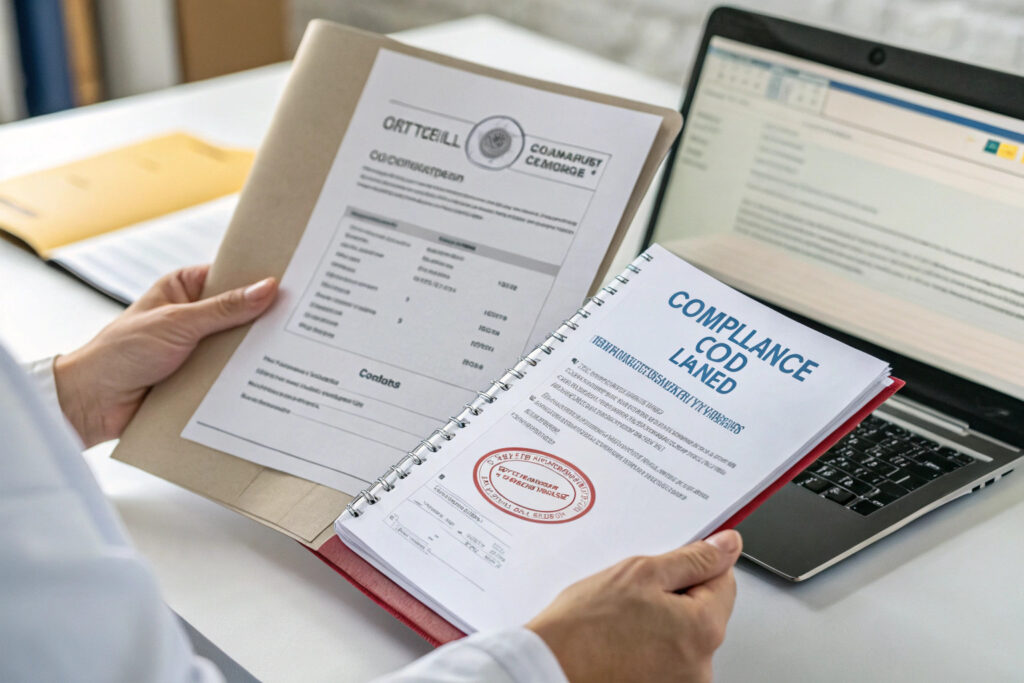
The core document is the factory's valid OEKO-TEX Standard 100 certificate, specifically the appendix that lists your product types and product class. This certificate proves that an independent, accredited institute has tested and certified the factory's production system. It is your primary evidence of due diligence. You should check the expiry date. A certificate that is about to expire in a month is a risk; you should ask for the renewal confirmation. Alongside the certificate, the factory should provide a product-specific conformity declaration. This is a legal document signed by the factory's authorized representative, declaring that the specific shipment of hats, identified by your purchase order number, was produced in accordance with the OEKO-TEX Standard 100 Class 1 requirements. This declaration transfers a portion of the legal responsibility from your brand to the factory. It says, in writing, "We made these hats according to this standard." If a failure later occurs, this document is the basis for your recourse against the factory.
For the US market, you will also need a Children's Product Certificate. The CPC is a self-issued document required by the CPSC for all children's products imported into the US. It certifies that the product meets all applicable federal safety rules, including lead content, phthalates, and flammability. An OEKO-TEX certified factory can support your CPC with the underlying test reports. The OEKO-TEX lab report serves as the third-party testing evidence for the chemical sections of the CPC. You, as the brand or importer, issue the CPC, but you rely on the factory's test data. An OEKO-TEX Grade 1 factory provides robust, reliable test data. A non-certified factory leaves you guessing. This documentation chain, from the OEKO-TEX certificate to the product-specific declaration to the CPC support, is your liability firewall. It demonstrates a systematic approach to safety that satisfies legal, retail, and insurance requirements.
How Can I Use the OEKO-TEX Certificate to Satisfy Retailer Compliance Portals?
Most major retailers now use online compliance portals like Retail Link, QMS, or custom platforms. You must upload your product compliance documents for each SKU. The portal will ask for a chemical test report, a factory audit report, and a product safety certificate. Uploading the factory's OEKO-TEX certificate and the accompanying conformity declaration often auto-populates the chemical safety fields and is recognized as a valid third-party certification.
I provide my clients with a digital compliance pack formatted specifically for these portals. It includes a high-resolution scan of the certificate, a vector logo file for their own packaging, and a PDF of the conformity declaration. I also include the lab's contact information so the retailer can verify the certificate directly if they choose. This proactive documentation makes the retailer's compliance review process smooth. It signals that you are a professional vendor who manages liability seriously. Retailers have limited compliance staff. They prioritize vendors whose paperwork is complete and verifiable on the first submission. An OEKO-TEX certified factory makes you that vendor. It turns a compliance hurdle into a competitive advantage.
What Is the Difference Between an OEKO-TEX Certificate and a Generic Mill Test Report?
A generic mill test report from a fabric supplier is a common document in the textile trade. It often lists a few basic parameters like colorfastness, shrinkage, and maybe a formaldehyde test. It is not equivalent to an OEKO-TEX certificate. A mill test report typically does not cover all components of the hat. It tests the fabric, not the trims. It is also not independently audited. The mill tests its own material in its own lab. There is no third-party verification.
I have seen mill test reports that were simply printed on a company letterhead with no lab accreditation number. They are marketing documents, not legal evidence. An OEKO-TEX certificate, on the other hand, is issued by an accredited, independent institute. It carries the institute's accreditation mark, the certification number, and a valid date range. It covers the entire article. For liability protection, you must be able to distinguish between these two levels of documentation. A factory offering a mill test report as proof of chemical safety is not providing adequate liability protection. You are still exposed. Demand the OEKO-TEX certificate and verify it online.
Conclusion
Your brand's liability exposure from a hat begins the moment the fabric touches skin. A chemical failure is not a quality defect you can fix with a discount on the next order. It is a legal event that can trigger recalls, fines, lawsuits, and the permanent erosion of consumer trust. The factory you choose is your primary defense. An OEKO-TEX Standard 100 Grade 1 certified factory has already invested in the chemical management system, the annual independent audits, the incoming material verification, and the production traceability that constitutes a comprehensive risk mitigation program. This certification transfers to you in the form of a documented, verifiable compliance package that satisfies retailers, insurers, and regulators.
The cost of choosing a non-certified factory may appear lower on the invoice, but the hidden liability premium is enormous. You are self-insuring against a chemical incident with your brand's future. At Global-Caps, we made the decision years ago to build our baby and kids hat production around the highest chemical safety standard in the world. We did this because we want our clients to sell their hats with absolute confidence. We want to hand you a certificate and a declaration that you can take to your buyer at a major retailer and say, "This product is safe. Here is the proof."
If you are ready to reduce your brand's liability exposure and build a supply chain on a foundation of certified chemical safety, I invite you to contact us. Reach out to our Business Director, Elaine, at elaine@fumaoclothing.com. She can provide you with a copy of our current OEKO-TEX Standard 100 Class 1 certificate, a sample compliance pack, and a technical consultation on your specific product requirements. Let's make sure the only headline your brand ever generates is a positive one.