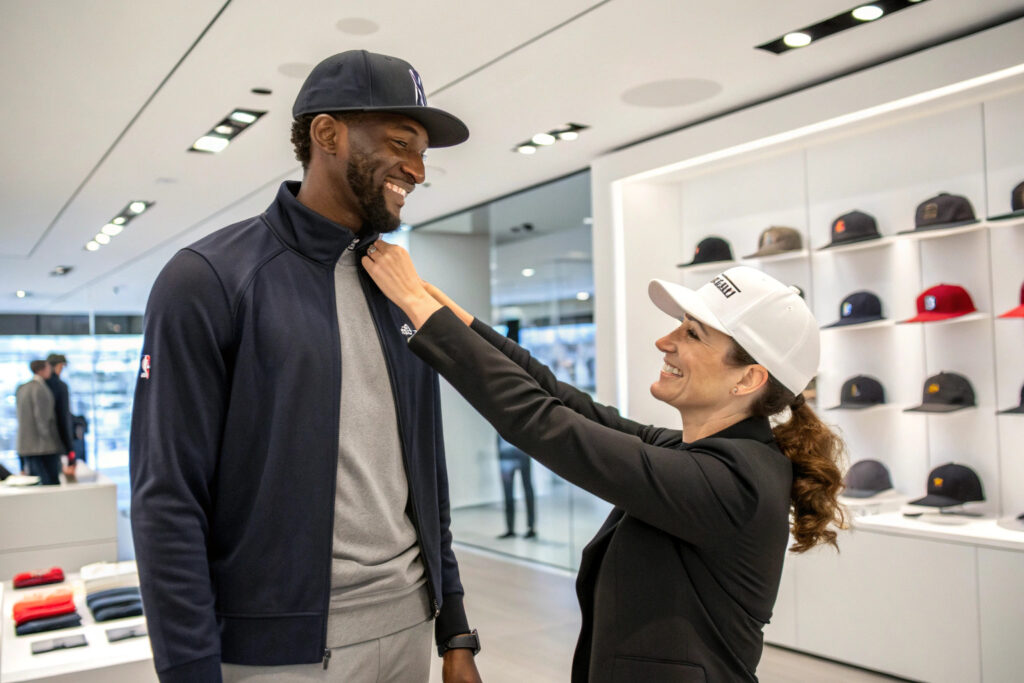
I received an email from a firefighter in Texas last year. He had a size 8 head, a circumference of 63.5 centimeters. He had spent ten years buying "one size fits most" caps that perched on top of his head like a yarmulke. He wrote, "I just want one hat that fits like a normal hat fits a normal person." That email hit me. The headwear industry has systematically underserved a large segment of the population. The standard cap is designed for a head circumference of 57 to 59 centimeters with a crown depth that assumes a certain head shape. Millions of people fall outside that range.
You source extra-deep crown fitted caps for big and tall headwear customers from a specialized manufacturer that offers extended size runs with specifically engineered deep-crown patterns, not just enlarged standard patterns. A true big-size cap starts with a crown pattern that adds depth at the center front seam, increases the dome volume, and adjusts the brim curvature to maintain proportionality on a larger head. The factory must offer sizes from 7 5/8 (60.6 cm) through 8 1/2 (65 cm) or larger, in both structured and unstructured silhouettes. The closure system, if not a true fitted elastic, must accommodate the larger size without looking strained. A standard cap scaled up will still fit poorly because the proportions are wrong. A deep-crown cap is a different product engineered for a different head.
I invested in developing a dedicated big and tall cap pattern library at Global-Caps. The firefighter in Texas now owns six caps from us. I want to share the technical specifications, the pattern differences, the available silhouettes, and the sourcing questions you need to ask a factory to verify they can genuinely serve this market. This is an underserved, loyal customer base that deserves a hat that fits with dignity.
What Pattern Modifications Are Required for a True Deep-Crown Fitted Cap?
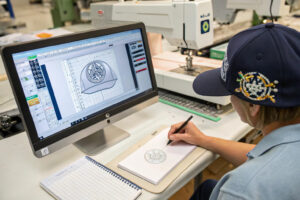
A deep-crown cap is not a standard cap with an extra inch of fabric added to the bottom. That approach creates a cap that is deeper but also baggy, unstructured, and prone to collapsing on itself. A proper deep-crown pattern is a complete re-engineering of the crown panels. The center front seam is lengthened to add vertical depth at the peak of the dome. The side panels are widened and curved with a steeper arc to create a fuller silhouette that does not pull tight across the temples. The front panel, where a logo is typically placed, is enlarged proportionally to maintain a balanced visual appearance. The sweatband is a wider, more absorbent material to manage the increased surface area and perspiration. The brim is shaped with a slightly wider spread and a deeper curve to frame a larger face properly.
I worked with our pattern engineer to develop three deep-crown blocks. A structured deep-crown block with a fused buckram front panel for customers who want the classic baseball cap silhouette that stands up off the forehead. An unstructured deep-crown block for customers who prefer a softer, more relaxed fit without the internal stiffening. And a high-crown trucker block that combines the deep front panel with a mesh back, maintaining the volume while adding ventilation. Each block is graded across a size range from 7 3/8 to 8 1/2 with specific adjustments to the seam curves at each size. A standard pattern grading algorithm assumes proportional scaling. A deep-crown grading algorithm adjusts the dome volume non-linearly. The larger sizes get progressively deeper relative to the circumference increase, because head shape tends to elongate vertically at the larger sizes, not just expand horizontally. This non-linear grading is the technical secret that separates a genuine big-size cap from a scaled-up standard cap.
The pattern engineering is the foundation. But the pattern must translate into a physical cap that maintains its shape on a larger head. The internal materials, the buckram, the visor board, and the sweatband, must be selected and cut to match the larger pattern without creating new fit problems.
How Does the Buckram and Visor Board Differ for Deep-Crown Structured Caps?
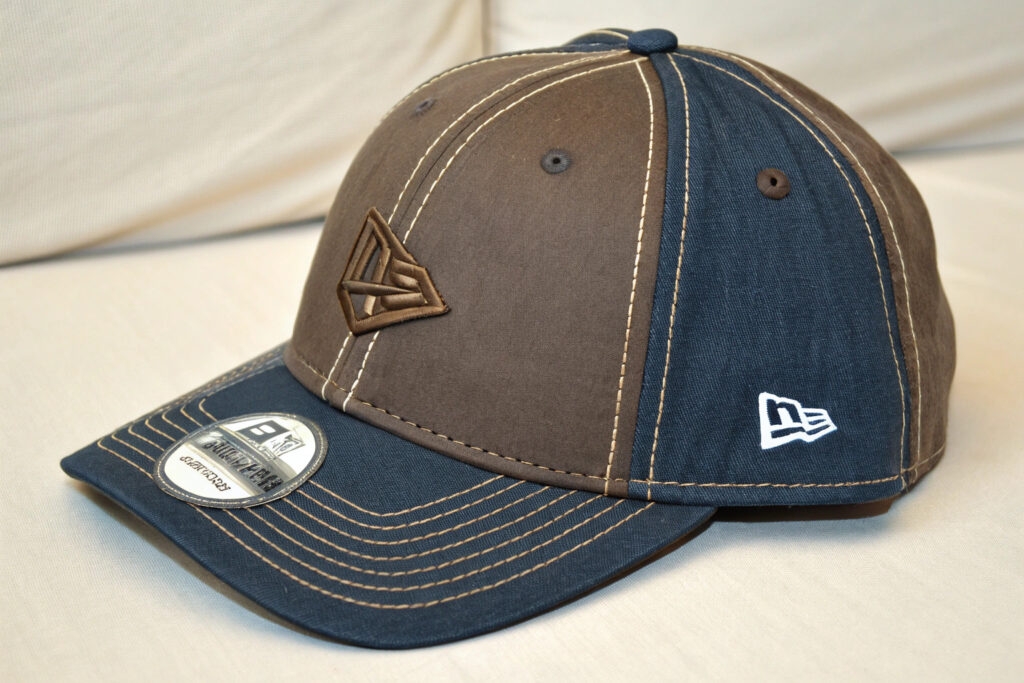
A standard structured cap uses a pre-cut buckram, a stiffened fabric, that sits behind the front two panels. In a standard cap, this buckram is designed to hold a dome on a head circumference of 57 to 59 centimeters. On a head circumference of 63 centimeters, the standard buckram stretches, distorts, and eventually collapses because the curvature does not match the larger head radius.
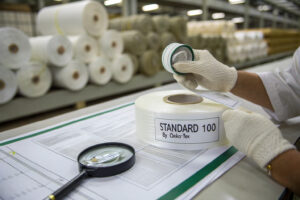
I source a specific deep-crown buckram that is pre-molded to a larger, deeper curvature. This buckram is not a standard inventory item at most component suppliers. It is a custom specification. The visor board, the internal brim stiffener, must also be wider to match the enlarged front panel. A standard visor board on a deep-crown cap leaves an unsupported brim edge that curls and warps. The visor board must be cut from a larger blank and shaped with the correct curvature for the larger hat profile. These custom components cost slightly more and require minimum order quantities from the component supplier. A factory that tells you they can make a deep-crown structured cap but does not mention these component specifications is planning to use standard components. The cap will not hold its shape.
What Sweatband Modifications Are Needed for Comfort on Larger Heads?
The sweatband on a deep-crown cap must be wider, more absorbent, and cut from a material with higher tensile strength. A standard sweatband is 2.5 to 3 centimeters wide. On a larger head, this feels like a thin string. I recommend a sweatband of 3.5 to 4 centimeters in width, made from a heavier-weight cotton terry or a moisture-wicking performance fabric. The wider sweatband distributes the pressure more evenly and prevents the red line across the forehead that is a common complaint from big-size cap wearers.
The stitching that attaches the sweatband to the cap must be a double-needle lockstitch with a high stitch density. The larger head circumference exerts more tension on the sweatband seam. A single-needle chain stitch will fail under repeated wear. The sweatband must also have an internal elastic section for fitted caps that allows micro-adjustment without the bulk of an external closure. This elastic must be a high-recovery, latex-free elastic that does not lose tension after repeated stretching over a larger head. The sweatband specifications are a critical comfort factor that most standard factory quotes overlook.
What Size Range and Fit Options Should a Genuine Big and Tall Supplier Offer?
The size range a factory offers is the first honest signal of their commitment to the big and tall market. A factory that claims to serve this market but only offers up to size 7 5/8 is not serious. The standard industry size range stops at 7 3/4. The underserved market starts at 7 7/8 and extends to 8 1/2 and beyond. A genuine supplier must have a documented size chart that goes to at least size 8, and preferably to size 8 1/2 or 3XL. The supplier must also offer different fit profiles, not just different circumferences. A head that is a size 8 can be round, oval, or long oval in shape. The same circumference number does not describe the same head.
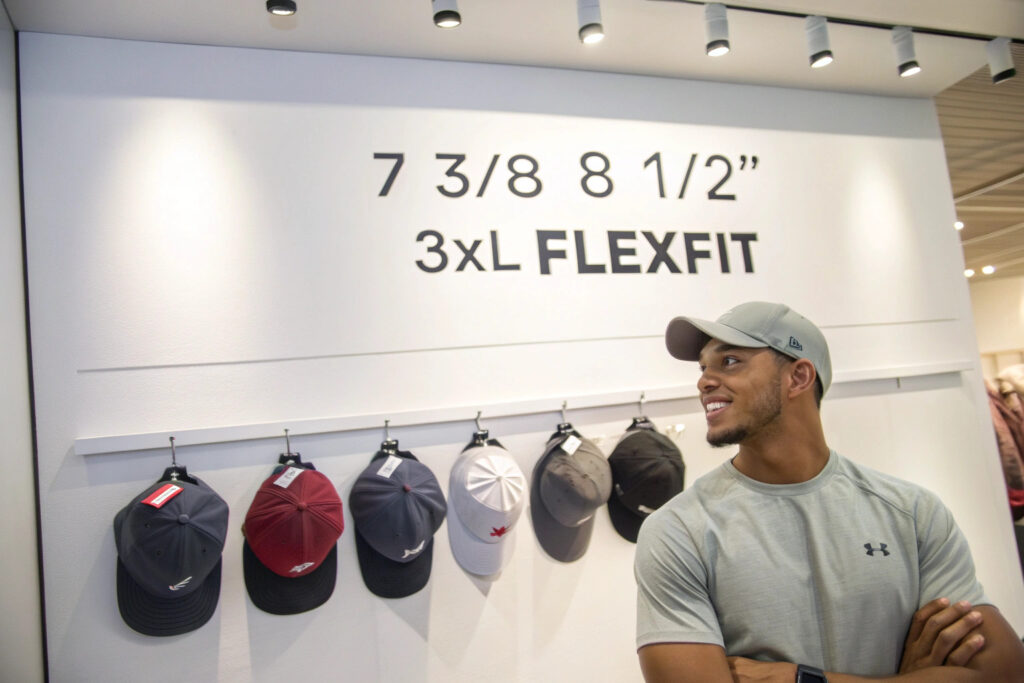
I offer our deep-crown caps in a standard oval fit and a long oval fit for the most common head shape variations. The long oval pattern adjusts the side panel curvature to add more room across the front-to-back dimension and slightly less across the side-to-side dimension. This eliminates the pressure points on the forehead and the back of the head that are common complaints from big-size wearers who wear a standard oval cap. I also offer a Flexfit-style fitted option that uses a heavy-duty elastic band integrated into the sweatband. This provides a half-size adjustment range within a single size. A Flexfit 2XL cap fits head sizes from about 7 3/8 to 7 5/8 comfortably. A Flexfit 3XL fits from 7 3/4 to 8. This flexible option is popular for corporate gift orders where exact head sizes are unknown.
The size chart is the numerical offer. But the customer's real question is not "what size do you offer" but "will this hat fit my specific head shape." The try-on experience for a big-size customer is often a series of disappointments. Your size chart and your return policy are the tools that rebuild trust.
What Is the Difference Between a Fitted Cap and a Flexfit for Big Sizes?
A true fitted cap comes in specific, fixed sizes like 7 3/4, 8, 8 1/4. The size is determined by the sweatband circumference. There is no adjustment mechanism. The fit is precise, clean, and streamlined. The downside is that the customer must know their exact hat size, measured with a flexible tape measure around the widest part of their head. A return is likely if the size is off by even a half-size.
A Flexfit cap uses a patented elastic band technology integrated into a fabric-covered sweatband. The cap stretches to fit a range of sizes. The advantage is forgiveness. A customer who falls between sizes gets a comfortable fit without needing to know their exact hat size. The disadvantage is that the elastic band loses tension after extended wear, especially in hot, sweaty conditions. For big and tall customers, I recommend the Flexfit for casual, everyday caps and the true fitted for premium, structured caps where a crisp silhouette is desired. The Flexfit technology is a licensed product used by many cap manufacturers. A factory must be an authorized Flexfit user to offer genuine Flexfit caps, or they must use an equivalent licensed elastic technology.
How Should a Size Chart Be Structured to Be Useful for Big and Tall Customers?
A standard size chart that just lists "S/M, L/XL, 2XL" is useless for a big and tall customer. They need a chart that maps the specific inch or centimeter circumference to the cap size. The chart should include three columns: the numerical hat size, the head circumference in inches, and the head circumference in centimeters. The customer measures their head with a tape measure, finds their centimeter or inch measurement, and reads across to the correct hat size.
I also include a "recommended fit" column on our size chart. For customers on the boundary between two sizes, the chart recommends the larger size for a structured cap, which has less give, and the smaller size for an unstructured or Flexfit cap, which has more stretch. This recommendation reduces the return rate. The hat sizing guide best practices from major retailers provide a good template for how to structure a helpful size chart.
What Materials and Construction Techniques Prevent the Cap From Looking Oversized?
The biggest fear of a big and tall customer is the "clown hat" look. A cap that is simply scaled up proportionally from a standard pattern will look oversized on a larger head. The brim will look too wide. The crown will look too tall. The logo will look too small. The cap will broadcast its size in a way that makes the wearer self-conscious. The engineering challenge is to create a cap that fits a larger head but looks visually normal, proportionally balanced, and stylish.
This is achieved through a combination of material selection, construction technique, and design detailing. The crown panels are cut from a fabric with body and drape, a substantial cotton twill of 260 to 300 GSM, that holds the dome shape without requiring excessive internal stiffening. Excessive stiffening makes the cap look like a box. The brim is cut with a slightly smaller proportional width relative to the crown than a standard cap. This tricks the eye into perceiving a normal proportion. The seams are structured with a slightly wider seam allowance and a double topstitch that creates a visual framework. The structured seams prevent the fabric from ballooning and create a tailored, sharp silhouette. The logo or embroidery is scaled up proportionally, but not linearly. A logo that is 20% wider on a 20% larger cap looks too big because the human eye judges logo size relative to the face, not the cap. I increase logo size by 10% to 15% for deep-crown caps, not 20%. The smaller proportional increase maintains a balanced, premium look. These are the aesthetic judgments that come from experience fitting real people, not just grading patterns mathematically.
The fabric weight and the structural sewing techniques are the primary tools for controlling the cap's visual volume. But the brim's shape and its relationship to the crown are the most visible proportion cues. A brim that is too flat or too wide immediately signals an off-the-rack cap that was not designed for a larger head.
What Fabric Weights Work Best for Deep-Crown Silhouettes?
A lightweight 180 GSM cotton twill is common in fashion caps. It drapes softly and is comfortable. On a deep-crown cap for a larger head, this lightweight fabric collapses. It does not have the internal structure to hold the dome shape. The cap looks deflated and sad. I use a minimum of 260 GSM cotton twill for deep-crown caps. A 300 GSM twill is even better for structured silhouettes. The heavier fabric has the body to stand up and hold the engineered shape.
For unstructured deep-crown caps, the fabric must be soft but substantial. I use a 240 GSM garment-washed cotton twill. The wash process softens the fabric hand feel and removes shrinkage, so the cap arrives at the customer's door already relaxed and comfortable. The heavier weight ensures the cap drapes around the head shape rather than flopping. The fabric weight guide for headwear is a useful reference for understanding the relationship between GSM and cap structure.
How Do You Proportion the Brim for a Larger Crown?
The brim width for a standard cap is approximately 17 to 18 centimeters across the widest span. On a deep-crown cap, the natural instinct is to scale this up to 19 or 20 centimeters to match the larger crown. This creates a "duckbill" look that is unflattering. The better approach is to keep the brim width at 18 to 18.5 centimeters and increase the brim depth, the distance from the crown attachment to the brim tip, by a small amount. This creates a brim that frames the face properly without looking exaggerated.
The brim curve is also critical. A standard brim is pressed with a gentle curve across the center. On a larger head, this curve can look flat and wide. I use a slightly deeper, more pronounced curve that wraps around the face more closely. This creates a slimming, face-framing effect that makes the cap look intentionally designed for the wearer. The hat brim shaping techniques are part of the finishing process and must be adjusted for each cap size.
What Sourcing Questions Should You Ask a Potential Deep-Crown Cap Factory?
A factory that can genuinely produce deep-crown fitted caps will answer specific technical questions without hesitation. A factory that is pretending to have this capability will give vague answers or promise to "figure it out." The questions you ask must be precise, technical, and verifiable. The factory's answers, or their inability to answer, will tell you everything you need to know.
Ask these five questions. First, "Do you have a dedicated deep-crown pattern block, or do you grade up from a standard block?" The correct answer is a dedicated block. Second, "What is the center front seam depth on your size 8 pattern, in millimeters?" The correct answer for a deep-crown size 8 cap is between 130 and 140 millimeters. A standard cap of the same circumference might have a center front seam depth of 110 to 120 millimeters. The specific number demonstrates that the pattern exists and has been measured. Third, "Can you provide a size 8 or larger pre-production sample for fit approval?" A factory that cannot produce an oversize sample is a factory that does not have the patterns or the component inventory to make one. Fourth, "What is your maximum size, and do you offer long oval fit options?" The correct answer is at least size 8 1/2 with an oval fit option. Fifth, "Can you share a fit test video of your deep-crown cap on a larger head model?" A factory that has done fit testing will have this video. A factory that has not will not. These questions filter out the factories that are hoping to win the order and then figure out the pattern later.
The technical questions verify the factory's current capability. But the pre-production sample is the physical proof. A sample made to your size specification, worn by a real person with a larger head size, and evaluated on a video call, is the definitive verification of fit and proportionality.
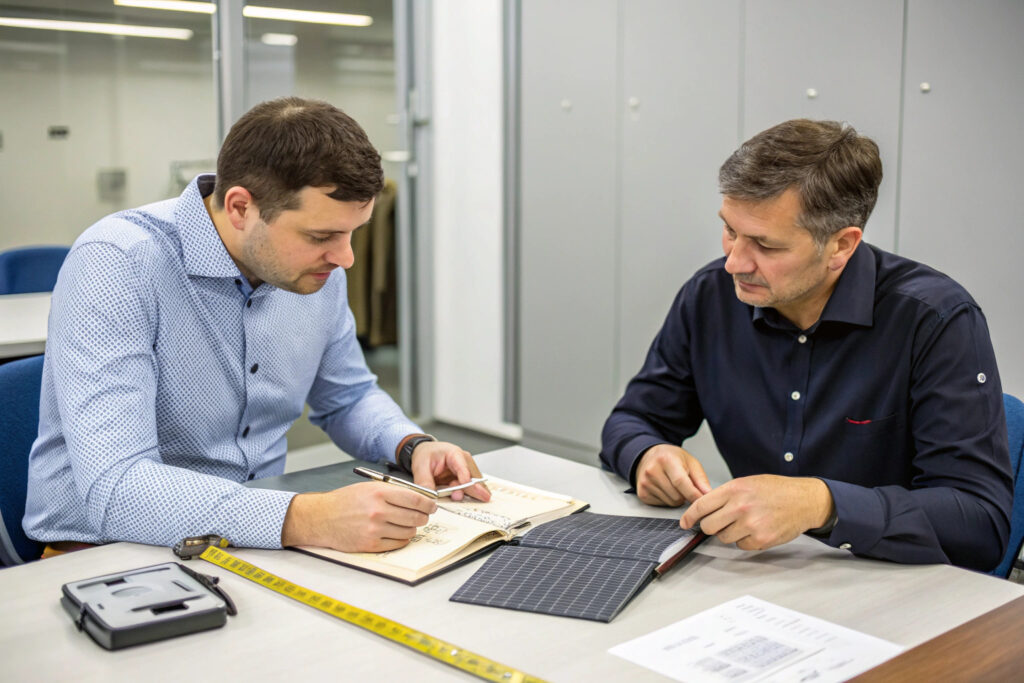
Why Must the Pre-Production Sample Be a Large Size?
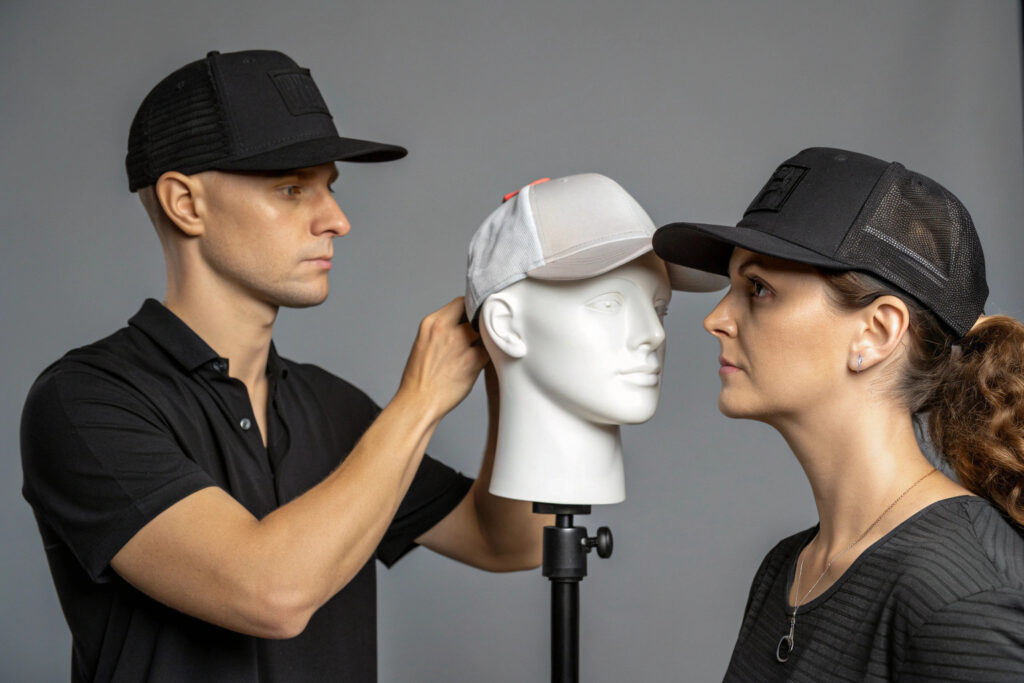
A factory that sends a size 7 3/8 sample to demonstrate their deep-crown capability is not demonstrating their deep-crown capability. The standard size sample looks fine because it is a standard size. The problems with pattern proportion, buckram fit, and sweatband tension only become visible at the larger sizes. You must request a sample in the size that represents the core of your big and tall customer base, typically a size 8. Wear the sample on a real person with that head size. Do not evaluate it on a table. Evaluate it on a head. The wearer should report on the forehead pressure, the temple tightness, the crown depth, and the overall visual proportion. Take photos from the front, side, and three-quarter view. The fit sample evaluation process for a new pattern is the single most important step before placing a bulk order.
What Minimum Order Quantities Are Typical for Extended-Size Cap Production?
Extended-size cap production requires custom components, dedicated pattern grading, and smaller production runs because the market, while loyal, is smaller than the standard-size market. The minimum order quantities are typically higher per size than a standard cap. Expect an MOQ of 100 to 150 units per individual size for a fitted cap with custom components. Expect an MOQ of 300 to 500 units total for a range of sizes within a single style. A factory that quotes a 50-unit MOQ per size is either using standard components, which will not fit properly, or is absorbing a significant cost that they will recoup elsewhere. The production minimums for specialized headwear are determined by the component supplier MOQs for the custom buckram, visor board, and sweatband. A transparent factory will explain the cost drivers behind the MOQ.
Conclusion
The big and tall headwear market is not a niche. It is a substantial segment of the population that has been taught to accept ill-fitting caps as normal. A deep-crown fitted cap is not a standard cap with extra fabric. It is a re-engineered product with a dedicated pattern, custom internal components, proportional brim adjustments, and a size range that extends to 8 1/2 and beyond. The sourcing process for these caps requires technical questions, a fit sample in the target size, and a factory partner that has invested in the pattern library and the component supply chain to serve this market properly.
I developed our deep-crown program because I kept hearing the same story from customers like the firefighter in Texas. They wanted a hat that fit. Not a special hat. Just a hat. The relief in their voices when they put on a cap that sits down on their head, that does not pop off, that looks proportional in a photograph, is why this program matters. It is a dignity product as much as a headwear product.
If you are building a collection for big and tall customers and need a factory that already has the deep-crown pattern blocks, the oversize components, and the fit-testing process in place, let us send you a fit sample in your target size. Our Business Director, Elaine, can prepare a size set for your evaluation and walk you through our pattern specifications on a video call. Email her at elaine@fumaoclothing.com with your size range and silhouette preferences. We will show you what a cap that actually fits looks like.