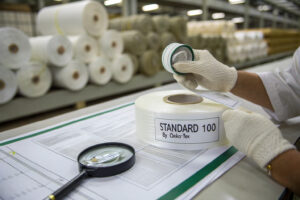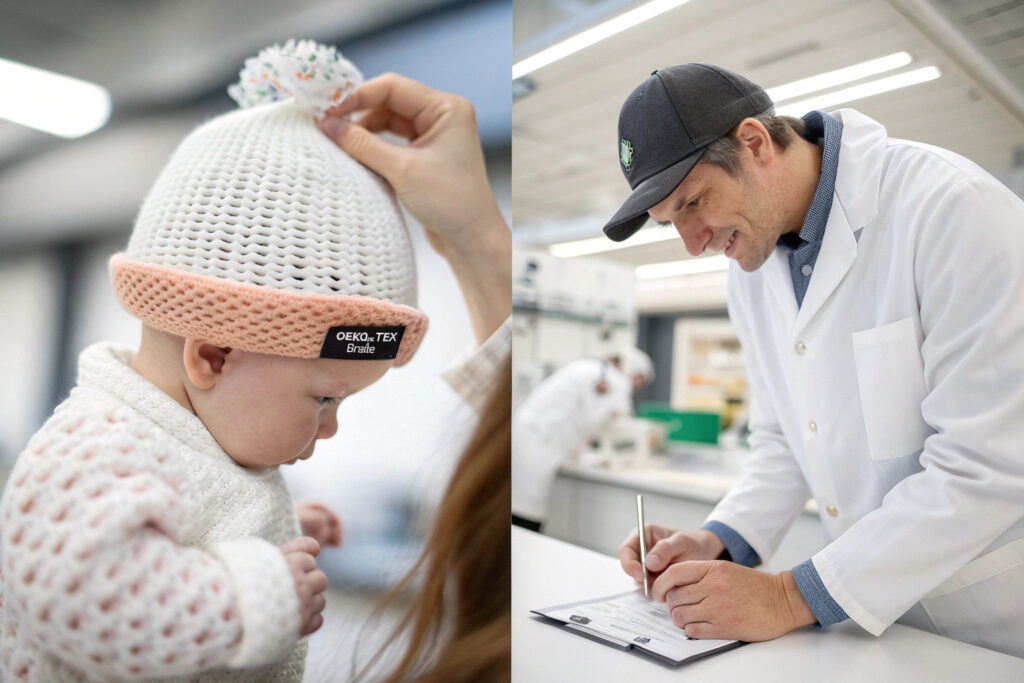
I watched a young mother in a Berlin boutique pick up a baby beanie and immediately turn it inside out. She ran her finger along every seam, checked the label, and held it to her nose. She did not do this with the adult baseball caps on the next shelf. She was not a textile engineer. She was a mother with an instinct that a product touching her baby's skin and mouth needed a different level of scrutiny. That instinct is correct, and it is written into the OEKO-TEX Standard 100 certification system.
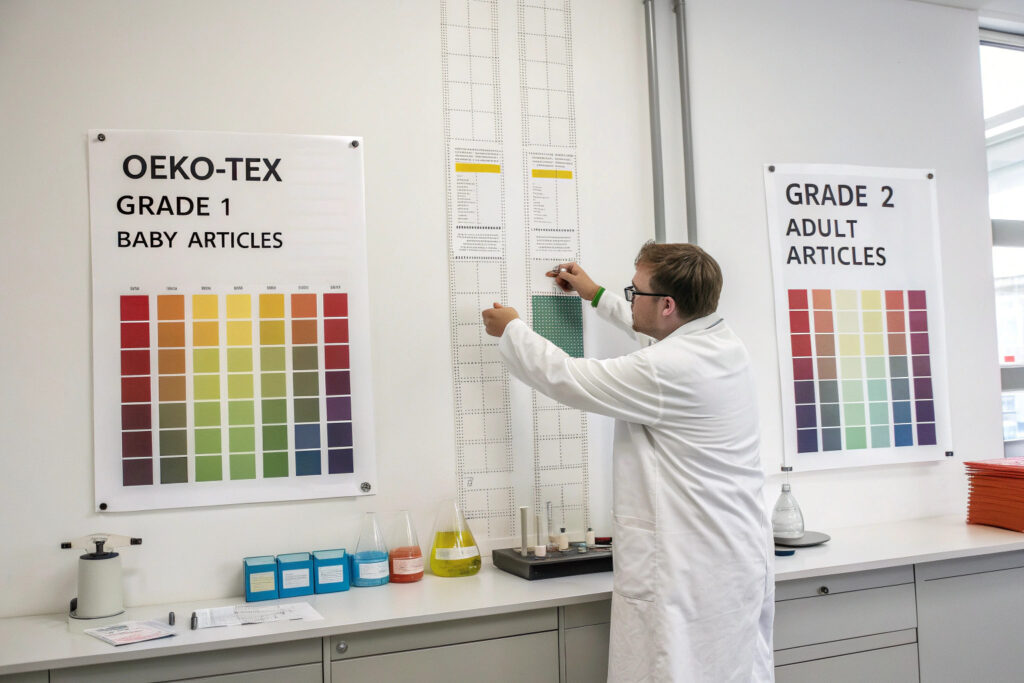
The OEKO-100 Grade 1 requirements for baby beanies are fundamentally stricter than the Grade 2 requirements for adult baseball caps. Grade 1, the "baby article" classification, applies to all textile products intended for infants and toddlers up to 36 months. It demands a lower limit value for formaldehyde, a zero tolerance for certain heavy metals, a stricter pH value range that matches infant skin, and a saliva-fastness test that adult products do not undergo. A baby beanie certified to Grade 1 has been tested on the assumption that a child will suck, chew, and drool on it. An adult baseball cap certified to Grade 2 has been tested on the assumption that it will touch adult skin, not adult saliva. The chemical safety bar for the baby beanie is higher. The testing protocols are more invasive. The failure thresholds are lower. A fabric that passes for an adult cap can fail for a baby beanie.
I manage our OEKO-TEX certification program at Global-Caps. I know exactly which test parameters tighten when we certify a baby beanie versus an adult cap. I want to walk you through the specific limit values, the additional tests, and the accessory requirements that separate these two certification grades. This is the scientific detail that protects the most vulnerable consumers and protects your brand from a safety failure.
What Are the Specific Chemical Limit Differences Between Grade 1 and Grade 2?
The numerical limit values in the OEKO-TEX standard are not secret. They are published and updated annually. The difference between Grade 1 and Grade 2 is a set of tighter numbers that reflect the difference between a baby's physiology and an adult's. A baby's skin is thinner, more permeable, and has a higher surface-area-to-body-weight ratio. A baby's immune system is developing. A baby's mouth is in constant contact with the textile. The Grade 1 limits are calibrated to protect this specific, vulnerable biology.
The formaldehyde limit is the most well-known difference. For Grade 2 adult products, the formaldehyde limit is 75 milligrams per kilogram, or parts per million. For Grade 1 baby products, the limit is 16 milligrams per kilogram. This is a 78% reduction. Formaldehyde is used in textile finishing to reduce shrinkage and wrinkles. A baby beanie that carries the Grade 1 label has been tested to ensure that the free formaldehyde content is below the detectable limit of most commercial test methods. The heavy metal limits also tighten. Antimony, which is used as a catalyst in polyester production, has a limit of 30 milligrams per kilogram for Grade 2. For Grade 1, the antimony limit is zero, non-detectable. This means a baby beanie made from polyester must use an alternative catalyst chemistry or be washed to the point where no antimony residue remains. The pH value range is another critical difference. Adult skin has a slightly acidic pH of around 4.5 to 5.5. Grade 2 products must test within a pH range of 4.0 to 7.5. Infant skin has a higher, more neutral pH at birth that gradually acidifies. Grade 1 products must test within a tighter pH range of 4.0 to 6.5, with a strong preference for the mid-range. A fabric that tests at pH 7.4 passes for an adult cap but fails for a baby beanie.
The numerical limits are the headline differences. But the standard also specifies a list of chemicals that are simply banned at any detectable level for Grade 1, while they may be allowed at trace levels for Grade 2. These bans target the specific chemical exposure pathways that are unique to infants.
Why Is the Formaldehyde Limit So Much Lower for Baby Products?
Formaldehyde is a volatile organic compound that off-gasses from textiles. A baby inhales the air directly above the beanie. The beanie fabric presses against the baby's nose and mouth during sleep. The inhalation exposure pathway is continuous and concentrated.
The 16 ppm limit for Grade 1 is based on the World Health Organization's indoor air quality guidelines and the known respiratory sensitization potential of formaldehyde. At levels above 16 ppm, the risk of skin irritation and respiratory irritation in an infant increases measurably. The formaldehyde in textiles limit values are derived from toxicological risk assessments that consider the specific exposure scenario of an infant mouthing a textile product.
What Heavy Metals Are Banned Completely in Grade 1?
Lead and cadmium are banned or strictly limited in all OEKO-TEX grades due to their well-known neurotoxic effects. But Grade 1 adds specific bans that do not apply to Grade 2. Mercury, a neurotoxin that can be present in some dye auxiliaries, has a limit of less than 0.02 milligrams per kilogram in Grade 2 but a non-detectable requirement in Grade 1. Chromium VI, a carcinogenic heavy metal, is banned completely in Grade 1 with a non-detectable limit, while Grade 2 allows a very low trace limit.
The logic is that an adult exposed to a trace heavy metal through skin contact has a mature liver and kidney system to filter it. An infant's metabolic systems are not fully developed. The same trace exposure has a proportionally larger biological effect. The heavy metal toxicity data supports a zero-tolerance approach for infant articles.
What Additional Tests Does a Baby Beanie Undergo?
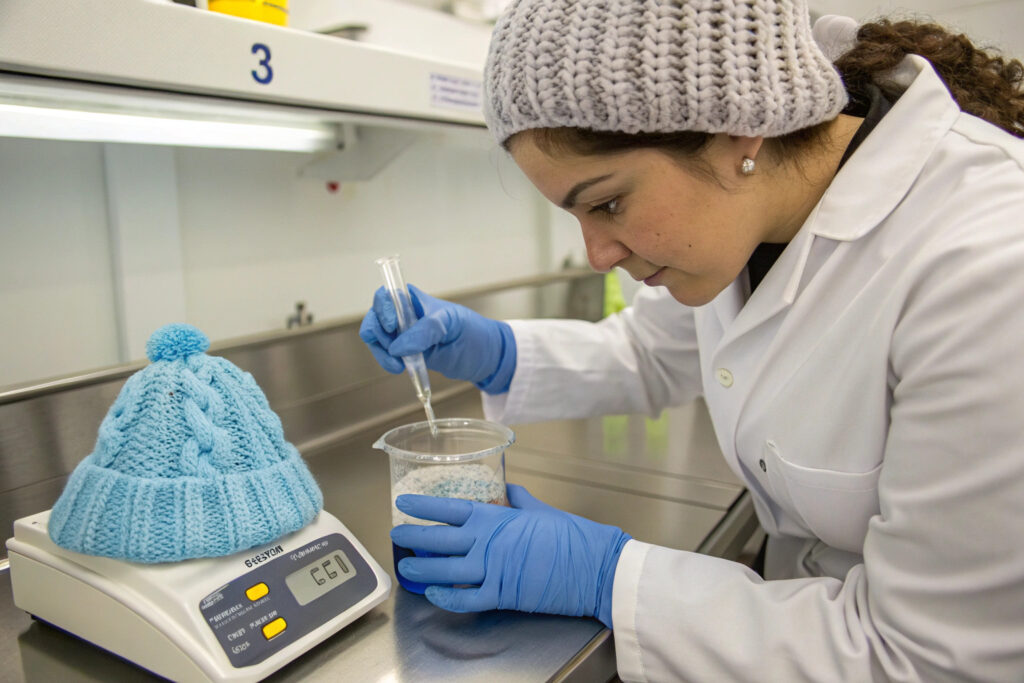
The Grade 1 certification is not just a tighter set of limits. It includes a specific test that Grade 2 products do not undergo. The saliva-fastness test, also called the saliva resistance test, simulates what happens when a baby sucks on the fabric. The test is based on the German DIN 53160 standard for colorfastness to saliva and perspiration. A swatch of the baby beanie fabric is soaked in a synthetic saliva solution at body temperature for a specified period. The solution is then analyzed for the migration of dyes, heavy metals, and other extractable chemicals.
This test is unique to baby products because mouthing behavior is unique to babies. An adult baseball cap does not go in an adult's mouth. The Grade 2 test for an adult cap includes a perspiration fastness test that simulates sweat, but not a saliva test. The saliva test is more aggressive. Saliva contains enzymes that can break down certain dye bonds that sweat cannot. A dye that is fast to sweat may bleed into saliva. A baby beanie that carries the Grade 1 label has been proven to hold its color and its chemical safety when a baby inevitably puts the brim in their mouth.
The saliva test is the signature additional protocol for Grade 1. But the entire set of colorfastness tests is also evaluated against a stricter interpretation. A slight color rub-off that might be acceptable on an adult cap worn over hair is a failure on a baby beanie that can be chewed.
What Is the Saliva Fastness Test and Why Is It Unique to Grade 1?
The synthetic saliva solution is formulated to match the pH, enzyme content, and ionic strength of human infant saliva. The fabric swatch is placed in contact with the solution under a standardized pressure and temperature for a defined contact time, typically 30 minutes to 2 hours. After the test, the solution is examined for any visible dye bleed. The fabric is also checked for any color change.
The test also evaluates the colorfastness of printed labels, embroidery threads, and any decorative elements on the beanie. A colorful embroidered animal face on the front of a baby beanie is subject to the same saliva test. The saliva fastness testing protocol is a key differentiator between a product that is safe for a nursery and a product that is only safe for an adult.
How Does the Perspiration Test Differ for Baby Skin?
The perspiration test for Grade 1 uses a synthetic perspiration solution that is formulated to match infant sweat, which has a different chemical composition than adult sweat. Infant sweat has a higher concentration of certain electrolytes and a slightly different pH profile.
The test simulates the condition of a baby wearing a beanie on a warm day. The fabric is soaked in the synthetic infant sweat solution, placed under pressure, and tested for dye migration and chemical leaching. The perspiration fastness standard for baby articles is often aligned with the most stringent medical textile testing protocols, reflecting the fact that a baby's skin barrier is less developed than an adult's.
Why Do Baby Beanies Have Stricter Accessory Requirements?
A baby beanie is not just a smaller version of an adult baseball cap. It is a product that will be worn by a human being who has no understanding of danger. Every component attached to the beanie is a potential choking, strangulation, or ingestion hazard. The OEKO-TEX Grade 1 standard extends its chemical safety logic to mechanical safety. Accessories, attachments, and labels are subject to requirements that do not exist in Grade 2.
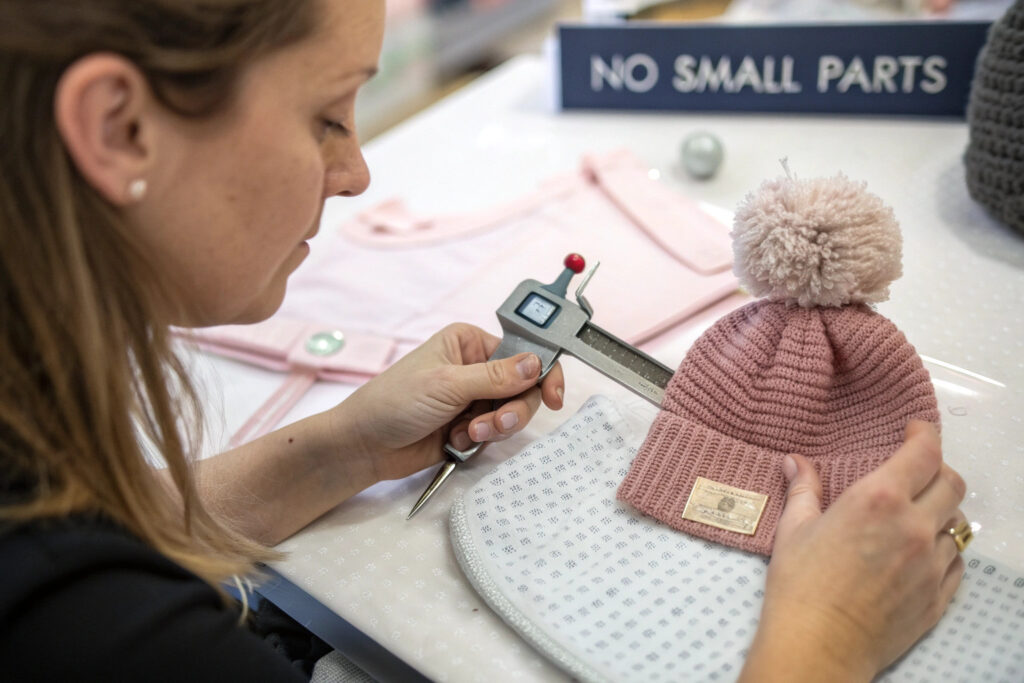
Pom-poms, ear flaps, ties, buttons, embroidered patches, and labels are all considered detachable components under the standard. They must pass a tensile strength test that simulates a child pulling and chewing on them. The attachment must withstand a force of at least 70 Newtons for 10 seconds without detaching or breaking into small parts that fit inside a small parts cylinder. If a pom-pom detaches and can enter a baby's mouth, it is a choking hazard. The chemical certification of the beanie fabric is meaningless if a baby chokes on the pom-pom. In addition to the mechanical attachment strength, the components themselves must be certified to Grade 1 chemical standards. The yarn used for the pom-pom, the thread used for the embroidery, and the ink used for the printed label must all have individual Grade 1 certifications or be included in the beanie's overall certification. A factory cannot use a Grade 2 polyester thread to sew a label onto a Grade 1 beanie. The entire product, including every accessory, must be Grade 1 safe.
The accessory requirements also extend to what is not attached. Many adult baseball caps use internal buckram, a stiff fabric coated with a resin, to give the front panel its structure. This resin is a chemical risk for a baby product. The construction of the beanie itself is different.
Why Are No-Detachable-Parts Standards Applied to Beanies?
The no-detachable-parts principle is derived from the international small parts regulations for toys, such as EN 71 in Europe and ASTM F963 in the US. A baby beanie is not classified as a toy, but it is used in the same environment, the crib or playpen, and is subject to the same mouthing behavior.
A decorative button that falls off an adult baseball cap is a minor quality complaint. A decorative button that falls off a baby beanie and is swallowed is a medical emergency. Our sewing protocol for baby beanies replaces all sewn-on buttons with embroidered button shapes. The visual design is preserved. The mechanical risk is eliminated. The small parts regulation under the CPSIA provides the test cylinder dimensions that define a choking hazard.
How Must Labels Be Attached to Comply With Grade 1?
The traditional woven label sewn into the inside seam of a cap can be a skin irritant for a baby. The label edge can scratch the sensitive skin on a baby's forehead. The sewing thread can create a small loop that catches a finger or toe.
Grade 1 baby beanies often use a direct-print label. The care instructions and fiber content are printed directly onto the fabric using a Grade 1 certified, non-toxic, water-based ink. If a physical label is necessary, it is sewn flat on all four sides with a soft, covered edge, and the thread ends are trimmed flush to prevent any loop. The labeling requirements for children's products include specific instructions for placement and attachment that minimize skin contact.
How Does a Factory Maintain Segregation Between Grade 1 and Grade 2 Production?
The chemical certification is a paper document. The physical reality on the production floor is where cross-contamination happens. A factory that produces both Grade 1 baby beanies and Grade 2 adult caps on the same sewing lines must have a documented segregation protocol. A single spool of non-certified polyester thread mistakenly used on a baby beanie voids the certification. The factory's quality management system must prevent this mistake.
I maintain a physical and procedural separation between our Grade 1 and Grade 2 production lines. The Grade 1 area is a designated zone with a painted boundary. All materials entering this zone are from a pre-approved, certified inventory with batch-specific OEKO-TEX certificates. The sewing machines, cutting tables, and storage racks in the Grade 1 zone are dedicated and are not used for non-certified production. Before a Grade 1 production run begins, a line clearance inspection is performed. The QC auditor checks every machine, every thread stand, and every material bin to confirm that no non-certified components are present. The clearance is documented on a checklist that is signed and dated. During production, an inline QC auditor performs random spot-checks of the thread spools on the machines against the approved thread certification list. After production, all leftover certified materials are returned to a locked, segregated inventory. This segregation protocol is audited during the annual OEKO-TEX factory inspection. The auditor walks the production floor and verifies that the physical separation exists and is being followed.
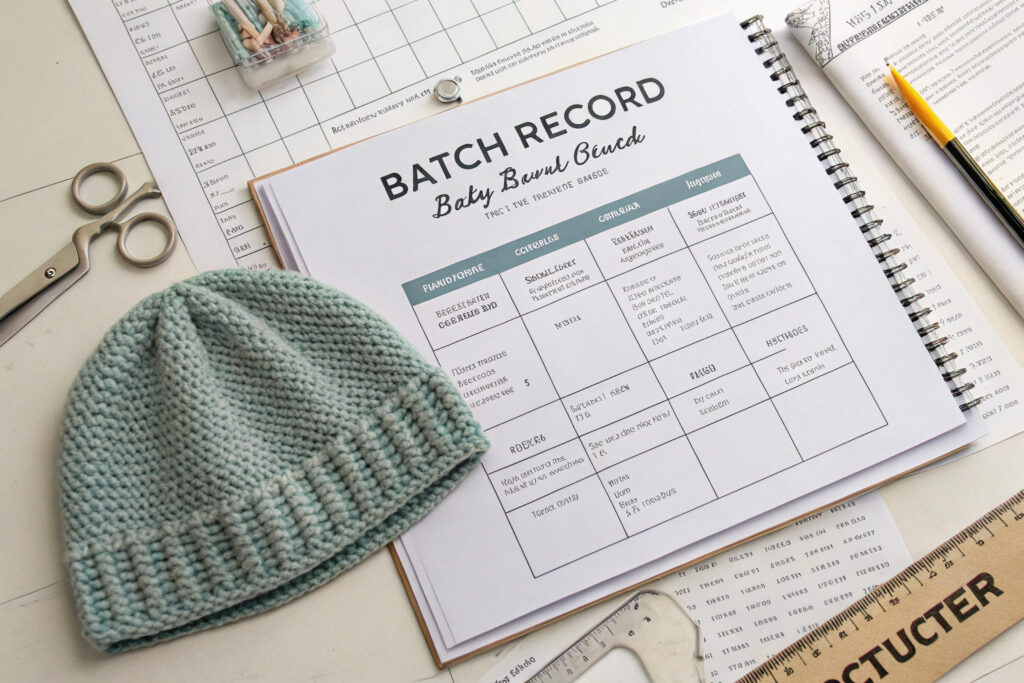
The physical segregation is the primary defense. The documentation system is the secondary defense that proves the segregation was maintained. The batch record for every Grade 1 baby beanie order must tell the complete story of the materials that went into it.
What Is a Line Clearance Procedure for a Grade 1 Production Run?
The line clearance procedure is a formal checklist process. The checklist has a line item for every potential contamination source. "All non-certified thread spools removed from the sewing stations." "All non-certified fabric rolls removed from the cutting table." "All cutting mats and machine surfaces wiped clean of any residue from previous runs." "All operators briefed on Grade 1 handling procedures."
The line supervisor and the QC auditor both sign the completed checklist. The checklist is filed with the production batch records. During the OEKO-TEX audit, the auditor randomly selects a past Grade 1 production batch and pulls the line clearance checklist. The production line clearance procedure is a standard practice in pharmaceutical manufacturing and is increasingly expected in certified textile production.
How Are Certified Materials Tracked Through the Cutting and Sewing Process?
Every roll of Grade 1 certified fabric and every spool of Grade 1 certified thread is logged into our ERP system with its certificate number, lot number, and incoming quantity. When a production order for baby beanies is released, the ERP system only permits the allocation of materials from the certified inventory lot.
The materials are physically moved to the Grade 1 production zone in sealed, labeled containers. The operator scans the barcode on the container before loading the material onto the machine. If a non-certified material barcode is scanned, the system blocks the transaction and alerts the supervisor. This material traceability system ensures that every component in the finished beanie is traceable back to its specific certified lot.
Conclusion
The difference between an OEKO-100 Grade 1 baby beanie and a Grade 2 adult baseball cap is not marketing. It is a measurable, auditable set of stricter limits, additional tests, and production protocols that reflect the biological vulnerability of an infant. The formaldehyde limit drops from 75 to 16 milligrams per kilogram. Heavy metals like antimony are required to be non-detectable. The pH range tightens to match infant skin. A saliva-fastness test is added to simulate mouthing behavior. Every accessory, from the pom-pom to the printed label, must be mechanically secure and chemically certified. And the factory must physically segregate the production of baby beanies from adult caps to prevent cross-contamination with non-certified materials.
I hold our Grade 1 certification with deep respect. It represents a commitment to the most vulnerable consumer. When I walk through our factory and see the green line separating the baby production zone, I see a promise. The promise is that a mother shopping in Berlin or New York can buy our beanie, turn it inside out, check every seam, and find nothing that could harm her child. That peace of mind is the product we actually sell.
If you are developing a baby hat or beanie collection and need a factory that already operates a certified, segregated Grade 1 production line with full material traceability, let us share our certification and our protocols. Our Business Director, Elaine, can send you our OEKO-TEX Grade 1 certificate with the detailed annex, our line clearance checklist, and a sample batch traceability report. Email her at elaine@fumaoclothing.com and ask for the Grade 1 Baby Product File. We will show you exactly how we protect the smallest heads in the world.