I answered a frantic call from a corporate events manager in New York on September 12th last year. She needed 3,000 custom logo caps for a national sales conference on November 1st. She had already paid a deposit to another factory. That factory had promised an October 15th delivery but had just emailed to say the shipment was delayed until November 10th. The conference would be over. The caps would be worthless. She was calling me to perform a miracle. I got the hats to her warehouse on October 28th. The miracle was not luck. It was a system.
You ensure a bulk cap order arrives before the Q4 deadline by locking three fixed points in time before you pay the deposit. First, lock a contractually binding ex-factory date that is at least 45 days before your in-hand deadline. This builds a buffer for the ocean transit, customs clearance, and a two-week contingency for port congestion. Second, lock a pre-shipment inspection date that is five days before the ex-factory date. This forces the factory to have the goods finished and ready for inspection early, exposing any delay before it is too late to recover. Third, lock a shipping method that is appropriate for the time of year. In Q4, the peak season surcharges spike, vessels are overbooked, and air freight becomes the only reliable option for orders finalized after October 1st. If your deadline is in November and your factory promises a sea freight delivery, they are promising a delay. Air freight from China to the US is four to seven days door-to-door under DDP terms. Sea freight in Q4 is a 30 to 45-day gamble. Accept the air freight cost or move your order date earlier. These are the only two choices.
I manage Q4 corporate gift orders every year. The pressure is intense, but the outcome is predictable when the process is engineered backward from the deadline. I want to share the production calendar logic, the risk points, and the communication protocols that transform a panic order into an on-time delivery. This is the project management framework that saves corporate reputations.
Why Does Q4 Require a Completely Different Production Timeline?
The fourth quarter is not just busy. It is structurally overloaded. The combination of back-to-school, Black Friday, Christmas, and corporate end-of-year budget spend creates a demand spike that strains every link in the supply chain. The fabric mills are at capacity. The embroidery thread suppliers run low on popular colors. The container shipping lines roll bookings. A production timeline that works in March, when the factory floor is operating at 60% capacity, will fail in October, when the same floor is at 110% capacity and working night shifts.
I add 15 calendar days to every Q4 order's production timeline compared to a Q2 order for the same product. This is not a safety margin. It is a realism adjustment. The 15 days cover the queue time at the cutting table, the wait for the embroidery machine to become available, and the extra day the packing team needs because they are handling triple their normal volume. I also build in a raw material pre-purchase milestone. For a Q4 order, I do not wait for the deposit to buy the fabric. I buy the standard black, navy, and white cotton twill in August based on forecasted demand. The fabric is in my warehouse before the PO is signed. This pre-stocking eliminates a 10-day fabric sourcing delay. A factory that does not pre-stock base fabrics for Q4 is a factory that will deliver late. The factory's raw material strategy in August is the buyer's delivery guarantee in November.
The timeline adjustment is a mathematical necessity. But the math only works if every milestone on the critical path has a date and an owner. A floating promise of "mid-October" is not a milestone. A specific date with a named responsible person is a milestone. The Q4 production calendar must be granular.
What Are the Critical Path Milestones for a Q4 Cap Order?
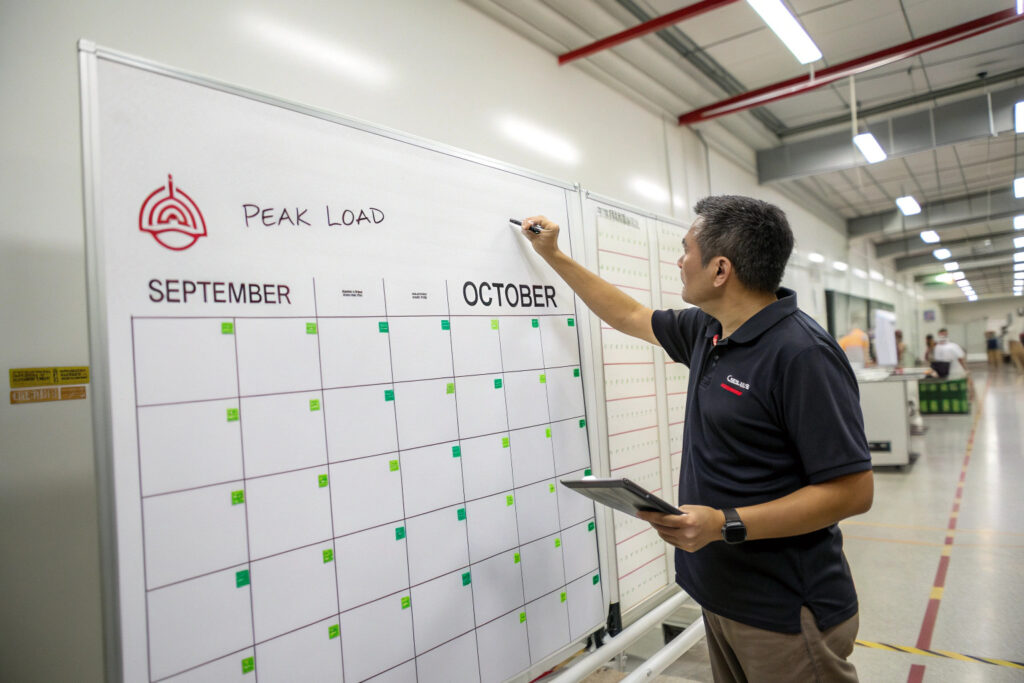
The critical path for a Q4 custom cap order has seven fixed milestones. Milestone one: artwork approval. The vector file is submitted, digitized, and a stitch-out is approved by the client. This must happen no later than September 1st for a November 15th in-hand date. Milestone two: lab dip and material approval. The custom fabric color swatch is approved. September 5th. Milestone three: pre-production sample approved. A physical sample of the complete cap is shipped and approved via video call. September 15th. Milestone four: bulk fabric cut. September 20th. Milestone five: bulk production complete and inline inspection passed. October 10th. Milestone six: final pre-shipment inspection passed. October 15th. Milestone seven: cargo handed to forwarder and departed. October 20th by air, or October 5th by sea. Each milestone has a one-week float built after it. If a milestone slips, the float absorbs it. If two milestones slip, the shipping method escalates from sea to air. This production timeline discipline is standard in project management and is absolutely critical for Q4 deliveries.
How Does Chinese National Day Impact Your October Shipment?
Chinese National Day, the first week of October, is a non-negotiable, nationwide shutdown. Factories close. Ports operate at reduced capacity. Customs offices are closed. No production happens during this week. No shipments clear during this week. A factory that promises an October 7th ex-factory date has forgotten that the factory is closed from October 1st to October 7th.
I add seven days to the timeline specifically for this holiday. The real impact is not just the seven days of closure. It is the backlog that accumulates. The week after National Day, every factory in China is trying to ship the orders that were supposed to ship during the holiday. The trucking companies are overwhelmed. The container bookings are double-booked. The real delay is closer to 10 to 12 days. A Q4 order that targets an ex-factory date of October 15th must be physically finished and inspected by September 30th. The Golden Week impact on shipping is predictable and must be planned into every timeline.
How Do You Set a Binding Ex-Factory Date That the Factory Honors?
A verbal promise of "we will ship in October" is not a date. It is a sentiment. A binding ex-factory date is a specific calendar date written into the purchase order that triggers a financial penalty if missed. The penalty transforms the date from a hope into a contractual obligation. Without the penalty clause, the factory prioritizes orders from buyers who do have penalty clauses. Your order becomes the one that gets pushed back when capacity tightens.
I recommend a graduated liquidated damages clause. For each full week of delay past the agreed ex-factory date, the factory deducts a percentage from the invoice. A standard rate is 2% of the order value per week, capped at 8%. This structure is fair. It compensates the buyer for the air freight upgrade that will be necessary if the sea freight window is missed. It also motivates the factory production manager to allocate resources to this order instead of a different one. The clause must be agreed upon in writing before the deposit is paid. I also build a "premium escalation" clause. If the delay exceeds two weeks, the factory is obligated to upgrade the shipment to air freight at their own expense to recover the delivery window. This clause is a powerful alignment tool. It ensures the factory shares the buyer's urgency. A factory that refuses a penalty clause is a factory that plans to fail.
The penalty clause is the stick. The incentive is the carrot. A factory that consistently delivers on time deserves a better price and a bigger share of your business. But even with a perfect contractual framework, the ex-factory date can be gamed if the factory rushes defective goods out the door to meet the date.

What Is the Difference Between Ex-Factory Date and On-Board Date?
The ex-factory date is the date the finished, inspected, and packed goods leave the factory gate. The on-board date is the date the container is loaded onto the vessel. The gap between these two dates is typically three to seven days for trucking, terminal delivery, and customs export clearance. A factory that quotes an "ex-factory date of October 15th" might not have the container on the water until October 22nd.
You must clarify which date is being quoted. The ex-factory date controls the factory's production responsibility. The on-board date controls the freight liability. I write both dates into the PO. "Ex-factory date: October 15th. Latest on-board date: October 20th." This dual-date structure closes the gap where containers sit in a trucking yard waiting for a vessel booking that the factory forgot to arrange. The incoterms definition of FOB clarifies the point at which risk and responsibility transfer from seller to buyer.
How Can a Pre-Shipment Inspection Enforce the Ex-Factory Date?
The pre-shipment inspection is a hard gate. Schedule the inspection for five days before the ex-factory date. If the goods are not 100% finished and packed when the inspector arrives, the inspection is a failure by default. The ex-factory date is automatically missed. The penalty clause activates.
I inform the factory of the exact inspection date and time two weeks in advance. I also send a reminder 72 hours before. This inspection appointment creates a production deadline that is physically enforced by a third party. The factory cannot claim the goods are "almost done." The inspector counts the cartons. If 100 cartons are required and only 80 are packed, the inspection is failed. The shipment is delayed. The factory learns very quickly that the inspection date is the real ex-factory date. This pre-shipment inspection scheduling strategy is a powerful project management tool.
What Shipping Method Is Most Reliable for a November In-Hand Date?
The shipping method decision for Q4 is a calculation, not a preference. You have a hard date. The transit time for each mode is known. The congestion factor for Q4 is known. The math tells you the answer. For a US West Coast delivery by November 15th, sea freight is viable if the goods depart China by October 5th. For a US East Coast delivery, sea freight must depart by September 25th to allow for the Panama Canal transit or the longer Pacific crossing plus rail. If your production is not finished by these dates, you are not a sea freight candidate. You are an air freight candidate. Accept this fact and budget accordingly.
Air freight from Shanghai to Los Angeles is three to four days of flight time, plus one day for customs clearance, plus one day for last-mile delivery. Total door-to-door: five to seven days under DDP terms. The cost is approximately four to six times sea freight. For a 500-cap order, the air freight premium might be $400 to $600. This is the cost of a missed deadline. Compare that $400 to the cost of 500 unusable caps, a damaged corporate client relationship, and a lost repeat order. The air freight premium is cheap insurance. I present this math to my clients in September. If the production timeline slips past the sea freight cut-off, I immediately issue an addendum for the air freight surcharge. The decision is made in seconds, not days. The clock does not negotiate.
Air freight is fast, but it is not magic. The cargo space in November is heavily booked. Advance booking and a relationship with a reliable freight forwarder are as important as the budget. The logistics partner's competence determines whether the five-day transit is a reality or a fiction.

How Do You Secure Air Freight Space During Peak Season?
Air freight space in November is a scarce commodity. The e-commerce giants book massive capacity for Black Friday and Christmas shipments. A small brand ordering 500 caps is a low-priority customer for the airline. You secure space by booking through a freight forwarder who has a guaranteed space allocation, a block space agreement, with the major carriers.
I book our Q4 air freight space in August. I provide my forwarder with a forecast of our expected weekly volume for October and November. The forwarder reserves the space against that forecast. When the actual shipment is ready, the cargo is loaded without a delay. A buyer who tries to book air freight on October 25th for a November 1st delivery will face spot rates that are double the contract rate and an unpredictable space availability. The air freight peak season dynamics are well documented by IATA.
Why Is DDP Shipping the Safest Option for Corporate Gift Deadlines?
DDP, Delivered Duty Paid, means the factory controls the entire logistics chain from the factory floor to the buyer's warehouse door. The factory books the air freight, clears the customs, pays the duties, and arranges the final truck delivery. The buyer's in-hand date is a single performance obligation for the factory.
Under FOB terms, the buyer's forwarder takes over at the port. If the forwarder delays customs clearance by two days, the buyer misses the deadline. The factory has fulfilled its contractual obligation because the goods left the factory on time. The buyer eats the loss. Under DDP, the factory is responsible for the entire timeline. If customs clearance takes an extra day, the factory upgrades the truck delivery to an expedited service to recover the day. The responsibility is undivided. For a corporate gift order with a non-negotiable deadline, DDP shipping transfers the logistics risk to the party best positioned to manage it.
How Should You Communicate With the Factory During the Q4 Rush?
Silence in Q4 is a leading indicator of a late shipment. A factory that goes quiet during the production window is a factory that is behind schedule and avoiding the conversation. Frequent, structured communication is not micromanagement. It is risk detection. A problem caught on October 1st can be solved. A problem discovered on October 25th is a disaster.
I establish a communication rhythm at the start of every Q4 order. Every Monday, the project manager sends a one-page status update email. The email contains a photograph of the goods in their current production stage, a percentage completion number, a red-yellow-green traffic light indicator for each milestone, and a note on any issues. If the traffic light is yellow or red, the email includes a specific recovery plan with a date. I also schedule two mandatory video calls. One at the pre-production sample approval stage, and one at the 50% production completion mark. During the 50% call, the factory walks the production floor with the camera and shows the actual goods in progress. This video evidence is much harder to fabricate than a written update. This communication cadence creates a rhythm of accountability. The factory knows that Monday's email is coming, that the video call is scheduled, and that silence is not an option.
The communication system is the nervous system of the project. It transmits information and detects pain. But the quality of the information depends on asking the right questions. A generic "how is the order going?" invites a generic "fine." A specific question demands a verifiable answer.

What Specific Questions Should You Ask in a Weekly Update?
I do not ask "is the order on track." I ask "how many cartons are fully packed and sealed as of this morning." I ask "send me a photo of the finished goods pallet with today's newspaper in the frame." I ask "what is the current vessel booking confirmation number." Each question demands a specific, falsifiable piece of data.
The newspaper-in-photo request is a simple verification technique. The factory cannot send an old photo if today's newspaper is in the frame. This technique is widely used in hostage negotiations and is equally effective in supply chain management. The supplier communication best practices emphasize specific, data-driven questions over open-ended status inquiries.
How Do You Handle a Factory's Request for a Deadline Extension?
A request for an extension is a test of the relationship. The factory is asking you to absorb a cost. Your response determines whether the cost lands on you or on them. My response is standard: "I understand the situation. Please confirm in writing the new ex-factory date you can commit to. Based on that new date, we will calculate the air freight cost required to recover the original in-hand date. Per our penalty clause, this air freight cost will be deducted from the final invoice. Please confirm you accept this deduction."
This response is firm, fair, and pre-agreed in the contract. It does not end the relationship. It enforces the agreement. The factory that caused the delay pays for the recovery. The buyer's deadline is protected. The factory learns that deadline extensions are not free. This contract enforcement mechanism preserves the commercial relationship by resolving the dispute according to a pre-agreed formula, rather than an emotional negotiation.
Conclusion
A Q4 corporate gift cap delivery is a test of a factory's project management capability, not its sewing speed. The winners are decided in the planning, not in the production. You win by locking a binding ex-factory date with penalty teeth. You win by pre-booking air freight space in August. You win by scheduling a pre-shipment inspection five days before the ship date to force early completion. You win by running a weekly communication rhythm with verifiable photo evidence. You win by accepting that air freight is not an emergency expense. It is the standard shipping method for orders finalized after October 1st. These disciplines are not secrets. They are standard operating procedures for any factory that takes corporate deadlines seriously.
I treat every corporate gift order as a reputation-critical project. The caps are not just merchandise. They are the physical presence of a brand at its most important event of the year. A late delivery is a brand failure. An on-time delivery is a brand victory that generates repeat orders for years. This is the standard I have built into our Global-Caps Q4 production system.
If you have a Q4 corporate gift order on your desk and need a factory that can commit to a binding delivery date with the documentation, the communication, and the logistics infrastructure to back it up, let us talk now, not in October. Our Business Director, Elaine, can build you a reverse-engineered production calendar from your in-hand date and confirm our Q4 capacity availability. Email her at elaine@fumaoclothing.com with your quantity, logo artwork, and deadline date. We will respond with a detailed timeline and a firm commitment. Let us get your caps into that conference room on time.