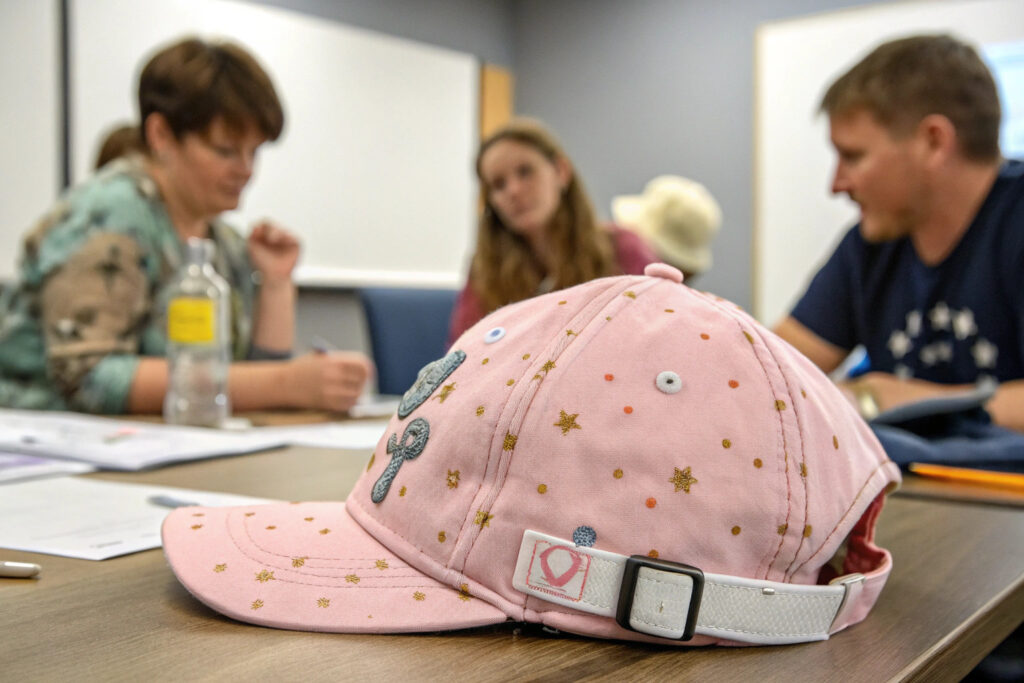
I sat in a meeting with a European children's wear buyer three years ago. She placed a kids' cap on the table and asked me to find the closure. I pointed to the metal tri-glide buckle on the back. She shook her head. "This is a strangulation hazard. It is non-compliant with EN 14682. This entire shipment would be seized at the EU border." I felt a cold rush. The cap was beautiful. The fabric was organic cotton. The embroidery was perfect. But the closure made it a legal liability. I had not done my homework on the safety code.
The best closure type for adjustable kids' caps that complies with global safety standards is a fabric hook-and-loop closure, commonly called Velcro, combined with a breakaway feature and no free-hanging drawcord ends. This closure satisfies three simultaneous safety requirements. It is adjustable without creating a loop that can catch on playground equipment. It releases under a predetermined tension before causing a strangulation or entrapment hazard. And it contains no small, detachable parts that pose a choking risk for children under three. The standards, primarily EU EN 14682, US ASTM F963 and CPSIA, and the drawstring clauses in various national regulations, converge on this design principle: an adjustable closure on a child's cap must not form a noose, must not dangle, and must not detach into small pieces. The hook-and-loop strap that folds back onto itself with a secure, stitched-down anchor is the nearest thing to a universal compliance solution.
I redesigned our entire kids' cap closure system after that meeting. I studied the regulations, interviewed testing lab engineers, and tested prototypes until we had a closure that passed every major market's requirements. I want to share that engineering logic with you, including the exact standards, the prohibited closure types, and the construction details that make a closure legally safe. This is not about creative design. It is about protecting children and protecting your business from a recall.
Why Are Drawcords and Long Straps Banned on Kids' Headwear?
The data behind the ban is tragic and unambiguous. Over a 20-year period, the US Consumer Product Safety Commission recorded multiple fatalities and numerous near-strangulation incidents involving drawstrings on children's clothing catching on playground slides, bus doors, and crib corners. A cap with a long fabric strap and a metal or plastic cord lock is functionally a noose waiting for an anchor point. A child running past a door handle, climbing a slide, or exiting a school bus is moving with enough momentum that a caught drawcord can stop them instantly by the neck. The force is not survivable.
The regulatory response to this data was decisive. The EU standard EN 14682:2014, titled "Safety of children's clothing — Cords and drawstrings on children's clothing — Specifications," categorically bans functional drawstrings, decorative cords, and any strap longer than a specified maximum in the head, neck, and chest area of clothing for children up to age 14. For the head and neck area of young children up to age 7, no drawstrings, functional or decorative, are allowed at all. This is not a guideline. It is a harmonized standard that creates a legal presumption of conformity with the EU General Product Safety Directive. In the US, ASTM F963 and the CPSIA incorporate similar restrictions. A cap closure that uses a free-hanging drawcord with a toggle is a prohibited product design for any child under 12 in the US and under 14 in the EU. The factory that manufactures it and the brand that sells it share the legal liability.
The regulatory text is specific about what constitutes a prohibited cord. But the interpretation of "functional" versus "decorative" can trap an inexperienced designer. A strap that is knotted and intended to look like a decorative bow is still a cord if it forms a loop. The safety assessment is based on the physical geometry, not the design intent.

What Is the Maximum Allowed Strap Length Under EN 14682?
The standard divides the child's body into zones. Zone A is the head, neck, and upper chest. For children up to age 7, no drawstrings or functional cords are permitted in Zone A at all. Not a short one. Not a decorative one. Zero. For children aged 7 to 14, a functional drawstring in Zone A is permitted only if it is a single continuous cord with no free ends, such as a sewn-in elastic loop, and it must not protrude more than a specified length when the garment is in a relaxed state. The maximum protrusion is 75 millimeters for any loop or strap in the head area.
For a cap, this means any adjustable strap that extends beyond the back opening of the cap by more than 7.5 centimeters is non-compliant. The strap must fold back onto itself and be secured, or it must be an internal adjustment system that does not protrude at all. The EN 14682 standard is the definitive reference for any brand selling children's clothing in the European market.
How Does the US CPSC Define a Hazardous Drawstring?
The US CPSC draws a similar line but focuses on the size of the cord loop and the presence of knots, toggles, and free ends. A drawstring with a toggle or knot at the end that can catch on a protrusion is classified as a substantial product hazard. The CPSC has issued multiple recalls specifically for children's hats with drawstrings, even when those hats were sold by major national retailers.
The enforcement mechanism is different from the EU. The EU uses a harmonized standard that prevents non-compliant goods from entering the market. The US uses a retrospective recall system. A non-compliant hat can be sold, and when an incident occurs or an inspection catches it, the CPSC issues a recall that forces the brand to refund consumers, destroy inventory, and pay a civil penalty. The CPSC drawstring guidance clearly states that children's upper outerwear with drawstrings at the hood or neck is subject to a voluntary recall commitment that is effectively mandatory.
What Closure Types Pass Both EU and US Safety Standards?
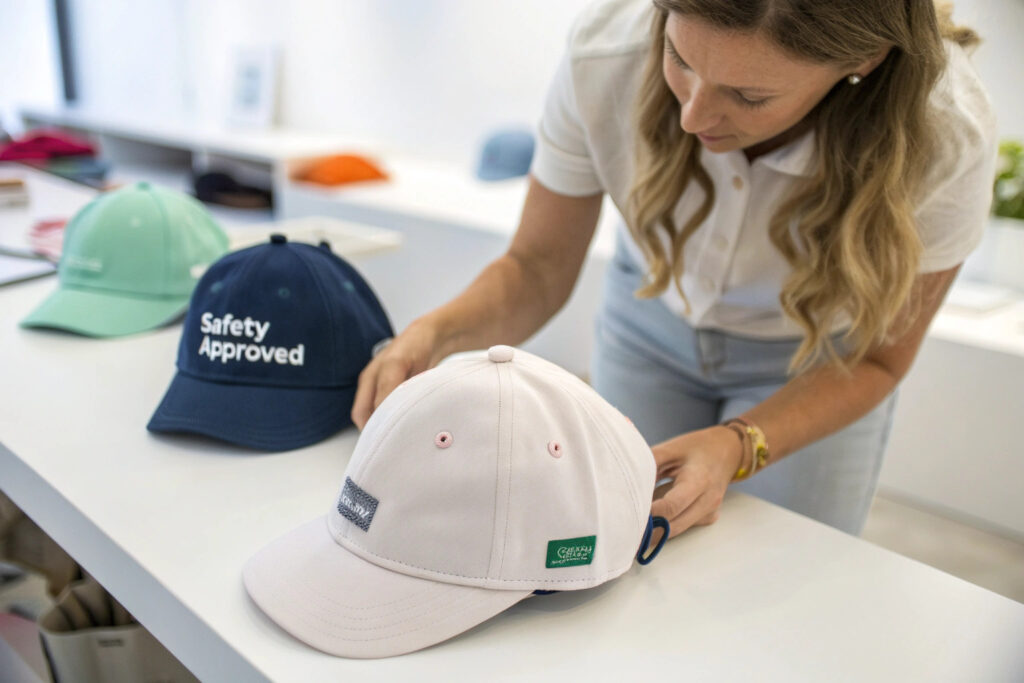
The regulatory filter eliminates most closure types. What remains is a short list of compliant designs that satisfy the no-loop, no-dangle, no-detachment requirements while still allowing the cap to adjust to fit growing children. The closures that consistently pass both EU and US safety testing are hook-and-loop fabric straps, side-release buckles on a very short fixed loop, and fully internal elastic or sliding adjustments. Each has a specific compliance profile that works for different age groups and product categories.
The hook-and-loop closure is the safest and most universally compliant option for children up to age 7. It consists of a fabric strap with a soft loop tape sewn onto the inside and a hook tape sewn onto the outside, or vice versa. The strap folds back onto itself and is secured by the hook-and-loop bond. There is no free-hanging end. There is no loop. There is no hard plastic piece that can detach. The closure is completely fabric-based and can be designed to be too short to form a loop around a test probe. The plastic side-release buckle is acceptable for children aged 7 and up, provided the buckle has a breakaway feature that releases under a tension of 22 Newtons or less, and the strap length is fixed so no dangle exists. The internal elastic closure is a premium solution where the adjustment is hidden inside the sweatband. A soft elastic band with a sliding adjuster is sewn into a tunnel, completely inaccessible to the child. This is the gold standard for toddler caps.
The choice between these three compliant types depends on the target age, the brand aesthetic, and the price point. But within each type, there are critical construction details that separate a truly safe closure from one that merely looks safe. The stitching method, the material choice, and the edge finishing are the hidden compliance factors.
Why Is Hook-and-Loop the Preferred Choice for Toddler and Baby Caps?
Hook-and-loop fabric closures eliminate three hazards simultaneously. There is no cord, so no strangulation risk. There is no hard plastic buckle, so no choking risk if the component detaches. And there is no small metal part, so no puncture or ingestion risk. The entire closure is textile. If it is sewn down with a lockstitch that meets the seam strength requirements of the relevant standard, it is extraordinarily safe.
For babies under 36 months, I recommend a hook-and-loop closure that is sewn flat against the cap, with the adjustment range built into the sweatband rather than an extended strap. The strap should be less than 50 millimeters in total exposed length, so it cannot form a loop around a small finger or a playpen post. The hook tape must be the softer, finer variety designed for infant wear, not the coarse industrial grade. The hook and loop fastener specifications for children's apparel include a soft-touch hook that does not scratch delicate skin.
When Is a Breakaway Buckle Considered Safe for Older Children?
For children aged 7 to 14, a side-release buckle is acceptable if it meets the breakaway force requirement. The buckle must release cleanly when a tension of 22 Newtons, approximately 2.2 kilograms of force, is applied in a straight pull. This force is low enough that the cap will come off before causing neck injury, but high enough that the cap stays on during normal play and wind.
The buckle must also have no sharp edges, must pass a torque and tension test for small parts, and must be made of a non-phthalate, food-grade plastic. The strap attached to the buckle must be sewn down to a fixed length with no sliding adjuster that could loosen and create a longer dangle. I recommend a "dead-strap" design. The buckle is sewn at both ends to a fixed-length strap, making it a fixed loop that the child cannot tighten. The breakaway buckle technology was developed for pet collars and has been adapted for children's safety products.
What Stitching and Assembly Methods Prevent Closure Detachment?
A safe closure type is worthless if it detaches from the cap during normal use. The best closure in the world becomes a choking hazard if a toddler pulls it off and puts it in their mouth. The attachment method must survive a standardized tensile force test without rupture, and it must do so consistently across every unit in a production run. This is a stitching engineering problem, not a design selection problem.
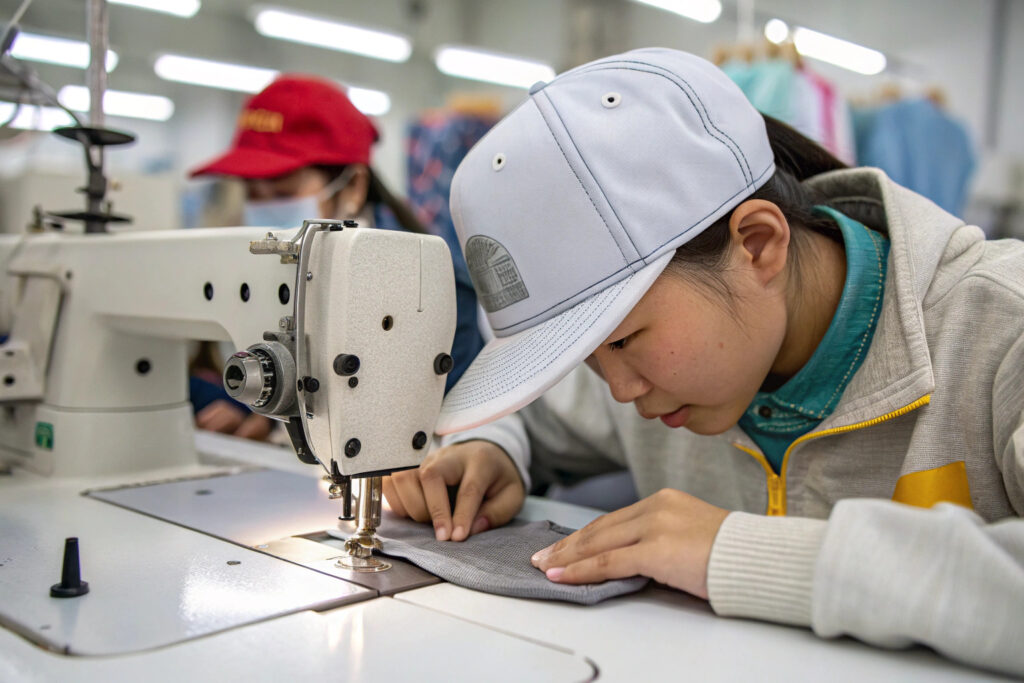
Our kids' cap closures are attached with a lockstitch bar-tack that applies a minimum of 30 stitches in a dense, reinforced pattern at both ends of the strap. The bar-tack is not a straight stitch. It is a zigzag stitch that distributes the load across multiple thread axes. We use a high-tenacity polyester core-spun thread for the bar-tack. This thread has a breaking strength of approximately 4.5 kilograms, which is far above the regulatory requirements. The strap material is folded over at the attachment point to create a double-thickness anchor. The needle penetrates four layers of fabric at the bar-tack location: the outer cap shell, the inner sweatband, and the folded strap end. This four-layer sandwich distributes the pull force across the entire back panel of the cap, not just a single weak point. The stitch density and thread type are specified in our tech pack, and the inline QC auditor checks the bar-tack length and thread tension on every production shift.
The stitching is the primary attachment mechanism. But the component's own geometry contributes to the security. A design detail that costs nothing in materials but adds significant safety margin is the strap's "pull-stop" feature, a simple fold or stitch that prevents the strap from being pulled completely out of the slider.
What Is the Minimum Seam Strength Requirement for Kids' Cap Closures?
The regulatory test method pulls the closure at a specified force and speed until failure. The closure assembly must withstand a force of 70 Newtons, approximately 7 kilograms, for a period of 10 seconds without rupturing, and the component must not detach into small parts that fit inside a small parts cylinder.
This test is performed on the finished cap, not on a fabric swatch. The entire closure, including the strap, the fastener, and the attachment to the cap, is gripped in the tensile tester. I recommend to our clients that they specify an internal standard of 90 Newtons minimum to provide a safety buffer above the regulatory minimum. The seam strength testing standard provides the detailed methodology.
How Do You Prevent the Hook-and-Loop from Scratching the Child's Neck?
A common complaint with hook-and-loop closures on kids' caps is that the rough hook side scratches the back of the neck when the strap is adjusted loosely and the hook tape is exposed. The solution is simple and should be a standard design feature. The hook tape is sewn onto a short, dedicated landing pad that is always covered by the loop strap. Even when the cap is adjusted to its maximum size, the hook tape never faces outward toward the skin.
Alternatively, we use a "fold-over" design where the strap folds back over the hook tape and the loop tape faces inward, or a "covered hinge" where a small flap of fabric permanently covers the rough edge of the hook tape. These are small pattern-making details that dramatically improve the tactile safety of the cap for a sensitive toddler. The infant product safety considerations extend beyond regulatory compliance to real-world user comfort and skin protection.
How Do I Document Closure Safety Compliance for a Retail Buyer?
A retail buyer, especially a large EU or US chain, will not take your word that the closure is safe. They will demand a documentation package that proves compliance with the specific standards that apply in their jurisdiction. This package is not a nice-to-have. It is a contractual requirement for onboarding as a vendor. The absence of this package will block your products from reaching the shelf.
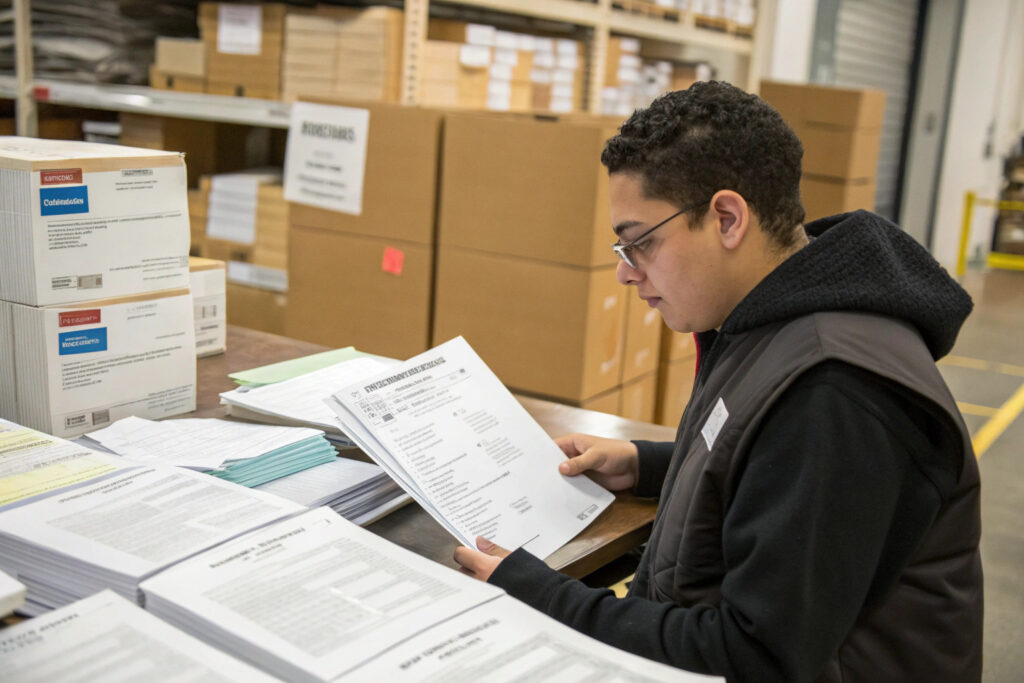
I prepare a Children's Product Certificate, formerly the General Certificate of Conformity, for every kids' cap order. This certificate lists the product identification, the applicable safety standards, the test lab that performed the testing, the test report date and reference number, and the name and contact information of the responsible party at our company. The CPC references specific test reports for small parts, lead content, phthalate content, and drawstring safety. I also prepare a third-party test report from an ISO 17025 accredited lab that explicitly tests the cap closure against the drawstring and cord requirements of EN 14682 and the breakaway force requirements. The report includes a photo of the tested closure. The package also includes a physical compliance sample, a sealed production sample that the buyer can compare against bulk shipments. This documentation is updated annually as the standards and lab accreditations change.
The documentation package is the formal proof. But a buyer's quality assurance team also conducts a simple visual checklist during a factory audit or a pre-shipment inspection. You should know what they will check so your documentation and your physical product tell the same consistent story.
What Specific Information Must a Children's Product Certificate Include?
The CPC must identify the product by SKU number and description. It must cite every applicable mandatory safety standard. For a kids' cap with a hook-and-loop closure, the applicable standards typically include ASTM F963 for mechanical hazards, the CPSIA lead and phthalate limits, and the relevant drawstring regulation. The CPC must also identify the third-party testing laboratory, the test report date, and the production batch covered by the certificate.
The certificate must be signed by a responsible individual at the manufacturing or importing company. I sign every CPC personally. This signature carries legal responsibility. The CPC requirements page on the CPSC website provides the exact template and filing instructions.
How Do I Prepare a Tech Pack That Specifies a Safe Closure?
The tech pack is the engineering drawing for the sewing floor. It must translate the safety standard into a visual, measurable production instruction. I include a dedicated "Safety Compliance" page in every kids' cap tech pack. This page has a large, labeled diagram of the closure. The diagram shows the maximum strap length with a dimension line and a "≤ 50 mm" notation. It shows the bar-tack location, the thread type, and the stitch count. It includes a small callout box that says "NO LOOSE CORDS. NO DETACHABLE PARTS. EN 14682 ZONE A COMPLIANT."
This visual instruction leaves no ambiguity for the pattern maker or the sewing supervisor. The compliance requirement is built into the production document, not just the testing document. The tech pack becomes the single source of truth on the factory floor.
Conclusion
The best closure for an adjustable kids' cap is not the one that looks the coolest or costs the least. It is the one that a testing lab has pulled to failure and documented as safe. A fabric hook-and-loop strap, sewn flat with a lockstitch bar-tack, with no free ends, no plastic hardware, and a soft, covered hook surface, is the most universally compliant closure for children under seven. For older children, a breakaway buckle on a fixed-length strap provides the security of a snap closure without the strangulation hazard. In every case, the stitching that attaches the closure to the cap is as critical as the closure type itself. A bar-tack that fails the tensile test is a design failure, not a sewing mistake.
I keep a file on my desk of every kids' cap recall notice issued in the last decade. The majority list "drawstring hazard" as the reason. A piece of string. A plastic toggle. A simple design choice that a factory made without understanding the consequence. My commitment as a manufacturer is to ensure that every kids' cap that leaves our factory has a closure that has been engineered, tested, and documented to the highest global safety standards. Your commitment as a buyer is to demand that documentation and to inspect the closure yourself against the visual checklist.
If you are developing a kids' cap line and need a factory that has already invested in the compliant closure engineering, the accredited lab testing relationships, and the documentation systems, let us share our work with you. Our Business Director, Elaine, can send you our Kids' Cap Safety Compliance Package, including our standard closure tech pack, sample CPC, and a physical sample of our hook-and-loop closure with the soft-touch hook tape. Contact her at elaine@fumaoclothing.com and request the Kids' Safety File. We design our closures so your customers never have to worry about them.