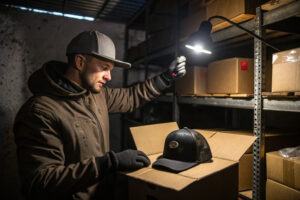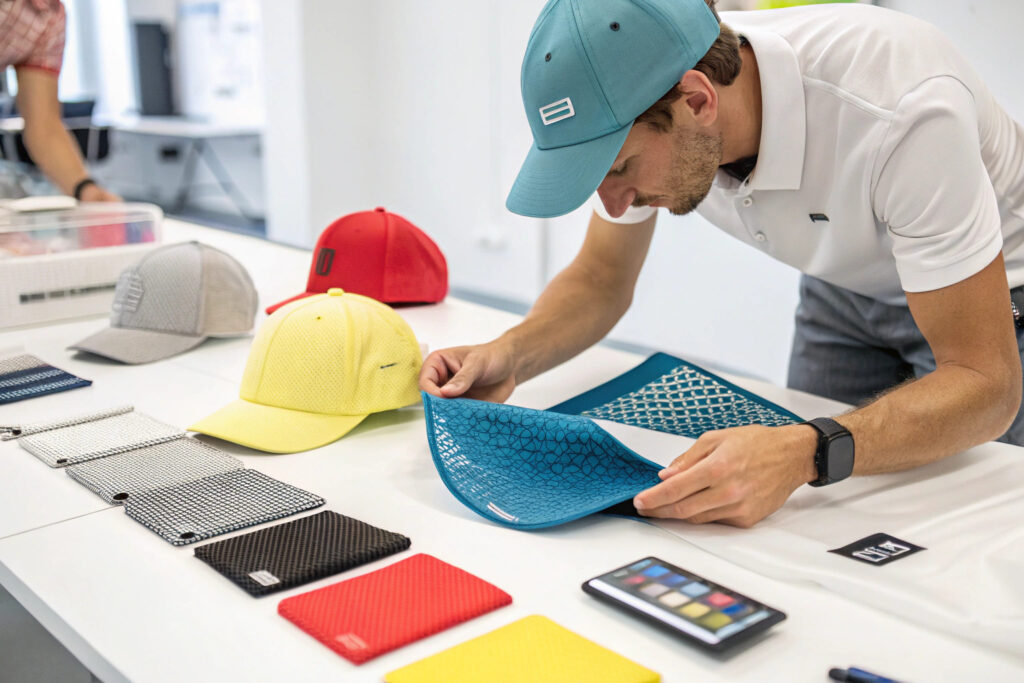
I stood in a trade show booth in Berlin last March, watching a buyer scrunch up a trucker hat in his fist. He let go. The mesh back panel sprang back to its original shape without a crease. He nodded, impressed. Five years ago, that same buyer had complained to me that trucker mesh felt cheap, plastic, and sweaty. Something has shifted. The material science behind the mesh has finally caught up to the demands of performance headwear.
The highest-rated breathable mesh materials for trucker hats in 2026 are recycled PET hexamesh for all-around performance, micro-perforated nylon tricot for a soft hand feel against the skin, and laser-cut TPE honeycomb for maximum structural ventilation. Each of these materials has moved past the old standard of cheap polyester netting. They now solve the three classic trucker hat problems: heat buildup, forehead abrasion, and foam collapse after washing. We test these materials in our Zhejiang factory for airflow, durability, and safety certification. The data is clear. The old plastic mesh is obsolete.
Our design team has been field-testing these new meshes with running clubs, golf courses, and outdoor brands across the US and Europe. The feedback reshapes our entire sourcing strategy. I want to walk you through the science of what makes a mesh truly breathable, the specific materials leading the market right now, and how to choose the one that matches your customer's exact use case. This is not just about keeping a head cool. It is about making a hat that someone forgets they are wearing.
What Defines True Breathability in a Trucker Hat Mesh?
Most people think a mesh is breathable if you can see holes in it. This is like saying a window is open if the glass is removed. True breathability is a system, not a hole size. It depends on three measurable properties: air permeability, moisture vapor transmission rate, and thermal absorptivity. You can have a mesh with giant holes that traps sweat vapor against the foam backing. That mesh feels breezy but leaves the head clammy.
We measure breathability with a standard ASTM D737 airflow test in our lab. We place the mesh fabric under a controlled air pressure and record how many cubic feet of air pass through per minute. But that number alone is deceptive. A loose, open knit scores high on airflow but collapses in the wash. The real magic is in the combination of high airflow and dimensional stability. A mesh must also be hydrophobic. It must push moisture outward, not soak it up. This is why the internal surface finish matters as much as the hole geometry. We apply a permanent wicking finish to our polyester meshes that lowers the surface tension. Sweat cannot form a flat film over the hole. It beads and moves through.
Understanding the physics of heat exchange across the mesh is what separates a marketing claim from a performance fact. The next layer of analysis moves past simple airflow into how the material interacts with the sun's infrared radiation.

How Does Moisture Vapor Transmission Rate Affect Comfort?
Airflow cools the head through convection. But when you are standing still at a barbecue or sitting in a dugout, there is no wind. The cooling must happen through vapor transmission. The MVTR measures how much water vapor passes through the fabric in 24 hours. A high MVTR means your sweat evaporates through the mesh, leaving the skin dry.
Standard trucker mesh uses a circular polyester yarn with a smooth surface. Water vapor squeezes through the gaps but does not interact with the yarn. Modern performance mesh uses a profiled yarn with channels. These channels wick moisture across a larger surface area, accelerating evaporation. We have tested an 8-channel recycled PET yarn from a Taiwanese mill that achieves an MVTR of 1,200 g/m²/24h. A standard mesh is around 800. That is a 50% improvement. The head feels noticeably drier after an hour. For a breathable fabric, this vapor transfer is the hidden metric that actually determines all-day comfort.
Why Does UV Resistance Matter for Mesh Longevity?
Trucker hats live in the sun. The back mesh of a trucker cap is directly exposed to UV radiation for hours. Cheap polyester mesh degrades. The UV rays break the polymer chains, and the mesh becomes brittle. After one summer, the holes start to tear along the seam lines where the mesh meets the front panels.
A high-rated mesh for 2026 must include a UV stabilizer in the polymer masterbatch. This is not a surface coating that washes off. It is baked into the fiber itself. We test our mesh panels under an accelerated UV weathering chamber set to simulate 500 hours of direct sunlight. A standard mesh loses 40% of its tensile strength. A stabilized recycled PET mesh loses less than 10%. This is the difference between a hat that lasts one festival season and one that stays in the customer's rotation for years. The UV degradation resistance is a direct function of material quality.
Which Recycled PET Mesh Materials Lead the Market in 2026?
The sustainability mandate has moved from a nice-to-have to a hard requirement for many retail buyers. But recycled content cannot be an excuse for poor performance. The market leaders in 2026 have solved the quality problem. They have matched, and in some cases exceeded, the durability and clarity of virgin polyester mesh. Our sourcing team has narrowed the field to three specific material types that consistently deliver on lab tests and customer feedback.
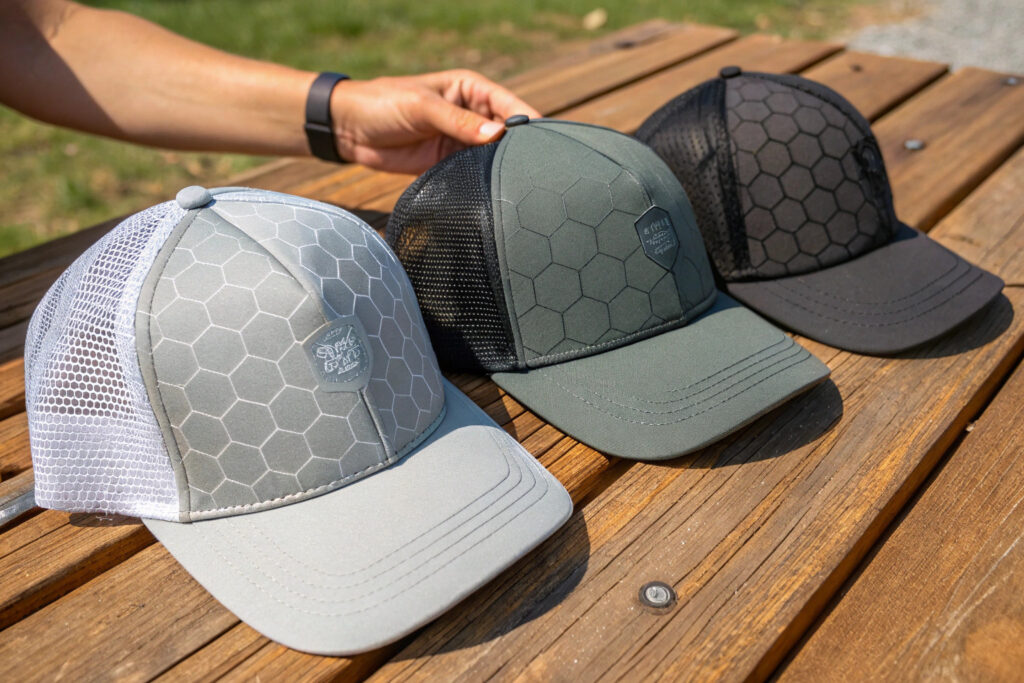
The first and most popular is the tight-weave hexamesh made from 100% post-consumer recycled PET bottles. This is not the floppy, oversized hole mesh of the 1980s. It has a crisp, hexagonal structure that holds a clean silhouette even after machine washing. We source ours from a certified mill in Jiangsu that provides a full chain-of-custody certificate. The second material gaining ground is micro-perforated nylon tricot. This is a knit fabric, not a woven mesh. It feels like a soft athletic jersey but with thousands of invisible laser-drilled microholes. It is silent. It does not make the "swish" sound that some customers dislike. The third and most premium is laser-cut TPE honeycomb. TPE is a thermoplastic elastomer, a rubber-like material. A laser cuts a geometric honeycomb pattern into a thin TPE sheet, creating a mesh that has zero fraying, incredible elastic recovery, and a futuristic aesthetic. Each of these materials represents a distinct price-performance tier for different market segments.
Choosing between these three is not just a cost decision. It is a brand positioning decision. The material you select communicates your brand's values on sustainability, athletic performance, or cutting-edge design. The practical differences show up most clearly in the wash test.
How Does Hexamesh Compare to Traditional Polyester Mesh in Durability?
Traditional trucker mesh is a warp-knitted polyester net with diamond-shaped holes. The problem is the raw edge. When you cut it and sew it into a seam, the yarn ends fray. The seam puckers after three washes because the individual yarns pull out of the stitching. Hexamesh solves this by using a tightly interlocked filament structure. The hexagonal nodes act as anchors. The cut edge is cleaner. The seam strength is higher.
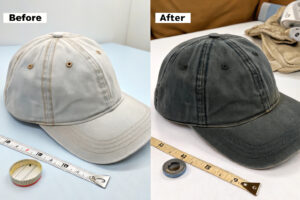
We run a standardized wash test of 20 cycles. The traditional mesh cap shows visible fraying at the side seams and a 15% loss of mesh tension. The recycled PET hexamesh cap loses only 3% tension and shows zero fraying. The recycled content does not weaken the fiber because the polymer is re-polymerized to the same chain length as virgin material. A recycled polyester mesh certified to the Global Recycled Standard gives you both the durability data and the marketing story for the hangtag.
What Are the Functional Benefits of Laser-Cut TPE Honeycomb?
TPE honeycomb mesh is a completely different category. It is not textile. It is a solid sheet that has been geometrically engineered. The laser beam creates perfectly smooth-edged hexagonal openings. Because there is no yarn, there is no capillary action. Water cannot soak into the material. It beads and rolls off instantly. This makes it ideal for water sports, beach hats, or any activity where the hat might get splashed.
The other unique property is stretch. TPE has a natural rubber-like elasticity without any spandex. The honeycomb geometry adds a structural stretch. When you pull it, the honeycomb cells elongate. When you release, they snap back perfectly. This means a one-size-fits-most trucker hat made with a TPE back panel fits a wider range of head shapes without a bulky adjustable closure. The downside is cost. TPE mesh is currently three to four times the price of recycled PET hexamesh. It is a premium category for technical outdoor brands. For a deep dive into the material itself, a thermoplastic elastomer supplier's guide explains the chemistry well.
How Do You Test Mesh Quality Before Placing a Bulk Order?
A salesman's mesh swatch on a ring binder always looks perfect. It has been ironed, trimmed, and selected from the best batch. The bulk mesh that arrives on the production floor four weeks later may be a different animal. You must test the mesh yourself, or demand a test report from an accredited lab, before you commit to cutting 5,000 hat panels. This is non-negotiable for any brand that values a consistent fit.
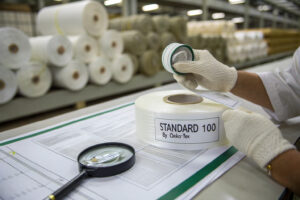
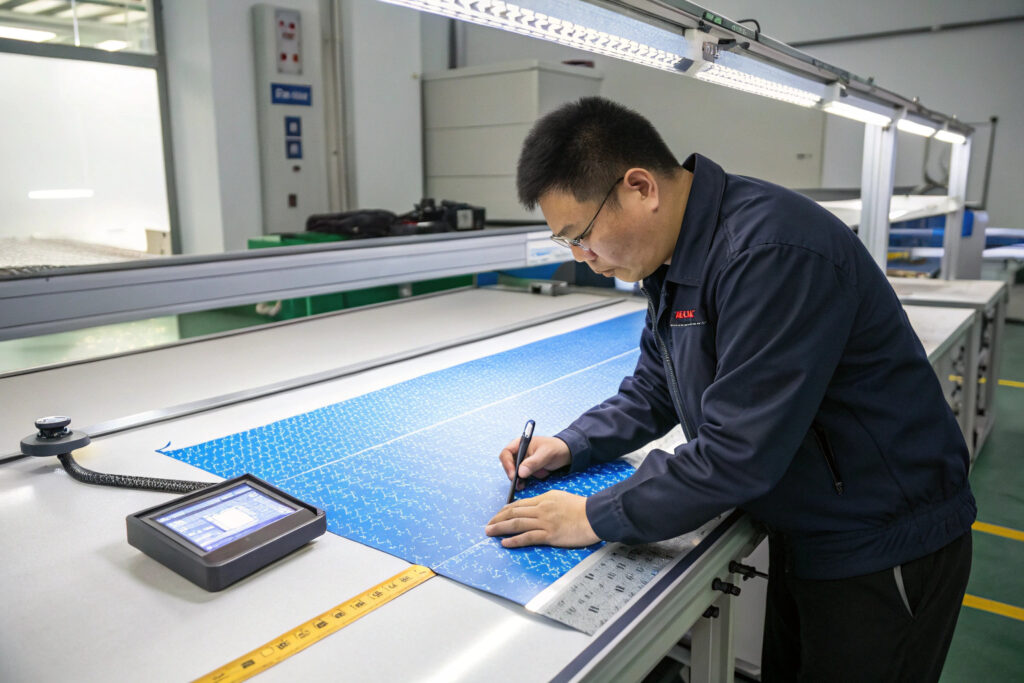
I put every new mesh through a four-point physical test protocol. Point one is the visual check. I stretch the mesh over a black lightboard in our inspection room. I look for thickness variations, clogged holes, and slubs that will look like defects on the final cap. Point two is the weight check. I use a precision gram scale and a die cutter. The mesh weight must fall within a 5% tolerance of the mill's spec. Point three is the seam slippage test. I cut a strip, sew it to a piece of twill, and pull it in a tensile tester. I want to see the mesh yarn break before the seam slips. Point four is the wash test. Five machine cycles, hot water, then re-measure the dimensions. If the mesh shrinks more than 2%, the final cap will pull tight against the plastic snap closure and buckle. This four-point check takes 30 minutes and can save a $20,000 production mistake.
A visual inspection under tension reveals about 80% of potential issues. But the remaining 20% hide in the material's chemical memory and its reaction to moisture. These require a more targeted, destructive approach.
What Is the Best On-Site Stretch and Recovery Test?
You do not need a lab to test elastic recovery. Take a permanent marker and draw a 10-centimeter line on the mesh in the direction of the stretch. Grip the mesh on either side of the line with both hands and stretch it firmly to a count of three. Release. Measure the line again. A quality mesh will return to within 5% of its original length. A poor mesh will stay stretched out by 10% or more.
Do this test on a swatch from the bulk shipment, not the salesman sample. Also, do it after the wash test. Some meshes have a chemical sizing that feels crisp initially but dissolves in water, leaving the mesh limp and overstretched. I have rejected entire rolls because the post-wash recovery failed. The hat would have looked great on the shelf but sagged into a shapeless bag after the first sweat-drenched wear. This simple manual test correlates well with expensive laboratory fabric testing equipment.
Why Should You Test the Mesh Against the Front Panel Fabric?
The mesh does not exist in isolation. It is sewn to a front panel, often a heavy cotton twill or a structured foam laminate. These two materials have different stretch and shrink profiles. If the cotton twill shrinks 3% and the mesh shrinks 0%, the seam puckers. If the mesh stretches more than the twill during the sewing process, the back panel bags out.
Our production team always sews a composite test swatch. We cut a half-crown piece, sew the mesh to the twill, and run it through the wash test as a complete assembly. We check for differential shrinkage at the seam line. This composite test is the only way to predict how the finished hat will behave. A mesh that passes all its individual tests but fails the composite test is a material mismatch, not a bad material. The seam quality of the union between mesh and solid fabric determines the entire hat's durability.
Which Mesh Material Works Best for Specific Activities?
A runner and a fisherman need different things from a trucker hat. The runner generates intense body heat. They need maximum vapor escape and minimum weight. The fisherman sits in direct sun with occasional spray. They need UV stability, water shedding, and a hat that will not mildew in a tackle box. There is no single "best" mesh. The best mesh is the one that matches the activity profile of the end user.
Our product development team has categorized our mesh offerings by activity. For high-exertion sports like running, trail hiking, and pickleball, the top performer is the micro-perforated nylon tricot. It is the lightest at 90 grams per square meter. Its MVTR is the highest. It feels like a second skin. For casual daily wear, festivals, and streetwear, recycled PET hexamesh is the champion. It offers the classic trucker look, excellent durability, and the lowest cost. For water sports, fishing, and beach use, the laser-cut TPE honeycomb is unmatched. It does not absorb water, it dries instantly, and it resists saltwater corrosion on the plastic snap. Matching the material to the motion prevents returns and builds a reputation for thoughtful design.
The activity-based selection process is not just about comfort. It is about safety and product longevity in specific environmental conditions. The presence of salt, chlorine, or extreme UV shifts the material requirements.

What Mesh Do Professional Outdoor Guides Prefer?
We sent a batch of samples to a fly-fishing guide service in Montana last year. They tested the hats for an entire season. Their feedback was unanimous. They rejected the standard hexamesh because the foam padding inside the front panel absorbed river water and dried slowly, leaving a musty smell. They rejected the nylon tricot because the microholes caught fine river silt and needed constant rinsing.
They settled on the TPE honeycomb with a mesh-only, no-foam front panel. The entire hat was a single layer of ventilation. It rinsed clean in the river, dried in ten minutes on the boat deck, and never developed the "hat funk" smell. They also noted that the TPE back panel did not catch on their fly line when they cast. This real-world feedback from outdoor professionals is more valuable to us than any lab spec. It shows how a specific mesh choice solves a specific occupational problem.
How Do High-Heat Environments Impact Mesh Performance?
A delivery driver in Phoenix needs a different mesh than a hiker in Seattle. In dry, extreme heat, the primary cooling mechanism is evaporative sweat loss. The mesh must have a high MVTR but also a low thermal conductivity. You do not want the mesh itself to heat up to 140 degrees in the sun and burn the back of the neck.
We measure the thermal effusivity of our mesh panels. Nylon tricot has the lowest "cold touch" sensation. It stays cooler to the initial touch in direct sun. Hexamesh can get hot to the touch, but its open structure releases the heat quickly. TPE has a higher thermal mass and can feel warm initially, but its white color option reflects a high percentage of solar radiation. For extreme heat environments, we recommend a white nylon tricot with a UPF 50 rating printed directly on the mesh. The UPF rating adds a health protection layer that a standard mesh lacks.
Conclusion
The mesh on a trucker hat is no longer an afterthought. It is a high-tech performance textile that defines the comfort, durability, and brand positioning of the entire product. In 2026, the highest-rated options are recycled PET hexamesh for proven all-around performance, micro-perforated nylon tricot for ultralight breathability, and laser-cut TPE honeycomb for waterproof, high-recovery technical applications. Each one solves a different set of problems for a different user.
I have watched our factory evolve from stocking one standard diamond mesh to managing a library of performance meshes with verified test data. This investment in material science allows our clients to speak with authority to their own customers. They do not have to guess whether the hat will shrink, fray, or trap heat. They have the lab reports and the field feedback to back up every claim.
If you are designing a trucker hat for a specific activity or demographic and need guidance on which mesh will perform best, we are ready to help. Our Business Director, Elaine, can ship you a mesh sample kit with lab test data and a wash comparison report. Contact her at elaine@fumaoclothing.com, and we will match your design vision with the engineering reality of the right mesh material. Your customer's head deserves a hat that breathes.