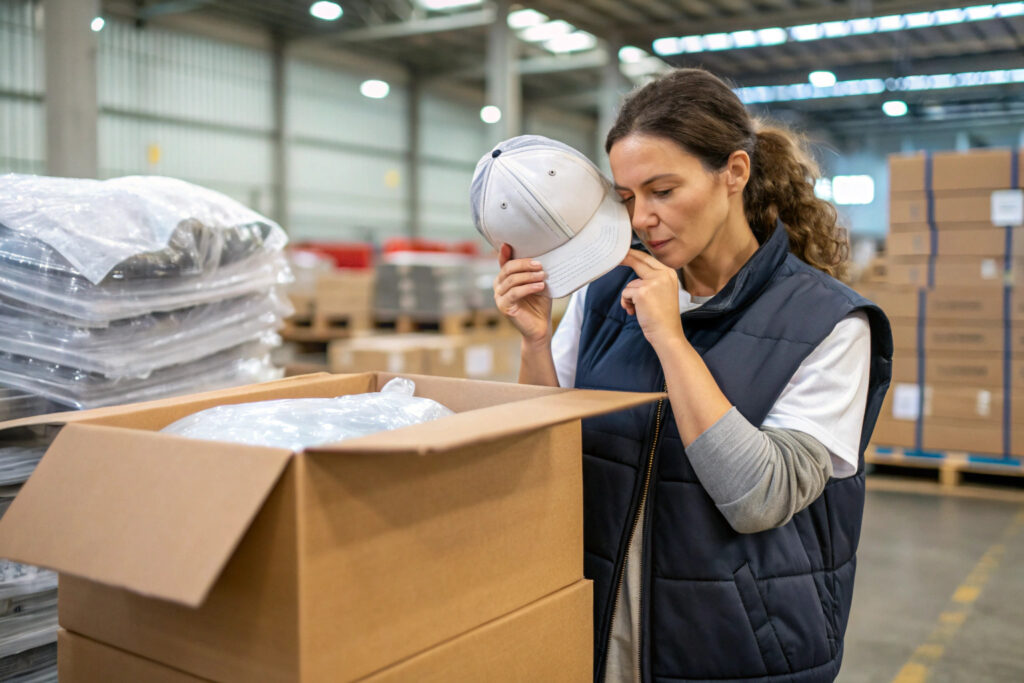
I still remember the call. A longtime customer in Chicago had just received 2,000 custom trucker hats for a big summer music festival. He opened the carton and a wave of sour, chemical fog hit his face. He could not hand these out to fans. They smelled like a mix of gasoline and mold. His panic was real. The event deadline was five days away, and this defect threatened to trash his entire investment.
Do not panic. Do not ship the hats out hoping the smell will fade. Isolate the entire shipment immediately in a well-ventilated area away from other inventory. Document the smell with a detailed written description, take photos of the polybag packaging, and pull random samples from different cartons. Then, notify your factory within 24 hours with a clear demand: a full rework or a replacement air shipment at their cost. The smell will not disappear on its own. It requires aggressive, structured intervention.
I have spent years building a quality control system at Global-Caps to prevent exactly this nightmare. But even the best systems can fail without a prepared response. I want to walk you through the forensic, practical, and negotiation steps that can salvage your inventory and your money. This is the emergency protocol you hope you never need but must have ready.
What Causes a Chemical Smell in Imported Hats?
The smell did not appear by magic. It has a source, and identifying that source is your first job. I have traced these odors through our supply chain for years. The root cause is almost always trapped volatile organic compounds, or VOCs. These are chemicals that did not fully cure or dry before the hat was sealed in its final packaging. When you open the box, the trapped gas hits you all at once.
The usual suspects sit inside the hat's construction. The front buckram, which gives a structured cap its shape, is coated with a stiffening resin. If that resin is low-quality or not baked long enough, it off-gasses a sharp, sour solvent smell. The foam backing in trucker hats is another culprit. Cheap polyurethane foam, often produced in unventilated workshops, holds a "memory" of the chemical bath it came from. Finally, there is the glue. The adhesive used to bond the layers together can release a vinegar-like or fishy odor if it is expired or improperly mixed. In wet seasons, these chemicals can also combine with moisture in the cardboard to breed a musty, mold-like stench.
The cause is not just a faulty material. It is a system failure in the factory's curing and storage process. Understanding this failure helps you judge whether the factory can truly fix the problem for a replacement order.
How Does Polybag Storage Accelerate the Smell Problem?
The polybag is a smell amplifier. Factories seal hats in polybags to protect them from moisture and dirt during ocean transit. But if the hat has not fully off-gassed its VOCs, the polybag acts as a sealed chamber. The chemicals volatilize and saturate the air inside the bag. Then, because the container heats up during the sea voyage, the pressure builds, forcing the chemical smell deep into the fabric fibers of the cap.
We learned this early on at Global-Caps. We changed our packaging protocol for any hat that uses foam or heavy resin. We add a small, discreet hole-punch to the polybag. This allows the hat to breathe. We also wait a mandatory 24 hours after the heat-seal process before a hat enters a polybag. I often ask a supplier I am auditing, "How long do your caps cure before bagging?" If they say "immediately," I know they are a smell risk.
Is the Smell Caused by Mold or by a Chemical Reaction?
It is critical to distinguish between a microbial problem and a chemical one. Mold smells earthy, damp, and alive. A chemical smell is sharp, synthetic, and solvent-like. Mold usually grows if the hats were packed with high moisture content. This often happens during the rainy season in southern China if the factory does not have a dehumidified storage room.
A mold problem means the hats are biologically contaminated. They pose a hygiene risk. A chemical smell means they are contaminated with volatile substances, which can be a skin irritant. You need to determine the type of defect because the fix is different. Mold requires a kill-step like ozone treatment. Chemical smells require off-gassing or heat treatment. We use a moisture meter on all bulk fabrics before cutting. If the cotton reads above 7% moisture, we reject the roll for storage until it is properly dried.
What Immediate Inspection Protocol Should I Follow?
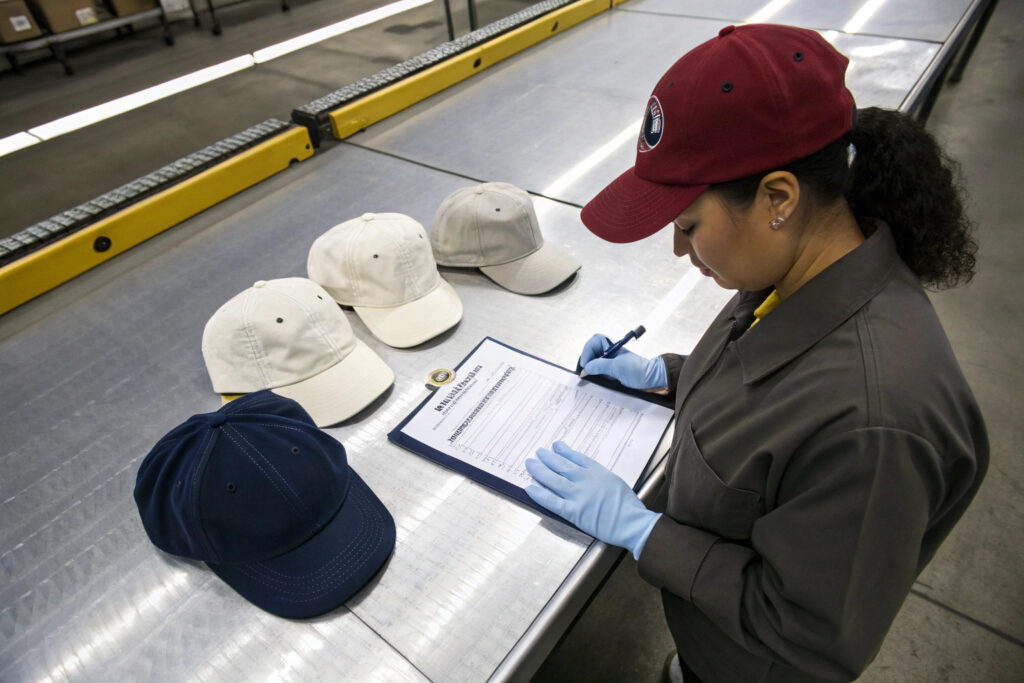
Do not tear open every box. You need a methodical approach to build a legal and commercial case for the factory to accept a return. Randomly grabbing hats off the top can be dismissed as an anomaly. You must follow a mini-AQL, or Acceptance Quality Limit, protocol. This creates a statistically valid record of the defect rate and severity.
I instruct our clients to take their shipment quantity and immediately perform a Level II general inspection. Open boxes from the top, middle, and bottom of the pallet. Smell is subjective, so you need to score the severity. I use a simple 4-point scale internally. Level 0 means no smell. Level 1 is a faint trace that airs out in seconds. Level 2 is a distinct, unpleasant odor that lingers. Level 3 is an overpowering, nauseating stench that fills the room. Tally the samples. If you hit a failure rate above 10% at Level 2 or Level 3, the entire lot is legally "unmerchantable" under the Uniform Commercial Code.
Once you have your statistical sample data, you need to gather physical proof that a lab can verify. This moves your claim from a matter of opinion to a matter of scientific fact.
How Do I Set Up a Simple Smell Test Jar?
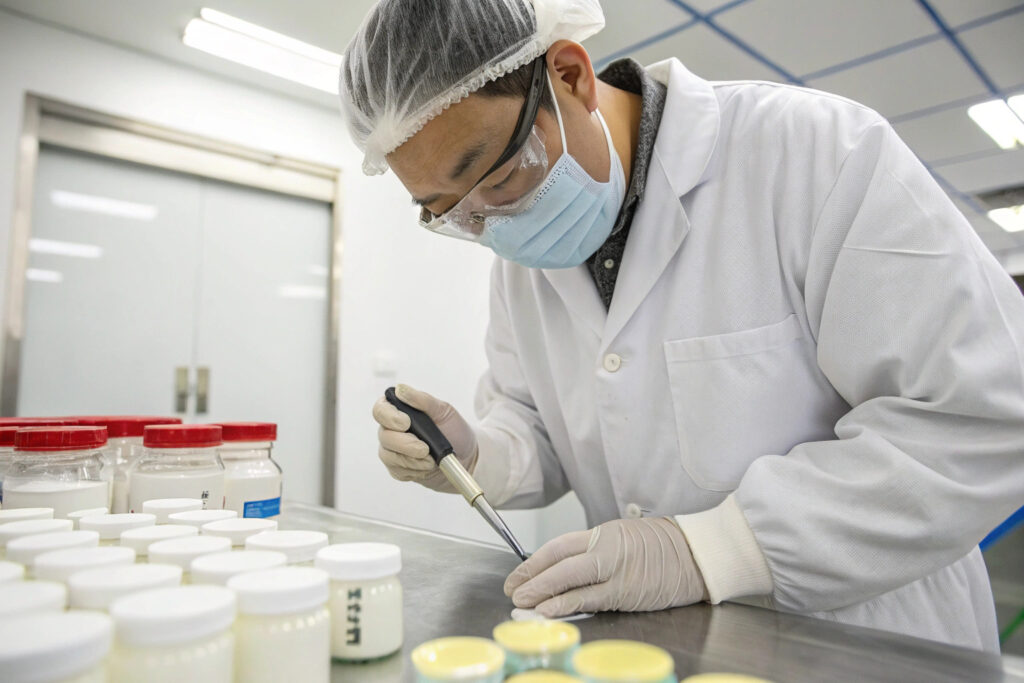
You can create a rudimentary lab test in your warehouse. Take a clean, odorless glass jar with a tight lid. Cut a 4-inch square swatch from the smelliest part of the hat, usually the front panel or inner sweatband. Put the swatch in the jar, seal it, and place it in a warm spot, like a sunny windowsill, for 30 minutes. Then open the jar and immediately smell the headspace.
This concentrated test confirms the defect and creates a point-in-time sample you can send to a third-party lab. I recommend clients send a sealed jar to a certified testing lab like Bureau Veritas or SGS for a VOC scan. This step costs money, but it transforms your argument from "this hat stinks" to "this hat contains 4.2 ppm of formaldehyde." A factory cannot argue with a chemical test report from an ISO-accredited lab.
What Photographic and Written Evidence Do I Need?
Factory managers see a thousand hat boxes a day. Your complaint email needs to force them to see the problem through your eyes. Photograph the shipping labels on the outer carton to prove it is their shipment. Photograph the production barcode sticker inside the hat to trace the exact production line and date. Then take a clear photo of the hat's front panel next to a written note describing the smell.
Write down the smell using precise analogies. Do not just say "bad smell." Say "smells like nail polish remover, indicating uncured acetate," or "smells like wet dog and basement, indicating mold." This helps the factory's QC team trace the exact chemical batch. I have seen factories deny claims for weeks, only to reverse their position immediately when shown a photo of the internal lot number and a detailed odor description.
How Can I Air Out or Remediate Smelly Hat Inventory?
The clock is ticking. Your customer is waiting, and a replacement shipment will take 15 days by air. You need a salvage plan now. I will be blunt. Some hats cannot be saved. If the chemical smell comes from a plasticizer in a synthetic leather patch, that off-gassing can last months. But if the smell is a light solvent trapped in the foam or sweatband, you can often remove it quickly enough to save the client relationship.
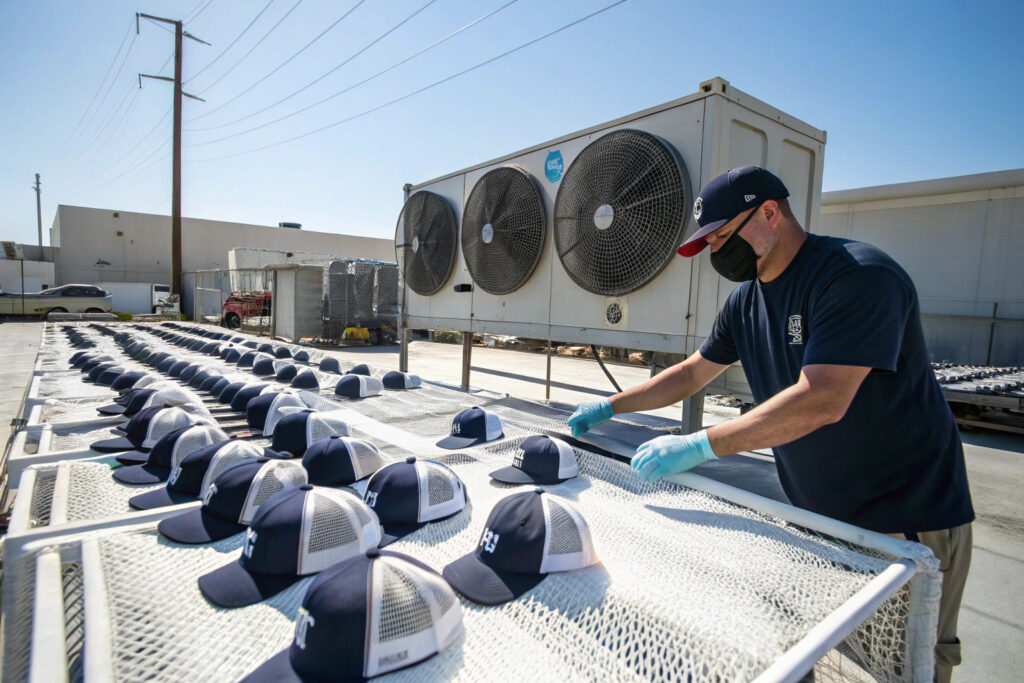
The most effective method is UV exposure combined with high airflow. Unpack the hats from their cartons and polybags. Remove any tissue paper or cardboard inserts. Lay the hats out on a clean tarp or mesh rack in direct sunlight. UV light is a powerful oxidizer. It helps break down volatile organic compounds. Set up industrial fans to create a cross-breeze over the hats. Rotate the hats every two hours. I have salvaged a batch of 1,000 caps in 48 hours using nothing but a parking lot, strong sun, and a team of three people. The smell dropped from a Level 3 to a Level 1, which was acceptable for the event giveaway.
If the sun is not enough, or if it is a rainy season in your area, you must move to more aggressive active methods. These carry risks, so you must test on a sample before committing the entire inventory.
Can Ozone Generators Safely Remove Hat Odors?
Ozone treatment is the nuclear option for stench removal. Many fire restoration companies use this to clear smoke damage. Ozone works by oxidizing the odor molecules at a chemical level. It is effective against mold and many VOCs. But I must warn you about a critical danger. Ozone also accelerates the degradation of natural rubber elastic bands and can slightly "yellow" bright white cotton fabrics.
We have used a third-party ozone chamber for small-batch remediation. The process takes 4 to 6 hours in a sealed container. You must air the hats out again for 12 hours after ozone treatment because ozone itself has a sharp, chlorine-like smell. Never let workers handle the hats without full ventilation after treatment. This method works best for synthetic hats like polyester trucker snapbacks. I avoid it for vintage-look organic cotton hats. Always test a set of 10 sample hats first and check the sweatband elasticity before and after with a spring scale.
What Commercial Deodorizers Are Safe for Cap Fabrics?
Avoid any spray that leaves a wet residue on the brim. Water can warp the visor board. You need a dry, enzyme-based deodorizer or a hydrocarbon-based odor eliminator. Look for non-aqueous products designed for furniture restoration, like those used on delicate upholstery. Apply it with a very fine mist from a pump sprayer. Do not soak the hat. A light mist over the inner sweatband and foam backing is enough.
After spraying, immediately place the hats back in the high-airflow drying setup. The fans will carry away the encapsulated odor molecules. I keep a supply of an automotive-grade fogging solution in our China sample room to test on prototype materials. If a new foam supplier's product smells, we test this fogger on it before approving the batch. You should ask any remediation company for a safety data sheet before letting them touch your textile inventory.
How Do I Negotiate a Compensation Claim With My Supplier?
This is where the relationship meets the road. A factory that values a long-term partnership will absorb the loss. A factory that only wants your next deposit will deflect blame. Your goal is not to make an enemy. It is to recover your costs without bankrupting your supplier, if possible. But you must lead with the facts, not with anger.
I teach my sales team a simple rule. The cost of a mistake is our burden. So when I advise a buyer on how to approach another factory for a claim, I give them the exact script I would accept. First, restate the agreed quality standard from the approved sample. Second, present the AQL failure data. Third, present the lab report if you have one. Fourth, state your demand clearly: a 100% credit, a re-manufacture with air freight, or a complete refund. Do not mix these demands. Pick the one that solves your customer's problem fastest. A quality claim is a logistical equation, not an emotional argument.
Cash is tight for everyone. The factory might push back with an offer of a small discount on the next order. You need to know when this is an acceptable compromise and when it is an insult.

What Is a Fair Remedy: Replacement, Refund, or Future Discount?
A future discount without a refund solves nothing for dead stock. You are left holding unsellable hats, and the factory gets to book a new sale. I reject this unless the odor is extremely mild and I can sell the hats as "seconds" locally. The factory's standard offer should be a rework. But reworking smelly hats in the US is often impossible because the chemical is inside the foam. So the true remedy is a replacement order shipped by air.
Calculate your exact landed cost per unit for the defective hats. Present this total cost, including the DDP freight you paid. Demand a credit note that covers this exact figure against the replacement order. If the factory refuses air freight for the replacement, they are effectively admitting they cannot guarantee the new product will arrive on time. A credible supplier who accepts fault will offer a credit note and free express shipping.
Should I File a Cargo Insurance Claim Instead?
This depends on the root cause. Insurance covers physical damage or loss during transit, not an inherent manufacturing defect. A moldy smell caused by the container sweating at sea might be a marine cargo insurance claim. A chemical smell from a cheap foam inside the hat is a product liability defect. The insurance adjuster will likely reject the latter.
If you have a marine cargo policy, you should still notify your broker in writing within the policy window. Let them make the determination. But do not wait for the insurance process to play out. Your customer is waiting now. I advise clients to negotiate directly with the factory for a replacement while simultaneously filing an insurance notice to keep the option open. State your case clearly to the factory: you are exploring all options, but they are the manufacturer responsible for the product quality.
Conclusion
A shipment that reeks of chemicals is a gut punch, but it is not a knockout. Your response must be clinical. Isolate the source. Document the defect with jar tests and lab reports. Remediate what you can with UV light and high airflow, but know when to write off a batch. And demand a concrete, costed compensation plan that respects your time. A factory that hides behind excuses is a factory you abandon. A factory that immediately air freights a replacement is a partner you keep through the rough patches.
The difference is in the preparation. I have built Global-Caps to be the kind of factory that obsesses over curing times and polybag breathability precisely so these calls do not happen. We test our foam batches for VOCs before they ever touch a shell fabric. This front-end investment in safety is the only true guarantee against a musty surprise on your loading dock.
If you are struggling with a compromised shipment from another factory and need a reliable production team, or if you want to ensure your next order comes from a facility with airtight chemical safety protocols, let us talk. Our Business Director, Elaine, can walk you through our in-house testing standards and show you how we prevent off-gassing defects completely. Send her a message at elaine@fumaoclothing.com, and let us take this particular worry off your plate for good.