I once watched a promising promotional products distributor lose $4,000 on a single order of 5,000 caps. He had negotiated a great FOB price from a factory and thought he had a 40% margin. He did not account for US customs bond fees, the port congestion surcharge at Long Beach, or the last-mile delivery to his client's warehouse in Kansas. He paid the price. His "profitable" order put him in the red.
To calculate the true landed cost of a custom cap under DDP terms, you simply ask your factory for one all-inclusive DDP unit price and multiply it by the quantity. That DDP price wraps the factory cost, sea or air freight, insurance, customs duties, brokerage fees, and final delivery into a single number. There are no surprise invoices. You know your exact landed cost per cap before it ships. This full transparency turns a complex import equation into a simple retail math problem.
I run a factory that pushes DDP terms because it saves our clients from the headaches I just described. We shift the logistics burden from your desk to ours. I want to show you how the sausage is made internally so you understand what goes into that clean DDP number. This knowledge helps you compare quotes honestly and spot a supplier who is hiding fees.
What Costs Are Included in a DDP Cap Quote?
Too many importers compare a DDP price to an FOB price as if they are the same thing. They are not. The FOB price is a naked product leaving the factory gate. The DDP price is the fully dressed product arriving at your doorstep. Pretending they are equal is like comparing a car's chassis cost to its on-the-road price. The shock comes later in the form of a demand for payment from the customs broker.
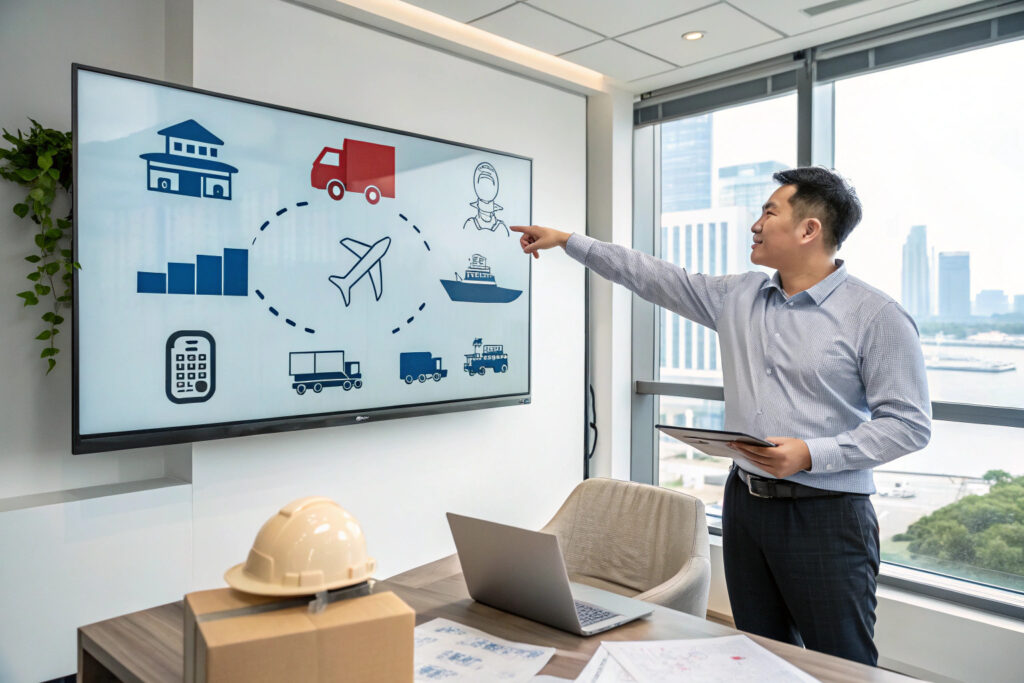
A proper DDP cap quote from our factory bundles six core cost buckets. The factory cost is first. It covers the fabric, the sweatband, the custom patch, and the sewing labor. The freight cost is second. It consolidates the sea freight or air freight. The insurance is third. The US customs duty is fourth. For caps, the duty rate usually falls under HTS code 6505.00, but we verify the exact rate for your fabric blend. The customs bond and brokerage fees are fifth. The last-mile trucking delivery to your final warehouse is sixth. We add one more invisible cost: our risk buffer for currency fluctuations between the Yuan and the US Dollar during the 30-day ocean transit. A genuine DDP quote has no asterisks.
A real DDP calculation is not a sticky note with one number. It is a spreadsheet with hard numbers backed by current freight indices. Let us look at the two most volatile elements that can destroy a budget if not locked down.
How Are Customs Duties Calculated for Different Cap Fabrics?
The duty rate is not a mystery. It is published. But the classification is where the risk sits. A 100% cotton twill cap might have a different duty rate than a cap with a polyester mesh back. At our company, we do not guess the HTS code. Our logistics partner files a binding ruling request with US Customs and Border Protection if the material mix is complex. We check the current HTS code for headwear before quoting.
This matters because a 1% duty difference on a $20,000 shipment is a $200 error. Some distributors think DDP is more expensive because a factory inflates the duty. The truth is, we pay the actual duty and show you the receipt. We build the exact rate into the price. If you try to calculate this yourself from overseas, you might forget the Merchandise Processing Fee, which can be 0.3464% of the shipment value. A factory with DDP muscle catches these line items.
What Freight and Surcharges Are Included in the Landed Cost?
Sea freight is not a flat rate. The spot market moves weekly. A DDP price from a responsible factory either uses a valid freight rate for the booking period or includes a small buffer to absorb a spike. We include the Bunker Adjustment Factor and the Peak Season Surcharge if the order ships between August and October. You should ask any factory quoting DDP for a clear breakdown of the freight component.
We also factor in the delivery duty paid logistics chain. This is not just the ocean crossing. It includes the terminal handling charge at the port of Los Angeles, the trucking wait time, and the chassis fee. Some low quotes exclude the terminal handling charge and then hold your cargo hostage until you pay. We detail every surcharge in our DDP appendix. You know the container is not just on the water. It is pre-cleared for the rail head or truck depot.
How Do I Avoid Hidden Fees in a DDP Agreement?
The nightmare is a DDP price that mysteriously does not include the customs exam fee. You receive a clean invoice. Then, a week after the ship sails, the factory emails you asking for an extra $800 because your container was randomly selected for an X-ray scan by US Customs. You either pay up or your cargo sits in limbo, accruing demurrage fees by the day.
You must force the factory to confirm in writing that the DDP price includes all destination charges, including random customs exams. I call this the "all-risk" DDP clause. At Global-Caps, our written DDP agreement explicitly lists the specific charges we absorb. We cover the Customs Bond, the Single Entry Bond, the Importer Security Filing, and even the potential exam fees. We build a statistical risk model for exams. If a client's cargo gets examined, we pay the fee from our margin, not the client's pocket. This is the trust transfer that DDP is supposed to guarantee.
Beyond the exam fee trap, there are two other soft costs that can hide in the shadows of a poorly written DDP agreement. A smart buyer knows to ask about these before signing a contract.

Does My DDP Price Include Customs Bond and ISF Filing?
The Importer Security Filing is required by US Customs 24 hours before the vessel loads in China. A single late filing carries a $5,000 penalty. You need to ask your supplier if they have a US-based customs broker to handle this or if they are using a cheap online service that cuts corners. We partner directly with a licensed broker in Long Beach who files the ISF within the window and confirms it in writing.
The continuous customs bond versus single entry bond is another trap. A factory might price DDP using a cheap single entry bond for a $10,000 order. This works once. But if you plan three shipments this year, you need a continuous bond. We advise our clients on the most cost-effective structure and build it into the DDP shipping cost calculation. We do not profit from the bond. We pass it through at cost and show the broker's invoice.
Are Port Storage and Demurrage Charges My Responsibility?
Under a true DDP deal, no cost of delay is yours, unless the delay is caused by your failure to provide information. However, demurrage is a gray area. Demurrage is the fee the shipping line charges if the container sits on the dock too long after arrival. A factory might claim a "DDP port price" that ends at the dock. If the delivery truck is delayed, you get hit with a $200 per day storage bill.
We solve this by using a bonded trucking partner in the US that prioritizes our containers. We track the vessel arrival time and dispatch the trucker to pull the container on Day 1 of free time. We keep strict control of the destination charges log. If a delay happens at the port because of a customs hold, we fight it on the backend with the broker. You are not left managing a dock receipt from a continent away.
How Can I Compare DDP Quotes from Different Factories?
I see buyers make a critical mistake. They take two DDP quotes and just look at the bottom line number. Factory A offers $2.50 per cap DDP. Factory B offers $2.75 per cap DDP. Factory A wins. But Factory A uses a 4-panel unstructured cap with a thin cardboard visor. Factory B is quoting a 6-panel structured cap with a fused buckram and a premium sweatband. They are not the same cap. The "landed cost" has become a false comparison.
The first step is to normalize the product spec. You must ask both factories to quote based on an identical spec sheet. Once the product is equalized, you then reverse-engineer the DDP price. I tell our clients to ask for a cost breakdown in three buckets: the ex-works product cost, the Chinese local charges, and the US destination charges. A factory that refuses to unbundle these three numbers likely has inflated the freight to cover their bad manufacturing efficiency. A transparent factory reveals these numbers willingly.
If you get the breakdown, you can finally compare apples to apples. But the unit price can still hide a critical variable that affects your final sell-through: the packaging weight and volume.

Why Does Packaging Weight Matter in a DDP Quote?
Air freight is charged by volumetric weight. Ocean freight is charged by container space. A bulky cap filled with tissue paper and shipped in a large individual gift box uses far more container space than a cap in a flat polybag. This difference can add $0.15 per unit to the DDP freight cost. I often advise clients to switch to a fold-flat premium packaging design.
We have an in-house packaging engineer who tests the crush limits of different box structures. We can show you a side-by-side DDP calculator. For example, 1,000 caps in standard boxes cost $250 to ship DDP. But 1,000 caps in flat-packed, compressed boxes cost $180. The product inside is identical. The box design is the profit lever. A factory that thinks about freight optimization during the design phase adds real value.
How Do I Factor in Tariff Risks Under US-China Trade Policy?
DDP terms sound magical until a new trade war tariff hits mid-shipment. A DDP contract must have a clause on who absorbs a sudden tariff increase between the booking date and the arrival date. A trustworthy factory spells out this risk. We currently insure our DDP price against the standard Section 301 tariffs that apply to Chinese headwear.
Our legal team adds a stability clause to our DDP agreements. We guarantee the price against trade policy swings for 30 days from the proforma invoice date. If you delay payment and the tariff changes after 30 days, we have to renegotiate. But for a confirmed order with a deposit, we lock the landed cost. This policy keeps me awake at night in a volatile trade climate, but it gives our customers the confidence to forward-sell to their retail clients.
Why Is a DDP Strategy Better for Small to Mid-Size Cap Importers?
I meet many small business owners who think importing is for the big players. They believe they need a logistics department and a customs lawyer to bring in a run of 500 custom caps for their online store. They try to manage the freight themselves using an online freight forwarder. The result is often a disaster. They get a shipping quote, then receive a second bill for "destination charges" that wipes out their profit.
Small importers benefit from DDP more than the giants. A Fortune 500 company has a logistics team to fight a $50 unfair demurrage charge. A solo Amazon seller does not. DDP converts a chaotic process into a simple product purchase. You stop being an importer. You become a buyer receiving a package. At our factory, we handle around 20 small-batch DDP shipments per month for startup hat brands. We consolidate their small pallets with other goods in a shared container. They receive a door-to-door service that costs marginally more than the sea freight alone, but with zero midnight panic calls.
The value of a DDP strategy for a growing business is not just financial. It is about focus and cash flow. The mental bandwidth you save is often worth more than the logistics margin.

How Does DDP Improve Inventory Forecasting and Cash Flow?
Predictable costs create predictable margins. A DDP unit price is fixed for at least 30 days. You can set your retail price or client quote with absolute confidence. You know your margins before the order leaves China. This transforms your inventory planning. You can calculate your exact cost of goods sold per unit and input it directly into your accounting software.
This also simplifies financing. When we provide a DDP price, you can easily calculate your open-to-buy budget. You know that $5,000 buys exactly X number of caps, delivered. There is no need to hold a 20% contingency fund for "surprise port fees." You can reinvest that cash into marketing the hats instead of holding it as a buffer against logistics volatility.
Does DDP Simplify the Returns Process for Promotional Products?
A hidden benefit of DDP that few discuss is the returns loop. With standard FOB terms, if a factory makes a quality error, you must ship the caps back to China at your expense, clear them through Chinese customs, and pay import duty into China. This is economically insane. The return freight and double-duty payment kills the value of the goods.
Under our quality guarantee, if a DDP shipment has a manufacturing defect, we issue a credit on the next order or absorb the return shipping into our own consolidation network. We have the infrastructure to receive returned goods in China without charging the client an unexpected duty. This is a massive advantage for promotional product distributors who cannot afford a quality dispute to eat a month's profit.
Conclusion
Calculating the true landed cost of a custom cap does not require a degree in international logistics. It requires a factory partner who delivers a truthful DDP price. You must look past the single dollar figure and demand to see the bones of the quote: the product spec, the duty classification, the freight breakdown, and the exam fee policy. When you strip away the mystery, DDP is a risk transfer. The factory assumes the volatility and the paperwork, and you gain the freedom to focus on selling hats, not fighting customs brokers.
Every time I see a new brand launch with a smooth, on-time delivery, I know they have chosen this path. Their product lands on their customer's doorstep as expected, with no hidden invoices trailing behind. This is the level of reliability I have worked to build into the Global-Caps DDP program. We have fine-tuned our shipping lanes and broker relationships precisely so you do not have to.
If you are tired of calculating worst-case customs scenarios and want a clear, itemized DDP quote for your next custom headwear project, let us do the heavy lifting. Our Business Director, Elaine, can prepare a landed cost proposal that breaks down every single charge for you. Reach out to her directly at elaine@fumaoclothing.com, and we will show you how simple importing can be when the factory takes full responsibility.