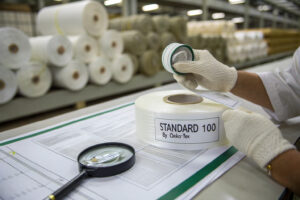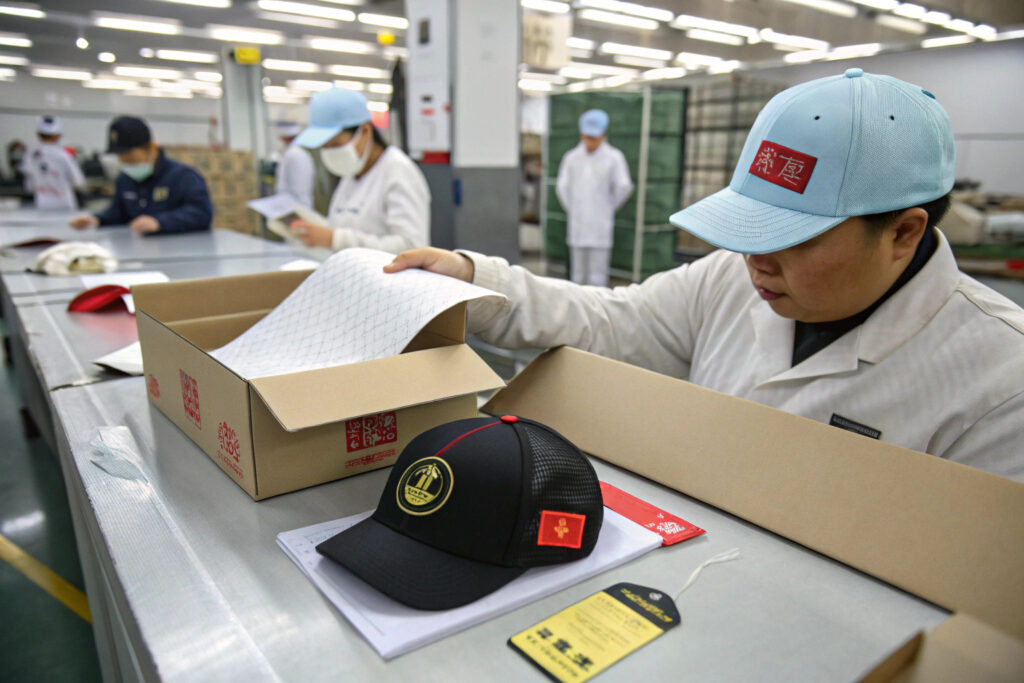
You spend months sourcing OEKO-100 certified fabric for your caps. You audit the thread. You test the sweatband. You verify the plastic snap. The cap is fully certified. You pack it in a beautiful custom box with a foil-stamped logo, a tissue paper wrap, and a adhesive sticker seal. You ship to your EU retailer. The retailer's compliance team tests the packaging. The ink on the box contains a restricted heavy metal. The adhesive on the sticker contains a phthalate. The packaging contaminates the certified cap. Your fully certified product is rejected because of the box it came in. The cap was safe. The packaging was not. The packaging is part of the product.
You ensure your custom hat packaging uses OEKO-100 certified inks and adhesives by extending the OEKO-TEX certification scope to include your packaging components, or by sourcing packaging materials from suppliers who hold their own valid OEKO-TEX certification for those specific materials. The inks, adhesives, coatings, and substrates of your hat box, tissue paper, hangtag, sticker, and any other packaging that contacts the cap must either be listed in your factory's OEKO-TEX appendix under an appropriate article group, or be covered by the packaging supplier's own OEKO-TEX certificate. A cap factory's OEKO-TEX certificate that only covers textile components does not cover the packaging. The packaging is a separate article category requiring separate certification.
At Global-Caps, I have extended my OEKO-TEX certification scope to include my standard packaging materials. The printed paperboard boxes, the tissue paper, the adhesive stickers, and the hangtags are listed in the appendix. I can provide the packaging supplier's OEKO-TEX certificates for custom packaging that falls outside my standard scope. The cap and the box are both certified.
What Packaging Components Fall Under OEKO-100 Certification Scope?
You assume the OEKO-100 certificate covers the whole product, including the packaging. The certificate covers "textile articles." A paperboard box is not a textile article. A polybag is not a textile article. An adhesive sticker is not a textile article. The standard covers these items under different article groups, but only if the certification scope explicitly includes them. A factory with a textile-only OEKO-100 certificate does not have certified packaging. The packaging is outside the scope. The assumption of coverage is the gap.
The packaging components that fall under the OEKO-100 certification scope include printed and unprinted paper and cardboard packaging that comes into contact with the certified textile product, adhesive stickers and tapes, tissue paper, hangtags made of paper or cardboard, and woven or printed labels. Plastic packaging such as polybags can be included but requires specific testing for plasticizer content. Each component is classified under a specific article group in the OEKO-TEX appendix. The component must be explicitly listed in the appendix to be covered.
My OEKO-TEX appendix lists "Printed Paperboard Packaging," "Unprinted Tissue Paper," "Adhesive Paper Stickers," and "Printed Cardboard Hangtags" under the appropriate article groups.
The key distinction is whether the packaging contacts the certified textile product. If it does, it should be certified.
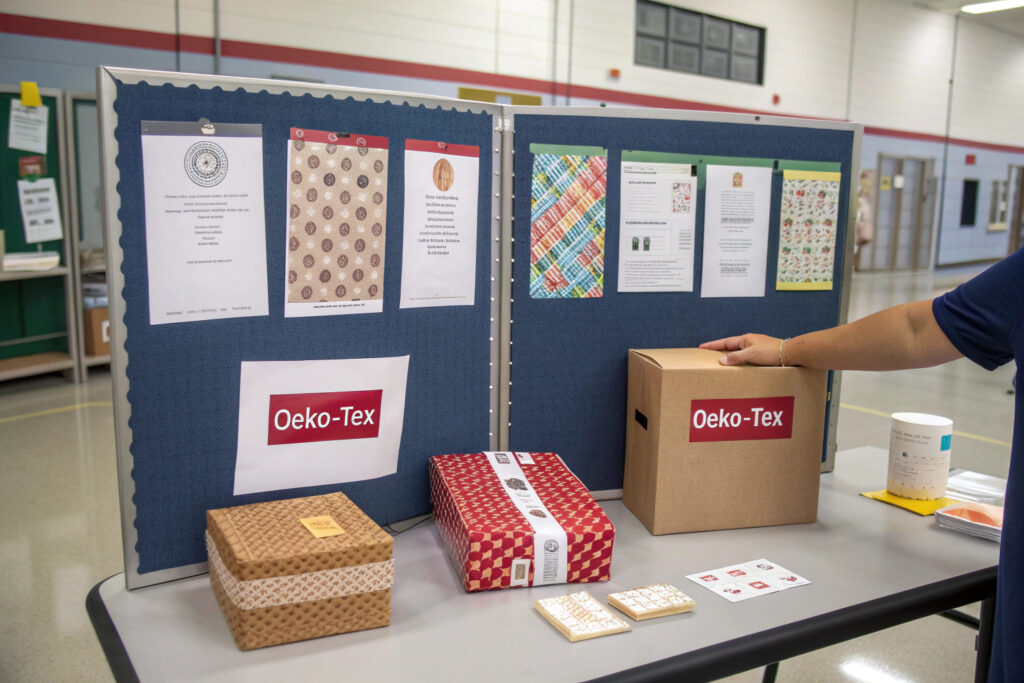
Why Must Adhesives, Inks, and Coatings Be Separately Verified for Compliance?
The adhesive on a sticker, the ink on a printed box, and the varnish coating on a hangtag are applied materials. They are not the substrate. The substrate—the paper or cardboard—may be certified. The applied materials are separate chemical formulations. The ink contains pigments, binders, and solvents. The adhesive contains polymers, tackifiers, and plasticizers. The coating contains resins and curing agents. Each of these formulations can contain restricted substances—heavy metals in pigments, phthalates in plasticizers, formaldehyde in binders.
The OEKO-TEX certification tests the finished component with the applied materials present. The adhesive, ink, and coating are tested as part of the component. A certificate for the base paper alone does not cover the ink or the adhesive.
My packaging supplier provides a finished component certificate that covers the substrate and all applied materials.
Does Tissue Paper or a Polybag Need OEKO-100 Certification If It Contacts the Cap?
Tissue paper that directly contacts the cap should be OEKO-100 certified. The tissue paper can transfer dyes, optical brighteners, or chemical residues to the cap fabric. Unprinted, unbleached tissue paper is low risk. Printed or colored tissue paper is higher risk.
A polybag that directly contacts the cap should be made from OEKO-100 certified polyethylene or be covered by a supplier certificate. Standard polybags can contain slip agents, anti-static agents, or plasticizer residues. A certified polybag is made from a tested, approved polyethylene formulation.
My standard packaging includes OEKO-100 certified unprinted tissue paper. I offer certified polybags as an upgrade option.
How to Specify Certified Inks and Adhesives in Your Packaging Purchase Order?
You order custom packaging. The PO says "Custom printed box with logo." The factory prints the box. The ink is a standard solvent-based ink from the cheapest supplier. The box looks great. The ink contains a restricted substance. The PO did not specify the ink chemistry. The factory used their standard ink. Their standard ink is not OEKO-100 certified. You got what you ordered. The problem is what you did not order. You did not order certified ink.
You specify certified inks and adhesives by including explicit chemical requirements in the packaging purchase order. The PO must state that all inks must be water-based, free of heavy metals, phthalates, and restricted solvents. All adhesives must be water-based acrylic or hot-melt formulations, free of formaldehyde and phthalates. The supplier must provide an OEKO-TEX certificate for the finished printed or adhesive-applied component, or an ISO 17025 lab test report demonstrating compliance with the OEKO-TEX Annex 4 limits for the relevant substance categories.
My packaging PO template includes a "Chemical Compliance Requirements" section with the specific ink and adhesive specifications.
The ink and adhesive technical data sheets are the documentary evidence of the chemical formulation.

What Specific Ink Chemistries Should the PO Mandate for Paper and Cardboard?
The PO should mandate water-based flexographic or water-based digital inks for paper and cardboard packaging. Water-based inks use water as the primary solvent. They do not contain the organic solvents found in solvent-based inks. They are low in volatile organic compounds. They are compatible with OEKO-TEX certification.
The PO should prohibit solvent-based inks, which contain volatile organic compounds such as toluene and xylene. The PO should prohibit UV-curable inks unless specifically formulated for food-contact packaging, as some UV inks contain uncured monomers that can be skin irritants.
My ink specification requires water-based inks with OEKO-TEX Eco Passport certification from the ink manufacturer.
How Should the PO Require the Supplier to Prove Adhesive Formaldehyde Content?
The PO should require the supplier to provide a test report from an ISO 17025 accredited laboratory showing the formaldehyde content of the adhesive, tested according to the OEKO-TEX method. The limit for formaldehyde in adhesives under OEKO-TEX Class II is 75 parts per million.
The supplier should also provide the adhesive manufacturer's technical data sheet stating the adhesive is formaldehyde-free. A formaldehyde-free adhesive uses a cross-linking chemistry other than formaldehyde-based resins. Water-based acrylic adhesives and hot-melt adhesives are typically formaldehyde-free.
My adhesive documentation for each packaging order includes the adhesive TDS and the third-party formaldehyde test report.
How to Verify That Your Packaging Supplier's Certifications Are Genuine?
You receive an OEKO-TEX certificate from the packaging supplier. The logo is correct. The format looks official. You file it. You do not verify the number on the Label Check database. You do not check that the appendix lists packaging. You do not confirm the certificate holder is the company that printed your boxes. The certificate is valid. It belongs to a different company. The packaging supplier borrowed a certificate from a sister company or a friendly supplier. The certificate is real. The application to your packaging is fake.
You verify the packaging supplier's certifications by entering the certificate number on the OEKO-TEX Label Check website, confirming the certificate holder name matches the supplier's legal entity name, checking that the appendix lists packaging materials as a certified article group, and verifying the validity dates are current. The verification process is identical to verifying a cap factory's certificate. The database is the single source of truth.
My packaging supplier verification is performed before the first order. I provide the verified certificate to my client. The client can re-verify independently.
The appendix must specifically list the packaging article group. A textile-only appendix does not cover packaging.
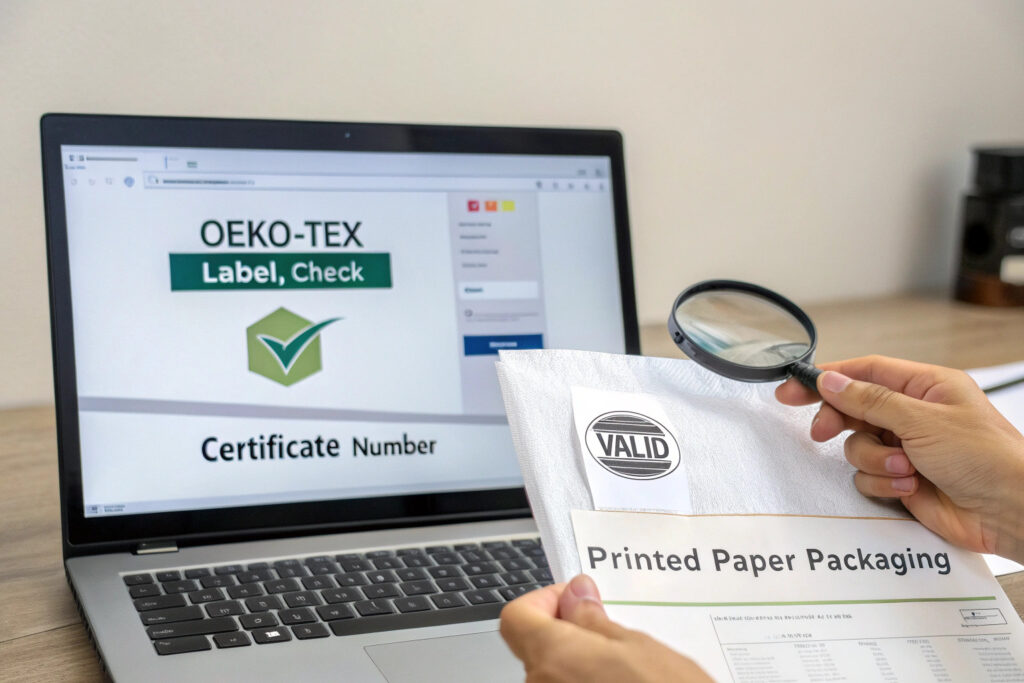
What Should the Supplier's OEKO-TEX Appendix Say About Packaging Materials?
The appendix should include an article group specifically for packaging materials. The article group description should read something like "Article Group 6: Paper and Cardboard Packaging - Printed - Including Adhesive Applied Labels." The article group should list the substrate material, the printing method, and any applied coatings or adhesives.
If the appendix only lists textile article groups, the packaging is not covered. The certificate does not apply to your boxes or hangtags.
My appendix review checks for the presence of a packaging-specific article group before accepting any packaging supplier.
Can the Inks and Adhesives Be Covered by a Supplier's REACH Declaration Instead?
A REACH declaration is a statement from the supplier that their product complies with the EU REACH regulation. It is a legal compliance document. It is not an OEKO-TEX certification. A REACH declaration covers the restricted substances under REACH Annex XVII and the SVHC Candidate List. It does not cover the full OEKO-TEX substance list.
For EU market access, a REACH declaration combined with an ISO 17025 lab test report may be accepted by some retailers in lieu of an OEKO-TEX certificate for packaging. The retailer's compliance team makes the determination. The safest approach is to obtain an OEKO-TEX certificate for the packaging.
My compliance documentation for packaging includes the OEKO-TEX certificate where available, or the REACH declaration plus the lab test report.
How to Integrate Packaging Compliance Into Your Overall Hat Certification File?
You have the cap certification file. You have the packaging certification file. They are in separate folders, managed by different people. An EU retailer audits your product compliance. They ask for the complete technical file for the product, including packaging. You scramble. The cap documents are in procurement. The packaging documents are in marketing. The file is fragmented. The audit is stressful. The compliance file should be unified.
You integrate packaging compliance into your overall hat certification file by creating a single product compliance file that includes sections for every component that contacts the product, including all packaging materials. The packaging section includes the supplier's OEKO-TEX certificate, the appendix showing packaging coverage, the ink and adhesive technical data sheets, and any third-party test reports. The summary sheet for the product lists every component—textile and packaging—with its certification status.
My compliance file structure is standardized. Every product file has a packaging section. The documentation is complete before the first shipment.
The component certification matrix is the summary document that makes the compliance file auditable at a glance.

How Should the Component Certification Matrix Include Packaging Items?
The component certification matrix is a table that lists every component of the finished product, the material composition, the supplier, the certification type, the certificate number, and the validity date. The matrix should include a section for "Packaging Components" with rows for the box, the tissue paper, the hangtag, any stickers, and any other packaging that contacts the cap.
Each packaging row states the OEKO-TEX certificate number or the lab test report number. The matrix is a one-page summary of the entire compliance status. An auditor can review it in 30 seconds and identify any gaps.
My certification matrix template includes a mandatory packaging section. Every packaging component is listed with its certification reference.
What Documentation Should Be Ready for an EU Retailer's Packaging Audit?
The EU retailer's packaging audit will request: the OEKO-TEX certificate for the cap, the OEKO-TEX certificate for the packaging or the packaging supplier's certificate, the appendix for each certificate showing the specific components are covered, the ink and adhesive technical data sheets, any third-party test reports for packaging components not covered by an OEKO-TEX certificate, and a summary matrix showing every component's compliance status.
The documentation should be organized in a single PDF file or a shared folder, clearly labeled with the product name and the document date. The documentation should be ready before the first shipment.
My retailer audit pack for each product includes all of these documents. The pack is updated annually or upon any material change.
Conclusion
Ensuring custom hat packaging uses OEKO-100 certified inks and adhesives requires extending the certification scope beyond the textile cap to include every packaging component that contacts the product. The inks, adhesives, and coatings on the box, tissue paper, hangtag, and stickers are separate chemical formulations that must be tested and certified. The packaging supplier must hold a valid OEKO-TEX certificate with an appendix that specifically lists packaging materials as a certified article group.
The certification is specified in the packaging purchase order through explicit chemical requirements: water-based inks, formaldehyde-free adhesives, heavy metal-free pigments. The supplier provides the OEKO-TEX certificate or an ISO 17025 lab test report. The certificate is verified on the OEKO-TEX Label Check database. The appendix is checked for packaging coverage.
The packaging compliance documentation is integrated into the overall product compliance file. A component certification matrix lists every cap component and every packaging component with its certification status. The complete file is ready for EU retailer audits before the first shipment. The certified cap in an uncertified box is an uncertified product. The box matters as much as the cap.
At Global-Caps, my OEKO-TEX certification covers my standard packaging. My packaging suppliers are certified. My compliance file includes the packaging section. My purchase orders specify the ink and adhesive chemistry. The cap and the box are both certified. The product is compliant from the sweatband to the sticker seal.
If you need custom hats with fully certified packaging, contact my Business Director Elaine. She can provide our packaging certification documentation, our packaging supplier certificates, and a sample compliance file for your review. Email Elaine at elaine@fumaoclothing.com. Let's certify the whole unboxing experience.