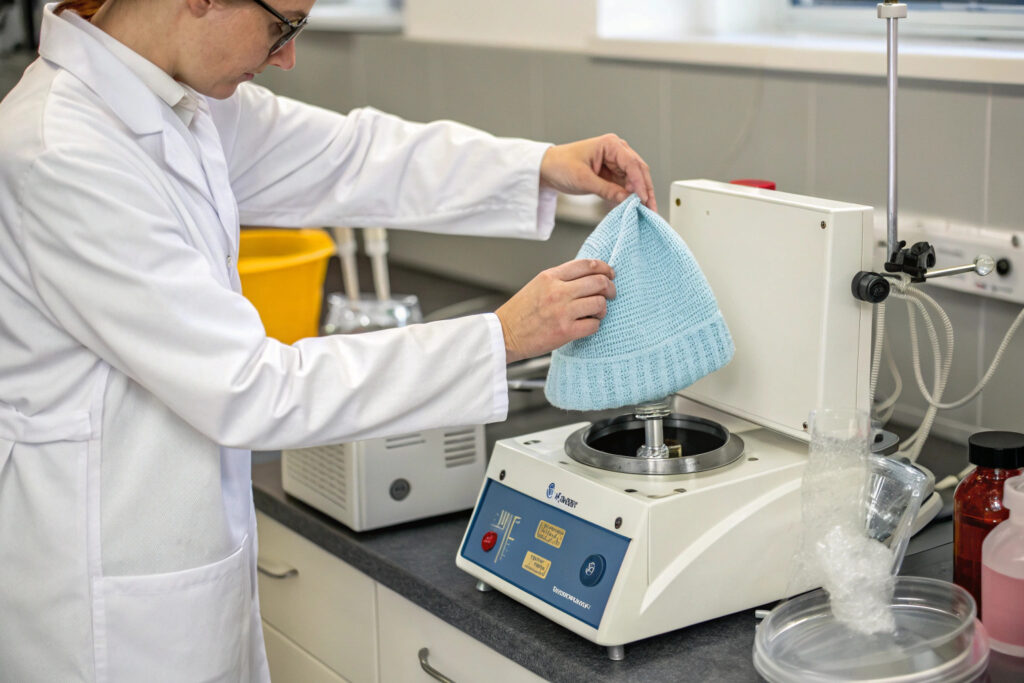
You buy fabric from a mill. The mill says it is "safe for babies." You make hats. You label them "Safe for Infants." You sell them. A mother buys one. Her baby chews on the brim. The baby develops a rash. She sues your brand. You go to court. The judge asks for your independent test report. You present the mill's marketing brochure. The judge dismisses it. "This is not a test report. This is an advertisement." The mill's verbal assurance has zero legal weight. The third-party lab test report is the only document that proves safety in a court of law.
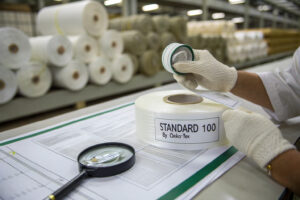
Third-party lab tests play the role of independent, legally defensible verification of OEKO-100 Grade 1 hat material safety. The tests are conducted by an ISO 17025 accredited laboratory that has no financial interest in the test outcome. The laboratory analyzes the fabric, thread, sweatband, and accessories for the full panel of restricted substances defined by the OEKO-TEX Standard 100 Class I: formaldehyde below 16 parts per million, extractable heavy metals below the strictest thresholds, no detectable pesticides, no chlorinated phenols, no phthalates, no organotin compounds, and no prohibited azo dyes. The test report is the scientific evidence that the material meets the highest textile safety standard. The manufacturer's self-declaration is a promise. The third-party test report is proof.
At Global-Caps, I commission third-party OEKO-TEX Class I testing from SGS or Intertek for every new material and every new dye lot. The test report is attached to the shipment. The client does not rely on my word. The client relies on the laboratory's data.
Why Can't a Factory's Internal Test Replace an Independent Lab Report?
You visit the factory. The owner proudly shows you their "in-house testing lab." It is a room with a pH meter, a washing machine, and a grey scale card. The lab technician is the owner's nephew. He tests the fabric. He writes "Pass" in a logbook. You accept this as a test report. The factory's internal test is a process control tool. It is not an independent verification. The factory has a financial incentive to pass the fabric. The nephew has an employment incentive to please his uncle. The internal test is a conflict of interest. The third-party test is an independent audit.
A factory's internal test cannot replace an independent lab report because the factory has a vested financial interest in the test outcome. A failing test result means the factory cannot ship the order, must reorder fabric, and may miss the delivery deadline. The internal tester is under pressure to find a pass. The third-party laboratory has no financial interest in the outcome. The laboratory is paid to perform the test, not to achieve a specific result. The laboratory's ISO 17025 accreditation is dependent on maintaining technical competence and impartiality. The laboratory's reputation and legal liability are on the line with every report.
My internal QC lab performs daily process control tests. The third-party lab performs the certification tests. The two functions are complementary but not interchangeable.
ISO 17025 accreditation is the legal standard that separates a credible laboratory from an unverified testing room.
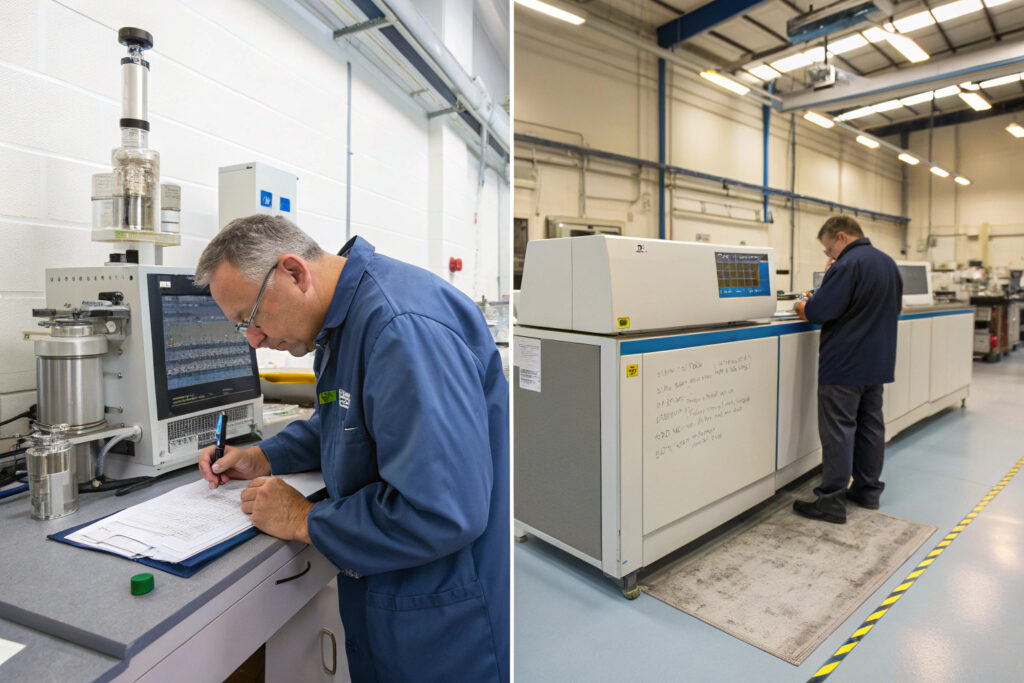
What Is ISO 17025 Accreditation and Why Does It Matter for Legal Compliance?
ISO 17025 is the international standard for the competence of testing and calibration laboratories. Accreditation to ISO 17025 means the laboratory's technical competence, quality management system, and impartiality have been assessed and verified by an independent national accreditation body. The accreditation is specific to each test method. The laboratory's scope of accreditation lists the exact tests they are authorized to perform.
For legal compliance, an ISO 17025 accredited test report is recognized by courts, customs authorities, and market surveillance agencies as valid scientific evidence. A test report from a non-accredited laboratory may be challenged and dismissed. The accreditation is the foundation of the report's legal credibility.
My test reports are always sourced from ISO 17025 accredited laboratories. The accreditation logo and certificate number are printed on every page.
How Does Impartiality Differ Between a Factory Lab and a Third-Party Lab?
Impartiality is the absence of conflict of interest. A factory lab is structurally conflicted. The lab reports to the factory management. The factory management's bonus depends on production output and on-time delivery. A failing test result threatens both metrics. The pressure to pass is inherent in the organizational structure.
A third-party lab is structurally impartial. The lab reports to an independent management team. The lab's revenue comes from testing fees, not from product sales. A failing test result does not harm the lab financially. The lab's accreditation requires documented impartiality policies and an annual impartiality review.
My third-party lab selection policy requires the lab to be accredited, independent, and free from any ownership or management links to my factory.
What Specific Chemical Tests Does a Third-Party Lab Run for Grade 1?
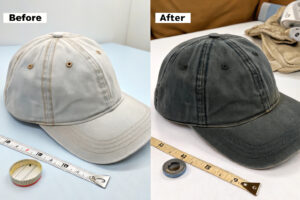
You think an OEKO-TEX test is a single test. It is not. It is a battery of over 100 individual chemical analyses grouped into substance categories. The laboratory tests for heavy metals, phthalates, formaldehyde, pesticides, chlorinated phenols, organotin compounds, azo dyes, carcinogenic dyes, chlorinated benzenes, chlorinated toluenes, polycyclic aromatic hydrocarbons, and more. Each substance category requires a different analytical method. The laboratory runs the fabric through gas chromatography, liquid chromatography, mass spectrometry, and inductively coupled plasma spectroscopy. The "OEKO-TEX test" is a full chemical workup that takes several days and costs several hundred dollars.
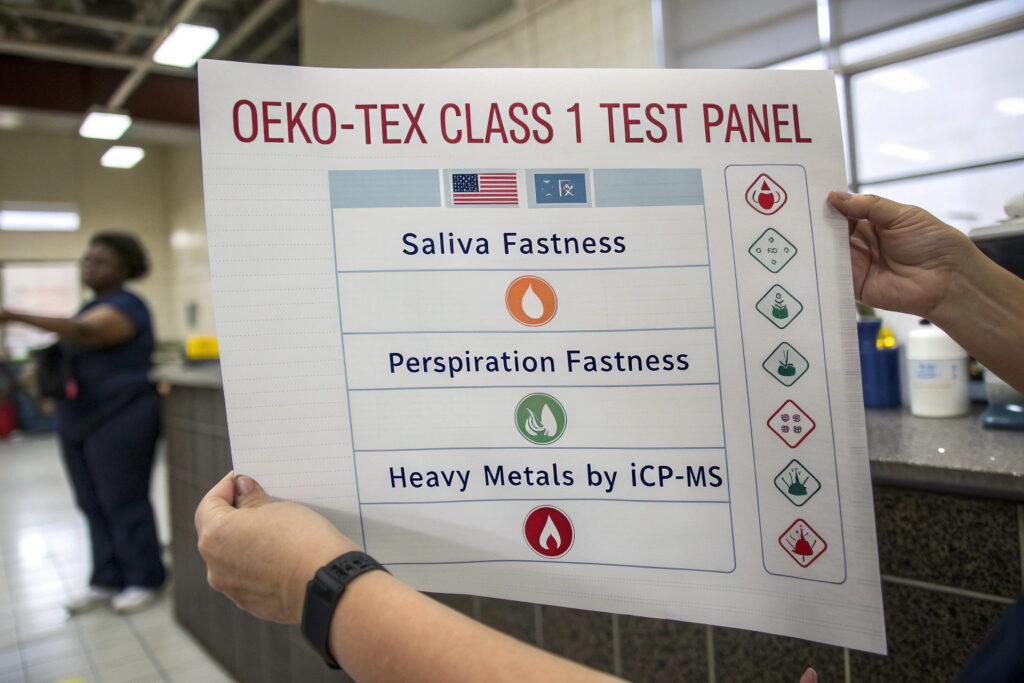
A third-party lab runs the complete OEKO-TEX Standard 100 Class I test panel, which includes heavy metal analysis by ICP-MS, phthalate analysis by GC-MS, formaldehyde analysis by UV-Vis spectrophotometry, pesticide and chlorinated phenol analysis by GC-MS or LC-MS, organotin analysis by GC-MS, azo dye amine release by GC-MS after reductive cleavage, pH value determination by aqueous extraction, colorfastness to saliva and perspiration, and the olfactory test for unusual odors.
My test request form specifies the full Class I panel. I do not request partial testing. The baby market requires the full panel.
The saliva fastness test is unique to Class I and is the most critical differentiator for baby products.
Why Are Heavy Metals Like Lead and Cadmium Tested to Parts-Per-Billion Levels?
The OEKO-TEX Class I limits for extractable heavy metals are set at levels that protect a baby who mouths the fabric. The limit for extractable lead is 0.2 milligrams per kilogram. The limit for extractable cadmium is 0.1 milligrams per kilogram. These are parts-per-billion levels.
The laboratory uses inductively coupled plasma mass spectrometry to achieve the required detection sensitivity. The instrument can detect metals at concentrations below 0.001 milligrams per kilogram. The test simulates the extraction of metals by stomach acid if a baby swallows a piece of the fabric.
My heavy metal test reports show the detection limit and the measured value for each element. The results are consistently below the detection limit.
What Is the Olfactory Test and Why Does It Matter for Baby Hats?
The olfactory test is a sensory evaluation performed by a trained panel. The testers smell the fabric sample for any unusual or offensive odors. An unusual odor can indicate residual solvents, degradation byproducts, or microbial contamination that might not be detected by the chemical tests.
A baby's sense of smell is sensitive. An unpleasant odor can cause the baby to reject the hat or can indicate a chemical that irritates the respiratory tract. The olfactory test is a practical, low-tech screening tool that complements the high-tech chemical analyses.
My fabrics pass the olfactory test consistently. The laboratory report includes a "No unusual odor" statement.
How Often Should Third-Party OEKO-100 Testing Be Repeated for Ongoing Orders?
You test one hat once. You get a Class I certificate. You use the same certificate for three years. You reorder the same hat. The factory changed the fabric supplier. The new supplier uses a different dye house. The new dye house uses a different chemical formulation. Your certificate covers the old formulation. Your new hats are not certified. The single test was a snapshot of a supply chain that has since changed. The certificate is a living document. The supply chain is a living organism. The testing must match the pace of change.
Third-party OEKO-100 testing should be repeated at a minimum of once per year to maintain the certificate validity. For ongoing production orders, testing should be repeated whenever a material change occurs—a new fabric supplier, a new dye lot from a new dye house, a new thread brand, a new plastic accessory. For high-volume baby product orders, quarterly testing is recommended as a best practice. The testing frequency is risk-based. Higher volume, higher risk. More vulnerable end user, more frequent testing.
My periodic testing schedule is published at the start of each year. Clients receive the test report for their specific production batch. No generic certificates.
A material change is the most common trigger for an unscheduled re-test.

What Triggers an Immediate Re-Test Between Annual Certification Cycles?
A material change triggers an immediate re-test. The material change can be a new fabric mill, a new yarn supplier, a new dye house, a new dye formulation, a new finishing chemical, a new embroidery thread brand, a new plastic snap or buckle supplier, a new woven label supplier, or a new packaging material that contacts the product.
Any of these changes alters the chemical input profile of the finished hat. The previous test report no longer covers the new material configuration. The re-test must cover the specific components that changed.
My material change log is reviewed weekly. Any change triggers a re-test order to the third-party lab within 24 hours.
How Do You Manage Test Reports for Multi-Component Hats With Different Materials?
A hat is an assembly of components. The crown fabric, the sweatband, the embroidery thread, the visor board, the plastic snap, and the woven label are all separate homogeneous materials. Each component may come from a different supplier. Each component requires its own third-party test report, or the component supplier must provide a valid third-party test report that covers the specific lot used.
The finished hat test report from the third-party lab should list every component tested. The report should state the material composition and the lot number of each component. The compliance file for the hat contains the finished product test report and the individual component test reports from each supplier.
My component testing matrix tracks every component, every supplier, every lot number, and every test report expiry date.
How Do Third-Party Test Results Strengthen Your CPSIA and REACH Compliance File?
You have an OEKO-TEX report. You have a CPSIA requirement. You have a REACH requirement. You think you need three separate sets of tests. You commission three sets of tests. You pay three laboratory bills. The OEKO-TEX test data can support both CPSIA and REACH compliance. You do not need to test the same hat for heavy metals three times in three different labs. You need to understand the regulatory overlap and present the existing data effectively.
Third-party OEKO-100 Grade 1 test results strengthen CPSIA and REACH compliance by providing independent chemical data that satisfies the testing requirements of multiple regulations. The OEKO-TEX heavy metal test results support the CPSIA total lead content requirement. The OEKO-TEX phthalate test results support the CPSIA phthalate prohibition. The OEKO-TEX azo dye test results support the REACH Annex XVII Entry 43 restriction. The CPSIA Children's Product Certificate can reference the OEKO-TEX test report as supporting evidence. The REACH technical file can include the OEKO-TEX report as part of the safety assessment.
My regulatory cross-reference matrix maps each OEKO-TEX Class I test parameter to the corresponding CPSIA and REACH requirement.
The CPSIA Children's Product Certificate can be issued using the OEKO-TEX third-party test data for the chemical safety sections.

Can an OEKO-TEX Class I Lab Report Support a CPSIA Children's Product Certificate?
Yes, with a qualification. The OEKO-TEX Class I heavy metal and phthalate test data can be used as supporting evidence for the CPSIA Children's Product Certificate, provided the testing was performed by a laboratory that is also CPSC-accepted for those specific test methods. The OEKO-TEX issuing institute or the third-party lab that performed the testing must be listed on the CPSC's list of accepted laboratories.
If the OEKO-TEX testing lab is not CPSC-accepted, the test data can still be used as supporting documentation, but a separate CPSC-accepted lab must issue the final CPC. The OEKO-TEX data reduces the amount of re-testing required.
My CPSC compliance strategy uses OEKO-TEX data as the primary chemical evidence, supplemented by a CPSC-accepted lab review.
How Does a Third-Party Report Satisfy EU Retailer RSL Documentation Requirements?
EU retailers maintain Restricted Substances Lists that specify the chemical limits for products they sell. The retailer's compliance team audits the supplier's test reports against their RSL. An OEKO-TEX Class I report from an ISO 17025 accredited laboratory covers 90 to 95 percent of the substances on a typical EU retailer RSL.
The retailer's compliance team maps the OEKO-TEX test parameters to their RSL. The parameters that are covered are checked off. The parameters that are not covered—typically a few specific substances unique to that retailer's policy—are identified for supplemental testing. The OEKO-TEX report is the foundation. The supplemental testing fills the gaps.
My retailer compliance pack includes an RSL gap analysis showing exactly which substances are covered by the OEKO-TEX report and which require supplemental testing.
Conclusion
Third-party lab tests are the independent, legally defensible proof of OEKO-100 Grade 1 hat material safety. The tests are conducted by ISO 17025 accredited laboratories with no financial interest in the outcome. The test panel covers over 100 chemical substances at the strictest limits for baby products. The factory's internal QC lab cannot replace the independent lab because the factory is structurally conflicted. The independent lab is structurally impartial.
Testing must be repeated annually at a minimum, quarterly for high-volume baby products, and immediately upon any material change. A material change log triggers re-test orders. The compliance file for a multi-component hat includes the finished product test report and the individual component test reports from each supplier.
The OEKO-TEX Class I test data supports multiple regulatory requirements. It provides the chemical evidence for CPSIA Children's Product Certificates and satisfies the majority of EU retailer RSL requirements. The regulatory cross-reference matrix maps each test parameter to the applicable regulations. The testing investment is leveraged across multiple compliance obligations.
At Global-Caps, third-party testing is not an occasional audit. It is a continuous production rhythm. Every new material is tested. Every new dye lot is tested. Every test report is filed by batch number and shared with the client. I do not ask my clients to trust my word. I give them the laboratory's data.
If you need OEKO-100 Grade 1 hats with complete third-party lab documentation, contact my Business Director Elaine. She can provide our latest SGS and Intertek test reports, our component testing matrix, and a sample regulatory compliance pack. Email Elaine at elaine@fumaoclothing.com. Let's prove safety with science, not promises.