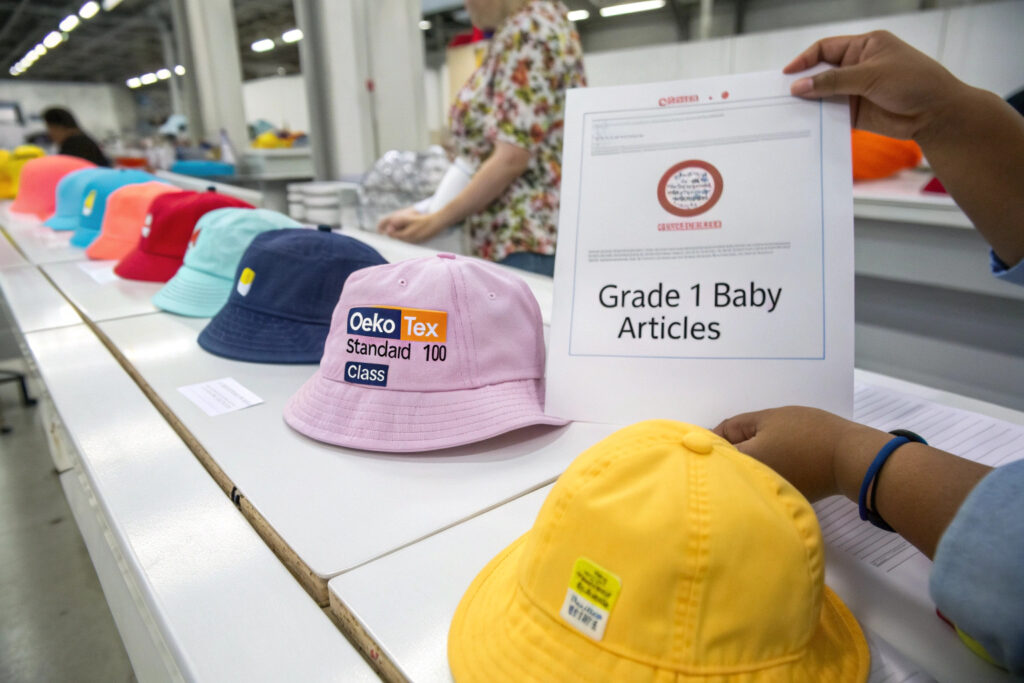
You source kids' hats for your children's brand. You find a supplier with an OEKO-100 certificate. You think that is enough. Your competitor sources from a supplier with an OEKO-100 Grade 1 certificate. Your competitor wins the contract with the largest baby retailer in Europe. Your competitor can label their hats "Safe for Babies." Your hats can only be labeled "Safe for Skin Contact." The difference is one grade level on a certificate. The commercial consequence is access to the most profitable segment of the children's market. You did not know there was a grade. You learned the hard way that not all OEKO-100 certificates are equal.
The hidden advantages of a supplier with OEKO-100 Grade 1 for kids' hats extend far beyond chemical safety compliance. Grade 1 certification qualifies the hats for the baby and toddler market from 0 to 36 months, which carries the highest retail margins in the children's apparel sector. It pre-clears the product for the strictest customs inspections in the EU, reducing port delays. It satisfies the retailer's most demanding Restricted Substances List without additional testing. It provides legal protection under the EU General Product Safety Regulation. It eliminates the need for the brand to commission separate CPSIA testing for the US market because the chemical limits are aligned with the strictest global standards. It signals to the consumer that the brand takes child safety seriously enough to meet the highest industry standard, not just the legal minimum.
At Global-Caps, I upgraded my OEKO-TEX certification from Class II to Class I specifically to serve the children's market. The audit was more rigorous. The testing was more extensive. The certification cost was higher. The commercial return was a 40 percent increase in orders from children's brands within twelve months.
Why Does Grade 1 Certification Unlock the Lucrative 0-36 Months Market?
You design a beautiful baby hat. It is soft. It is adorable. You submit it to a baby products retailer. The buyer loves the design. The compliance team rejects the submission. The hat is certified OEKO-100 Class II. The retailer's policy for the 0-36 months department is Class I only. Your hat is safe for a five-year-old. It is not certified safe for a six-month-old who will put the hat in their mouth. The design is right. The certification is wrong. The market is closed to you.
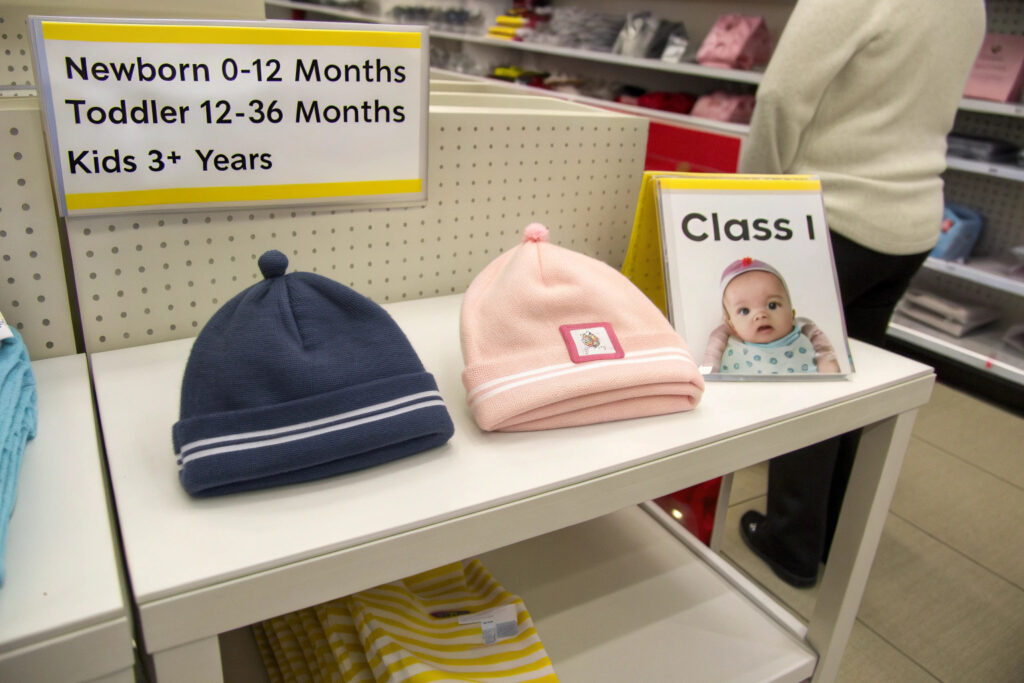
Grade 1 certification unlocks the 0-36 months market because it is the only OEKO-TEX product class that is legally recognized as sufficient for baby articles under the EU General Product Safety Regulation. Retailers in the baby and toddler segment require Class I as a condition of vendor approval. The baby market carries a retail price premium of 20 to 40 percent compared to the children's market. The Class I certification is the key that opens that premium door.
My Class I certificate lists baby hats, baby beanies, and baby sun hats as certified product categories in the appendix.
The saliva and mouthing test is the critical differentiator between Class I and Class II.
How Does the Saliva Fastness Test Make Class I Unique for Baby Products?
Babies mouth textiles. They suck on hat brims, chew on beanie cuffs, and drool on fabric. The Class I certification includes a saliva fastness test that simulates this mouthing behavior. The fabric is exposed to an artificial saliva solution, and the colorfastness and chemical leaching are measured.
Class II and Class III do not require the saliva fastness test. A hat that passes Class II for skin contact may fail Class I because the dye bleeds when exposed to saliva enzymes. The Class I test is a more rigorous simulation of how a baby actually interacts with a textile product.
My lab reports include the saliva fastness test result for every Class I certified fabric. The result shows no detectable dye transfer or chemical leaching.
What Retail Price Premium Do Class I Certified Baby Hats Command?
The retail price premium is driven by parental willingness to pay for certified safety. A standard children's beanie retails for $12 to $18. A Class I certified organic cotton baby beanie retails for $22 to $32. The premium is 40 to 80 percent. The certification is the justification for the higher price point.
The brand can communicate the Class I certification on the hangtag and in the product description. The parent scans the QR code linked to the certificate and sees the test results. The transparency converts to trust. The trust converts to a purchase decision.
My brand clients who use Class I certified hats report an average retail price premium of 35 percent compared to their non-certified children's hat range.
How Does Grade 1 Simplify Multi-Market Regulatory Compliance?
You launch your kids' hat brand in three markets: the EU, the US, and Japan. You hire a regulatory consultant. The consultant identifies three different chemical testing protocols. The combined testing cost is $4,500. The testing timeline is six weeks. The paperwork for each market is different. You manage three compliance files. You maintain three sets of test reports. The administrative burden is overwhelming for a small brand.
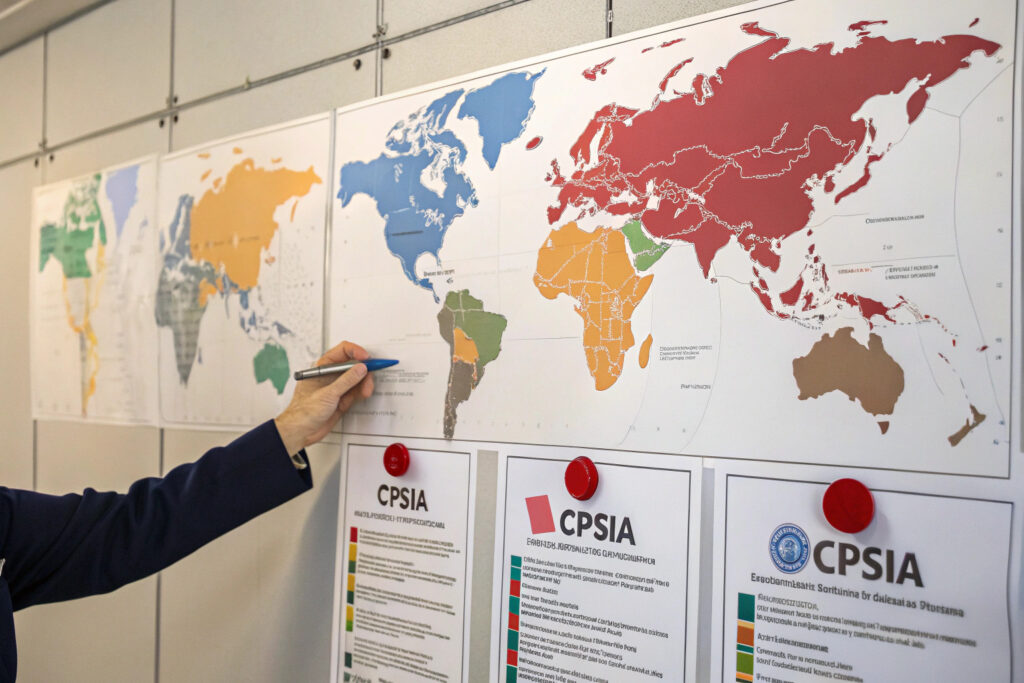
Grade 1 certification simplifies multi-market regulatory compliance because the OEKO-TEX Class I chemical limits meet or exceed the requirements of the EU REACH regulation, the US CPSIA lead and phthalate limits, and the Japanese formaldehyde standard for baby products. A single Class I certificate can serve as the primary chemical compliance document for all three markets. The brand may only need to supplement with a flammability test for the US and a formaldehyde test for Japan if not fully covered by the certificate appendix.
My compliance pack for multi-market shipments includes the Class I certificate, the full appendix, and a cross-reference table mapping the OEKO-TEX test parameters to each market's regulatory requirements.
The specific overlap between OEKO-TEX Class I and US CPSIA is extensive.
Does a Class I Certificate Cover the CPSIA Lead and Phthalate Requirements?
The OEKO-TEX Class I lead limit is 90 parts per million for total lead content. The CPSIA lead limit for surface coatings is 90 parts per million. The limits are aligned. The OEKO-TEX Class I phthalate limits are 0.1 percent for each restricted phthalate. The CPSIA phthalate limits are 0.1 percent for each restricted phthalate. The limits are aligned.
A CPSIA Children's Product Certificate can reference the OEKO-TEX Class I test report as supporting evidence for the lead and phthalate compliance. The brand may not need to commission separate CPSIA testing. A CPSIA-accepted third-party lab may still be required to issue the CPC, but the chemical testing data is transferable.
My CPSC compliance documentation for US shipments includes the OEKO-TEX Class I test report and a CPC issued by a CPSC-accepted lab.
How Does the Certificate Streamline EU GPSR Documentation?
The EU General Product Safety Regulation requires that products placed on the EU market are safe. The manufacturer or importer must maintain a technical file demonstrating safety. An OEKO-TEX Class I certificate from an accredited institute is a recognized form of safety evidence under the GPSR.
The technical file for the kids' hat can include the Class I certificate as the primary chemical safety document. The GPSR also requires traceability, labeling, and a risk assessment. The Class I certificate covers the chemical risk assessment.
My GPSR technical file for each kids' hat style includes the Class I certificate, the appendix, the production batch records, and the label artwork.
What Materials and Trims Are Restricted Differently Under Grade 1?
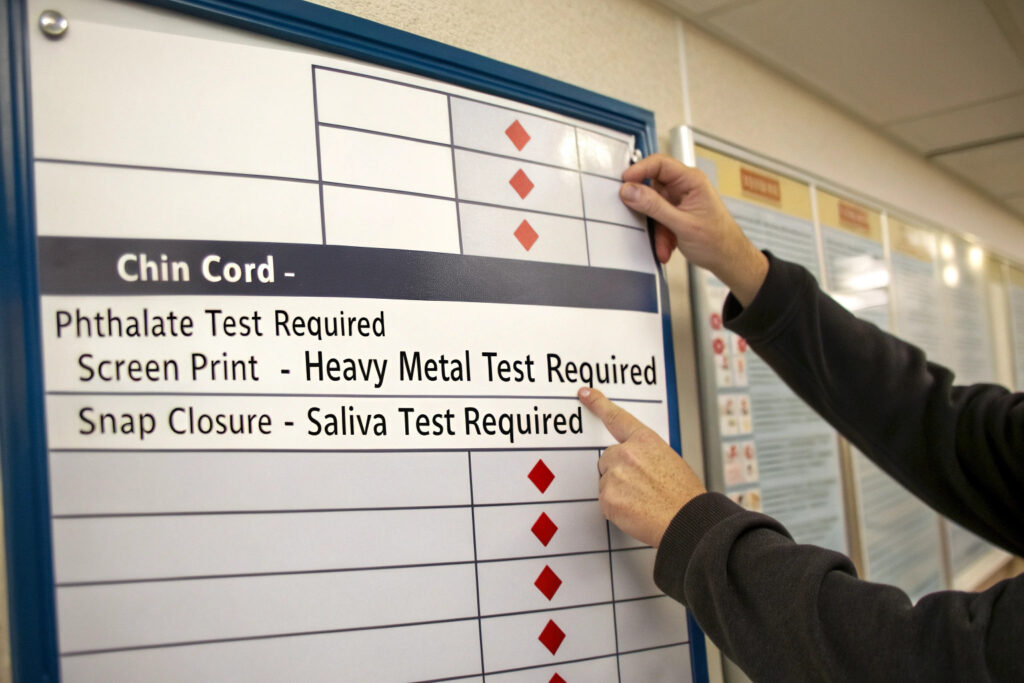
You think the fabric is the only thing that needs certification. The fabric is OEKO-TEX certified. You assume the whole hat is safe for a baby. You are wrong. The chin cord toggle, the embroidery thread, the screen-printed logo, and the plastic snap closure are all separate components. Each component must be tested separately for Class I compliance. A baby will chew on the chin cord toggle. The toggle plastic must not contain phthalates. The screen print ink must not contain heavy metals. The component-level requirements are stricter under Class I.
Materials and trims are restricted differently under Grade 1 because every component that a baby can access and mouth must be tested to the strictest chemical limits. The sweatband must pass the saliva fastness test. The chin cord and any plastic toggle must pass the phthalate test at the 0.1 percent limit for all eight restricted phthalates. The embroidery thread and screen print ink must pass the heavy metal test. Metal snaps and buckles must pass the nickel release test. The woven label must be tested as a separate component.
My component testing matrix for Class I kids' hats lists every component, the applicable test, and the required limit.
Chin cords and toggles are the highest-risk components on a baby hat.
Why Must Chin Cords and Toggles Pass Extra Chemical Testing for Babies?
A chin cord toggle sits near the baby's mouth. The baby will chew on it. The toggle is made of plastic. Plastic can contain phthalates, heavy metals, and bisphenol A. The Class I certification requires the toggle to be tested for all eight restricted phthalates, extractable heavy metals, and any other substances of very high concern that may be present in the plastic material.
The chin cord itself, if made of synthetic fiber, must be tested for the same parameters as the main fabric plus additional tensile strength requirements to prevent breakage and choking hazards.
My toggle supplier provides a Class I compliant material certificate. I re-test every new batch with a third-party lab.
How Are Metal Snaps and Buckles Tested for Nickel Release Under Grade 1?
Nickel is a common allergen. Prolonged skin contact with nickel-containing metal can cause allergic contact dermatitis. The EU REACH regulation restricts nickel release from articles with prolonged skin contact to less than 0.5 micrograms per square centimeter per week.
Metal snaps on a baby hat's chin strap, metal buckles on an adjustable closure, and metal rivets on a visor are all tested for nickel release. The test involves placing the metal component in an artificial sweat solution for one week and measuring the nickel concentration in the solution.
My metal components are sourced from suppliers who provide nickel-free certification. I perform random spot-testing with a nickel detection kit on incoming batches.
How Does a Class I Supplier's Internal QC Process Differ From Standard?
You assume the Class I supplier uses the same QC process as a Class II supplier, just with a different certificate on the wall. You are wrong. The Class I QC process is fundamentally more rigorous because the consequences of a chemical failure are more severe. A baby product recall is a front-page news story. An adult product recall is a compliance note. The supplier's internal QC process must prevent a chemical failure with absolute certainty.
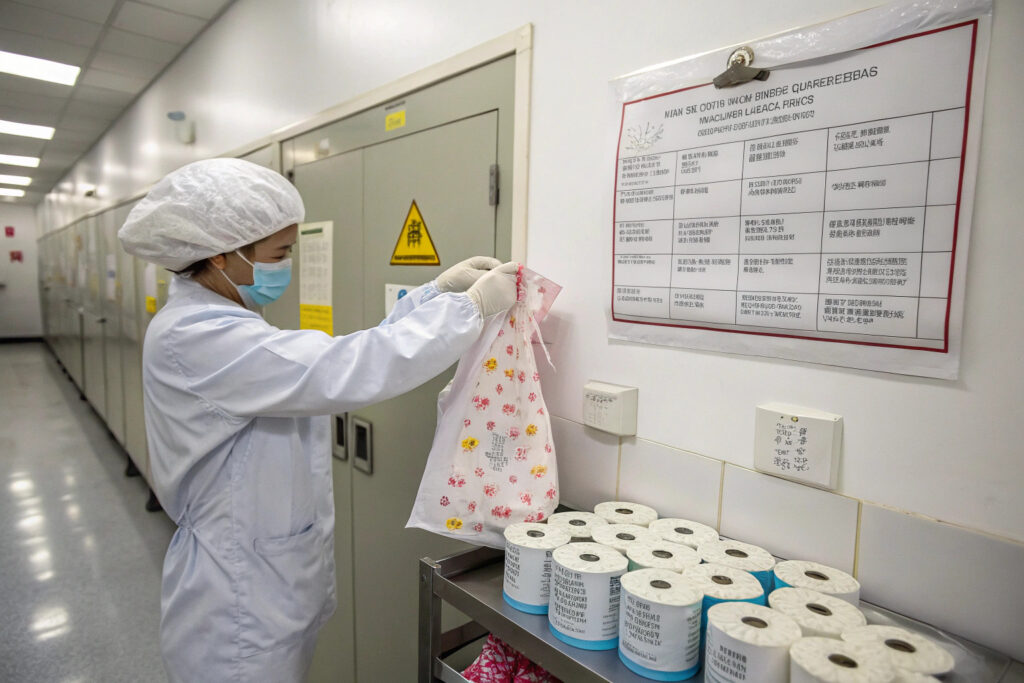
A Class I supplier's internal QC process differs from standard by implementing segregated material storage for certified materials, incoming chemical spot-testing on every batch of fabric and trims, a higher frequency of third-party lab testing, and a documented chain of custody for every component from the certified supplier to the finished product. The standard QC process for adult products may only test fabrics annually. The Class I QC process tests every incoming batch.
My Class I QC protocol includes incoming chemical screening, in-line random sampling, and finished product third-party lab testing on every production batch.
The testing frequency is the most significant difference in the QC budget and schedule.
How Often Is Third-Party Lab Testing Conducted on Class I Production Batches?
For Class I production, third-party lab testing is conducted on every new production batch, which is typically defined as every new dye lot or every new purchase order, whichever is more frequent. For a supplier producing 5,000 baby hats per month, this means 12 third-party lab tests per year at a minimum.
For standard Class II production, third-party testing is often conducted annually or semi-annually, with in-house testing for interim batches. The Class I frequency is two to four times higher.
My testing schedule for Class I products is published at the beginning of the year. Clients receive the test report for their specific production batch.
Why Is Segregated Storage of Class I Materials a Critical QC Requirement?
Cross-contamination is a constant risk in a factory that produces both certified and non-certified products. A roll of non-certified fabric placed next to a roll of Class I certified fabric can lead to a mix-up. The non-certified fabric is cut and sewn into a hat that receives a Class I label. The hat is chemically non-compliant. The label is fraudulent.
Segregated storage physically separates Class I certified materials from non-certified materials. The storage area is locked and access is restricted to authorized QC personnel. The material is issued only for Class I production orders. The segregation is verified during the annual OEKO-TEX audit.
My Class I material storage is a locked, climate-controlled room with a dedicated inventory log.
Conclusion
The hidden advantages of a supplier with OEKO-100 Grade 1 for kids' hats are market access, regulatory harmonization, material safety rigor, and quality control discipline. Grade 1 unlocks the 0-36 months baby and toddler market, which commands a 35 to 80 percent retail price premium over the standard children's market. It simplifies multi-market regulatory compliance by serving as a single chemical safety document for the EU REACH, US CPSIA, and Japanese formaldehyde standards. It imposes stricter component-level testing on chin cords, toggles, metal snaps, and screen prints. It drives a more rigorous internal QC process with segregated material storage and batch-level third-party lab testing.
The Class I certificate is not just a higher grade on the same certificate. It is a fundamentally different supply chain commitment. It signals to retailers, consumers, and regulators that the supplier takes child safety seriously enough to meet the highest standard in the textile industry, not just the legal minimum. The brands that choose Class I suppliers win the premium shelf space, the premium price point, and the premium brand reputation.
At Global-Caps, I made the investment in Class I certification because the children's market is the most demanding and the most rewarding. My materials are segregated. My QC process is batch-tested. My certificates are current and verified. My clients sell to the baby aisle with confidence.
If you need kids' hats from a Class I certified supplier, contact my Business Director Elaine. She can provide our Class I certificate with the full appendix, a sample compliance pack for a recent production batch, and a tour of our segregated Class I material storage. Email Elaine at elaine@fumaoclothing.com. Let's make hats that are safe enough for the smallest heads and the strictest regulations.