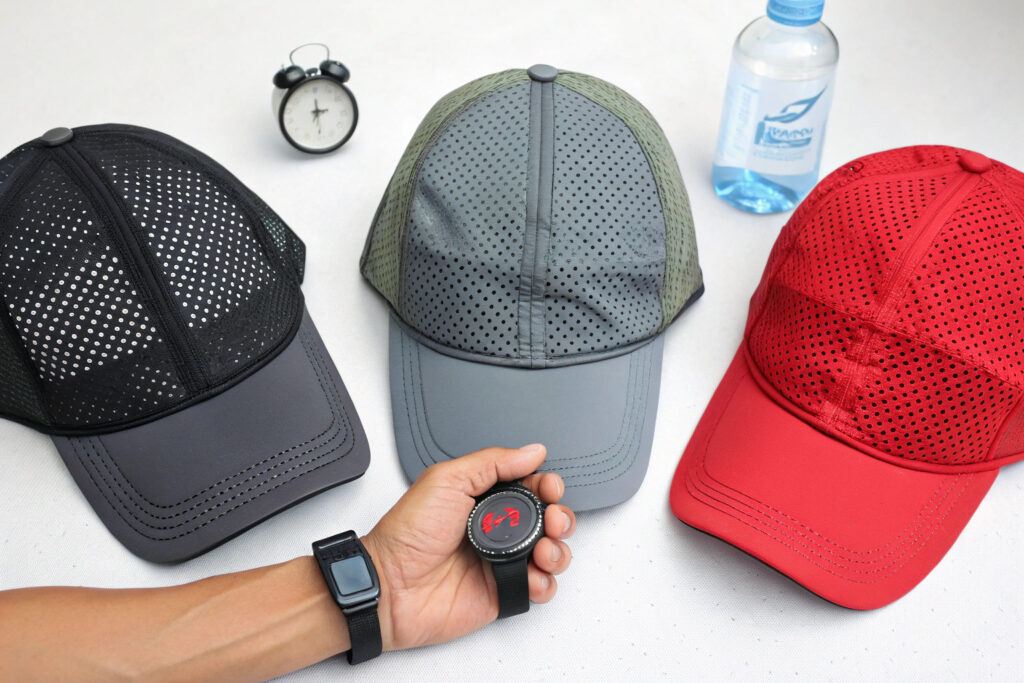
You design a running cap. You focus on the front panels. Lightweight mesh. Laser-cut vents. Moisture-wicking sweatband. The cap looks fast. You give it to a runner. They run 10 kilometers. They come back. "The back is a sweat sponge. It doesn't adjust. It bounces." Your beautiful front panel design is ruined by the closure. The back of the cap is the part the runner actually feels during the run. The front is for the shelf appeal. The back is for the performance.
The best closed-back closures for breathable summer running caps are perforated elastic stretch panels, lightweight polyester mesh with a reflective velcro strap, and laser-cut vented fabric with a low-profile buckle. The closure must perform three functions simultaneously: secure the cap on the head during high-motion activity, allow maximum airflow to the back of the head where heat accumulates, and wick sweat away from the occipital area. A closed-back closure is preferred over a snapback or open strap for running because it prevents hair tangling, provides 360-degree sun protection for the scalp, and creates a clean, aerodynamic profile.
At Global-Caps, I design running caps for performance brands. The closure is the first component I prototype. If the closure fails the bounce test, the cap fails. The fabric can be perfect. The fit must be perfect.
Why Is a Stretch-Fit Closure Preferred Over a Snapback for Running?
You wear a snapback cap on a run. The plastic snap digs into the back of your head. Your ponytail catches on the strap. Every stride, the cap bounces because the snap is a fixed circumference and your head is between sizes. After five kilometers, you take the cap off and carry it. The snapback is a fashion closure. It is not an athletic closure. The stretch-fit is engineered for motion.
A stretch-fit closure is preferred over a snapback for running because it provides continuous, distributed tension that adapts to the runner's head movement without pressure points. The elastic panel expands and contracts with each stride. There is no hard plastic component to dig into the occipital bone. There is no gap between the strap and the head for hair to escape. The cap stays in place. The runner forgets they are wearing it.
I use stretch-fit closures on 80 percent of my performance running caps. The feedback from runners is consistent.
The tension distribution is the key engineering difference between the two closure types.

How Does a Continuous Elastic Panel Distribute Tension Without Pressure Points?
A continuous elastic panel is a band of spandex-blend fabric sewn around the entire circumference of the cap base. The tension is distributed evenly across 360 degrees. The force on any single point is minimal. The panel stretches uniformly.
A snapback concentrates all the retention force at two points: the two sides of the plastic snap. The force is a point load. The point load creates a pressure point. After 30 minutes, the pressure point becomes pain.
I design my stretch panels with a graduated tension profile. The tension is firmer at the bottom edge and softer at the top edge.
Can a Stretch-Fit Cap Accommodate Ponytails and Different Head Shapes?
Yes, with a specific design feature. A stretch-fit cap can include a ponytail opening at the back, reinforced with a stretch binding. The elastic panel accommodates the ponytail without losing tension. The cap stays secure.
Different head shapes are accommodated by the stretch range of the elastic. A standard stretch panel accommodates a 3 to 5 centimeter circumference range.
I offer a ponytail-compatible stretch panel with a reinforced cross-cut opening.
How Does a Perforated Elastic Panel Improve Airflow at the Occipital Zone?
You use a solid elastic panel. It stretches. It fits. The runner wears it. The back of the head is the hottest zone during a run. The solid elastic traps the heat. The runner's occipital zone becomes a sauna. The cap is comfortable at the start. It is uncomfortable by kilometer three. The fit is good. The breathability is zero.
A perforated elastic panel improves airflow at the occipital zone by allowing convective heat exchange through the fabric. The body heat from the scalp rises and escapes through the perforations. Cool ambient air enters through the front and side vents and flows out through the back perforations. The perforation pattern must balance the hole area for airflow with the remaining material area for structural tension.
I use a laser-perforated elastic with a hole density of 15 to 20 percent open area. The airflow is measurable.
The size, spacing, and pattern of the perforations determine the balance between airflow and durability.
What Hole Diameter and Spacing Optimize Breathability vs. Durability?
A hole diameter of 1.5 to 2.5 millimeters is optimal for elastic panels. Smaller holes restrict airflow. Larger holes weaken the elastic and cause tearing at the perforation edges. The spacing between holes should be 3 to 5 millimeters edge to edge. This creates an open area of 15 to 25 percent.
The perforation pattern should be staggered, not grid-aligned. A staggered pattern distributes the tensile stress evenly between the holes.
I test the perforation durability by stretching the panel to 200 percent elongation for 1,000 cycles.
Does Laser-Cut Perforation Outperform Knitted Mesh in Elastic Closures?
Laser-cut perforation produces clean, sealed edges on a solid elastic sheet. The holes are precise and do not fray. The remaining material is a continuous, unbroken elastic film or fabric.
Knitted mesh is a fabric with inherent holes from the knitting structure. The holes are less precise. The edges of the holes are yarn loops that can snag and unravel. Knitted mesh also stretches less uniformly than a solid perforated sheet.
I use laser-cut perforation for premium running caps. Knitted mesh is a budget alternative.
What Role Does a Reflective Velcro Strap Play in Running Cap Safety?
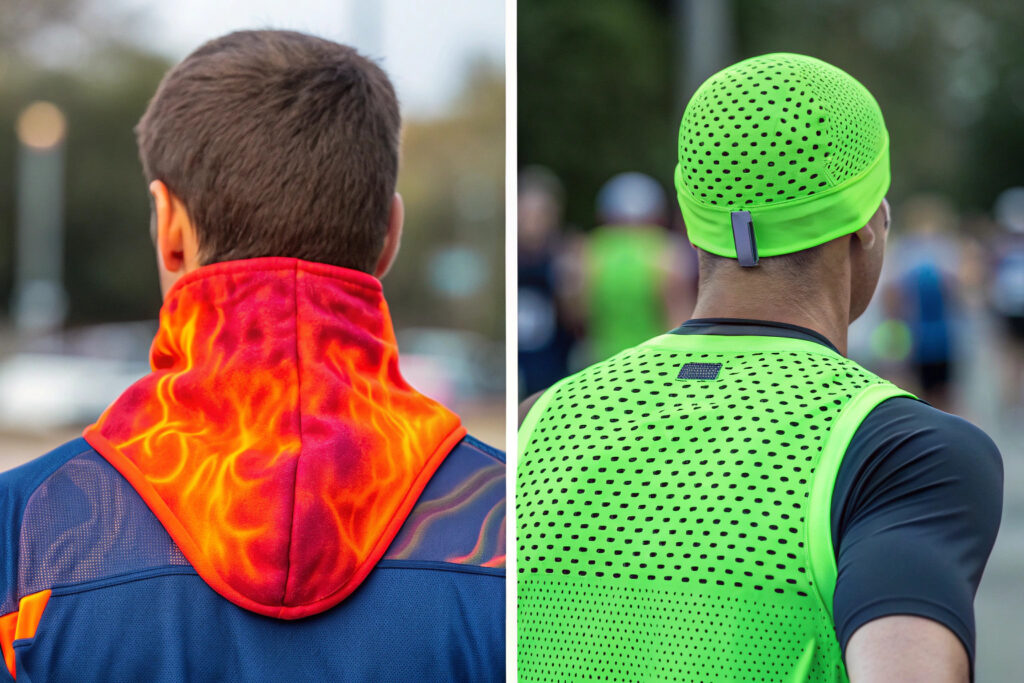
You run at 6 AM. It is dark. You wear a dark cap. A car approaches from behind. The driver does not see you until they are 20 meters away. You add a reflective element to the front of the cap. The front faces forward. The car is behind you. The reflective element on the front is invisible to the driver. The most critical safety zone for a runner is the back of the head. That is where the car approaches. That is where the reflective material must be.
A reflective velcro strap serves a dual function on a running cap. It provides micro-adjustable fit tension for the wearer. It provides a large, visible reflective surface on the back of the cap that faces approaching vehicles. The reflective material is integrated into the strap fabric, not printed on the surface where it can wear off. The strap is a functional safety device, not a decorative trim.
I source reflective velcro with glass bead retroreflective technology. It returns light directly to the source.
The adjustability of the velcro strap complements the stretch panel for a customized fit.

How Does Micro-Adjustable Velcro Tension Complement a Stretch Panel?
A stretch panel provides a baseline fit for a range of head sizes. A velcro strap provides fine-tuning within that range. The runner adjusts the velcro for a snugger fit at the start of the run. As the fabric absorbs sweat and relaxes slightly, the runner can re-adjust the velcro.
The combination of stretch panel and velcro strap is the most versatile closure system for running caps.
I design the velcro strap to sit over the stretch panel, not replace it.
What Are the Retroreflective Standards for Running Apparel?
The European standard EN 17353 defines the requirements for enhanced visibility equipment for medium-risk situations. The American standard ANSI/ISEA 107 defines the requirements for high-visibility safety apparel. For running caps, a reflective area of at least 25 square centimeters on the back panel is recommended.
The reflective material must maintain its retroreflective performance after washing, abrasion, and exposure to sweat.
I test my reflective materials to EN 17353 for retroreflectivity after 25 wash cycles.
How Does a Low-Profile Buckle Compare to Elastic and Velcro for Lightweight Caps?
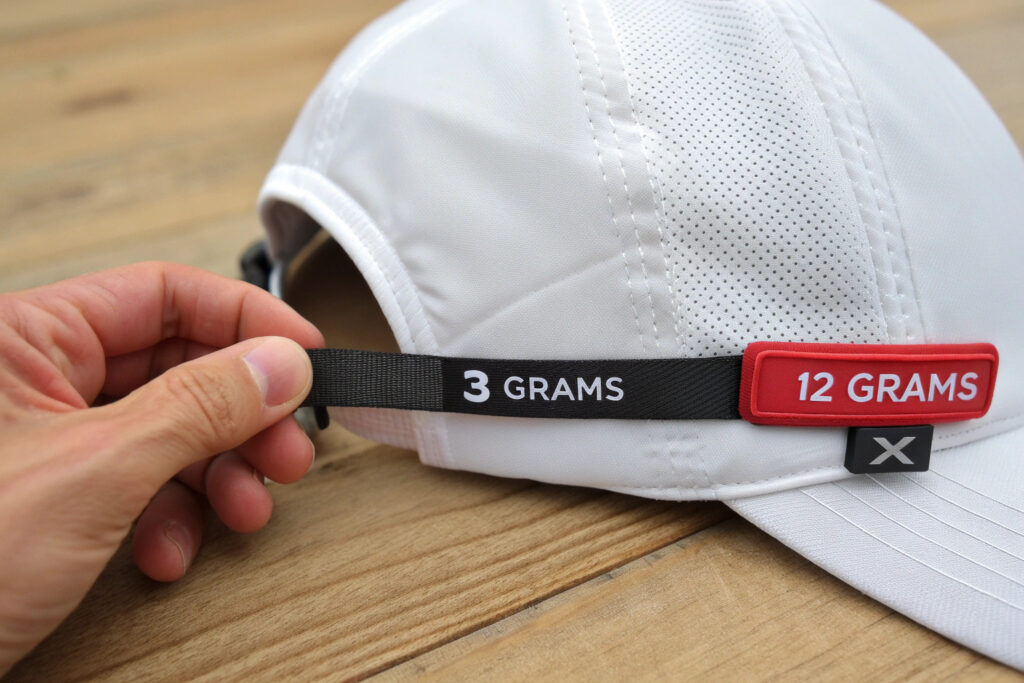
You use a standard plastic buckle. It is thick. It weighs 12 grams. It bounces against the back of the skull. The runner develops a sore spot. The buckle is visible through the cap fabric. It creates a bump. The bump catches on backpack straps and headphone bands. The buckle works for hiking. It fails for running.
A low-profile buckle compares favorably to elastic and velcro for ultra-lightweight racing caps where every gram matters. The buckle provides a secure, adjustable closure with minimal material. It weighs less than 4 grams. It sits flat against the head with no protrusion. It is easy to adjust mid-run with one hand. The trade-off is that it does not distribute tension as evenly as a full elastic panel. It is best suited for elite runners who prioritize weight over all-day comfort.
I use a low-profile buckle from a specialist injection molding supplier. The buckle is 2.5 millimeters thick.
The material choice for the buckle is critical to prevent breakage during adjustment.
What Is the Weight Difference Between a Nylon Buckle and a Full Elastic Panel?
A nylon buckle with a thin polyester strap weighs approximately 4 to 6 grams total. A full elastic panel with spandex and polyester face fabric weighs approximately 15 to 20 grams. The weight saving is 10 to 15 grams.
For an elite marathon runner, 10 grams on the head is noticeable over 42 kilometers. For a casual 5K runner, the weight difference is negligible compared to the comfort advantage of the elastic panel.
I recommend the lightweight buckle for racing caps and the elastic panel for training caps.
Can a Silicone Grip Strip Replace a Mechanical Closure on Racing Caps?
Yes. A silicone grip strip is a continuous band of silicone printed or bonded to the inside of the cap's base edge. The silicone grips the skin or hair and prevents the cap from slipping. No mechanical closure is needed. The cap is pull-on.
This is the lightest possible closure system. It is used in elite racing caps and triathlon caps. The cap must be accurately sized because there is no adjustment. The silicone grip must be skin-safe and washable.
I produce silicone grip caps for professional running teams. The fit is custom to the team's head size distribution.
Conclusion
The best closed-back closures for breathable summer running caps are perforated elastic stretch panels, reflective velcro straps, and low-profile nylon buckles. Each serves a different performance profile. The stretch-fit closure provides the best comfort and tension distribution for distance running. The perforated elastic panel adds occipital zone ventilation. The reflective velcro strap adds micro-adjustability and rear-facing visibility for dawn and dusk running. The low-profile buckle minimizes weight for racing.
The closure is the most critical component for running cap performance. It determines whether the runner forgets the cap or throws it off at kilometer three. The front panel design attracts the buyer on the retail shelf. The closure keeps the cap on the head during the run.
At Global-Caps, I engineer running caps from the back forward. I prototype the closure first. I test it on runners. I collect feedback. I iterate. The result is a cap that performs as good as it looks.
If you need a running cap with a high-performance closed-back closure, contact my Business Director Elaine. She can send you samples of our stretch-fit, perforated elastic, reflective velcro, and low-profile buckle options. Email Elaine at elaine@fumaoclothing.com. Let's build a cap that runs as fast as your customers.