You design a beautiful custom label. The font is perfect. The colors match your brand palette. You approve the sample. The bulk order arrives. You sew the labels into your hats. You ship to your EU distributor. The shipment is stopped at customs. The label contains a restricted phthalate in the ink. The label is a minor component, but it contaminates the entire product. Your hats are non-compliant. The label you spent weeks designing is now the reason your hats are impounded.
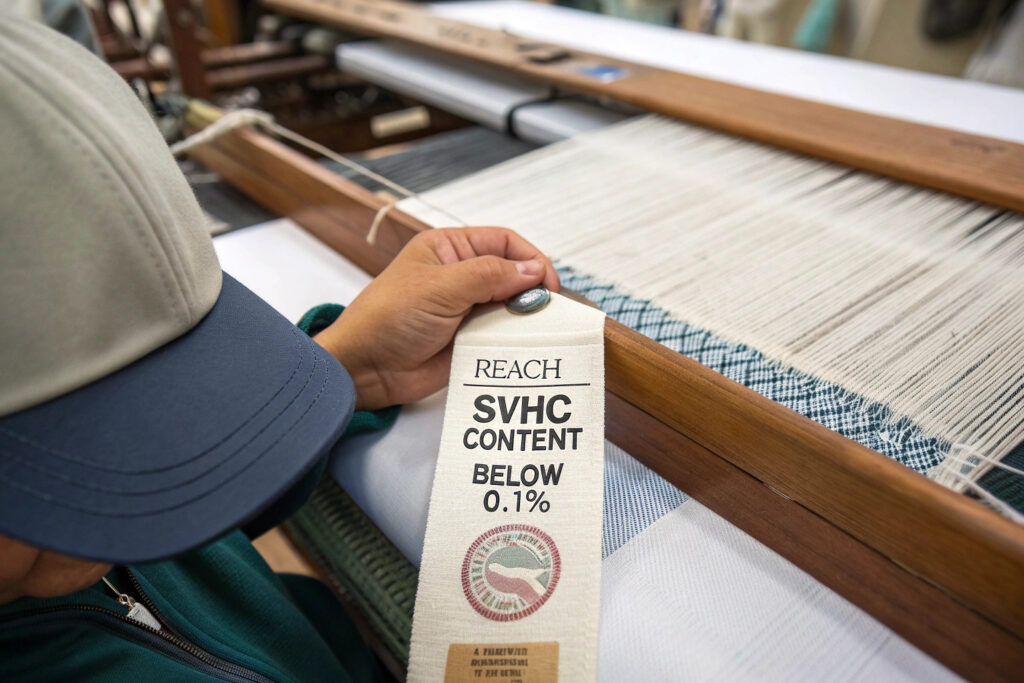
You source custom woven labels that meet REACH standards by working with a label manufacturer who provides a valid REACH compliance declaration, uses OEKO-TEX certified yarns, and prints with phthalate-free, heavy-metal-free inks. You request a third-party lab test report for the specific label construction, not a generic material certificate. The label must comply with REACH Annex XVII restrictions for substances in articles and must not contain any Substance of Very High Concern above the 0.1 percent weight-by-weight threshold in the finished label.
At Global-Caps, I treat the label as a critical component, not an afterthought. My label supplier is audited. The labels are tested. The paperwork is included in the shipment compliance pack.
What Are REACH Standards for Textile Labels and Trims?
You think REACH only applies to the main fabric. The label is small. It weighs two grams. You assume it is exempt. It is not exempt. REACH applies to every article placed on the EU market, regardless of size. A non-compliant label renders the entire hat non-compliant. The regulation does not have a de minimis weight exemption for articles.
REACH is the European Union regulation for Registration, Evaluation, Authorisation, and Restriction of Chemicals. For textile labels, the key requirement is compliance with Annex XVII, which restricts specific hazardous substances in articles supplied to the public. The label must not contain restricted phthalates above 0.1 percent, restricted azo dyes that release carcinogenic amines above 30 parts per million, or heavy metals like lead and cadmium above the specific migration limits. Additionally, the label must not contain any Substance of Very High Concern on the Candidate List above 0.1 percent without communicating this to the customer.
My label supplier provides a REACH compliance declaration for every order. The declaration lists the tested substances and the results.
The REACH definition of an "article" is specific. A woven label is an article. The dye on the label is part of the article.

Why Does the 0.1 Percent SVHC Threshold Apply to a 2-Gram Woven Label?
The 0.1 percent threshold for Substances of Very High Concern is calculated by weight of the homogeneous article. The woven label is an article. If the label weighs 2 grams and contains 3 milligrams of a restricted phthalate, the concentration is 0.15 percent. The threshold is exceeded. The label is non-compliant.
The small size of the label does not exempt it. The threshold is a concentration limit, not a total mass limit. A small article can easily exceed the threshold if a restricted substance is used in the dye, the yarn coating, or the backing adhesive.
I calculate the SVHC concentration for every label component. The lab report shows the concentration for each restricted substance.
How Do the EU REACH and US CPSIA Standards Differ for Label Compliance?
REACH and CPSIA are different regulatory frameworks with different restricted substance lists and different thresholds. REACH focuses on a broad range of chemicals in articles. CPSIA focuses specifically on children's products and limits lead and phthalates.
For adult headwear labels, CPSIA does not apply unless the hat is marketed for children. REACH applies to all headwear sold in the EU, regardless of the target age group. A label that is compliant with CPSIA for lead may still fail REACH for other heavy metals or SVHCs.
I maintain separate compliance files for US and EU orders. The label specification changes based on the destination market.
How to Specify Yarn Composition to Avoid Restricted Substances?
You ask a label supplier for a quote. They quote the cheapest polyester yarn. You approve the quote. The labels arrive. They are compliant on paper because the supplier provided a generic certificate. But the yarn is a petroleum-based polyester dyed with azo dyes from an uncertified dye house. The generic certificate does not cover the actual yarn lot. You trusted the certificate. You should have specified the yarn.
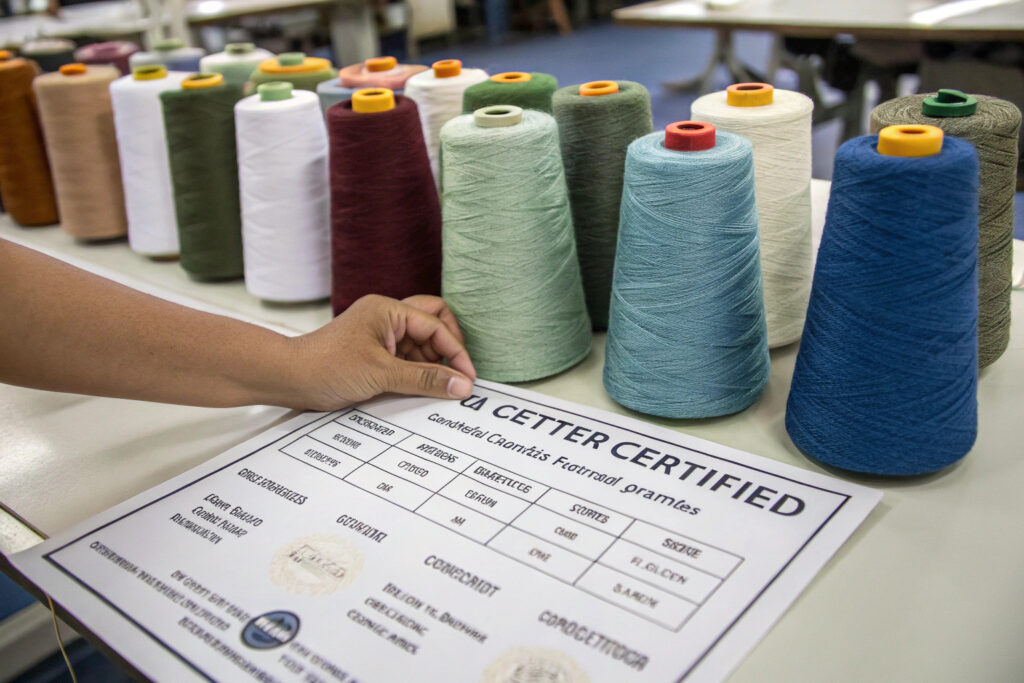
You specify yarn composition to avoid restricted substances by requiring the label manufacturer to use yarns that are pre-certified under OEKO-TEX Standard 100 Class I or GOTS. The specification must state that the yarn must be free of restricted azo dyes, heavy metals, and phthalates. You also specify that recycled polyester yarn must be GRS certified to ensure the chemical inputs are controlled.
My label purchase orders include a yarn specification clause. The supplier must provide the yarn certification lot number.
Recycled polyester is a popular eco-choice, but the chemical risk profile is different from virgin polyester.
Does Recycled Polyester Yarn Pose a Higher Chemical Risk for Labels?
Recycled polyester yarn is made from post-consumer plastic waste, primarily PET bottles. The waste stream can be contaminated with inks, adhesives, and cleaning chemicals from the original bottles. If the recycling process does not include a thorough decontamination step, residual chemicals can carry into the yarn.
The GRS certification addresses this risk. The standard requires the recycler to test the output for restricted substances. A GRS-certified recycled polyester yarn has a chemical risk profile comparable to virgin OEKO-TEX certified yarn.
I only use GRS-certified recycled polyester for labels. The GRS transaction certificate is part of my label compliance pack.
What Certifications Should Your Label Yarn Supplier Provide?
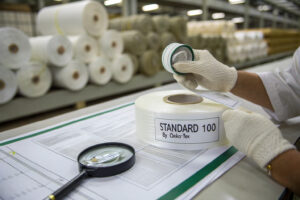
The label yarn supplier must provide three certifications. The yarn certificate confirming OEKO-TEX Standard 100 Class I or GOTS certification. The dye lot certificate confirming the dyes used are free of restricted azo dyes and heavy metals. The supplier declaration confirming the yarn contains no SVHCs above 0.1 percent.
These three documents are independent of the label manufacturer's own certificate. They trace the chemical compliance to the raw material source.
I file these supplier certificates with the label purchase order. The chain of custody is documented.
How Do You Verify the Chemical Safety of Label Printing Inks?
The woven label is beautiful. The yarn is OEKO-TEX certified. The label is printed with a gold metallic ink to match your brand. You ship the hats. The EU lab tests the label. The gold ink contains cadmium. The label fails REACH. The yarn was compliant. The ink was not. You focused on the fabric and forgot the print.
You verify the chemical safety of label printing inks by requesting the ink supplier's technical data sheet and REACH compliance declaration. The ink must be free of heavy metals, restricted phthalates, and restricted azo dyes. You specify that the ink must be suitable for textile printing and must meet the OEKO-TEX Standard 100 Class I requirements for chemical residues on the finished label.
I use only water-based phthalate-free inks for label printing. The ink supplier provides a batch-specific compliance certificate.
Metallic inks are the highest risk category. The metallic pigment is often a heavy metal compound.
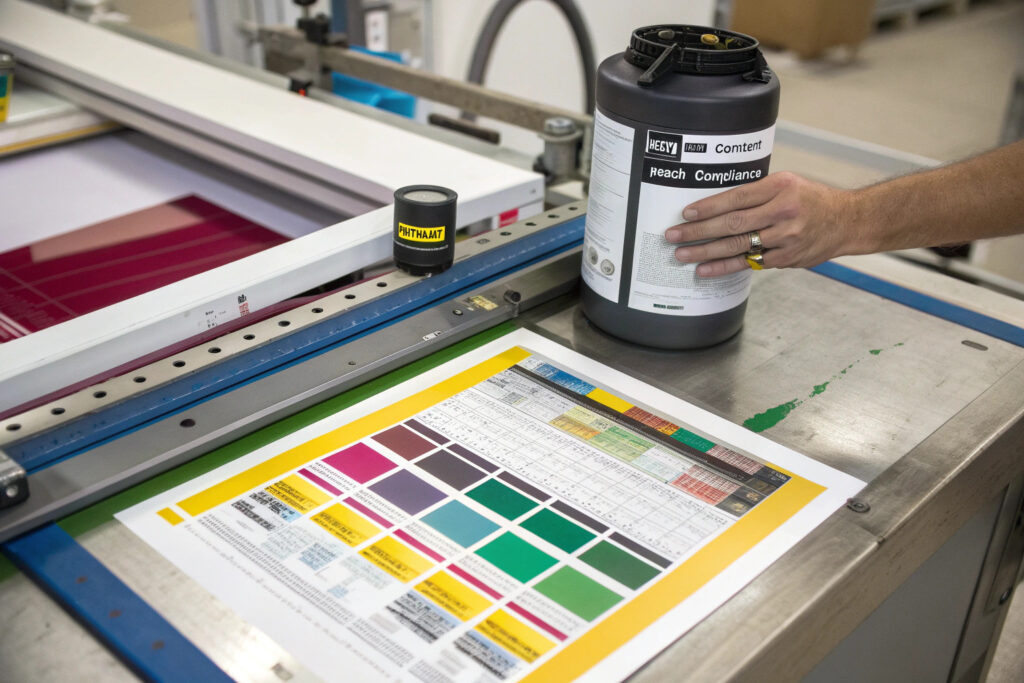
Why Are Phthalate-Free Plastisol and Water-Based Inks Critical for Labels?
Plastisol inks are PVC-based. They require phthalate plasticizers to achieve flexibility. Phthalates are restricted under REACH Annex XVII. A label printed with standard plastisol ink will exceed the 0.1 percent phthalate threshold.
Water-based inks do not contain PVC or phthalates. They cure by evaporation of water. The printed film is phthalate-free. They are the safer choice for REACH compliance.
I eliminated plastisol inks from my label supply chain. All prints are water-based or silicone-based.
Can You Request a Migration Test for Printed Label Inks?
Yes. A migration test measures whether chemicals from the printed ink transfer to the skin or to the surrounding fabric under conditions of use. The test simulates perspiration and friction. The printed label is placed in contact with a sweat simulant. The simulant is analyzed for restricted substances.
This test is relevant for labels sewn into the sweatband, where contact with perspiration is continuous.
I commission migration tests for labels used in direct skin contact zones.
What Documentation Should You Receive With a REACH-Compliant Label Order?
The label supplier sends an invoice and a delivery note. You file them. Six months later, your EU customer asks for the label compliance documents. You email the supplier. They reply, "We don't have batch-specific tests. Here is our general certificate." The general certificate is three years old. It does not cover your label construction. You cannot prove compliance. Your customer rejects the shipment.
You should receive four documents with a REACH-compliant label order: a REACH compliance declaration specific to your label construction, a third-party laboratory test report for the finished label, the yarn supplier's OEKO-TEX or GOTS certificate, and the ink supplier's technical data sheet and compliance declaration. The documents must reference your purchase order number or the label batch number.
I provide a label compliance pack to my clients with every bulk hat shipment.
The REACH compliance declaration is a legal document signed by the manufacturer.

What Should a REACH Compliance Declaration for Labels Include?
The declaration must include the manufacturer's name and address, the product description, the purchase order or batch reference, a statement that the product complies with REACH Regulation (EC) No 1907/2006, a list of the specific Annex XVII restrictions checked, a statement on SVHC content, the name and signature of the responsible person, and the date.
A generic declaration without a batch reference is not valid for a specific order.
My declaration template includes all required fields. The supplier signs and dates it.
How Long Should You Retain Label Compliance Records for EU Audits?
EU market surveillance authorities can request compliance documentation for up to 10 years after the product is placed on the market. The REACH regulation requires the documentation to be retained for the period the article is supplied plus 10 years.
You must archive the label compliance records for at least 10 years. The documents must be retrievable by batch number.
I maintain a digital archive of all label compliance documents. The files are named by client, purchase order, and year.
Conclusion
Sourcing custom woven labels that meet REACH standards requires a supply chain approach. You start with the yarn. The yarn must be OEKO-TEX Standard 100 Class I or GOTS certified. You move to the ink. The ink must be water-based and phthalate-free, with a heavy metal content below REACH thresholds. You verify the finished label with a third-party lab test. You collect the documentation: the REACH compliance declaration, the lab test report, the yarn certificate, and the ink technical data sheet.
The label is a small component, but its compliance is mandatory. A non-compliant label contaminates the entire hat. REACH does not exempt small articles. The 0.1 percent SVHC threshold applies regardless of weight. The documentation must be batch-specific and retained for at least 10 years.
At Global-Caps, I source my woven labels from a REACH-compliant supplier. The yarn is OEKO-TEX certified. The ink is water-based and phthalate-free. The finished label is lab-tested. The documentation is included in your shipment compliance pack. You do not need to chase the label supplier. The paperwork is already on your desk.
If you need custom woven labels that meet REACH standards and integrate seamlessly with your headwear production, contact my Business Director Elaine. She can coordinate the label design, the compliance documentation, and the production timeline. Email Elaine at elaine@fumaoclothing.com. Let's make labels that open EU doors, not close them.