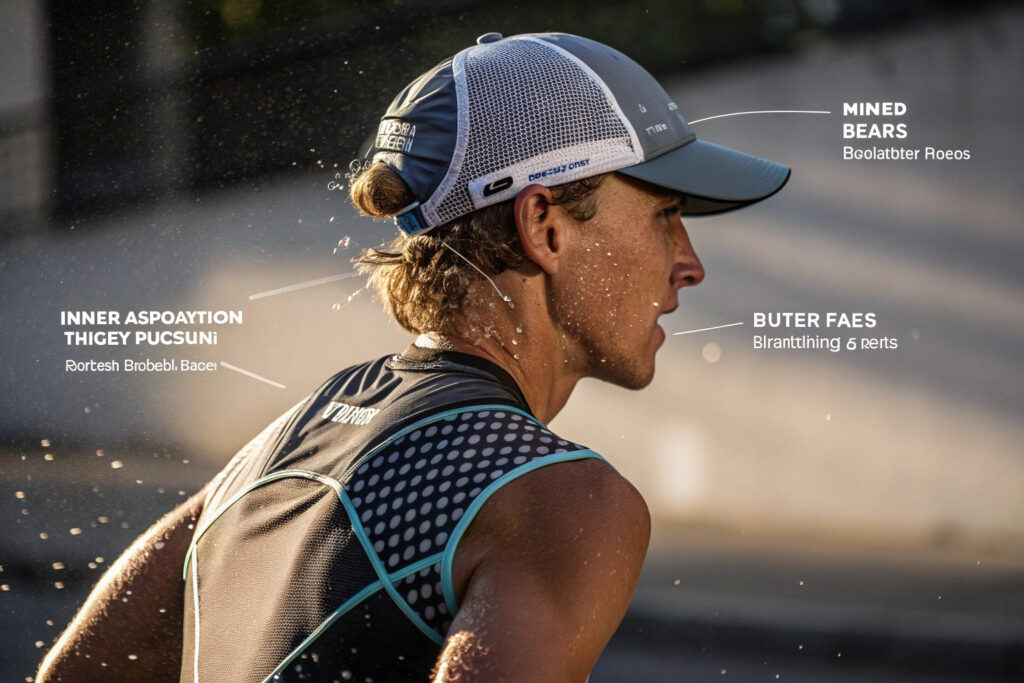
Your customer buys a "performance cap." They wear it for a 10K run. The cap soaks up sweat like a kitchen sponge. It gets heavy. It drips salt water into their eyes. They get a rash on their forehead from the wet fabric rubbing. They throw the cap in the trash and leave a one-star review. You thought "polyester" meant moisture-wicking. It doesn't. You confused fiber content with fabric engineering.
The best moisture-wicking fabrics for high-performance sports caps are polyester-based technical knits with a specialized cross-section and a hydrophilic finish. Coolmax, polyester micromesh, and recycled performance polyester with a wicking treatment are the industry leaders. The fabric must move sweat from the skin side to the air side. It must not absorb the moisture like cotton does. The sweatband is the most critical zone. A poly-spandex blend with a terry loop back is the gold standard for the forehead interface.
In my factory, the sports cap segment has grown 40% year over year. The brands that win are the ones who understand the physics of sweat. They don't just buy "polyester." They buy a moisture management system.
Why Does Polyester Mesh Outperform Cotton in Sweat Management?
Cotton is a natural fiber. It is a hollow cellulose tube. It loves water. It absorbs sweat and holds it. The fabric swells. The cap gets heavier. The wet cotton sticks to the forehead. It blocks airflow. It becomes a sauna on your head. The customer feels like they are wearing a wet towel. Polyester is a synthetic polymer. It is hydrophobic. It hates water. A single polyester fiber does not absorb moisture into its core. The water stays on the surface and moves through the gaps between the fibers.
Polyester mesh outperforms cotton because it uses capillary action to pull sweat away from the skin and spread it across a large surface area for rapid evaporation. The mesh structure creates a chimney effect. Body heat pushes the moisture vapor out through the holes. Cotton holds the sweat against the skin and blocks the chimney.
I still sell cotton caps for fashion. But for any brand marketing a "sports" or "performance" hat, cotton is a liability. It is a complaint waiting to happen.
You need to understand the specific physics of the fiber. It is not about the brand name. It is about the cross-sectional shape of the filament under a microscope.
What Is Capillary Action and How Do Fabric Channels Move Sweat?
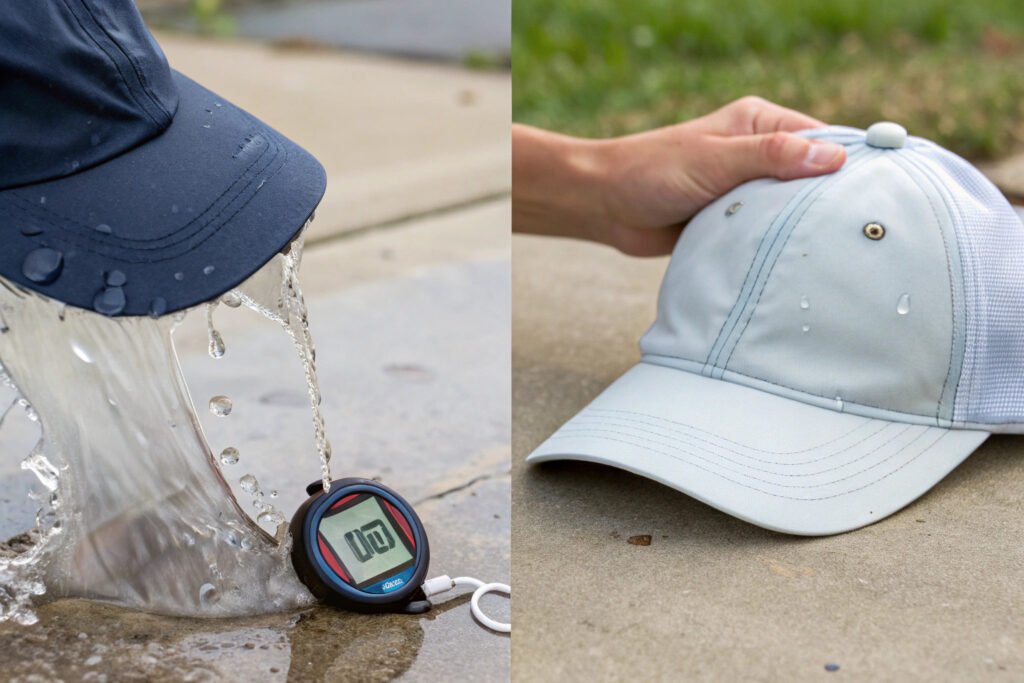
Capillary action is the movement of liquid through a narrow space against gravity. It is the same physics that pulls water up a paper towel. In a fabric, the narrow spaces are the gaps between the yarn fibers and the channels engineered into the fiber surface.
A standard round polyester filament has small gaps between the fibers. Sweat moves through these gaps slowly. A technical wicking fiber, like Coolmax, has a multi-channel cross-section. It looks like a four-leaf clover or a gear under a microscope. The channels increase the surface area and create deeper capillary pathways. Sweat is pulled along these micro-rivers by surface tension.
I test the wicking speed of my fabrics using a vertical wicking test. A strip of fabric is hung vertically with the end in a water bath. I measure how high the water rises in 10 minutes. A good wicking fabric reaches 100mm in under 10 minutes. A basic polyester reaches 60mm. Cotton reaches 40mm but spreads outward, not upward. The vertical rise is the key metric. It proves the sweat is moving away from the skin.
How Does Anti-Microbial Treatment Prevent Odor in Synthetic Cap Fabrics?
Polyester wicks sweat. But polyester holds bacteria. The bacteria feed on the sweat residue and multiply. They produce the smell. A polyester cap worn for a week without washing can smell like a gym locker room. Cotton does not hold the smell as strongly, but it holds the wetness. The trade-off is real.
An anti-microbial treatment solves the smell problem. It is a finish applied to the fabric that inhibits the growth of odor-causing bacteria. The most common treatment is a silver-ion based compound. Silver ions disrupt the bacteria's cell membrane. The bacteria cannot reproduce. The cap stays fresh.
I use Polygiene and Silvadur treatments on my sports cap sweatbands. These are bluesign approved and OEKO-TEX certified. The treatment lasts for the life of the cap, not just a few washes. I also offer a zinc-based option which is more cost-effective. The anti-microbial treatment is invisible. The fabric feels the same. The performance difference is dramatic. You should demand an AATCC 100 test report. This test measures the bacterial reduction percentage. A 99% reduction is the industry standard.
What Is the Role of the Sweatband in a High-Performance Sports Cap?
You focus on the cap crown. The mesh looks sporty. The brim is light. You ignore the sweatband. The customer runs. The sweat drips down their face. The cap is a failure. The sweatband is the only part of the cap that touches the skin. It is the first line of defense. A cheap sweatband ruins a great cap.
The sweatband in a high-performance sports cap acts as a gutter and a sponge. It captures the sweat before it rolls down the forehead. It wicks the moisture laterally across the band to spread the evaporation area. It must be soft against the skin to prevent chafing. It must dry fast. The best sweatbands use a combination of a wicking polyester face fabric backed with a thin hydrophilic foam or a terry loop knit.
I spend more time engineering the sweatband than any other single component. The customer's entire experience of the cap is filtered through that strip of fabric on their forehead.
The material choice for the skin-contact layer and the shape of the band itself both influence performance. A narrow band is lighter but less absorbent. A wide band catches more sweat but feels hotter.
Why Is a Poly-Spandex Terry Backing the Gold Standard for Sweatbands?
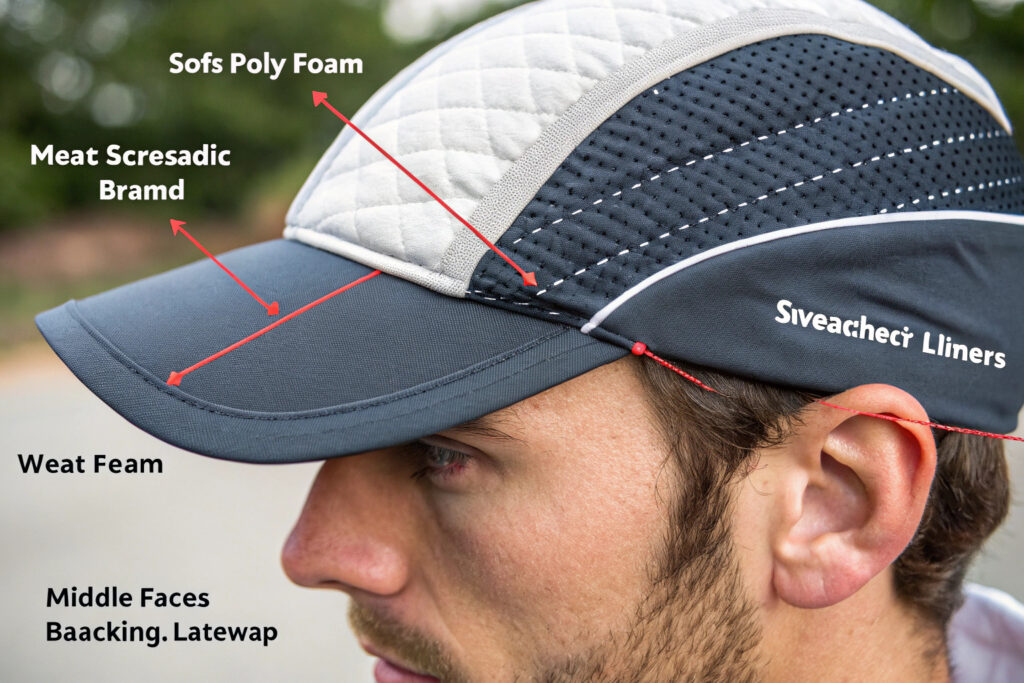
A terry backing is a looped pile surface. Think of a towel. The loops increase the surface area dramatically. A smooth sweatband has a flat surface. It touches the skin at a limited number of points. A terry sweatband has thousands of tiny loops pressing against the skin. Each loop acts as a capillary wick.
The poly-spandex terry backing is the gold standard because the polyester wicks, the spandex stretches, and the terry loops capture and distribute. The polyester moves the sweat. The spandex keeps the band snug against the forehead without a tight elastic strap that causes a headache. The terry loops create a soft cushion.
I source my sweatband material from a specialist mill. The fabric is knitted on a circular machine with a ground yarn of polyester and a loop yarn of micro-polyester. The loop side faces the forehead. The back side is flat and sewn to the cap crown. I test the absorbency by dripping 5ml of water onto the band and measuring the time to fully absorb. A terry band absorbs in under 2 seconds. A flat band takes 5 seconds or longer.
How Does a Perforated EVA Foam Liner Improve Sweatband Performance?
A standard sweatband is just fabric. It holds a limited amount of sweat. Once saturated, it drips. A perforated EVA foam liner inside the sweatband acts as a reservoir. The foam absorbs the excess sweat and holds it away from the skin. The perforations allow air to circulate through the foam to dry it between uses.
The EVA foam liner is a thin strip, about 3mm thick, inserted into a pocket inside the sweatband. It is the same material used in high-end running shoe insoles. It is lightweight and flexible. The perforations are laser-drilled.
I offer a perforated EVA liner as an upgrade on my sports caps. It adds about $0.40 to the unit cost. The sweatband stays dry on the skin side for longer. The runner's forehead stays comfortable. The drying speed is faster because the foam spreads the moisture across a larger surface area inside the cap. The liner also adds structure to the front panel, helping the cap keep its shape even when damp.
How Does Laser-Cut Ventilation Affect Cap Breathability?
You see a cap with embroidered eyelets. You think "ventilation, checked." But the eyelets are small. The embroidery thread fills half the hole. The air barely moves. The customer's head overheats. Embroidered eyelets are a fashion detail. Laser-cut holes are an engineering decision.
Laser-cut ventilation improves cap breathability by creating clean, open holes without thread obstruction. The laser melts the fabric edge, sealing it so the hole does not fray or shrink in the wash. The size, number, and placement of the holes can be precisely controlled. The airflow is measurable. A well-ventilated cap drops the internal crown temperature by 2 to 3 degrees Celsius compared to a solid crown cap.
I use a laser cutter for my high-performance sports cap panels. The holes are placed in the highest heat zones: the top of the crown and the sides above the ears. The laser beam does not touch the fabric. It burns the hole. The edge is sealed instantly.
You need to understand the difference between the old mechanical way and the new optical way. The hole is not just a hole. It is a precision feature.
What Is the Difference Between Embroidered Eyelets and Laser-Cut Perforations?
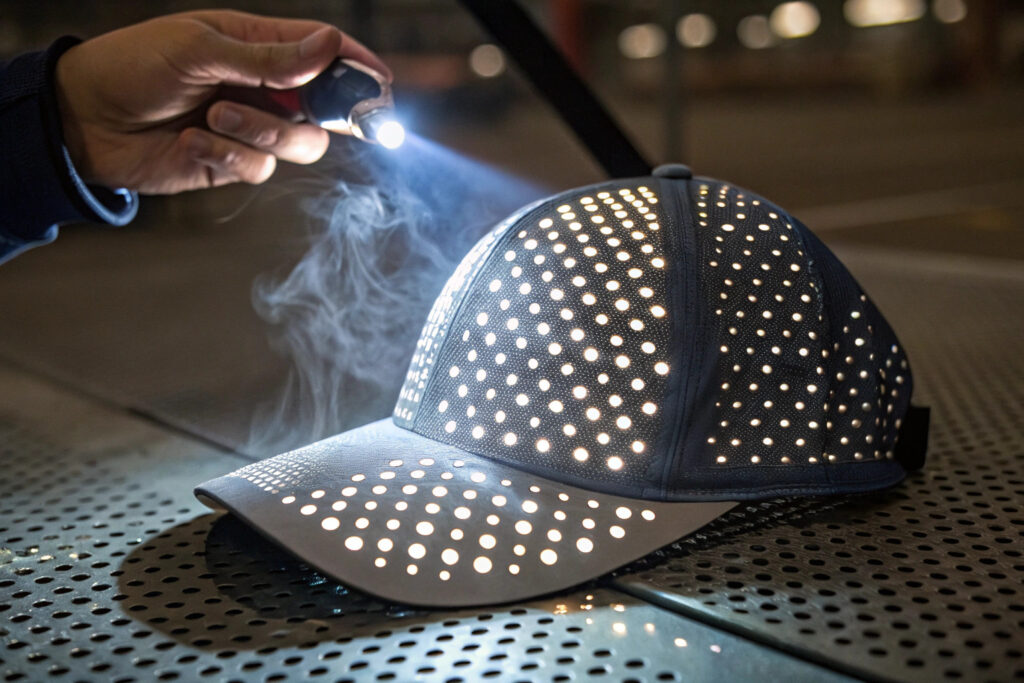
Embroidered eyelets are sewn holes. A machine punches a small hole and then wraps thread around the edge. The thread is thick. It reduces the effective hole diameter by 30 to 50 percent. The thread also absorbs moisture. It can fray and look ragged after a few washes.
Laser-cut perforations are burned holes. The laser beam vaporizes the fabric. The edge is a clean, hard ring of melted polymer. There is no thread to block the airflow. The hole is the exact diameter programmed into the laser software. It stays that size forever.
I measure the air permeability of a ventilated panel using a Frazier air permeability tester. A panel with laser-cut perforations shows 20 to 30 percent higher airflow than the same panel with embroidered eyelets of the same diameter. The laser cutting also allows for custom shapes. I can cut a logo into the panel. The logo becomes the ventilation. This is a premium brand feature.
Where Should Vent Holes Be Placed for Maximum Heat Escape?
The human head has a thermal map. The top of the crown is the hottest zone. Heat rises. The sides above the ears are also hot due to blood flow. The back of the head is cooler. Placing vent holes randomly is a design choice. Placing them on the thermal map is a performance choice.
I place the largest vent holes on the top panel of the crown. The heat escapes vertically. A chimney effect forms. Cool air enters from the sides. Hot air exits from the top. This is passive convection.
I place smaller holes on the side panels. These act as intake vents. The runner's forward motion pushes air into the side vents. The air circulates and exits the top. I avoid placing holes on the front panel. The front panel has the logo. The holes would distort the embroidery. Also, the front panel faces forward into the wind, which can cause a parachute drag effect if too open. The vent placement map I use is based on thermal imaging studies of runners. The data shows the exact heat spots.
What Are the Best Lightweight Brim Materials for Running Caps?
The cap looks great. The crown is lightweight mesh. The sweatband is wicking terry. But the brim is a thick plastic board sewn between two layers of heavy cotton. The cap bounces with every stride. The brim catches the wind and lifts off the head. The customer is annoyed. The brim is the rudder of the cap. A bad brim ruins the aerodynamics.
The best lightweight brim materials for running caps are EVA foam, PE plastic sheet, and fused fabric-only brims. The key is to eliminate the heavy pressed cardboard or thick plastic board. An EVA foam brim is soft, flexible, and weighs about 5 grams. It does not absorb water. It can be crushed and bounced back to shape. A PE sheet brim is slightly stiffer, good for a more structured look, and weighs about 8 grams.
I switched my entire sports cap line to lightweight brims three years ago. The feedback was instant. "Finally, a cap I forget I'm wearing."
The brim material must survive the washing machine and the suitcase. The traditional brim is durable but heavy. The lightweight brim must prove it is tough.
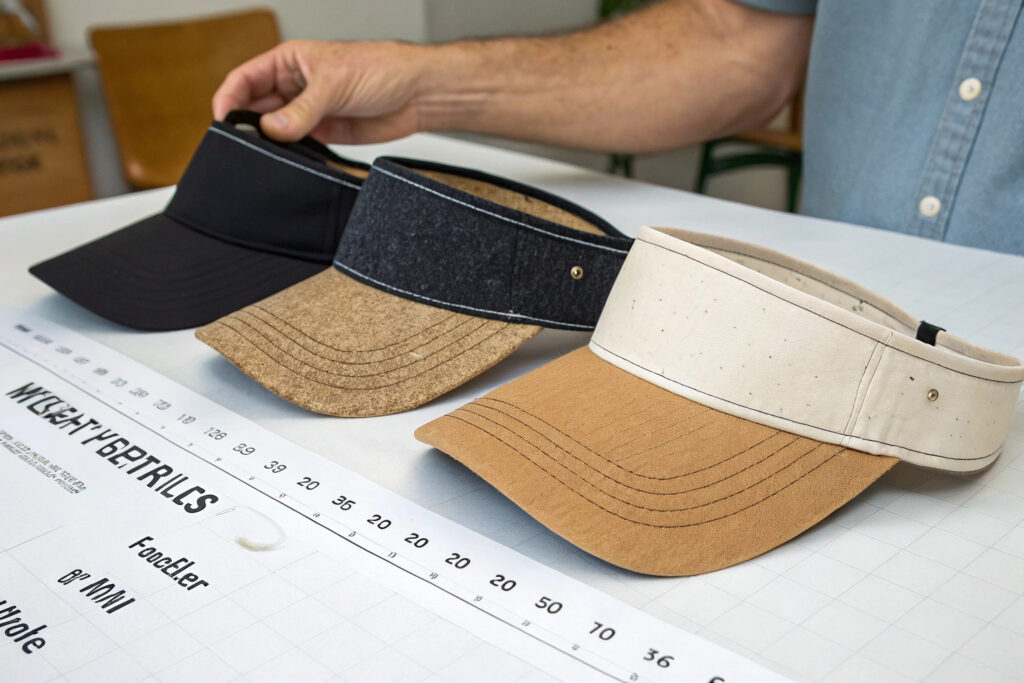
How Does an EVA Foam Brim Compare to a Traditional Plastic Stay Brim?
A traditional plastic stay brim is a die-cut sheet of polypropylene or polyethylene. It is about 1mm thick. It is stiff. It holds a permanent curve. It weighs about 15 to 20 grams. When wet, it stays the same shape, which sounds good, but it means the cap cannot be folded or packed flat.
An EVA foam brim is a die-cut sheet of ethylene-vinyl acetate foam. It is about 2mm thick but lighter in density than plastic. It weighs 5 to 8 grams. It is flexible. You can roll the cap and pack it. The brim bounces back. It floats on water. It is machine washable.
The EVA brim does not hold a sharp permanent curve as well as the plastic stay. For a running cap, this is a benefit. The softer curve conforms to the head. It does not create a wind scoop. The plastic stay is still better for a structured baseball cap worn for fashion. For performance, the EVA brim wins on weight and packability.
What Is a "Floating" or "Packable" Brim Design and Why Does It Matter?
A floating brim has no stiff insert at all. The brim shape is created by fusing multiple layers of fabric together with a heat-activated adhesive. The resulting brim is soft like a piece of thick felt. It provides shade but collapses completely flat. The cap can be folded into a pocket.
A packable brim design matters for the running and outdoor market. The customer wants a cap that lives in their running belt or backpack. They want to pull it out, shake it, and have it spring back. A traditional plastic brim would crease and crack.
I produce a packable cap with a fused fabric brim. The construction involves three layers of polyester microfiber with a hot-melt interlining. The layers are pressed under heat and pressure. The brim is permanently bonded. It provides just enough shade for a 10K run. It weighs 3 grams. It is the ultimate lightweight solution. The trade-off is structure. It looks casual, not sharp. For a serious running cap, the look is perfect. For a golf cap, the EVA foam brim is a better middle ground.
Conclusion
The best moisture-wicking fabrics for high-performance sports caps are engineered polyester knits with a multi-channel cross-section like Coolmax, paired with a poly-spandex terry sweatband and a lightweight EVA foam brim. The fiber must wick through capillary action, not absorb like cotton. The sweatband is the critical interface. It must be soft, terry-backed, and optionally lined with a perforated foam reservoir. The crown must breathe. Laser-cut ventilation beats embroidered eyelets for airflow. The brim must be lightweight, flexible, and packable. EVA foam and fused fabric brims outperform traditional plastic stays.
Cotton is the enemy of performance. Polyester without a wicking finish is just plastic. A cap is a system. The sweatband captures, the crown ventilates, and the brim stabilizes.
At Global-Caps, we engineer sports caps for brands that sell to serious athletes. We test the wicking height, the absorbency speed, the air permeability, and the brim weight. We do not guess. We measure.
If you need a high-performance sports cap that moves sweat, breathes heat, and floats on your customer's head, let's build it. Contact our Business Director Elaine. She can send you our performance fabric swatch kit, including Coolmax, micro-mesh, and terry sweatband samples. Email Elaine at elaine@fumaoclothing.com. Let's engineer a cap that wins the race.