You have a logo. You have a dream. You need 100 custom golf visors for a charity tournament. You email ten factories. Nine say "MOQ 500 pieces." The tenth says "MOQ 1,000." You feel invisible. You think the industry does not care about small brands. This is the wall that stops most startups before they ever hold their first product.
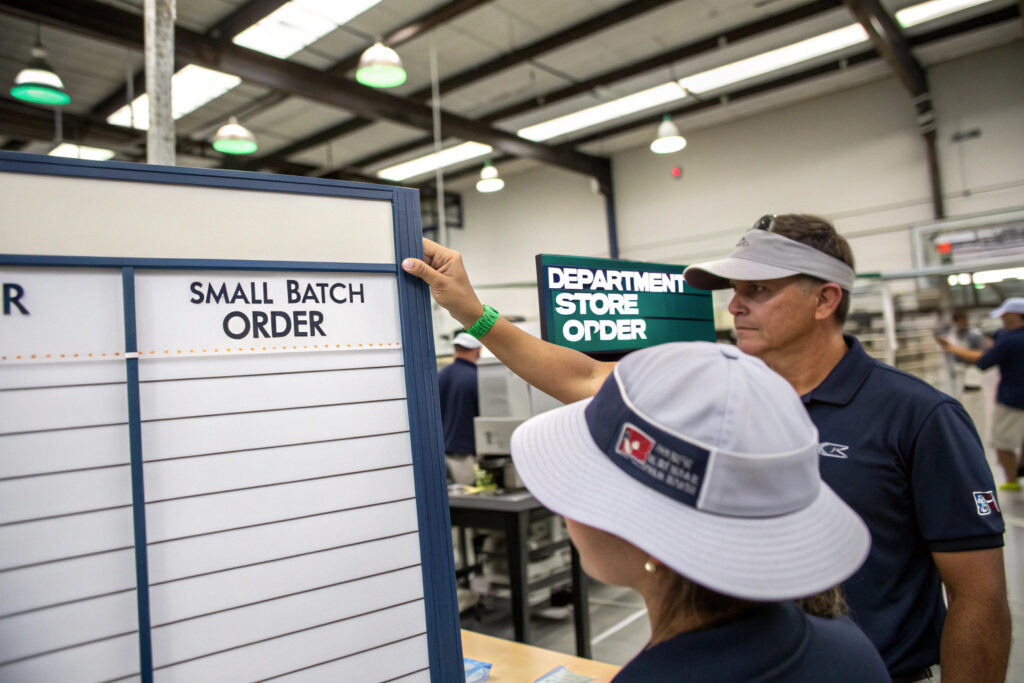
You negotiate a low MOQ for your first custom golf visor order by offering to use stock materials, accepting a slightly higher unit price, and bundling your order with the factory's existing production runs. You do not ask for a completely new fabric. You do not demand a custom snapback closure. You stay flexible on the details. At Global-Caps, I reserve a specific weekly production slot for "Small Batch Launch" orders. We cut these alongside a big department store order. The big order covers the machine setup cost. The small order rides on its coattails.
The factory is not rejecting you. The factory is rejecting the high cost of stopping a line for a tiny run. I want to teach you how to lower that cost for the supplier. When you lower their cost, they lower the MOQ.
What Makes a Supplier Open to Small Batch Custom Visor Orders?
You call a massive factory. They make 100,000 hats a month. You ask for 50 pieces. They laugh. Not because they are rude. Because their machines are the size of a bus. Changing the thread on those machines takes longer than sewing your 50 visors. You are knocking on the wrong door.
A supplier opens up to small batch orders when they operate flexible, modular sewing lines rather than long, rigid assembly conveyors. A factory that focuses on boutique brands or has a dedicated sampling-to-small-production pipeline is your target. These suppliers have cross-trained sewing operators who can switch between a baseball cap and a golf visor in minutes. They also keep a library of stock materials. If they have black polyester visor bodies already in the warehouse, cutting 50 pieces is trivial. If they have to order a special roll of fabric from the mill, 50 pieces becomes impossible.
Find the factory that looks bored with huge orders. Find the one that treats small orders as a sport.
You need to identify the physical signs of flexibility. A factory's layout tells you the truth about their willingness to run small batches. Ask for a video tour before you ask about MOQ.
How Do Modular Sewing Lines Differ From Progressive Bundle Systems?
Progressive Bundle Systems are the traditional model. A bundle of 500 visor brims moves from station to station. Each worker does one tiny task. The system is incredibly fast for 5,000 units. It is useless for 50 units. The changeover time kills the margin.
Modular Sewing Lines use small teams. One team of three or four operators builds the entire visor. They sit in a U-shaped cell. They have all the machines they need within arm's reach. When the 50 visors are done, they switch to a different product. The setup time is almost zero because the machines are general-purpose.
I converted half my factory to modular cells. The lean manufacturing principle here is "single-piece flow." For a golf visor, one team handles the brim insertion, the crown stitching, and the Velcro closure attachment. They see the visor from flat fabric to finished product. The quality ownership is higher. The flexibility is unmatched. A modular cell can profitably run a 30-piece order if the unit price reflects the slower pace. You should ask a potential supplier, "Do you use a line system or a cell system?" If they say "cell system," your low MOQ request has a chance. If they stumble on the question, they are a mass-production line and you need to find a different partner.
Why Does a Factory's Raw Material Inventory Define the True MOQ?
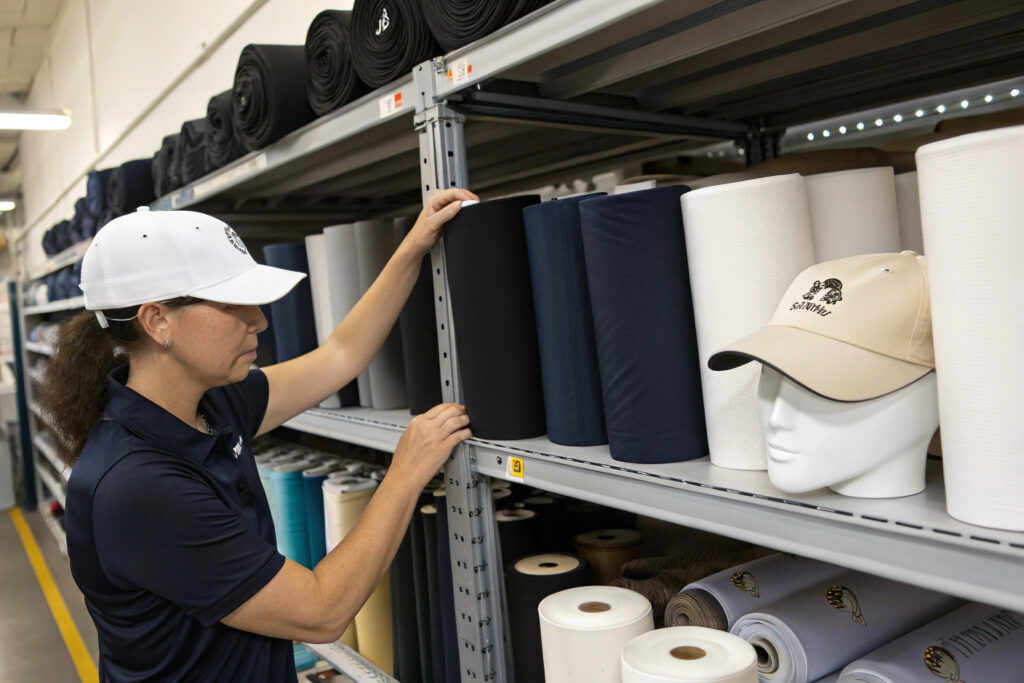
The real MOQ is not a number on a price list. The real MOQ is the minimum order quantity of the fabric mill. The mill sells fabric in rolls. A standard roll of polyester visor fabric is 100 yards. That fabric makes about 400 golf visors. That is the hidden mathematical floor.
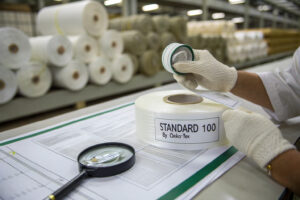
If you want a specialty color, the factory buys the whole roll. You must buy the output of that roll. The factory does not want to keep 75 yards of lime green fabric on the shelf for three years. You are paying for the waste. If you choose a stock color that the factory buys in bulk—black, white, navy—the roll is already in the warehouse. The factory can cut 50 units from a 500-yard master roll. There is zero waste.
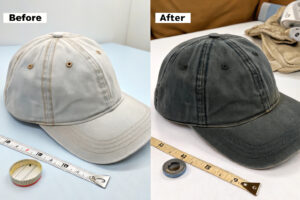
I show my stock fabric swatch card to first-time buyers first. "Pick from these 12 colors, and I can do 100 pieces." The moment you say "I need a custom Pantone match," the fabric MOQ kicks in. You need to buy the dyeing setup and the minimum roll length. A custom dye order for a small batch is the fastest way to kill a low MOQ negotiation. I advise startups to launch with stock colors. Prove the market. Then scale into custom colors. This is inventory math, not factory greed.
How Can You Use Stock Materials to Drop the Minimum Order Quantity?
You want a unique shade of seafoam green. It matches your brand guide perfectly. The factory says the MOQ for that color is 500. You fight it. You demand 100. The factory refuses. The deadlock kills the project. The color is the enemy of the small order.
Using stock materials drops the MOQ because the factory eliminates the fabric procurement risk. The material is already paid for. The cutting table can slip your 50 visors into the queue between two large runs. The sewing operators know how the fabric behaves. There is no trial and error. Stock fabrics are pre-tested for shrinkage and colorfastness.
When you accept the stock white visor body and only customize the embroidery and the sweatband print, you become a fast, low-risk transaction. Not a risky development project.
You need to understand the specific components that drive the cost. The visor brim and the closure strap are the two parts where stock options save the day.
What Standard Visor Brim Shapes Are Typically In Stock?
The brim is the soul of the golf visor. A custom brim curve requires a custom aluminum mold. That mold costs $300 to $500. A small order cannot absorb that tooling cost. But factories keep a library of standard brim shapes.
The three standard shapes are the classic curved brim, the flat bill brim, and the mid-curve brim. The classic curved brim is the most common for golf. We keep 10,000 units of pre-formed classic brims in black, white, and navy in our warehouse. The brim is made of a plastic composite board covered in fabric. We buy these from a brim specialist in bulk.
If you choose the standard curve, we just pull the brim from the shelf. Zero setup time. If you want a unique wider brim or a super-short retro brim, we need a new mold. The mold takes 2 weeks and $400. That's a 1,000-piece project. For a 100-piece order, you embrace the standard curve. You can still customize the fabric covering on the brim. I can cut the stock black brim board and cover it with your custom logo fabric. That is a compromise that gives you a unique look without the tooling cost.
How Do Pre-Cut Velcro Straps vs Custom Buckles Impact Minimums?
The closure on a golf visor is usually a Velcro strap or a plastic buckle. A custom metal buckle with your logo is beautiful. It also has an MOQ of 2,000 pieces from the hardware factory. A standard black Velcro strap has an MOQ of 1 piece.
Pre-cut Velcro straps are a stock item. We cut them in bulk from a master roll. They have a standard sewing margin. The operator sews the loop side to the strap and the hook side to the visor back. It is fast and cheap. You can customize the strap length, but you use the standard width.
A custom plastic buckle requires an injection mold. The mold cost is $800 to $1,500. The buckle factory minimum production is 1,000 shots. This is a non-starter for a low MOQ order. I tell my new brands to use a premium Velcro with a debossed leather-like tab. The tab gives the back of the visor a high-end look without the buckle's tooling cost. You can also use a stock plastic clip from a buckle catalog. These clips are always available in small quantities. You pick one that matches your aesthetic. You avoid the MOQ trap. The closure is visible on the back of the head. Make it clean, but don't let it be the reason your order fails.
Why Does Production Slot Piggybacking Work for Small Brands?
You are a small fish. You ask the factory for a dedicated production slot. The factory calculates the cost of stopping the line, cleaning it, setting up your materials, running 100 pieces, and cleaning it again. The fixed cost is higher than your entire order value. They say no. You feel rejected. But you don't need your own slot. You need a seat at an existing table.
Production slot piggybacking works because the machine setup cost is shared. If a factory is already running 5,000 white golf visors for a golf resort, adding your 100 white visors costs almost nothing extra. The thread is the same. The needle is the same. The operator just loads your embroidery file onto the machine for 20 minutes. The large order covers the line setup. Your small order is incremental profit for the factory.
I actively look for piggybacking opportunities for my startup clients. I check the production calendar. I find a big order with a similar color and structure. I offer the small brand a slot in the shadow of the giant.
You need to time your approach and structure your product specification to maximize the match with the big order. This is not luck. This is scheduling strategy.
What Is the Best Time of Year to Request a Piggybacked Production Slot?
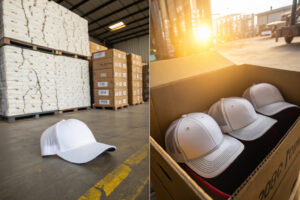
The golf season has a predictable production calendar. The bulk orders for spring retail happen in October and November. The bulk orders for holiday corporate gifts happen in August and September. The factory floor is packed with visors during these windows.
The best time for a small piggybacked order is exactly during these peak bulk months. Do not approach the factory in December when the lines are quiet and there is no big order to piggyback on. In December, your 100-piece order is the only thing on the schedule. The full setup cost lands on you.
I tell my golf startup clients to plan their launch around the factory's production cycles. If the factory is cutting white visor bodies for a major tournament order in August, your white visor sample should be ready in July. You slot in. If you miss the window, you wait. The Chinese New Year period is the dead zone. No piggybacking happens. The factory is shut. Plan your first order to hit the floor in March, August, or October. These are the peak piggybacking seasons.
How Does Sharing Embroidery Thread Colors With Big Runs Cut Costs?
Thread changes are time-consuming. The embroidery machine operator must cut the thread, remove the cone, load a new cone, and re-tension the machine. If you have a unique neon orange logo, and the big order uses navy and white, your thread change costs the factory 15 minutes. They bill you for it.
If your logo colors match the thread colors already loaded on the machine, the changeover cost is zero. The operator just swaps the memory stick and loads your file. The physical setup is identical. I always show my small-batch clients the thread palette for the concurrent big orders. "Here is the resort order. They use white, dark green, and gold. Can your logo work with these colors?"
Often the small brand can adapt. They keep their brand identity but use the gold thread that is already on the machine. This shared resource strategy is a secret weapon. The big order pays for the thread cone setup. The small order borrows it. The factory sees a seamless extension of the existing run. Your MOQ drops. Your price drops.
What Per Unit Price Premium Is Fair for a Sub-500 Visor Order?
The factory quotes $3.50 per visor for 1,000 units. You ask for 200 units. The new quote is $6.00. You think they are punishing you. You feel the price gouge. But the material cost is the same. The labor cost is actually higher because the operator is slower on a new style. The setup cost is amortized over fewer pieces.
A fair price premium for a sub-500 piece golf visor order is 25% to 50% above the bulk 1,000-piece price. If the 1,000-unit price is $3.50, a 200-unit price between $4.40 and $5.25 is reasonable. The premium covers the non-recurring engineering cost, the machine set-up time, and the higher per-unit labor of a small batch. You are not being overcharged. You are paying for flexibility.
Transparency from both sides builds trust. I show my cost breakdown to new clients. They see the fixed costs and the variable costs. They understand why the curve bends up at low quantities.
You need to distinguish between the charges that happen once and the charges that repeat per piece. This breakdown helps you negotiate which costs you can eliminate.
How Do Non-Recurring Engineering Charges Impact Small Batch Pricing?
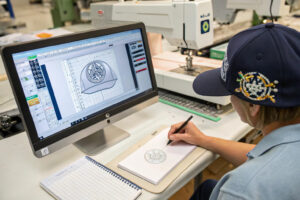
A Non-Recurring Engineering charge is a one-time fee. It covers the digitizing of the logo, the making of a cutting die, or the creation of a screen print screen. These costs hit a small order very hard.
If the digitizing fee is $50, and you order 1,000 visors, the fee is $0.05 per visor. You don't notice it. If you order 100 visors, the fee is $0.50 per visor. It adds 15% to the unit price. The NRE charge is legitimate. The digitizer spent two hours on your file.
I separate the NRE charges from the unit price in my quotes. I want the client to see the cost. You can negotiate the NRE. You can offer to pay the digitizing fee upfront and own the file. Then for your reorder, the NRE charge is zero. You can also ask the factory to waive the screen setup fee if you commit to a reorder within six months. This is a risk-sharing deal. The factory waives the upfront fee, and you sign a small contract for a future order.
The cutting die for a custom visor brim is a larger NRE. A steel rule die costs $150. It lasts for thousands of cuts. If you don't want to pay it, you limit your design to the standard brim shapes we discussed earlier. The choice is yours. Pay for the die and own a unique shape. Or skip the die and use the standard shape. That is the trade-off.
When Is It Reasonable to Pay a 50% Deposit for a Small Custom Run?
The factory asks for a 50% deposit on a small order. You feel uneasy. What if they disappear? What if the quality is bad? The deposit protects the factory. They are buying materials and reserving labor for a client with no history.
A 50% deposit is standard for a first-time small-batch order in the headwear industry. The factory's risk is high. Your custom golf visor has no resale value if you cancel. It has your logo. The factory cannot sell it to anyone else. The deposit covers the material cost and part of the labor. It is a commitment signal.
I always structure the payment as 50% upfront and 50% before shipment. The balance payment is due when I send the final inspection photos. This protects both sides. You see the finished goods. You pay. I ship. For very small orders under $500 total, I sometimes require 100% payment upfront. The administrative cost of chasing a small balance is not worth it. You should always use a secure payment method like Trade Assurance or a business PayPal. Never wire a deposit to a personal account. You can also ask for a sample before the bulk deposit. A pre-production sample paid for out-of-pocket builds trust. You spend $50 on a sample. The factory spends $0 on a gamble. The sample is the bridge.
Conclusion
Negotiating a low MOQ for your first custom golf visor order is a game of understanding the factory's cost structure. You start by finding the right factory. Look for one with modular sewing cells, not a rigid mass-production line. Check their stock fabric inventory. Choose a color from the shelf, not a custom dye.
You then make smart design compromises. Use a standard brim curve to avoid tooling charges. Use a pre-cut Velcro strap instead of a custom buckle. Time your order to piggyback on a larger production run. Match your logo thread colors to the thread already loaded on the embroidery machine. Accept a fair price premium of 25% to 50% to cover the setup cost.
Finally, structure the deal with transparency. Pay the digitizing fee upfront. Pay a 50% deposit to signal your commitment. Use a secure payment platform. The factory wants to say yes. They want long-term partners. But they need the math to work.
At Global-Caps, we built our small batch program specifically for brands like yours. We keep the stock materials, the flexible cells, and the piggybacking calendar ready. You don't need to fight the system. You need to work inside it.
If you are ready to launch your first order of custom golf visors without the 1,000-piece headache, let's talk. Contact our Business Director Elaine. She can send you our stock color card and walk you through the piggybacking schedule for this quarter. Email Elaine at elaine@fumaoclothing.com. Let's get your visors on the course.