
As an owner of a hat manufacturing company in Keqiao, I’ve witnessed every conceivable quality challenge—from a customer discovering a nearly invisible stitch inconsistency in a batch of 10,000 fedoras, to the fatigue that sets in during late-night shifts, making even our best inspectors prone to oversights. The cost isn't just financial; it's our reputation. In today's market, where clients demand absolute consistency and are acutely aware of sustainability, traditional quality control (QC) methods are becoming a bottleneck.
Deploying AI-powered defect detection in hat manufacturing is a strategic move from reactive inspection to proactive quality assurance. It directly tackles the core limitations of human inspection—fatigue, inconsistency, and speed—while introducing unprecedented levels of precision, data-driven process optimization, and significant long-term cost savings. For a fashion-forward industry like ours, it’s not just about finding flaws; it’s about enabling bolder designs and guaranteeing the quality that global brands expect.
This transition is more than an upgrade; it's a fundamental shift in how we perceive quality. Let’s explore how this technology addresses the specific pain points of hat manufacturing and transforms QC from a cost center into a competitive advantage.
How Does AI Overcome the Limitations of Human Inspection?
Human inspectors are the backbone of traditional QC, but their capabilities have inherent and well-documented constraints. In hat production, these limitations directly impact both quality and cost. Fatigue is inevitable; studies show that after just 30 minutes of continuous visual inspection, error rates can increase by approximately 20%. Subjectivity also plays a role—one inspector might pass a slight color variation in a wool beret, while another might reject it, leading to inconsistent standards across batches.
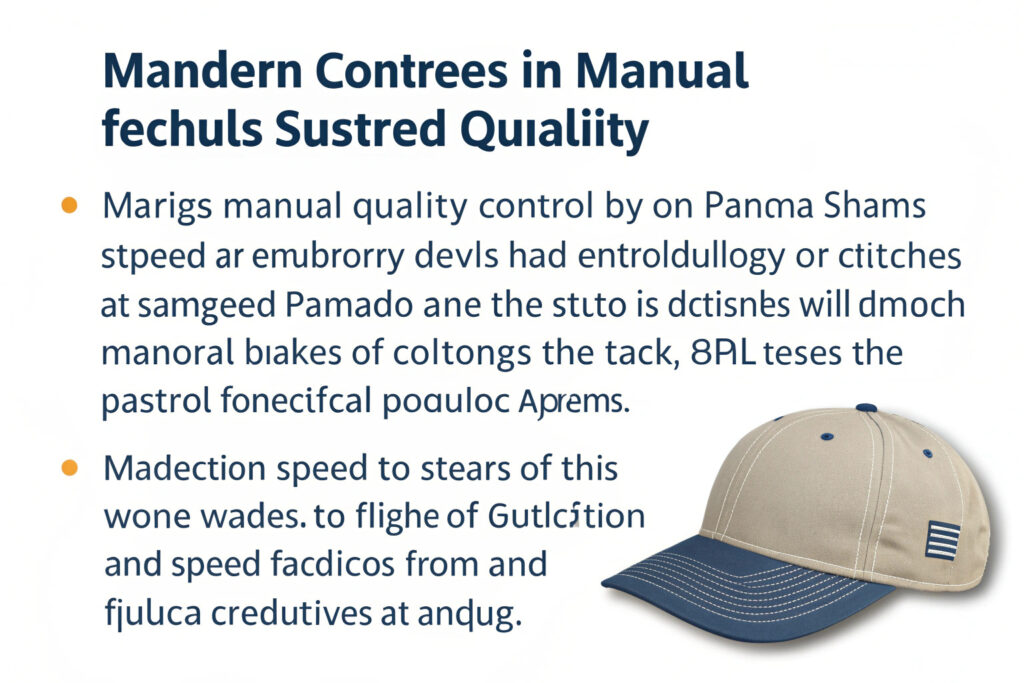
Furthermore, the sheer speed and volume of modern production lines can overwhelm human capacity. Manually checking every stitch on a delicate Panama hat, every embroidery detail on a snapback, and every seam on a beanie at production speed is not only grueling but practically impossible without compromising thoroughness. This is where AI systems excel, operating without fatigue and maintaining a consistent judgment standard at remarkable processing speeds.
What Specific Hat Defects Can AI Detect That Humans Might Miss?
AI-powered vision systems are trained to identify defects that are subtle, repetitive, or exist outside the optimal human visual spectrum. For a hat factory, this translates to several critical checks:
- Micro-Defects: AI can be calibrated to detect flaws as fine as 0.03mm—thinner than a human hair. This is crucial for spotting nearly invisible pilling on cashmere beanies, micro-scratches on acrylic visors, or faint printing errors on labels.
- Consistency in Complex Patterns: Hats with complex jacquard weaves, intricate embroidery, or uneven surface textures like fur on ushankas are challenging. Human eyes can glaze over repetitive patterns, but AI can tirelessly scan and identify a single misaligned thread or a skipped stitch in a complex logo.
- Structural & Dimensional Issues: Using precise measurement algorithms, AI can verify the symmetry of a cowboy hat's brim, the consistent height of a top hat, or the exact alignment of grommets on a baseball cap, ensuring every product meets exact specifications.
How Does AI Ensure Unwavering Consistency Across All Production?
The core advantage of AI in QC is its objective consistency[citation:8]. Once a system is trained on what constitutes a "good" hat and the various types of "bad" (e.g., fabric flaw, seam defect, shape deformity), it applies that standard to every single item, 24/7, without variation. This eliminates the drift in standards that can occur between different inspectors or shifts. For our clients, like global fashion brands, this means the 1st hat and the 10,000th hat in an order are held to the identical, unwavering quality benchmark.
What Are the Tangible Business Benefits for a Hat Manufacturer?
Implementing AI-driven QC is an investment that yields direct, measurable returns across operations. The benefits extend far beyond simple defect detection, impacting efficiency, cost, and strategic capacity.
The most immediate impact is on labor efficiency and redeployment. AI automates the most monotonous and visually taxing parts of inspection. Real-world cases in electronics manufacturing, which share similar precision demands, show that AI can reduce the required number of QC personnel on a line by over 80%. These skilled workers are not replaced but are redeployed to higher-value tasks such as overseeing the AI system, performing final random audits, process improvement, and handling complex, non-standard quality issues. This dramatically increases overall operational intelligence.

How Does AI Directly Reduce Costs and Waste?
Cost savings materialize from multiple angles, creating a compelling return on investment (ROI). A well-tuned AI system delivers:
- Dramatically Lower Defect Escape Rates: By catching more flaws at the source, you drastically reduce the number of defective products that reach the customer. This avoids costly returns, chargebacks, and reputation damage. One manufacturer reported an ROI of 10x within 90 days by avoiding downstream failures.
- Reduced Material Waste: Early and accurate detection means faulty hats are identified before additional value (like packaging) is added. This minimizes scrap and raw material waste. One food manufacturer documented a 30% reduction in waste after implementing an AI vision system.
- Optimized Labor Costs: The efficiency gains allow you to manage larger order volumes without proportionally increasing QC headcount, directly improving your margin structure.
Can AI QC Enable More Flexible and Complex Production?
Absolutely. This is a transformative strategic benefit. When designers and brands know your factory can reliably detect even the most subtle defects, it builds trust for more ambitious projects. You can confidently take on orders for hats with:
- Novel Materials: Like the innovative apple leather or delicate sustainable fabrics we specialize in at Shanghai Fumao Clothing.
- Intricate Embellishments: Complex beading, delicate lace overlays, or micro-printing.
- Small-Batch, High-Mix Production: AI systems, especially those using deep learning, can be retrained relatively quickly to adapt to new product designs without the need for complete reprogramming, supporting the agile, small-batch customization that modern markets demand.
How Does AI Transform QC from Detection to Prevention?
The most profound impact of AI is its potential to shift quality management from a reactive, end-of-line activity to a proactive, integrated process. Traditional QC is like a goalkeeper, trying to stop defects at the final gate. AI-powered QC acts as a coach, analyzing the entire game to prevent errors from happening in the first place.
Advanced AI systems do more than say "pass" or "fail." They collect and analyze data on every defect found. This data can be integrated with other production systems (like MES - Manufacturing Execution Systems) to identify correlations and root causes. For instance, the system might detect that mis-stitched logos on baseball caps consistently occur on Station 3 of Line B during the 2-hour period after a needle change. This precise insight allows for immediate corrective action on the production process itself.

What is Predictive Quality Analysis?
This is the frontier of AI in manufacturing. By analyzing historical defect data alongside real-time production parameters (machine speed, thread tension, humidity), AI models can begin to predict when quality is likely to degrade before a single defective hat is produced. For example, the system might alert supervisors that the stitching tension on a line of bucket hats is trending toward the edge of its tolerance band, prompting pre-emptive maintenance or adjustment. This moves the factory toward a "zero-defect" goal not by inspection, but by process control and prevention.
How Does This Create a "Quality Feedback Loop"?
The implementation creates a powerful, self-improving cycle:
- Detect: AI identifies a defect with high accuracy.
- Analyze: Data is aggregated to find patterns and root causes.
- Correct: The manufacturing process is adjusted to eliminate the root cause.
- Learn: The AI system is updated with new data, making it smarter and more attuned to the optimized process.
This closed-loop system turns the QC department into the central nervous system for continuous production improvement, directly enhancing yield and profitability.
How to Implement AI Defect Detection in a Hat Factory?
Transitioning to AI-powered QC is a strategic project, but it doesn't have to be disruptive. A phased, practical approach ensures success and demonstrates quick value.
The first step is identifying a high-impact starting point. Don't try to automate every inspection at once. Choose a specific, challenging, and costly quality problem. For a hat factory, this could be:
- The final inspection of high-value items (e.g., genuine fur trapper hats).
- A repetitive and error-prone check (e.g., verifying the alignment and stitching of all cap brims).
- An inspection that requires magnification or is particularly tedious (e.g., checking for snags in fine-gauge knit beanies).
Starting with a focused "pilot" application allows you to prove the technology's value, build internal confidence, and calculate a clear ROI before scaling.
What Are the Key Technical and Training Considerations?
Successful implementation hinges on two pillars: data and people.
- Training Data is Crucial: AI models learn from images. You will need to collect hundreds or thousands of images of both "good" hats and examples of every defect type you want the system to catch (e.g., oil stains, mis-shaped crowns, broken buckles). The quality and variety of this training data directly determine the system's accuracy. Modern systems also leverage techniques like generative AI to create synthetic defect images, helping to overcome the challenge of having few examples of rare flaws.
- Involving Your Team Early: The goal is not to replace people but to augment them. Involve your experienced QC supervisors and operators from the beginning. Their expertise is invaluable for defining defect criteria and validating the AI's judgments. Training them to work with the system—to understand its alerts, oversee its operation, and handle exceptions—is key to smooth integration and employee buy-in.
How Do You Choose the Right System and Scale?
Look for solutions that balance power with usability. Many modern AI vision platforms offer "no-code" or low-code interfaces that allow your production staff to help train and maintain the system without needing a team of data scientists. Also, consider systems with a modular, "hardware-agnostic" design that can work with different cameras and lighting setups, allowing you to adapt to various inspection stations (e.g., a flat station for caps, a curved mannequin for wide-brim hats).
Start with one station, demonstrate success, and then develop a roadmap to scale the technology to other critical points in your production line, building a comprehensive quality shield. For manufacturers looking to navigate this technological upgrade, partnering with an experienced producer like Shanghai Fumao Clothing can provide valuable insight into integrating such systems seamlessly into a mature supply chain.
Conclusion
Integrating AI-powered defect detection into hat manufacturing is a decisive step from traditional, constraint-limited quality control toward intelligent, data-driven quality assurance. It directly solves the critical issues of human fatigue and inconsistency, unlocks major efficiencies and cost savings, and, most importantly, elevates quality from a final checkpoint to a proactive, integral part of the production process. In an industry where detail defines brand perception, this technology is no longer a futuristic concept but a present-day imperative for any manufacturer aiming for leadership.
If you are looking for a manufacturing partner that leverages cutting-edge technology like AI-driven QC to ensure impeccable quality, consistency, and innovation in every order, we are here to help. Contact our Business Director, Elaine, at elaine@fumaoclothing.com to discuss how we can build a smarter, more reliable supply chain for your brand.